

Quick Answers: The Morning Routine at a Glance
The Core Morning Routine, Step by Step
Step 1 in Detail: Wash, Rinse, or Skip the Cleanser?
Several dermatologists in routine guides advise exactly that skin to splash with water and move on.
Step 2 in Detail: The One Serum Slot
What the study supports is the pairing: antioxidant underneath, sunscreen on top.
The alternatives earn their place for people vitamin C does not suit:
- Niacinamide for oil balance, redness and marks, and for skin that finds vitamin C stingy. It asks nothing of the sun schedule and layers with almost everything.
- Hyaluronic acid for dehydration, applied to damp skin and sealed by moisturizer. It treats water, not damage, which is why it pairs with either of the others on different days.
- Nothing at all, which remains a legitimate choice. The treatment slot is optional by design; a three step morning is a complete morning.
Step 3 in Detail: Moisturizer by Skin Type
|
Cream with ceramides or glycerin, applied to slightly damp skin |
||
|
Skipping moisturizer worsens most acne routines; dryness and irritation feed the cycle |
Step 4 in Detail: Sunscreen, the Step With the Trial Behind It
In the Nambour trial (Hughes and colleagues, Annals of Internal Medicine, 2013; the trial record at the University of Manchester), 903 adults under 55 were assigned to apply sunscreen daily or only when they felt like it, and after four and a half years the daily group showed no detectable increase in skin aging and 24 percent less aging overall.
Hold the limits alongside the headline, as this page does everywhere: the trial ran in high UV Australia, and its sunscreen was SPF 15 or higher by the standards of the time.
The finding is about the daily habit, not about any magic number, and it is still the strongest evidence any morning step has.
The working rules, from the American Academy of Dermatology’s sunscreen guidance and the AAD’s application guidance:
- Broad spectrum, SPF 30 or higher, water resistant is the standard spec. Higher SPF buys margin against under application, which is nearly universal.
- Amount is the weak point. Use the two finger rule: a strip of sunscreen along your index and middle fingers, roughly half a teaspoon, covers face and neck. Most people apply half the tested dose or less.
- Apply about 15 minutes before going out, then reapply about every two hours outdoors, and right after swimming or heavy sweating.
- Clouds do not cancel the step. UVA passes through cloud cover and window glass; a bright window desk is a genuine exposure situation.
- Mineral or chemical is a preference, not a hierarchy. Mineral filters (zinc oxide, titanium dioxide) suit sensitive skin and work immediately; tinted mineral formulas add iron oxides, which help against the visible light that worsens melasma.
Sunscreen goes on last, after moisturizer has settled for a minute or two. Give it a few minutes to set before makeup, and apply makeup with patting motions rather than rubbing ones.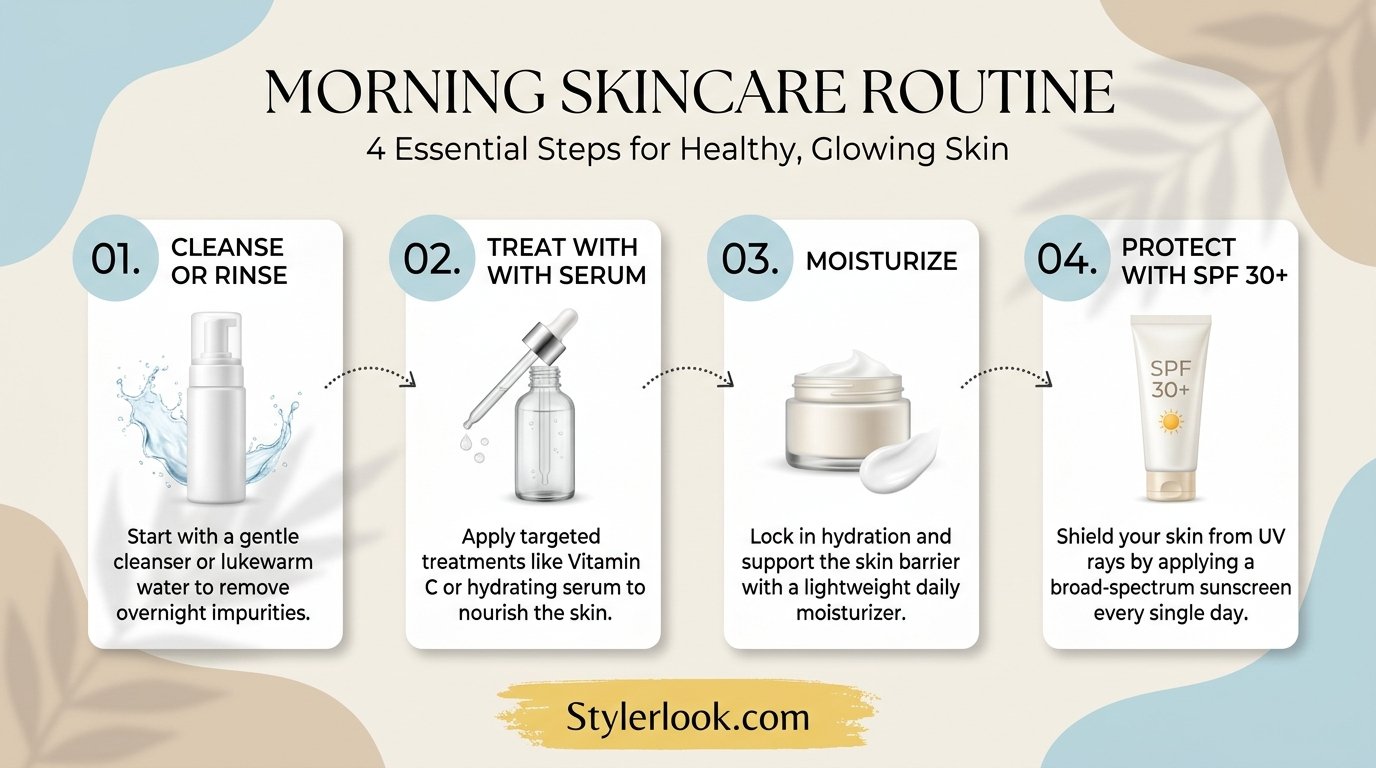
The Morning Routine by Skin Type
The core never changes; the choices inside it do. Five complete mornings:
|
Skin type |
Cleanse |
Treat |
Moisturize |
Protect |
|---|---|---|---|---|
|
Oily |
Gentle foaming or gel cleanser |
Niacinamide, optional |
Gel moisturizer or none |
Matte or fluid SPF 30+ |
|
Dry |
Water rinse or cream cleanser |
Hyaluronic acid on damp skin, or vitamin C |
Ceramide rich cream |
Moisturizing SPF 30+ |
|
Sensitive |
Lukewarm rinse or fragrance free cream cleanser |
None, or niacinamide later |
Fragrance free cream |
Mineral SPF 30+, tinted if cast is an issue |
|
Acne prone |
Gentle cleanser, no scrubs |
Prescribed treatment as directed |
Non-comedogenic lotion |
Non-comedogenic SPF 30+ |
|
Combination |
Gentle cleanser |
Vitamin C or niacinamide |
Light lotion, cream on dry zones only |
Comfortable SPF 30+ worn daily |
Two notes on the table. First, teenagers need the short version of whichever row fits: cleanser, moisturizer if dry, SPF.
Second, the over 40 morning is the dry or combination row with the antioxidant slot taken seriously and the sunscreen habit treated as the main event, because that is what the trial measured.
Morning Versus Night: The Division of Labor
Half the routine confusion online comes from mixing the two shifts. Keep them separate and both get simpler:
|
Morning shift |
Night shift |
|
|---|---|---|
|
Job |
Protect |
Correct and repair |
|
Cleanse |
Light: rinse or gentle cleanse |
Full: remove sunscreen, makeup, the day |
|
Treatment |
Antioxidant (vitamin C class) |
Retinoid or exfoliating acid, a few nights a week |
|
Moisturize |
Lighter texture |
Richer texture welcome |
|
Final step |
Sunscreen, always |
Moisturizer or a facial oil, if used |
For the layering mechanics that both shifts share, see our skincare routine order guide; for pacing rules when building both routines from zero, see our guide to how to start a skincare routine: one new product at a time, weeks before judging.
Real Mornings: Shaving, Makeup, Gym, Windows and Seasons
Shaving slots between cleansing and everything else: wash, shave, rinse, pat dry, then moisturizer and SPF. Vitamin C straight onto freshly shaved skin stings; on shave days, moisturizer first is the comfortable order.
Our men’s skincare routine builds the full men’s morning around that slot.
Makeup goes on after sunscreen has set for several minutes, patted rather than rubbed. Makeup with SPF does not replace the sunscreen layer, because nobody applies foundation at the tested thickness.
Gym mornings split by timing. Training before the routine: rinse the sweat off, then run the normal morning. Training after: your sunscreen is spent, so cleanse lightly and redo steps three and four before the day continues.
Windows and weather change less than people hope. Cloudy days keep the sunscreen; winter keeps the sunscreen and swaps moisturizer up a weight; summer keeps the sunscreen, prefers water resistant formulas, and adds reapplication after sweating.
The textures are seasonal; the protection is not.
The maximalist question deserves a straight answer. The Korean skincare routine runs long, layered mornings, and some skin enjoys them.
But the routine you perform three hundred mornings a year beats the elaborate one performed thirty times, which is why this page builds a short core and labels everything beyond it optional.
Morning Mistakes and How to Fix Them
- Pilling under sunscreen or makeup. Cause: too many layers, too much product, silicone heavy stacks, no settle time. Fix: use less, drop a layer, let each layer settle, apply sunscreen in smooth strokes.
- Tight, squeaky skin after washing. Cause: hot water or a cleanser too strong for mornings. Fix: lukewarm water, a gentler cleanser, or the rinse only experiment from step 1.
- Vitamin C stinging or turning orange. Cause: sensitive skin meeting a strong acid formula, or an oxidized bottle.
Fix: alternate mornings, a lower strength, and retire any serum that has turned dark orange; store it away from light and heat.
- White cast. Cause: untinted mineral sunscreen at the correct (generous) dose. Fix: a tinted mineral formula, or a chemical sunscreen if your skin tolerates it; do not fix cast by applying less.
- Skipping sunscreen on indoor days. Cause: the belief that glass blocks everything. Fix: judge by exposure, bright window desks count, and keep the habit unbroken on ordinary days.
- Judging the routine in a week. Cause: impatience. Fix: hydration is days, tone is weeks to months, prevention is years. Our best skincare routine roundup exists for readers ready to compare full routine frameworks once the basics are running.
Amounts at a Glance
Half the routine failures online are dose failures: too much cleanser, serum floods, and sunscreen applied like a rumor. The working doses:
|
Product |
Working amount |
Notes |
|---|---|---|
|
Cleanser |
A coin sized amount |
Sixty seconds of gentle fingertip contact does the work |
|
Serum |
Two to three drops, or a pea sized amount |
One thin layer; more serum is not more effect |
|
Eye cream |
A grain of rice per eye |
Optional step; your moisturizer covers the area otherwise |
|
Moisturizer |
A pea to coin sized amount |
More for dry skin and winter, less for oily skin |
|
Sunscreen |
Two finger lengths, about half a teaspoon |
Face and neck; this is the dose the SPF number assumes |
|
Lip SPF |
A normal balm application |
The forgotten square inch of the morning |
Notice the pattern: every product is a small dose except the sunscreen, which is a large one.
That asymmetry is the morning routine in miniature, gentle with everything that touches the barrier, generous with the one step that carries the trial evidence.
Building the Habit: Your First Two Weeks
If you are starting from zero, do not start with the full table. Start with the habit, because adherence is the variable every study quietly depends on.
Days 1 to 4: two steps. Moisturizer after your morning wash or rinse, then sunscreen. Nothing else.
The goal is placement: products by the sink, sunscreen where you will see it, the routine attached to an existing anchor like brushing your teeth.
Days 5 to 10: add the cleanse properly. Settle the wash versus rinse question with the one hour test from step 1, morning by morning, until your skin’s preference is obvious.
This is also the week to notice texture: if the moisturizer feels wrong by midday, this is when you learn it, with nothing else in the way.
Days 11 to 14: consider the serum slot. Only now, with the core automatic, decide whether a treatment earns a place, and choose it by the single concern that bothers you most: dullness and spots point to vitamin C, oil and redness to niacinamide, tight dehydration to hyaluronic acid.
Two disciplines protect the experiment. Introduce one change at a time, so any stinging or breakout has an obvious suspect.
And skip nothing on the sunscreen step while you experiment; the new product gets judged under the protection the routine exists to provide.
By the end of week two you own a routine fitted to your skin instead of copied from a stranger’s shelf, which is the difference between a routine that lasts years and one that lasts until the next video.
Keep Reading on StylerLook
This page is the morning hub of the skincare cluster at StylerLook. The pages around it each keep their own job, and the morning works best when all of them stay in their lanes.
Start with the complete skincare routine hub, morning and night for the full day in one view. Go deeper on mechanics with our skincare routine order guide, and on beginnings with our guide to how to start a skincare routine.
Brand and format routes branch from there: The Ordinary skincare routine for a single brand morning, our men’s skincare routine for the shaving integrated version, and the Korean skincare routine for the long layered alternative, with our best skincare routine roundup comparing complete routine frameworks when you are ready to upgrade the core.
Frequently Asked Questions
What is a good morning skincare routine?
For most people: cleanse gently (or rinse), one optional treatment serum such as vitamin C, moisturizer suited to your skin type, and broad spectrum sunscreen SPF 30 or higher, every morning.
Three steps are essential; everything beyond them is an add on chosen for a specific concern.
What is the correct order for a morning skincare routine?
Cleanse first, then treatment products thinnest to thickest (toner or essence if used, then serum, then eye cream), then moisturizer, then sunscreen last so it can form an even film. Makeup goes on after sunscreen has set.
Sunscreen is the fixed final step.
Do I have to wash my face with a cleanser in the morning?
Not always. The AAD’s washing guidance is twice daily for most people, but oily and acne prone skin generally benefits from a gentle morning cleanser, while dry or sensitive skin often does better with a lukewarm water rinse plus moisturizer.
If your skin feels tight and squeaky after morning washing, that is a sign to soften the step.
Can I just splash water on my face in the morning?
Yes, for many dry, normal or sensitive skin types a lukewarm water rinse removes overnight sweat and residue without stripping oils, and dermatologists quoted in routine guides endorse it. Oily skin that wakes up greasy usually needs the cleanser.
Judge by how your skin feels an hour later, not by habit.
Should vitamin C serum be used in the morning or at night?
Morning is the classic slot: vitamin C is an antioxidant, and research on vitamin C with E and ferulic acid (Lin et al., 2005) showed it added photoprotection under UV exposure, which is daytime work.
It can also be used at night; the pairing with sunscreen is the reason the morning became the standard recommendation.
Does vitamin C replace sunscreen?
No.
In the 2005 study, a 15 percent L-ascorbic acid formula with vitamins E and ferulic acid provided roughly 8 fold photoprotection against solar simulated radiation in test conditions, which the authors frame as a complement to sunscreen, not a substitute.
No antioxidant carries an SPF rating.
What SPF should I use in the morning?
The American Academy of Dermatology recommends a broad spectrum, water resistant sunscreen with SPF 30 or higher, every day.
Higher SPFs add margin for the under application most people do, but SPF 30 applied properly and reapplied beats SPF 100 applied thinly once.
How much sunscreen should I apply to my face and neck?
A practical guide is the two finger rule: a line of sunscreen along the index and middle fingers covers the face and neck, roughly half a teaspoon.
Most people apply half or less of the tested amount and get far less protection than the label number, so generous application matters more than the SPF digit.
How often should I reapply sunscreen?
When you are outdoors: about every two hours, and immediately after swimming or heavy sweating, per AAD guidance. Apply the morning layer about 15 minutes before going out.
Indoor days away from windows are the one context where reapplication is a judgment call rather than a rule.
Does sunscreen go before or after moisturizer?
After. Sunscreen is the final skincare step so its protective film sits uninterrupted on top. Let moisturizer settle for a minute or two first.
Makeup, if worn, goes on after the sunscreen has set for several minutes, which also reduces pilling.
Can I skip moisturizer if my sunscreen feels moisturizing?
Many oily and combination skin types can, in the morning, because modern sunscreen formulas carry substantial emollients. Dry skin usually cannot. Test it: if your skin feels comfortable, not tight, by midday without moisturizer, your sunscreen is doing both jobs.
Do I need a toner in my morning routine?
No. Toner is the most optional step in the modern routine. A hydrating, alcohol free toner can add a light water layer before serums, which some dry skin types enjoy, but nothing in the evidence base requires it.
Astringent, alcohol heavy toners belong to an older era of skincare.
Where does eye cream fit in the morning routine?
After serums and before moisturizer, patted gently around the orbital bone. It is optional: your regular moisturizer covers the area for most people.
A dedicated eye cream earns its place mainly for morning puffiness or when the eye area needs a different texture than the rest of the face.
Can I use hyaluronic acid in the morning?
Yes. Hyaluronic acid is a humectant that fits any morning: apply it to slightly damp skin after cleansing, then seal it with moisturizer and sunscreen.
The common mistake is using it alone on dry skin in a dry climate, where a humectant without a seal can leave skin feeling tighter.
Can I use niacinamide in the morning?
Yes. Niacinamide is one of the easiest morning ingredients: it supports the barrier, helps oil balance and tone, layers under sunscreen without photosensitivity issues, and combines with most other ingredients.
It is a frequent dermatologist suggestion for people who cannot tolerate vitamin C.
Should I use retinol in the morning?
No. Retinoids are the night shift: sunlight degrades several of them, and retinoid treated skin is more sun sensitive while adjusting.
The morning’s job in a retinoid routine is protection, which is why the retinoid guides and the sunscreen advice travel together.
Can I use vitamin C and niacinamide in the same morning routine?
In modern formulations, yes. The old warning came from 1960s studies of unstable mixtures at high heat; today’s stabilized products are routinely used together, and many serums combine them.
If your skin is reactive, separate them by a few minutes or by routine (one morning, one night) rather than abandoning either.
Is it okay to exfoliate in the morning?
A gentle exfoliant can be used in the morning, but most routines place exfoliation at night, two or three times a week at most, because exfoliated skin is more sun sensitive that day.
If you exfoliate in the morning, the sunscreen step becomes even less negotiable. Daily exfoliation, morning or night, is more than skin needs.
How long should I wait between skincare layers?
There is no strict laboratory rule; the practical guidance is to let each layer settle until it no longer feels wet, usually well under a minute for serums, and to give sunscreen a few minutes to set before makeup.
Long gaps are unnecessary. Pilling, not impatience, is the sign to slow down or use less product.
What is a good morning routine for oily skin?
A gentle foaming or gel cleanser, an optional lightweight treatment (niacinamide suits oily skin well), a gel or gel cream moisturizer (or none, if your sunscreen moisturizes), and a matte or fluid sunscreen SPF 30+.
The mistake to avoid is skipping moisturizer and SPF to feel less greasy, which usually backfires by midday.
What is a good morning routine for dry skin?
Rinse with lukewarm water or use a cream cleanser, apply a hydrating serum to damp skin, follow with a ceramide rich cream moisturizer, and finish with a moisturizing sunscreen.
Dry skin’s morning is about keeping water in; every step should add or seal moisture, and hot water is the enemy at the basin.
What is a good morning routine for sensitive skin?
The minimum done gently: lukewarm rinse or a fragrance free cream cleanser, a bland fragrance free moisturizer, and a mineral sunscreen with zinc oxide or titanium dioxide, which the AAD suggests for sensitive skin.
Skip fragrance, skip new actives, and add nothing without a patch test.
What is a good morning routine for acne prone skin?
A gentle cleanser (not a scrub), any prescribed treatment used as directed, a non-comedogenic moisturizer, and a non-comedogenic sunscreen. Skipping moisturizer and sunscreen worsens most acne routines: dryness and UV both aggravate marks and irritation.
Persistent or painful acne is a dermatologist case, not a product problem.
What is a good morning routine for combination skin?
The balanced version of the basics: gentle cleanser, light moisturizer everywhere or richer cream only on dry zones, and a comfortable SPF 30+ you will actually wear daily.
Combination skin rarely needs zone specific serums in the morning; the moisturizer split is usually the only adjustment that matters.
What should a morning routine look like in your 20s?
Three habits: gentle cleansing, moisturizer fitted to your skin type, and daily SPF 30+, which is the highest value step of the decade because prevention compounds.
Add one active only for a named concern (vitamin C for dullness, niacinamide for oil and marks). The 20s routine is where the sunscreen habit is built.
What changes in a morning routine after 40?
The core does not change; the support does.
An antioxidant serum earns its place, moisturizer may need to be richer as skin dries with age, and daily sunscreen discipline matters most of all: in the Nambour randomized trial, adults under 55 assigned to daily sunscreen showed 24 percent less skin aging over 4.5 years than discretionary users.
What is a morning skincare routine for men?
The same three steps: wash with a gentle facial cleanser, moisturize, and apply SPF 30+. For shavers, the order is cleanse, shave, then treatment or moisturizer, then sunscreen, since freshly shaved skin absorbs and stings differently.
Nothing about the core routine is gendered; only the shaving slot is specific.
Where does shaving fit in a morning routine?
After cleansing and before moisturizer and sunscreen. Wash, shave with a lubricating gel, rinse, pat dry, then moisturize and finish with SPF.
Applying active serums like vitamin C directly after shaving can sting; on shave days, moisturizer first is the comfortable order.
Can I wear makeup over sunscreen?
Yes. Let the sunscreen set for several minutes, then apply makeup with patting rather than rubbing motions to avoid disturbing the film.
Remember that makeup with SPF does not replace sunscreen: nobody applies foundation at the tested thickness, which is why the sunscreen layer underneath does the real work.
Do I need sunscreen on cloudy days or indoors?
Cloudy days, yes: UV, especially UVA, penetrates cloud cover, and the AAD recommends daily sunscreen regardless of the forecast.
Indoors, it depends on exposure: glass blocks most UVB but not UVA, so a desk beside a bright window is a real exposure situation, while a windowless room is not.
Mineral or chemical sunscreen for the morning?
Both work when they are broad spectrum SPF 30+ and you apply enough.
Mineral filters (zinc oxide, titanium dioxide) start working immediately and suit sensitive skin but can leave a cast; chemical filters are cosmetically lighter but need about 15 minutes before exposure.
Tinted mineral formulas are a useful middle path, and the iron oxides in tints help against visible light, relevant for melasma.
What is the two finger rule for sunscreen?
Squeeze a strip of sunscreen along your index and middle fingers; that amount, roughly half a teaspoon, is the dose for your face and neck.
It exists because under application is the main reason real world protection falls short of the label, so the rule replaces guessing with a measure your hands carry everywhere.
How long does a morning skincare routine take?
The core three steps take about three to five minutes, including the short settle time before sunscreen and makeup. Even a five step version with serum and eye cream fits in ten.
A morning routine that regularly takes longer is usually a routine with redundant steps.
How many products does a morning routine actually need?
Three essential products (cleanser, moisturizer, sunscreen) and rarely more than five in total. The AAD cautions that layering many products, especially several anti aging treatments, commonly irritates skin.
Every product past the core should be able to name the single job it does.
Can I use the same moisturizer morning and night?
Yes, if it suits your skin at both ends of the day. Many people prefer a lighter texture in the morning (under sunscreen and makeup) and a richer one at night, but that is preference, not physiology.
The morning non negotiable is what sits on top of the moisturizer: sunscreen.
Can I use a face oil in the morning?
Yes, but place it carefully: a drop or two mixed into or pressed over moisturizer, with sunscreen still last and applied generously. Thick oil layers right before sunscreen can disturb the SPF film, so minimal amounts are the rule.
Oily skin types usually skip morning oils entirely and lose nothing.
Why do my products pill in the morning?
Pilling is usually physics, not failure: too many layers, too much product, silicone heavy formulas stacked under sunscreen, or makeup applied before layers settle.
Fixes in order: use less, drop one layer, let each layer settle, and apply sunscreen with smooth strokes rather than rubbing.
Does a morning routine change between winter and summer?
The steps stay; the textures shift. Winter usually wants a richer moisturizer and gentler cleansing as indoor heating dries skin; summer wants lighter gels and a water resistant sunscreen, with reapplication after sweating.
Seasonal swaps are texture decisions; sunscreen is the constant in both.
How soon will I see results from a morning routine?
Hydration and comfort improve within days. Tone and dark spot changes from vitamin C type products take weeks, commonly two to three months of daily use.
The sunscreen result is measured in years: the Nambour trial needed 4.5 years to show its 24 percent difference in aging. Judge products in weeks, prevention in years.
Can I use vitamin C serum every morning?
Daily use is the standard pattern for vitamin C serums and how the research formulas were used. Sensitive skin can start on alternate mornings and build up.
Store the bottle away from light and heat, and retire it if it turns dark orange or brown, which signals oxidation.
What should a teenager’s morning routine include?
A gentle cleanser, a light moisturizer if skin feels dry, and SPF 30+ sunscreen: the full list for most teens.
Acne products belong in a routine only when acne is actually present, used as directed, and persistent or scarring acne in a teen deserves a dermatologist rather than a bigger routine.
Is a 10 step morning routine better than a 3 step one?
No evidence says so, and irritation data points the other way. The 10 step routines are a marketing descendant of K-beauty maximalism; dermatology guidance consistently favors the short routine done daily.
The routine you perform every single morning beats the elaborate one performed twice a week, every time.
Conclusion
Morning skincare routine success is boring on purpose: a gentle cleanse or rinse, at most one serum with a named job, a moisturizer your skin type agrees with, and broad spectrum SPF 30 or higher worn every single day, in that order.
The research honors exactly that modesty. The vitamin C finding is a partnership effect under sunscreen, and the Nambour trial rewarded nothing fancier than showing up daily with an ordinary sunscreen.
Build the short version until it is automatic, version it for your skin, and let the mornings accumulate.
When in doubt on any given morning, protect the order and protect the last step.
A rushed morning with sunscreen still beats a perfect morning without it, and that ranking, not the shelf of bottles, is what your skin will remember in ten years.

8 thoughts on “Morning Skincare Routine for Beginners: The Right Order to Follow”