
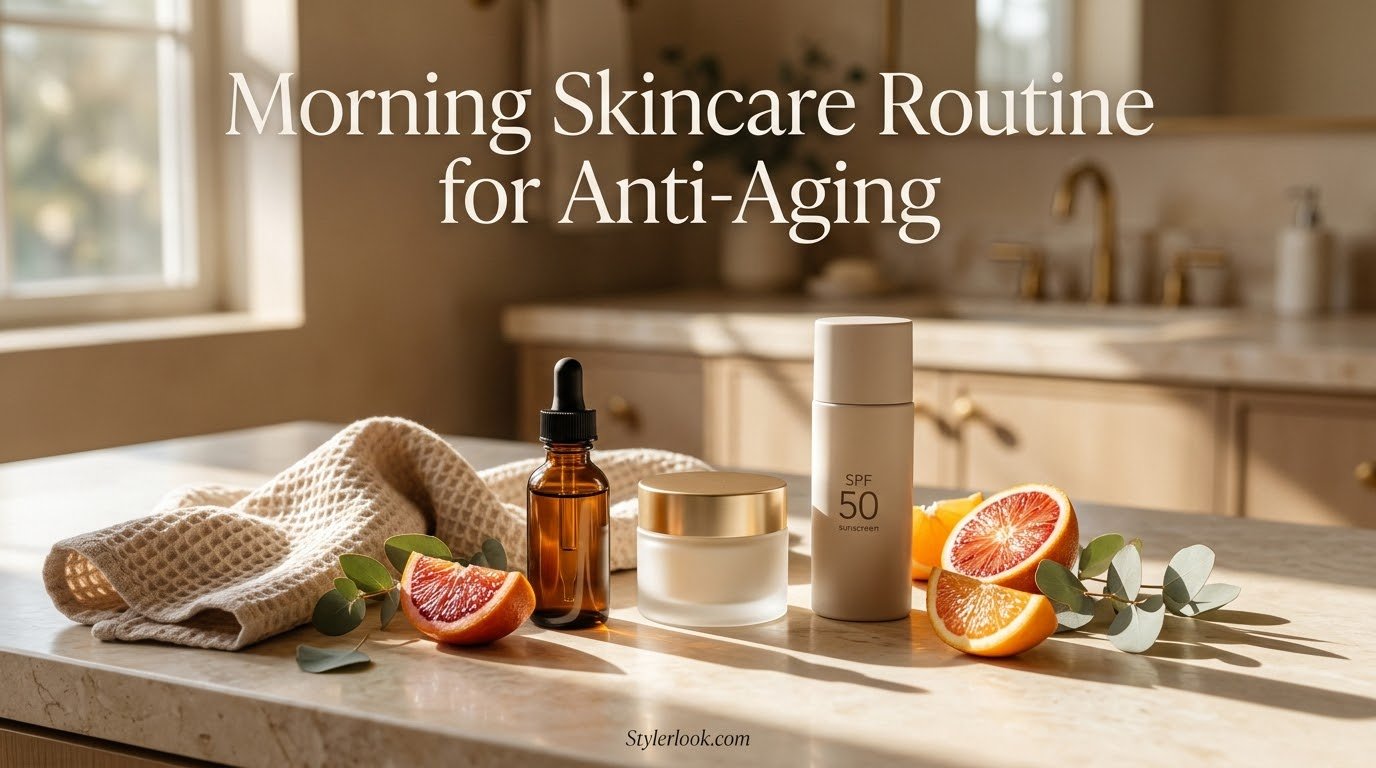
A morning skincare routine for anti aging has a different job than its evening twin. Mornings protect, nights correct, and confusing the two wastes both.
The morning shift defends against the day’s ultraviolet light and pollution. The night shift runs the repair actives, chiefly retinoids, that daylight degrades.
So the morning routine stays deliberately short. Four steps at most: cleanse or rinse, antioxidant, moisturizer, sunscreen.
One of those steps owns the strongest evidence in the entire category. Sunscreen is the anti aging product, and everything else plays support.
This page grades every step by its evidence, then sets the dose. Because in the morning, how much matters as much as what.
Everything here is general information about routines. Changing spots, persistent irritation, or prescription questions belong with a dermatologist.
The Short Version
Short on time? Rinse, vitamin C, moisturizer, sunscreen, in that order, and extend everything to the neck.
That four step line is the whole doctrine in miniature. The rest of this article grades it, doses it, and adjusts it by decade.
The basics version lives in the morning skincare routine basics. This page is the anti aging specialization, built on trials rather than trends.
The Doctrine: Mornings Protect, Nights Correct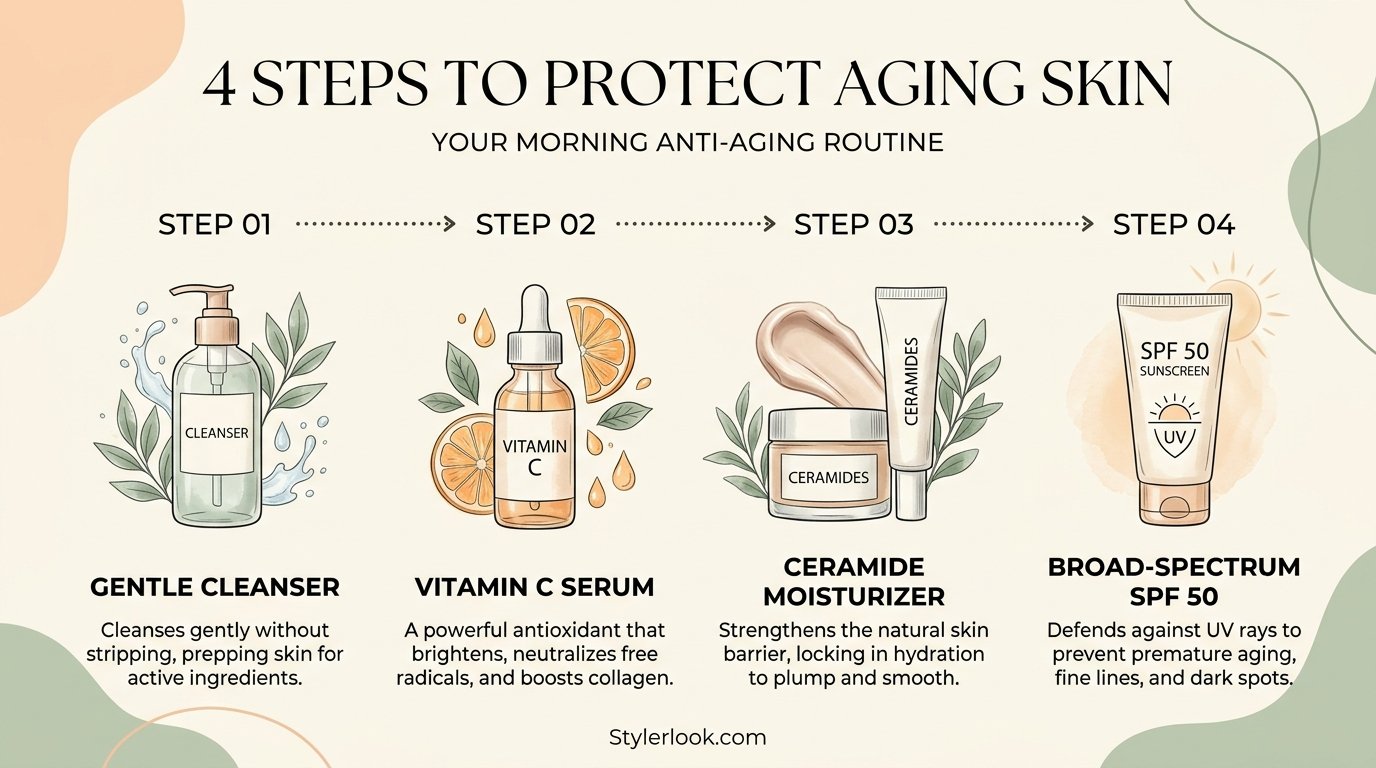
One routine builder, the Beauty Cares AM and PM builder, names the rule in its cleanest form. AM protect, PM repair is the golden division of labor.
Protection means blocking what ages skin during the day. Ultraviolet light drives collagen breaking enzymes and pigment, hour by ordinary hour.
Correction means stimulating renewal when skin is out of the sun. Retinoids do that work at night, where light cannot degrade them.
The division protects your budget as well. Every product has one shift, so nothing is bought twice for two jobs.
It also protects tolerance. Spreading actives across the day halves the irritation load any single routine carries.
The Evidence Ladder
Not every morning step stands on equal proof. Reading the ladder prevents expensive faith in weak rungs.
Sunscreen sits on top, holding a randomized controlled trial. No other morning product can say that.
The American Academy of Dermatology’s consumer position follows closely. One summary, the AAD anchored routine guide, quotes it directly: sunscreen and moisturizer are the two most effective anti aging products consumers can buy.
Vitamin C stands a rung below, on formulation science and smaller trials. Real support, honestly graded, and never sunscreen’s equal.
Below that sit the comfort layers: niacinamide, peptides, hyaluronic acid. Plausible, pleasant, and optional, in that order.
|
Step |
Evidence tier |
What backs it |
|---|---|---|
|
Sunscreen daily |
Randomized trial |
Nambour study, 903 adults, 4.5 years |
|
Moisturizer |
Authority position |
AAD names it a top two anti aging product |
|
Vitamin C serum |
Formulation science plus smaller trials |
Ascorbic acid studies and stabilization research |
|
Niacinamide, peptides |
Smaller trials, plausible mechanisms |
Support roles for tone and barrier |
|
Eye creams, mists |
Comfort and habit value |
Optional layers, no trial anchor |
An evidence review, the evidence based skin aging review, grades interventions the same way. Tier discipline is the honest format for this topic.
Two popular numbers need flags before they travel further. The claim that about 80 percent of visible aging comes from UV is a widely cited estimate, not a measurement.
Collagen loss of roughly 1 percent a year after the mid twenties is the same species: a useful rule of thumb, printed here as a strand.
Step 1: Cleanse or Rinse, by Skin Type
The morning cleanse is optional equipment, and for anti aging skin it is often the wrong default.
Skin wakes up carrying last night’s products, not the day’s dirt. A gentle rinse preserves the barrier that aging already thins.
Dry and mature skin usually does best water only, or a cream cleanser when the night before ran rich.
Oilier skin may prefer a mild gel cleanser. The test is the tightness check: squeaky skin afterward means the cleanser took too much.
A reviewed clinic routine, the NeoDermatologist morning and night routine, ranks the gentle cleanse among the steps that matter most. Morning versions of that cleanse should be the gentlest of the day.
Skipping the morning cleanser saves money and barrier. It is the only step this article recommends deleting on purpose.
Step 2: Vitamin C, the Support Act
Vitamin C earns its morning slot as an antioxidant shield. It neutralizes free radicals that UV and pollution generate during the day.
It also works behind the scenes on collagen. Vitamin C is a required cofactor in collagen building, which is why skin levels matter with age.
The formulation decides whether any of this happens. L-ascorbic acid at 10 to 20 percent, in an acidic formula, is the researched form.
Vitamin E and ferulic acid stabilize that fragile molecule. The pairing research is why the ferulic combination became the benchmark formula class.
Sensitive skin takes the derivative route instead. Ascorbyl glucoside, SAP, and MAP trade raw potency for tolerance, a fair trade on reactive faces.
Apply it after cleansing, before moisturizer, on dry skin. Three to five drops cover the face; the neck gets its own share.
Oxidation is its predictable failure. A serum that turns orange or brown is degrading, and darkened serum gets replaced, not finished.
Storage slows the clock. Dark bottle, cool drawer, cap closed, and buy sizes you finish within a few months.
Step 3: Moisturizer, the Second AAD Product
Moisturizer holds the second authority endorsement in the routine. The AAD position names it beside sunscreen, and for aging skin the reason is dryness.
Older skin loses water faster, a barrier story more than a vanity one. Trapped water plumps the surface, and fine lines look softer while it lasts.
Choose by decade and season. Ceramide creams suit most aging faces, gel creams serve oilier skin in summer, and richer balms answer winter.
Apply it over the vitamin C, on slightly damp skin when possible. Damp application is the free upgrade nobody charges for.
Extend the moisturizer downward without thinking. Neck, chest, and the backs of hands age in public and get forgotten in private routines.
The fuller barrier framework sits in the dry skin routine guide. Morning moisturizing for anti aging is that framework with a sunscreen waiting on top.
Step 4: Sunscreen, the Anti Aging Product
Now the trial. The Nambour study randomized 903 adults in Queensland to daily or discretionary sunscreen and followed them for 4.5 years.
The daily group showed 24 percent less skin aging than the discretionary group. Stronger still, daily users showed no detectable increase in aging across the study.
That is the best evidence any cosmetic step owns. It belongs to an inexpensive, unglamorous product used in the tested quantity, daily.
Choose broad spectrum SPF 30 or higher for the face. Broad spectrum is the phrase that covers the UVA aging rays, not just UVB burn.
Chemical and mineral filters both work when used properly. Mineral suits sting prone eyes and sensitive skin; chemical textures often win on elegance and adherence.
Tinted formulas add a pigment dividend. Iron oxides help against visible light, which matters for melasma and dark spot prone skin.
Sunscreen always goes last among skincare, after moisturizer, before makeup. It needs to form the undisturbed film the tests assume.
The Dose Chapter
SPF numbers are earned at a specific dose: 2 milligrams per square centimeter of skin. Apply less, and the labeled protection falls steeply.
The two finger rule translates the dose. Two finger lengths of sunscreen, from base to tip of index and middle fingers, cover face and neck.
Compare that with the pea sized dab most routines use. The dab delivers a fraction of the labeled SPF, every single morning.
This is why SPF moisturizer usually underdelivers. Nobody applies two finger lengths of moisturizer as a daily habit, so the hybrid’s rating stays theoretical.
Makeup with SPF fails the same arithmetic harder. A foundation layer is far thinner than the tested dose, whatever the bottle claims.
Keep makeup, by all means. Just file it as decoration, not protection, and let the real sunscreen underneath do the rated work.
Outdoors, the dose renews. Reapply every two hours, and after swimming or heavy sweating, with sticks and cushions making reapplication realistic.
Let the film set before makeup. A couple of minutes of patience prevents the pilling and patchiness blamed on products.
What Stays at Night
Retinoids headline the night shift for two mechanical reasons. Sunlight degrades several retinoid forms, and retinized skin is more sun sensitive by day.
Used at night, they do the category’s deepest repair work. Used in the morning, they mostly waste money and invite irritation.
Vitamin C in the morning, retinoid at night is the standard separation. The pairing table in the doctrine source grades that combination as the correct split.
Strong exfoliating acids mostly follow retinoids to the evening. Readers who insist on a morning acid owe their skin doubled sunscreen discipline for the following week.
The night build itself lives in the nighttime skincare routine. This article’s only night instruction is keep the shifts separate.
Prescription retinoids deserve their own sentence. Tretinoin routines are clinician territory, especially alongside procedures, pregnancy questions, or stubborn irritation.
The Age Band Mornings
One routine cannot serve three different decades honestly. Skin at 35, 48, and 62 asks different morning questions.
|
Decade |
Morning emphasis |
Texture and notes |
|---|---|---|
|
30s |
Prevention consistency |
First antioxidant, daily SPF becomes non negotiable |
|
40s |
Coverage and tone |
Vitamin C daily, neck and hands join, richer moisturizer |
|
50s and menopause |
Dryness led protection |
Gentler vitamin C or derivatives, tinted SPF for pigment, seals and creams |
In your 30s, the routine is a habit installation project. Sunscreen consistency now is the cheapest anti aging decision of your life.
In your 40s, tone joins texture as a concern. Vitamin C becomes daily, and the neck and hands enter the routine permanently.
After menopause, estrogen decline accelerates dryness and thinning, per the literature strands. Mornings get richer, gentler, and more moisturizer led.
Sensitive aging skin borrows from the gentle dry and sensitive routine freely. Tolerance outranks potency at every decade past fifty.
None of the bands adds steps beyond four. The products change weight, the architecture does not.
Comfort Fixes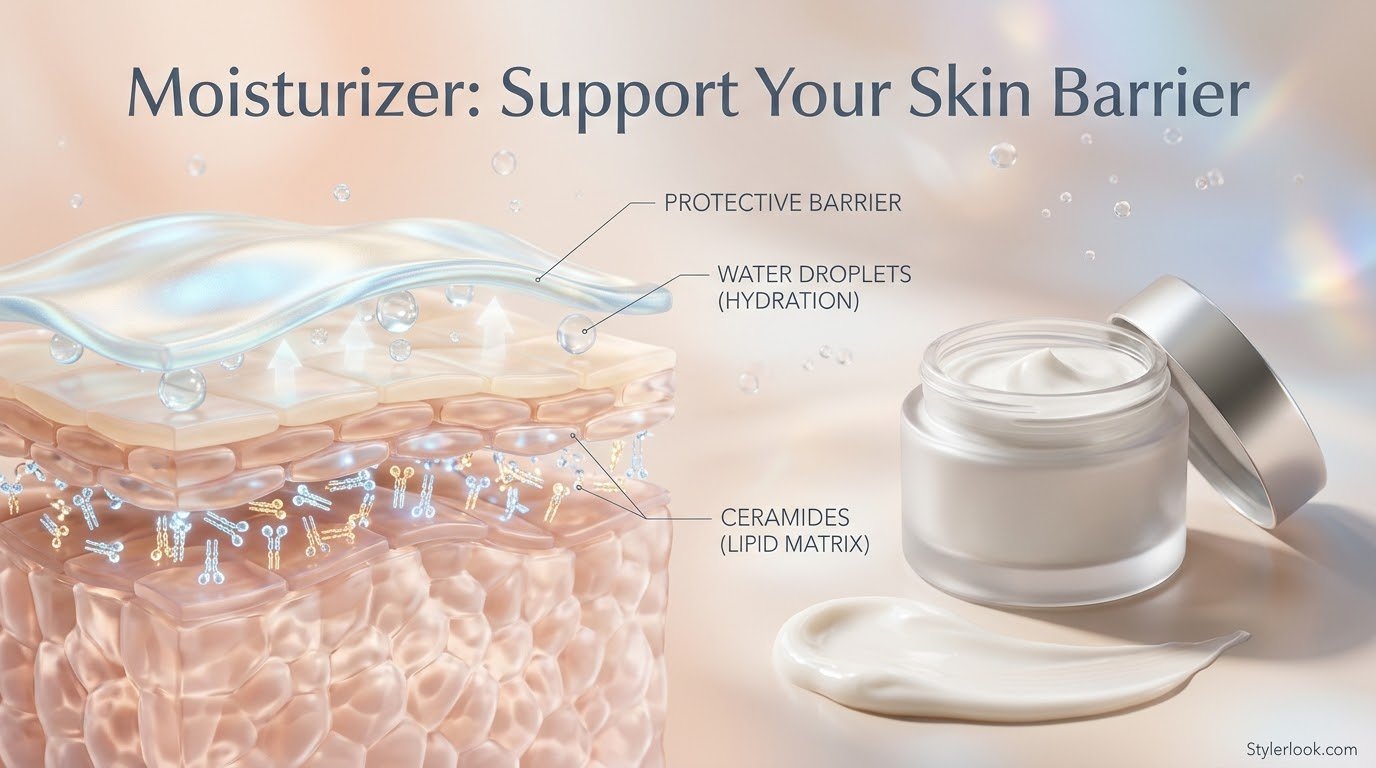
Pilling has boring causes. Too much product, layers applied wet on wet, or silicone heavy formulas stacked in the wrong order.
Fix it with less. Thinner layers, brief pauses, and sunscreen given its setting minutes resolve most pilling without new purchases.
Eye sting has a standard detour. Use mineral sunscreen around the eyes, or keep your usual formula below the orbital bone and add sunglasses.
White cast answers with formulation shopping. Tinted and modern gel textures have largely solved it for daytime wear under makeup.
Makeup over sunscreen works when the film sets first, and the makeup prep routine carries the full layering. The two minute pause is its cheapest trick.
Comfort is not cosmetic trivia here. The routine that stings is the routine that stops, and stopping forfeits the trial proven step.
The Five Minute Morning and the Budget Order
Time the routine honestly and it fits in five minutes. Rinse thirty seconds, serum one minute, moisturizer one minute, sunscreen two.
Longer mornings collapse on weekdays. The four step ceiling exists because adherence is the active ingredient no serum replaces.
Spend in evidence order. Sunscreen first, in a texture you enjoy at full dose, because it carries the trial.
Vitamin C second, at a price you can replace when it oxidizes. A mid priced serum used daily beats a luxury bottle rationed weekly.
Moisturizer third, and the drugstore is full of worthy ones. Everything after that is optional and should be bought last, if at all.
Beginners building from zero get the wider map in the how to start a skincare routine guide. This topic’s budget lesson is protect first, decorate later.
Mistakes That Undo Mornings
Mistake one: retinol at sunrise. The night active spent in daylight, degraded and irritating, earning nothing.
Mistake two: the pea sized sunscreen. A labeled SPF 50 worn at a quarter dose performs like a much weaker product.
Mistake three: SPF moisturizer as the plan. The hybrid shortcut fails on quantity, as the dose chapter shows.
Mistake four: chasing percentages. Vitamin C at irritating strengths, abandoned by week two, protects nothing.
Mistake five: neck amnesia. A protected face above an unprotected neck and chest tells the whole story at a glance.
Mistake six: new product pileups before photos or events. Mornings before big days run the proven basics, nothing experimental.
Every mistake is an architecture error, not a shopping error. The fix is sequence, dose, and patience, in that order.
Order questions in general get their full treatment in the skincare routine order guide. The anti aging order adds only one rule: sunscreen owns the last skincare slot.
The wider routine library at Stylerlook home covers the neighboring topics. This page’s claim is narrow: the morning, graded and dosed.
Reading a Vitamin C Label
The vitamin C shelf rewards slow readers. The form name decides more than the percentage printed largest.
L-ascorbic acid is the researched form, potent and fragile in equal measure. It wants an acidic formula, an opaque bottle, and your patience.
Derivatives wear longer names and calmer temperaments. Ascorbyl glucoside, sodium ascorbyl phosphate, and magnesium ascorbyl phosphate convert toward ascorbic acid in skin.
Percentage games mislead across forms. Twenty percent of a derivative is not twenty percent of L-ascorbic acid, whatever the shelf talker implies.
Company matters on the label. Vitamin E and ferulic acid in the ingredient list signal a formula built for stability, not just strength.
Packaging is a feature, not a vanity. Airless pumps and dark glass slow oxidation more than any antioxidant claim on the front.
Water position tells a story too. Ascorbic acid high in a water based serum behaves differently from oil suspended forms.
Buy the size your routine finishes. A small bottle used up fresh beats a large bottle aging open on the counter.
When a serum stings at every use, believe it. Tolerance is data, and the derivative shelf exists precisely for that report.
A Week of Mornings, Honestly Timed
Monday runs the textbook version. Rinse, vitamin C, moisturizer, sunscreen, neck included, five unhurried minutes at the mirror.
Tuesday compresses. The same four steps at half speed, because the routine was designed to survive exactly this morning.
Wednesday adds weather. Rain or shine, the sunscreen step does not negotiate, since UVA passes clouds and windows on the commute.
Thursday is the two product minimum. Moisturizer and sunscreen only, on the morning everything else goes wrong, and the doctrine survives intact.
Friday checks the serum. A glance at its color catches oxidation early, before a month of darkened serum does nothing quietly.
Saturday goes outdoors. Water resistant sunscreen, a hat as the unglamorous co star, and reapplication at two hour marks.
Sunday audits the shelf. Expiry dates, empties, and the one product nobody reaches for, which the budget stops rebuying.
Notice what the week never contains. No morning heroics, no new actives midweek, and no step that exists only for content.
The Seasonal Rotation
The four steps never rotate. Textures do, twice a year, in opposite directions.
Summer asks for lighter everything except protection. Gel moisturizers, fluid sunscreens, and reapplication discipline carry the hot months.
Sweat and swimming rewrite the reapplication clock. The two hour rule becomes the every swim rule, and water resistance stops being optional.
Winter asks for richness everywhere except the step count. Creamier cleansers, ceramide heavy moisturizers, and lip SPF for cracked, sun exposed lips.
Indoor heating dries the barrier overnight. Mornings may add a hydrating layer on damp skin before the cream, the one sanctioned addition.
Spring and autumn are audit seasons. Photograph the skin in the same light and compare across twelve weeks, the honest progress record.
High altitude and snow holidays break the pattern upward. Reflection and altitude strengthen exposure, and the dose and reapplication both climb.
When Mornings Need a Clinician
Routines manage products and habits. Some morning discoveries are referrals, and spotting them is part of a good routine.
A new, changing, or bleeding spot is not a skincare question. It is a dermatology appointment, made promptly and without a serum trial first.
Pigment that spreads despite faithful sunscreen deserves examination. Melasma and its mimics separate only under professional light and history.
Irritation that survives a stripped back routine has outgrown the shelf. Two weeks of basics without improvement is a reasonable escalation line.
Questions about prescription retinoids, procedures, or pregnancy safe actives are clinician conversations. This article stays in the general information lane deliberately.
Bring the routine list to that appointment. A clinician reading your actual four steps gives better guidance than one guessing at them.
The morning routine then resumes its proper size. Protection daily, correction nightly, and medicine where medicine belongs.
The Supporting Cast, Graded Honestly
Niacinamide is the friendly understudy. It supports tone and barrier at gentle percentages and layers under almost anything without drama.
Its trial record is real but modest. A double blind study of 5 percent niacinamide in women 40 to 60 found improvements in fine lines, spots, and blotchiness over twelve weeks.
Place it where it fits your skin. Niacinamide can ride inside the moisturizer, which is the cheapest way to own it.
Hyaluronic acid is a water manager, not an anti aging active in the trial sense. It pulls water to the surface and lets the cream keep it there.
Dry climates expose its limit. Without damp skin and a sealing cream above it, a hyaluronic serum can leave skin feeling tighter, not fuller.
Peptides are the promising juniors. Mechanisms are plausible and early studies are kind, but the morning evidence ladder keeps them below vitamin C.
Buy them inside moisturizers if you enjoy them. Do not let a peptide serum displace the sunscreen budget or the vitamin C slot.
Eye products are comfort purchases. The eye area ages early because its skin is thin, and it still needs chiefly moisturizer and sunscreen, gently applied.
Antioxidant blends beyond vitamin C (resveratrol, green tea, ectoin) appear in new launches yearly. Grade them as pleasant extras until trials say more.
The cast list has one rule. Supporting players support; the moment one demands the sunscreen’s budget or slot, the casting is wrong.
Skin Types Run the Same Four Steps
Dry aging skin reads this article most literally. Rinse only mornings, rich creams, and moisturizing sunscreens at full dose.
Oily aging skin exists and is underserved. Gel cleansers, derivative or low percentage vitamin C, gel moisturizers, and fluid sunscreens keep the steps identical.
Combination skin zones its textures. Richer cream on the cheeks, lighter layers on the T zone, one sunscreen over everything.
Sensitive aging skin slows the ladder. One new product per fortnight, derivatives before L-ascorbic acid, and mineral sunscreen as the default.
Deeper skin tones weight pigment protection higher. Tinted sunscreen with iron oxides earns its place, and vitamin C serves tone as much as texture.
Fair, sun damaged skin weights the trial highest. For this reader the morning is a medical grade habit wearing cosmetic clothes, and reapplication is sacred.
Every type ends at the same ceiling. Four steps, honestly dosed, outperform ten steps at a dab on every skin type measured.
Starting From Zero and the First Twelve Weeks
Week one buys only sunscreen. Wear it daily at full dose while the rest of the shelf stays exactly as it was.
This sequencing isolates reactions. When something stings in week three, the newcomer is the suspect, not the whole routine.
Weeks two to four add the moisturizer. Choose the ceramide cream your skin type asked for and let the pair settle.
Weeks five to eight audition vitamin C. Start with the gentler form or percentage your tolerance suggests, on alternate mornings first.
Weeks nine to twelve judge with photographs. Same light, same angle, no filter: the only progress record that cannot flatter.
Most beginners discover the routine feels finished early. That feeling is the finding: four steps, dosed right, were the destination all along.
Resist the victory lap purchase. The serum launched next month joins a queue, and the queue moves at one product per month, maximum.
Keep the receipts discipline simple. Date opened, written on the bottle, settles every later argument about age and oxidation.
Twelve weeks is also the review horizon the trials use. Judging earlier judges habit formation, not skin change, and habits deserve their own praise.
By week twelve the morning should feel boring. Boring is the texture of a routine that will still exist next year.
The Mirror Card: Setup That Protects the Habit
Where products live decides whether they get used. The four steps belong at the sink, in order, left to right.
A small printed card helps more than motivation. Rinse, serum, moisturizer, sunscreen, taped inside the cabinet door where the routine happens.
Keep the reapplication format where the day happens. A stick or cushion in the bag outperforms the big bottle at home at 2 in the afternoon.
Set the sunscreen beside the toothbrush, not the serums. It belongs to the hygiene sequence, the part of the morning that never gets skipped.
Partners and households share the dose lesson visually. Two finger lengths, demonstrated once, ends the pea sized era for everyone under the roof.
Travel compresses but never deletes. Decant the four steps, keep them in the carry on, and let cabin dryness argue for the moisturizer.
None of this is glamorous, and that is the point. The morning routine is infrastructure, and infrastructure is judged by whether it is simply always there.
One Sentence for Every Product on the Counter
Run the counter test before any purchase. Each product must state its shift, its evidence, and its dose in one sentence, or it leaves.
The sunscreen passes easily: protection shift, trial evidence, two finger dose. It is the template the others are graded against.
Vitamin C passes with an asterisk: protection support, formulation grade evidence, three to five drops, replaced when it darkens.
The moisturizer passes on authority: barrier shift, AAD endorsed category, a damp skin application extended downward.
Everything else auditions. Toners, mists, eye creams, and second serums must name the gap they fill in the four steps, not beside them.
Most counters fail the test in an instructive way. The products without sentences are decorations bought during other routines’ research.
Return them to the shelf of good intentions.
The morning that remains is shorter, cheaper, and measurably better evidenced than the cluttered one.
It is also calmer to run. Four products means four decisions, and decision fatigue is a real ingredient in abandoned routines.
Give the trimmed counter a month before judging it. Skin reports slowly, and the first honest signal is comfort, then photographs at twelve weeks.
If a gap genuinely appears, the queue admits one product. The doctrine survives additions; it only refuses additions without sentences.
Frequently Asked Questions
1. What is the best morning skincare routine for anti aging?
Four steps, protection led. Rinse or gentle cleanse, vitamin C, moisturizer, then broad spectrum SPF 30 or higher, extended to the neck, in about five minutes.
2. How many steps should a morning anti aging routine have?
Four, by design. Cleanse or rinse, antioxidant, moisturize, protect.
More morning steps mostly buy irritation and skipped days; adherence is the active ingredient.
3. What order should morning anti aging products go in?
Thinnest to thickest, sunscreen last. Cleanser, then serum, then moisturizer, then SPF as the final skincare layer before makeup, with brief pauses between layers.
4. Is sunscreen really the most important anti aging product?
Yes, on the strongest evidence available. The Nambour randomized trial found daily users aged measurably less, and the AAD names sunscreen a top two anti aging product.
5. What did the Nambour sunscreen trial find?
Daily use beat discretionary use clearly. In 903 adults over 4.5 years, daily sunscreen users showed 24 percent less skin aging and no detectable increase in aging.
6. Do I need to wash my face in the morning?
Often, no. Many faces, especially dry and mature ones, do best with a water rinse or a cream cleanser.
Tight, squeaky skin after washing signals over cleansing.
7. Where does vitamin C go in a morning routine?
Second, right after cleansing. Apply vitamin C to dry skin before moisturizer and sunscreen, so the antioxidant layer sits closest to the skin.
8. What percentage vitamin C should I use in the morning?
Ten to twenty percent for L-ascorbic acid. That is the researched range.
Start lower if you sting easily, and climb only as tolerance proves out.
9. Why does my vitamin C serum turn orange?
It oxidized. Ascorbic acid degrades with light and air, darkening as it loses strength.
Store it cool and dark, and replace serum that turns orange brown.
10. Can I use retinol in the morning?
It is a poor use of it. Sunlight degrades several retinoids and retinized skin is more sun sensitive.
Retinoids belong to the night routine.
11. Why is retinol a nighttime product?
Light and sensitivity both point to night. Retinoids can break down in UV and raise sun sensitivity, so evening use protects the ingredient and your skin.
12. Can I use vitamin C and retinol on the same day?
Yes, split across the day. Vitamin C in the morning and a retinoid at night is the standard separation, and it also lowers irritation.
13. How much sunscreen should I apply to my face?
About two finger lengths for face and neck. That approximates the tested dose of 2 milligrams per square centimeter at which SPF ratings are measured.
14. What is the two finger rule for sunscreen?
A dose shortcut. Squeeze sunscreen along the full length of your index and middle fingers.
That amount covers the face and neck at roughly the tested thickness.
15. Is moisturizer with SPF enough in the morning?
Rarely, as actually applied. SPF moisturizer only delivers its rating at two finger lengths, which almost nobody applies.
A dedicated sunscreen is the reliable plan.
16. Does the SPF in makeup count as sun protection?
No, not at makeup quantities. Foundation layers are far thinner than the tested sunscreen dose.
Treat makeup SPF as decoration over real sunscreen, not protection itself.
17. Should sunscreen go before or after moisturizer?
After moisturizer, always. Sunscreen is the final skincare layer, forming an undisturbed film.
Moisturizer goes underneath, makeup goes on top after it sets.
18. How long should I wait between morning layers?
Brief pauses suffice. Give each layer a moment to settle, and let sunscreen set a couple of minutes before makeup.
Long timers are unnecessary.
19. When should I reapply sunscreen?
Every two hours outdoors. Reapply after swimming or heavy sweating too.
Indoors away from windows, the morning application is what most guidance builds on.
20. Chemical or mineral sunscreen for anti aging?
Both work; choose by comfort. Mineral suits sensitive skin and sting prone eyes.
Chemical textures are often more elegant.
Whichever one you actually apply daily is the right category.
21. Is tinted sunscreen better for dark spots and melasma?
For pigment prone skin, often yes. Tinted sunscreens add iron oxides, which help block the visible light that worsens melasma and dark spots.
22. Can I use niacinamide in the morning?
Yes, it is morning friendly. Niacinamide layers well under moisturizer and sunscreen, supporting tone and barrier without sun sensitivity concerns.
23. Where does hyaluronic acid fit in the morning?
Under the moisturizer. Apply hyaluronic acid serum to damp skin after vitamin C, then seal with cream so the water it attracts stays put.
24. Do I need an eye cream in a morning anti aging routine?
No, it is optional. The eye area needs sunscreen and moisturizer more than a separate cream.
Buy eye cream for comfort, not as an anti aging requirement.
25. What morning routine suits dry aging skin?
Moisturizer led and gentle. Rinse or cream cleanse, a tolerant vitamin C, a ceramide rich cream on damp skin, and a moisturizing sunscreen at full dose.
26. What morning routine suits oily aging skin?
Light textures, same order. A gentle gel cleanser, vitamin C, a gel moisturizer, and a matte or gel sunscreen keep the four steps without heaviness.
27. How does the morning routine change after menopause?
Dryness takes the lead. Literature strands link menopause to faster collagen and moisture loss, so mornings get richer creams, gentler actives, and tinted SPF for pigment.
28. What morning routine should I follow in my 30s?
Build the habit. Sunscreen daily at full dose, a first vitamin C, and a simple moisturizer.
Consistency in your 30s is the cheapest anti aging move available.
29. What changes in a morning routine in my 40s and 50s?
Coverage joins prevention. Vitamin C becomes daily, products extend to neck, chest, and hands, and moisturizers get richer as dryness climbs.
30. Can I use exfoliating acids in the morning?
Generally, keep them at night. Morning acids raise sun sensitivity.
If you use one, sunscreen discipline must double for the following week.
31. Why does my sunscreen pill over my serum?
Too much, too wet, wrong order. Use thinner layers, let each settle briefly, and give sunscreen its setting minutes before adding anything on top.
32. Why does sunscreen sting my eyes and how do I fix it?
Keep chemical filters off the eye area. Use a mineral sunscreen around the eyes, or apply your usual one below the orbital bone and add sunglasses.
33. How do I apply makeup over sunscreen without ruining it?
Let the film set first. Wait a couple of minutes after sunscreen, then apply makeup gently without rubbing.
A moisturized, set base wears best.
34. How long should a morning anti aging routine take?
About five minutes. Rinse, serum, moisturizer, sunscreen.
The ceiling is deliberate: routines longer than real life allows collapse on weekdays.
35. What is the cheapest effective morning anti aging routine?
Sunscreen plus moisturizer, done well. A dedicated SPF 30 you enjoy at full dose and a drugstore ceramide cream outperform an expensive serum used sporadically.
36. Should I apply skincare to my neck and hands in the morning?
Yes, every morning. The neck, chest, and backs of hands age visibly and get forgotten.
Extend the same products downward at almost no extra cost.
37. Is vitamin C or sunscreen more important?
Sunscreen, and it is not close. Sunscreen owns the randomized trial evidence.
Vitamin C supports it as an antioxidant and cannot substitute for it.
38. Can antioxidants replace sunscreen?
No. Antioxidants mop up some free radicals UV generates, but they do not block UV itself.
They complement sunscreen; the trial evidence belongs to sunscreen.
39. What if vitamin C stings my skin?
Step down, do not push through. Lower the percentage, buffer it over moisturizer, or switch to a gentler derivative like ascorbyl glucoside or SAP.
40. Are expensive vitamin C serums worth it?
Not by default. The benchmark ferulic formulas are costly, but stabilization and percentage matter more than brand.
A mid priced serum used daily wins.
41. When should I see a dermatologist about aging skin?
For changing or stubborn signs. New or changing spots, persistent irritation, spreading pigment, or questions about prescriptions and procedures deserve a dermatologist, not more products.
42. Does blue light from screens age skin enough to matter?
Less than marketing suggests. Screens emit far less relevant light than daylight.
Daylight through windows is the exposure worth managing with daily sunscreen.
Conclusion
A morning skincare routine for anti aging is a protection shift with a four step ceiling. Rinse, antioxidant, moisturizer, sunscreen, and nothing the night does better.
Hold the evidence ladder in view. Sunscreen owns the trial, moisturizer owns the authority endorsement, and vitamin C supports both without impersonating either.
Dose like the tests assume. Two finger lengths, every morning, extended to the neck, outlast every expensive serum used at a dab.
Start tomorrow with the minimum that works. One enjoyable sunscreen, applied at full dose before anything decorative, begins the routine’s evidence working for you.
