

When to use retinol in skincare routine questions sound simple, and they hide four separate timing decisions. Get one wrong an the best product in the world still disappoints you.
Retinol fails people on schedule, not on chemistry. The ingredient has decades of research behind it, yet most beginners quit within weeks because nobody gave them the clock.
The clock has four hands, and this page sets all of them. Time of day, position in the routine, week of the ramp, and season of life.
Everything here is general information, not medical advice. Pregnancy, diagnosed skin conditions, and persistent reactions belong to your own dermatologist, and the flags appear wherever they matter.
The Short Answer: Four Clocks, One Table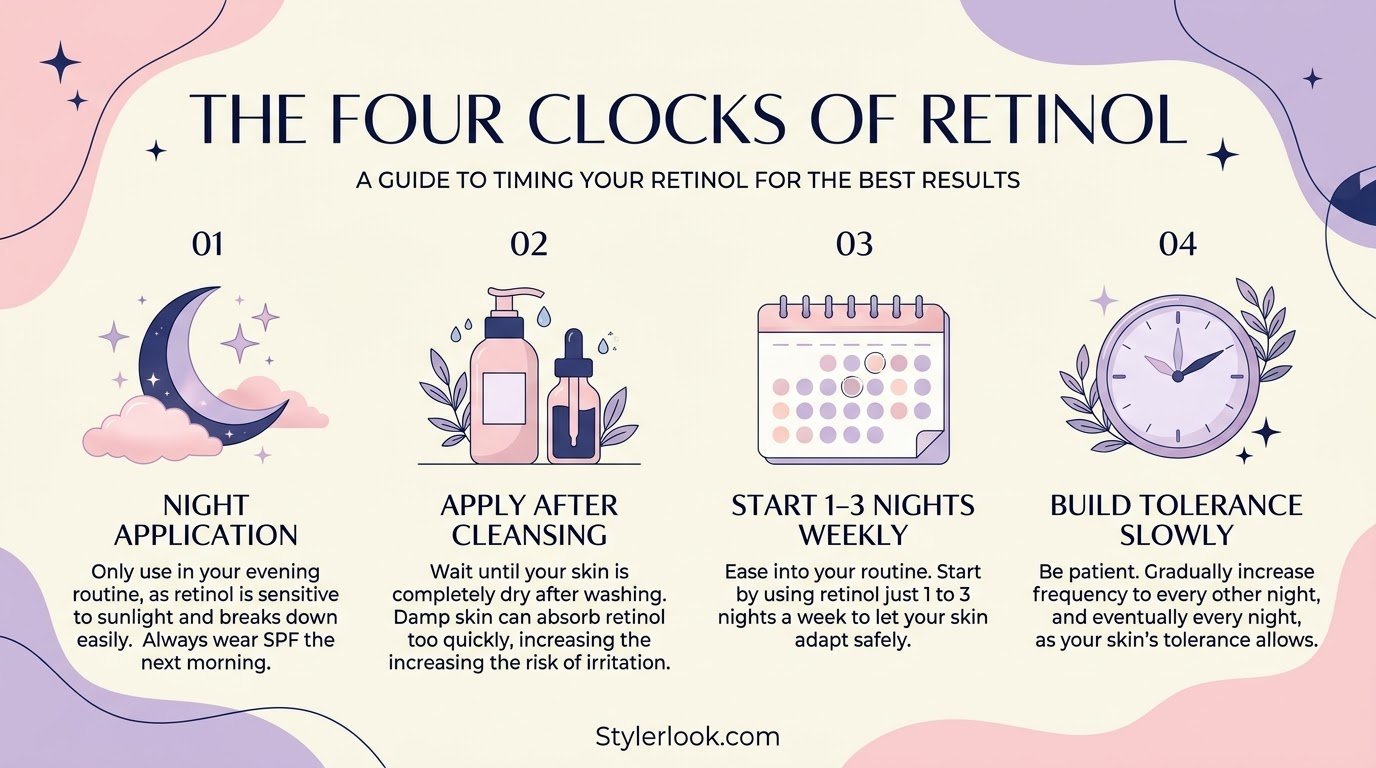
Retinol belongs at night, on clean and fully dry skin, in a pea sized amount, before moisturizer. That single sentence answers most of the question most people actually ask.
The full answer needs the whole system at once. A night application on the wrong week of the ramp still irritates, and a perfect ramp fails without morning sunscreen.
|
Clock |
The Rule |
Why |
|---|---|---|
|
Time of day |
Night only |
Sunlight degrades retinol; retinol raises sun sensitivity |
|
Position |
After cleansing, on fully dry skin, before moisturizer |
Direct contact works; damp skin over absorbs and irritates |
|
Frequency |
Start 1 to 3 non consecutive nights, ramp over 6 to 8 weeks |
Tolerance is built, not assumed |
|
Season of life |
Start when concerns justify it; avoid in pregnancy; pause around damage |
Timing includes your calendar, not just your evening |
Keep this table open beside the Okoaskin timing guide, which states the same consensus in its shortest form. Night, dry skin, ramped frequency, and sunscreen every morning form the non negotiable core.
Everything after this section explains and proves those four rows. Skim the clocks you already know and read the ones you keep getting wrong.
Clock One: Time of Day, and Why Night Is Not a Preference
Retinol goes on at night, and the rule rests on chemistry, not tradition. Two separate mechanisms punish a morning application, and either one alone would settle the question.
First, retinol is photounstable. Sunlight breaks the molecule down, so a morning layer spends the day degrading under the very light it fears.
Second, retinol makes skin more sensitive to the sun while you use it. Daytime application pairs peak sensitivity with peak exposure, which is exactly backwards.
Night application also matches your skin’s own schedule. Skin shifts into repair mode while you sleep, and the treatment step belongs in the repair shift.
Could you use it in the morning under strict sunscreen? Technically yes, and practically pointless. One evening application is the standard routine every serious source teaches.
Twice a day is worse, not better. It doubles irritation risk without a clear benefit, a point the timing guides state unusually bluntly.
The rest of your routine reorganizes around this one decision. Your morning skincare routine becomes the home of vitamin C, hydration, and sunscreen, which is where those ingredients perform best.
Clock Two: Position in the Routine
Order decides how much retinol your skin actually meets. The treatment sits after cleansing and before moisturizer, and two details inside that sentence do the heavy lifting.
Cleanse Gently, Then Wait for Dry
Wash with a mild, non exfoliating cleanser on retinol nights. Leave the acid cleansers and scrubs in the cupboard, because the evening already contains one active.
Pat dry and wait until your skin is fully dry before applying anything. Damp skin pulls retinol in faster, and faster penetration means more irritation with no added benefit.
Guides differ on the exact wait, from a few minutes to twenty. Treat the range honestly: the requirement is dryness itself, not a stopwatch number.
Dose: One Pea, Five Dots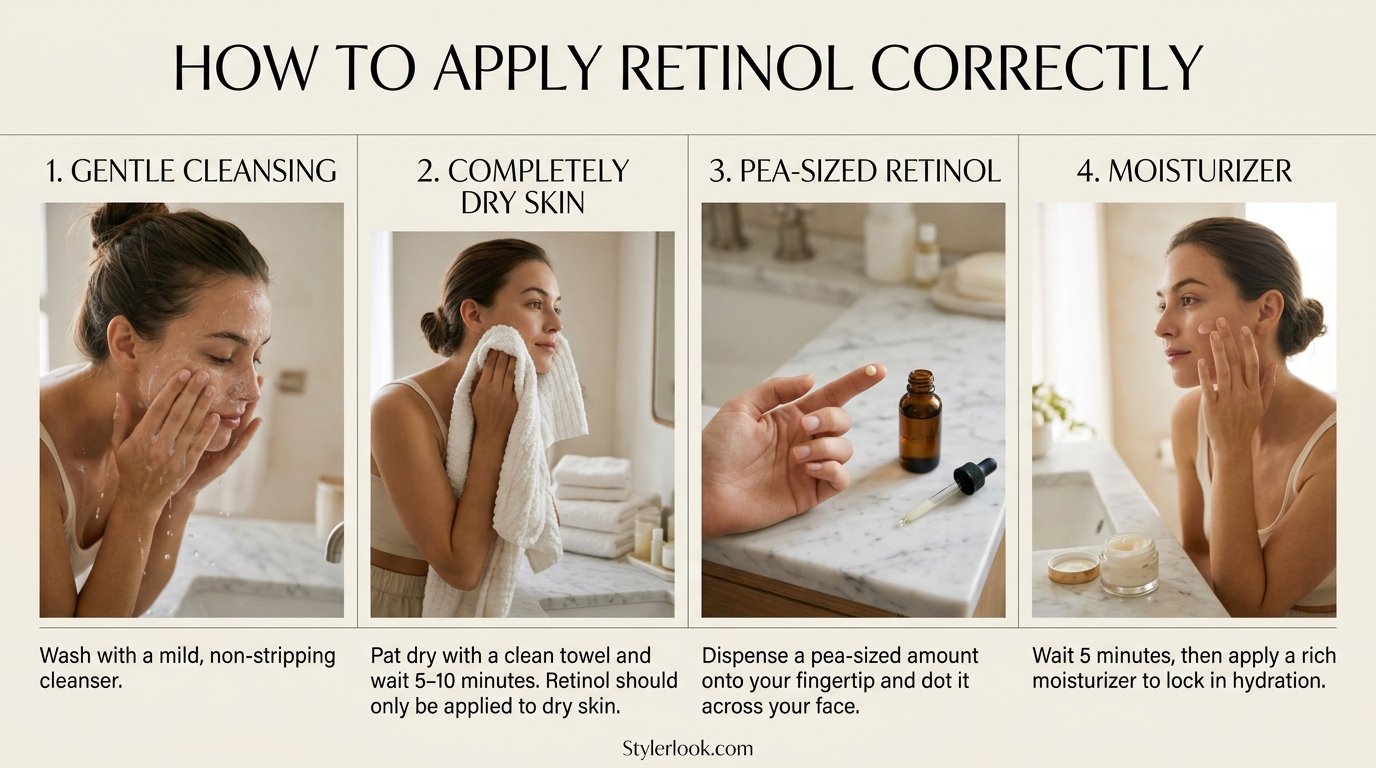
Use a pea sized amount for your whole face. More product does not work faster; it only irritates faster, and this is the easiest beginner error to fix.
Dot the pea across forehead, both cheeks, and chin, then spread thinly. The five dot method stops the first zone from drinking the entire dose.
Keep retinol away from the eyelids and lash line, the lips and mouth corners, and the creases beside the nose. Those zones are thinner and complain first.
Sensitive skin can protect the corners first. A swipe of plain moisturizer or balm over the eye corners, lips, and nose creases shields them before the pea goes on.
Before or After Moisturizer?
Before, for most people. Retinol on bare dry skin reaches the skin directly, and the moisturizer afterwards seals it in and buffers the edges.
A retinol serum takes the serum step, right before moisturizer. A retinol cream can serve as the moisturizer step itself, which simplifies the night.
Hydrating serums are flexible partners. The Shani Darden layering guide notes a hydrating serum can sit just before or after retinol depending on tolerance, and hydration never conflicts with the treatment.
Sensitive and dry skin get a different protocol entirely, and it has its own section next. The sandwich method exists because the standard order is too direct for some faces.
The Standard Night, Step by Step
Run retinol nights like a checklist, and the routine stays calm while tolerance builds. The same four steps, in the same order, every treatment night.
- Cleanse gently. Use a mild cleanser and lukewarm water. Skip exfoliating cleansers, scrubs, and cleansing brushes tonight.
- Dry completely. Pat dry with a clean towel and wait until no dampness remains. This pause protects you more than any product upgrade.
- Apply the pea. Dot and spread the retinol across forehead, cheeks, and chin. Keep clear of eyes, lips, and nose creases.
- Moisturize. Follow with a plain, fragrance free moisturizer. On tight nights, a richer cream or a drop of facial oil on top is fine.
Notice what is missing: no toner wars, no second active, no ten step ceremony. During the ramp, boring is the strategy, and the nighttime skincare routine stays deliberately short.
The full skincare routine order behind this short version lives in the site’s order guide. Retinol night is simply that order with the treatment seat filled and everything else simplified.
The Sandwich Method: The Sensitive Skin Branch
The sandwich method flips the order on purpose: moisturizer, retinol, moisturizer. The first layer slows absorption, and the second seals and soothes.
Dermatologists recommend it because the buffer cuts irritation significantly while keeping efficacy largely intact. Diluted contact beats abandoned routines, every single time.
Who Should Sandwich From Night One
Start sandwiched if your skin is dry, sensitive, or reactive, or if actives have burned you before. Beginners with eczema or rosacea in their history should ask a dermatologist first instead.
First time users over 40 often sandwich too. Skin adjusts more slowly with age, and the clinic guidance builds extra moisture into older starters’ schedules.
The Sandwich Protocol, Step by Step
- Cleanse and dry exactly as in the standard night. The dry rule never relaxes, sandwich or not.
- Apply a thin moisturizer layer over the whole face. Let it settle for a few minutes so the retinol does not slide.
- Apply the pea sized retinol over the buffer, dots first, avoiding the protected corners as usual.
- Seal with a second moisturizer layer. A richer cream suits dry skin; a standard lotion suits everyone else.
Sandwiching is a starting position, not a life sentence. Many users graduate to the standard order after a month or two of calm skin, and some stay sandwiched forever with full results.
Clock Three: The Ramp, Week by Week
Frequency is where beginners actually fail. Retinol tolerance is built over weeks, and the build has a calendar you can write down today.
The principle underneath every schedule is identical: start low, go slow, and increase only when your skin stays comfortable. Irritated skin is the number one reason people quit, ahead of price, patience, and product choice.
The Eight Week Calendar
|
Weeks |
Frequency |
What to Watch |
|---|---|---|
|
1 to 2 |
2 non consecutive nights per week |
Mild dryness may appear; burning or swelling should not |
|
3 to 4 |
Every third night, or 3 nights weekly |
Flaking, persistent redness, tightness |
|
5 to 8 |
Every other night if comfortable |
Hold steady if irritated; steady beats ambitious |
|
After 8 |
Every other night, or nightly if calm |
Nightly is an option after 2 to 3 months, never a requirement |
The beginner level and frequency tables publish a nearly identical plan beside level tables. Independent sources converging on the same calendar is what a consensus looks like.
Two comfortable nights a week outperform seven irritated ones. A routine you abandon delivers zero percent of the ingredient, whatever the label promised.
Starting Nights by Skin Type
Your skin type sets the first rung, not the destination. The clinic beginner protocol lays out the starting grid most clearly.
|
Skin Type |
Starting Strength |
Nights per Week (Weeks 1 to 4) |
Notes |
|---|---|---|---|
|
Oily, resilient |
0.3 percent retinol |
2 |
Can move to 3 nights from week 5 |
|
Normal |
0.2 to 0.3 percent |
2 |
Buffer if tightness appears |
|
Dry |
0.1 to 0.2 percent |
1 to 2 |
Sandwich every time |
|
Sensitive or reactive |
0.1 percent or a gentle ester |
1 |
Patch test first |
|
Combination |
0.2 to 0.3 percent |
2 |
T zone first, cheeks later |
|
Breakout prone |
0.3 percent or adapalene path |
2 |
A short purge is possible |
|
Over 40, first time |
0.2 to 0.3 percent |
2 |
Slower adjustment; moisture first |
Beginners belong in the 0.1 to 0.3 percent band. Higher percentages are not faster in the first months; they simply produce more irritation, which is the quitting mechanism.
Patch test before the first full application: a small amount behind the ear or on the inner forearm for a few nights. A rash, itching, or swelling there saves your whole face the experiment.
Skin Cycling: A Popular Way to Hold the Ramp
Skin cycling wraps the same ramp in a four night rotation: exfoliation night, retinoid night, then recovery nights of hydration and moisturizer. The framework is popular because the calendar is memorable.
Treat it as a scheduling system, not a medical rule. Its real value is structural: it forces rest nights between actives, which is exactly what the conflicts table below demands anyway.
If a named rotation keeps you consistent, use it. If the plain calendar above keeps you consistent, that works too, because the ramp matters more than the branding of the rotation.
Clock Four: Season of Life
The last clock runs in months and years, and it decides when retinol enters your life, when it pauses, and when it should never start.
What Age to Start
Start when your concerns justify it, which is the Cleveland Clinic framing the brand guides cite. Acne and post blemish marks can bring retinol into a routine in the late teens or twenties, under guidance for younger users.
For anti aging, a proactive start is the common advice: begin before fine lines and laxity are established, typically in the mid twenties to thirties. Starting later still helps; the clock is forgiving about late arrivals.
The L’Oreal Paris retinol guide makes the same point from the brand side. Whenever you start, the ramp applies in full, because skin age does not exempt anyone from tolerance building.
Pregnancy and Planning: A Hard Stop
Topical retinoids are not recommended during pregnancy. Dermatology and obstetric guidance, summarized across the sources for this page, advises avoiding retinoids while pregnant or planning a pregnancy.
Breastfeeding sits in the same caution zone in most guidance. These are questions for your own clinician, not for a product label or an article, and no exceptions are negotiated here.
Pause Conditions and Restarts
Never apply retinol to sunburned, freshly waxed, broken, or severely irritated skin. Pause around peels and procedures until the treating clinician’s guidance says restart.
Restarting after a break is its own skill. Tolerance fades over weeks away, so restart like a beginner at reduced frequency, sandwiched if needed, and rebuild.
Planning an event that matters? Count backwards eight to twelve weeks. A beginner who starts retinol the month of a wedding photographs their retinization, not their results.
Season and Climate Adjustments
Summer use is legitimate with stricter SPF discipline, since sensitivity and UV peak together. Many beginners prefer a fall start, when the ramp happens under gentler light.
Dry heat and air conditioning argue for the sandwich every time plus a richer final cream. Humid climates can lighten the sealing layer while keeping every timing rule intact.
Partners and Conflicts: Splitting the Week
Retinol rarely fails alone; it fails in bad company. The solution is scheduling, not sacrifice: every major active can stay in your life, on its own shift.
The Morning Split: Vitamin C
Vitamin C belongs in the morning, retinol at night, and that split is the standard architecture across sources. The antioxidant works the day shift under sunscreen, where it earns its keep.
Stacking vitamin C and retinol in the same evening raises irritation risk without a clear gain. Split the clock and you keep both ingredients at full usefulness.
The skincare routine hub shows how the two halves assemble into one week. Day shift protects, night shift treats, and neither steals the other’s seat.
Alternate Nights: Exfoliating Acids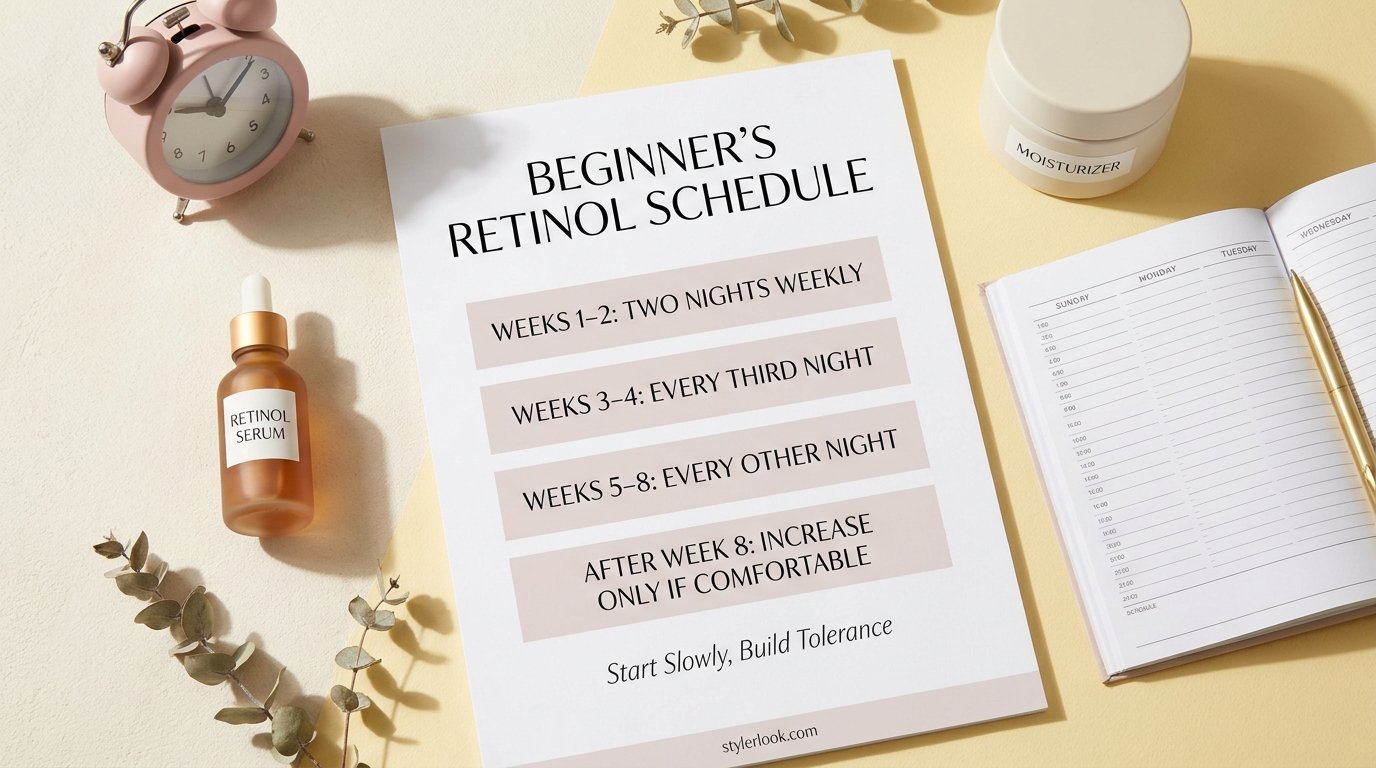
AHAs and BHAs get their own nights, never the retinol night. Alternate them, and each active works without compounding the other’s irritation.
One order guide states the stakes plainly: retinol plus an exfoliating acid on the same night is the most common cause of a damaged barrier in people who thought they were doing everything right.
During the first ramp weeks, many beginners drop exfoliants entirely. Reintroduce them on alternate nights only after the retinol base is calm and stable.
The Hard Conflict: Benzoyl Peroxide
Avoid benzoyl peroxide in the same routine as retinol unless a dermatologist directs it. The pairing is highly irritating together, and benzoyl peroxide can degrade some retinoids on contact.
Adapalene formulations are the documented exception territory, and exceptions live in clinician conversations, not in self assembled layering experiments.
|
Ingredient |
Verdict |
Scheduling Rule |
|---|---|---|
|
Vitamin C |
Partner, wrong shift |
Morning only; retinol keeps the night |
|
Hyaluronic acid |
Partner |
Same night fine, before or after retinol |
|
Niacinamide |
Partner |
Same night generally fine; introduce changes one at a time |
|
Ceramide moisturizer |
Partner |
The default seal on every retinol night |
|
AHA or BHA |
Conflict by stacking |
Alternate nights only |
|
Benzoyl peroxide |
Hard conflict |
Not in the same routine without a dermatologist |
|
Facial scrubs |
Conflict by stacking |
Not on retinol nights |
Read the table as a week planner, not a ban list. Nothing here is exiled from your routine; two items simply work different shifts.
The Morning After: SPF Is Part of the Treatment
The retinol night is only half the protocol. The following morning decides whether the night’s work survives the day.
Run the standard morning: gentle cleanse or rinse, vitamin C or a hydrating serum if you use one, moisturizer, then broad spectrum SPF 30 or higher.
Reapply sunscreen every two hours outdoors, and after swimming or sweating. A single morning coat is a fair weather promise, and UV does not keep office hours.
Dermatology guidance summarized by the AAD stresses consistent daily SPF for retinoid users. Skipping it accelerates the very sun damage the retinol is meant to address.
Think of sunscreen as the ramp’s final step, repeated daily rather than weekly. The four clocks all stop if this one habit does.
New to routines entirely? The how to start a skincare routine primer shows how a morning and night pair is built from zero. Retinol slots into that skeleton at exactly one seat.
Retinization: The Adjustment Window
Most beginners meet retinization in the first weeks: dryness, mild flaking, redness, or tightness as the skin adapts to faster turnover. The window typically runs about two to six weeks.
Tightness or slight sensitivity around day ten to fourteen is a recognized pattern, not an alarm. The dermatologist tips summary frames it as normal adjustment backed by the dermatologist guidance they summarize.
Breakout prone skin may see a short purge as turnover speeds up and clogged pores surface early. A brief flare inside the adjustment window differs from a reaction, and the next paragraph draws that line.
Stop signals are different in kind: persistent burning, swelling, blistering, or a rash that does not settle after stopping. Those end the experiment and start a clinician conversation.
Managing the window is scheduling again. Drop back a rung, sandwich every application, simplify everything around the retinol, and let moisturizer do overtime until the skin settles.
Pushing through genuine irritation is not discipline. The ramp rewards the user who adjusts the calendar, and punishes the one who treats redness as a toll to pay nightly.
Results Timeline: Honest Ranges, Named Sources
Retinol is a consistency ingredient, and its timeline is measured in weeks and months. Anyone promising days is selling, and the sources worth trusting refuse to.
Early changes are quiet: smoother feel, fewer clogged pores, makeup sitting better. A controlled study of 0.1 percent retinol, reported by a brand source, noted improvements after eight weeks of use.
The evidence anchor for the category is the Mukherjee et al. 2006 review in Clinical Interventions in Aging: topical retinoids reduce the appearance of fine wrinkles and improve mottled pigmentation and texture.
Prescription strength timelines run longer still, with dermatology sources describing three to six months of consistent use for visible change. Over the counter retinol asks for the same patience at a gentler slope.
If nothing has changed after three to four months of consistent, tolerated use, the next step is a dermatologist conversation, not a stronger percentage bought in frustration.
Judge the ingredient at week twelve, not at day twelve. The ramp calendar and the results calendar are the same document read at different speeds.
Mistakes to Avoid
Most retinol damage is scheduling damage, and every item below is a clock error wearing a disguise. Read them as the four clocks, inverted.
- Starting nightly. The classic failure. Tolerance is built over weeks, and skipping the build converts a proven ingredient into a rash with good marketing.
- Applying to damp skin. Wet skin absorbs retinol faster and complains louder. The dry wait costs minutes and saves the whole ramp.
- Using more than a pea. Doubling the dose doubles irritation, not speed. The pea is a measured dose, not a serving suggestion.
- Stacking actives at night. Acids, scrubs, or benzoyl peroxide beside retinol turns one treatment into a barrier incident. Split the shifts instead.
- Skipping morning SPF. The night shift builds sensitivity along with results. Unprotected days spend both, and the net progress can go negative.
- Quitting inside retinization. Weeks two to four feel worst and mean least. Adjust the schedule first; abandon only on genuine stop signals.
- Starting before an event. A fresh ramp plus photographs equals regret. Count back eight to twelve weeks, or start after the event.
- Chasing percentages early. Strength is the last dial to turn, after frequency and consistency are proven. The best skincare routine guidance makes the same hierarchy point across routines.
How to Start Tonight
Everything above compresses into a single evening. If you own a beginner strength retinol and a plain moisturizer, you already own the whole kit.
- Cleanse at night with your gentlest cleanser. Lukewarm water, no scrub, no acid wash.
- Dry fully and protect the corners if your skin runs sensitive. Moisturizer on the eye corners, lips, and nose creases first.
- Apply the pea, sandwiched if you are dry or sensitive, straight onto dry skin if you are not. Dots first, spread thin.
- Moisturize, set tomorrow’s sunscreen out where you will see it, and mark the calendar. Your next retinol night is two or three days away, not tomorrow.
That is the entire first night of a routine people maintain for decades. The sophistication is in the calendar, and the calendar is now yours.
Keep the wider routine simple while the ramp runs. The Stylerlook skincare collection covers the supporting steps when you are ready to add them back, one at a time.
Frequently Asked Questions
When should you use retinol, morning or night?
At night. Sunlight breaks retinol down, and retinol makes skin more sun sensitive while you use it. Night application gives it the best chance to work and the least chance to irritate, and your skin repairs itself while you sleep.
Why can’t you use retinol in the morning?
Two reasons: UV light degrades the ingredient before it can work, and photosensitivity raises the risk of redness and sunburn during the day.
With strict sunscreen it is technically possible, but there is little reason to; one evening application is the standard routine.
Do you apply retinol before or after moisturizer?
Before, for most people: retinol goes on clean, dry skin so it reaches the skin directly, and moisturizer seals it.
If your skin is dry or sensitive, the sandwich method reverses the logic on purpose: moisturizer, retinol, then moisturizer again to buffer it.
What is the sandwich method for retinol?
Moisturizer first, then retinol, then another layer of moisturizer. The buffer slows absorption and cuts irritation significantly without meaningfully reducing efficacy, which is why dermatologists commonly recommend it for sensitive and beginner skin.
How often should a beginner use retinol?
Start with 1 to 3 non consecutive nights per week depending on skin type (one night for dry or sensitive skin, two to three for oily or resilient), then build slowly. Increase only when your skin stays comfortable.
What is a good retinol ramp schedule?
A common pattern: weeks 1 to 2, two non consecutive nights weekly; weeks 3 to 4, every third night or three nights; weeks 5 to 8, every other night.
Nightly use is optional after two to three months and only if your skin is calm; many people stay at every other night permanently with full results.
Can you use retinol every night?
Eventually, if your skin tolerates it, but nightly is not required and is not a badge of progress. Two or three comfortable nights a week outperform daily use followed by an irritation break. Consistency beats intensity.
Can you use retinol twice a day?
No. Twice daily use doubles the irritation risk without a clear benefit. One evening application, used consistently, is the standard for over the counter retinol.
Should retinol go on dry or damp skin?
Fully dry. Damp skin pulls retinol in faster and raises irritation without adding benefit. Cleanse, pat dry, and wait a few minutes until the skin is completely dry before applying.
How long should you wait between retinol and moisturizer?
Guidance varies: many routines apply moisturizer right after; some guides suggest waiting several minutes (5 to 10, occasionally up to 20 after washing for the dry skin step).
The essential waits are before retinol (skin fully dry) and keeping the total routine gentle.
How much retinol should you use?
A pea sized amount for the whole face. Dot it on the forehead, cheeks, and chin, then spread thinly. More product does not work faster; it only irritates faster.
Where should you not apply retinol?
Keep it away from the eyelids and lash line, the lips and mouth corners, and the creases of the nose. Protect those corners with moisturizer or balm first if your skin is sensitive.
Can you use retinol and vitamin C together?
Yes, by splitting the clock: vitamin C in the morning, retinol at night. That is the standard architecture. Using both in the same evening routine raises irritation risk for most people without a clear gain.
Can you use retinol with AHAs or BHAs?
Not on the same night, for most people. Alternate nights: exfoliant one night, retinol another. Layering both in one routine is one of the most common causes of a damaged barrier in otherwise careful users.
Can you use retinol with benzoyl peroxide?
Avoid combining them in the same routine unless a dermatologist directs it; benzoyl peroxide can degrade some retinoids and the pair is highly irritating together. Adapalene is the documented exception in formulated products, which is a clinician conversation.
Can you use retinol with hyaluronic acid?
Yes. Hydrating serums pair well with retinol and can go before or after it depending on tolerance. On retinol nights, hydration is a partner, not a conflict.
Can you use retinol with niacinamide?
Generally yes; niacinamide is a common buffer friendly partner in retinol routines and formulas. As with any new pairing, introduce one change at a time.
What should you use on non retinol nights?
Keep it simple: gentle cleanse, hydrating serum if you use one, and moisturizer. Exfoliants, if you use them, belong on their own alternate nights, not stacked onto recovery nights during the ramp.
What is skin cycling and where does retinol fit?
A popular rotation framework: one night exfoliation, the next night a retinoid, then one or two recovery nights of hydration and moisturizer, repeating.
It is a scheduling system, not a medical requirement; the ramp matters more than the brand name of the rotation.
What is retinization and how long does it last?
The adjustment period in the first roughly 2 to 6 weeks, when dryness, mild flaking, redness, or tightness commonly appear as skin adapts. It is the phase most people quit in, usually just before tolerance arrives.
Is purging normal when starting retinol?
A short flare of breakouts can happen as turnover speeds up, especially in breakout prone skin. Burning, swelling, blistering, or a rash that does not settle is not purging; stop and contact a clinician.
How long does retinol take to work?
Weeks to months.
Early changes like smoother feel can come sooner; controlled study reporting on 0.1 percent retinol noted improvements after eight weeks, and dermatology sources describe tone and fine line changes taking longer, often three to six months for prescription strength.
No honest source promises days.
What percentage of retinol should a beginner start with?
Low: roughly 0.1 to 0.3 percent retinol is the common beginner band (some sensitive protocols start with gentler retinoid esters).
Higher percentages are not faster in the first months; they mainly produce more irritation, which is the top reason people quit.
When should you start using retinol, at what age?
It depends on your concerns and goals, as the Cleveland Clinic framing puts it: acne and post blemish marks can bring it into a routine earlier.
For anti aging, a proactive start before visible signs is commonly advised, often in the mid 20s to 30s. A dermatologist can personalize this.
Can you use retinol in summer?
Yes, with discipline: night application and strict morning SPF matter more, not less, in high UV months. Some people prefer to start in lower UV seasons so the ramp happens under gentler conditions.
Should you use retinol before a big event or photos?
Not as a beginner. Start at least a full ramp (about 8 to 12 weeks) before an event that matters, so any retinization is finished and tolerance is established.
Can you use retinol during pregnancy?
No. Topical retinoids are not recommended during pregnancy, and dermatology and obstetric guidance summarized across sources advises avoiding them while pregnant or planning pregnancy. Ask your clinician about alternatives.
Can you use retinol while breastfeeding?
Guidance commonly advises avoiding retinoids while breastfeeding as well, or asking your clinician first. This is a question for your own doctor, not for a product label.
Should you pause retinol after waxing, sunburn, or a peel?
Yes. Do not apply retinol to sunburned, freshly waxed, broken, or severely irritated skin, and pause around peels and procedures until your clinician or the treatment guidance says to restart.
What are the signs you should stop and see a dermatologist?
Persistent burning, swelling, blistering, or a rash that does not settle after stopping; deep painful breakouts; or using retinoids with a diagnosed condition like eczema or rosacea without guidance. Those are clinician territory.
Does retinol expire or degrade in the tube?
Retinol is sensitive to light and air, which is why it is sold in opaque, air restricted packaging. Store it away from sunlight and heat, and respect expiry dates; a degraded product wastes the whole ramp.
Can you apply retinol to your neck and chest?
Cautiously: neck skin is thinner and often more reactive. Many people extend a small amount once facial tolerance is proven, at lower frequency, and buffer more. Test the area like a beginner again.
What should your morning routine look like on retinol?
Gentle cleanse or rinse, vitamin C or a hydrating serum if you use one, moisturizer, and broad spectrum SPF 30 or higher. Reapply sunscreen every two hours when outdoors, after swimming or sweating.
Why is sunscreen non negotiable with retinol?
Retinol increases sun sensitivity, and UV exposure undoes the improvements you are building. Dermatology guidance summarized by the AAD stresses consistent daily SPF for retinoid users; skipping it accelerates the very damage retinol is meant to address.
What if retinol stings every time you use it?
Slow the system down: fewer nights, the sandwich method, a lower percentage, and a simpler routine around it. If stinging persists with burning or swelling, stop and talk to a dermatologist rather than pushing through.
Can you restart retinol after a break?
Yes, but restart like a beginner at reduced frequency, especially after a break of several weeks or after irritation. Tolerance fades; the ramp is cheaper the second time if you respect it.
Is encapsulated retinol different for timing?
The clock stays the same (night, dry skin, ramped frequency). Encapsulation is a delivery system designed to release retinol more gradually, which some sensitive users tolerate better; it does not change when to apply it.
Retinol serum or cream: does timing differ?
No. Both are night steps after cleansing on dry skin. Serums take the serum position before moisturizer; a retinol cream can serve as the moisturizer step itself for some routines.
Can you wear makeup the morning after retinol?
Yes. The morning routine (cleanse, moisturize, SPF) sits under makeup normally. Flaking during retinization is the only practical obstacle, and moisturizer plus gentle handling manages most of it.
Should you exfoliate before applying retinol to help it penetrate?
No. That is the same night stacking error. Exfoliants get their own nights; retinol penetrates adequately on clean dry skin, and forced penetration is just irritation by another name.
How do you know retinol is working if nothing dramatic happens?
Quiet signs count: smoother texture, fewer clogged pores, makeup sitting better, and slow softening of lines and marks over months. Retinol is a consistency ingredient; the absence of drama at week three is normal, not failure.
Where can you verify retinol guidance from a medical source?
The American Academy of Dermatology’s public guidance is the standard reference, and clinic sources like the Cleveland Clinic publish retinol explainers that brands cite. For anything personal (pregnancy, diagnosed conditions, prescriptions), your own dermatologist outranks every article.
Conclusion
When to use retinol in skincare routine terms is a calendar, not a moment. Night only, on dry skin, pea sized, ramped over eight weeks, and paused when life or skin says pause.
The four clocks forgive almost everything except impatience. Start low, sandwich when sensitive, split the conflicting actives, and let sunscreen guard the gains every single morning.
Pick your starting night this week, write the ramp on a real calendar, and keep the routine boring until week eight.
Then choose your next step: step up frequency, hold at every other night proudly, or explore the wider routine guides linked throughout this page.
This page is general information about cosmetic skincare routines. It is not medical advice. If you are pregnant, planning a pregnancy, managing a diagnosed skin condition, or experiencing a persistent reaction, speak with a dermatologist before using retinoid products.
