

Skincare routine for men advice fails in one of two directions: a ten product shelf no man keeps, or three vague steps with the shaving left out.
Your face has a variable most routines ignore: the razor. It exfoliates, irritates, and rearranges your week, so this system is built around it.
Three steps carry the base. Two tracks split at the chin, shaver and beard wearer. One calendar schedules everything else.
The Short Answer: Three Steps Carry the Whole Routine
Morning: wash with a gentle cleanser, moisturize, finish with broad spectrum SPF 30 or higher. Night: wash, moisturize, done.
That base takes two to five minutes and covers most men completely. American Academy of Dermatology’s skin care guidance for men teaches the same skeleton: type first, gentle products, sunscreen daily.
Everything after this section is an upgrade or a track: the shave protocol, the beard protocol, the calendar, and the fixes.
Morning: Wash, Moisturize, Protect
Wash with a facial cleanser, not the bar soap from the shower. Lukewarm water, fingertips, thirty to sixty seconds, pat dry.
Overnight your skin produced oil and sweat. The morning wash clears it so moisturizer and sunscreen sit on skin, not on residue.
Moisturize right after washing, while skin is barely damp. Match the weight to your type: gel for oily, cream for dry.
Sunscreen goes last, every morning, whatever the weather. Give it a minute to set before dressing or shaving over it.
How Much: The Amounts Nobody Tells Men
The Beauty Transit’s three step routine for men is nearly alone in the research in printing amounts, so they are adopted here as the working standard.
Cleanser: a coin sized amount. Moisturizer: a pea to coin sized amount for the face.
Sunscreen: about one teaspoon for the face, plus more for ears, neck, and scalp. Most men apply half of what the rating assumes.
Night: Wash, Treat, Moisturize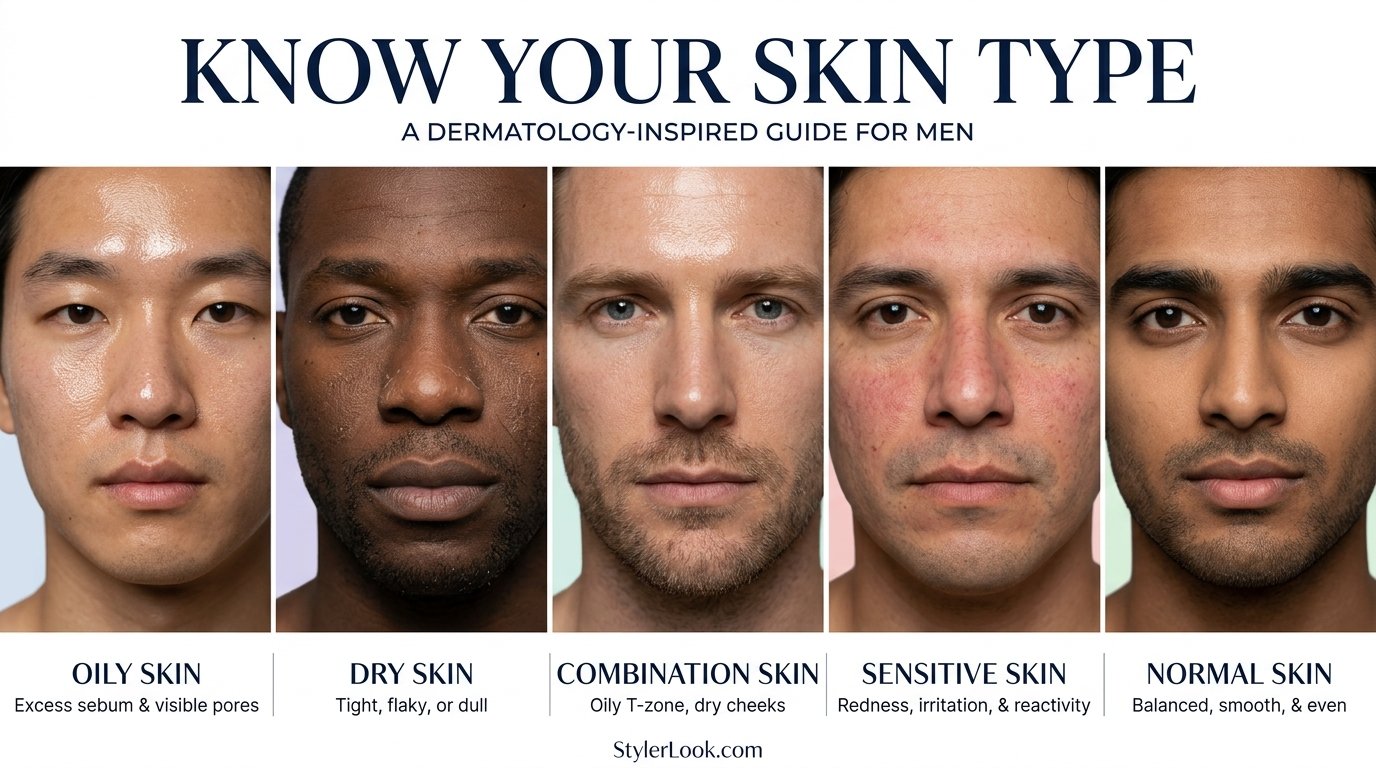
The night wash is the one to keep if you ever skip one. It removes sunscreen, sweat, pollution, and the day’s oil before bed.
Treatments live at night when you add them: a retinoid or an exfoliant, on their scheduled nights, never stacked carelessly.
Finish with moisturizer, a richer one than the morning’s if your skin runs dry. Sleep is when barrier repair does its shift.
Morning skincare routine and Nighttime skincare routine teach the two general routines in full; this page’s job is what changes because you are a man.
Track One: The Shaver’s Protocol
Shaving is controlled exfoliation with a blade. Done well, it smooths skin; done badly, it manufactures redness, bumps, and ingrowns.
The protocol is the AAD’s, and every credible guide in the research repeats it because it works.
1. Wash first, with warm water. A warm shower is ideal: softened hair cuts easier, and a clean face keeps bacteria out of nicks.
2. Use a moisturizing shave gel or cream. Dry shaving and soap foam are irritation recipes.
3. Shave in the direction hair grows. With the grain on the first pass; it is the single biggest bump prevention habit.
4. Rinse the blade after each swipe. Press lightly, use short strokes, and never stretch your skin taut.
5. Change the blade after five to seven shaves. A dull blade is the most common cause of burn and ingrowns alike.
6. Moisturize after, not an alcohol splash. The sting is not medicine; it is fragrance and alcohol on freshly scraped skin.
Forefront Dermatology’s routine for men sequences the same steps inside its clinic routine, including cleansing before the shave and a cool rinse after.
Razor Burn vs Razor Bumps: Two Different Problems
Razor burn is surface irritation: redness and stinging right after shaving, from a dull blade, pressure, or dry shaving. It settles in days.
Razor bumps are pseudofolliculitis barbae: hairs, usually coarse or curly, curve back into the skin and inflame. They arrive later and linger.
Burn needs technique and a day off. Bumps need a less close shave: with the grain, no taut skin, and a single or double blade.
If bumps are painful, spreading, or scarring, stop self treating. That is a dermatologist’s case, especially in deeper skin tones.
Electric Razors: The Variation
An electric razor changes the irritation profile, not the routine. There is no blade exfoliation, so scheduled exfoliation matters more, not less.
Shave on clean, dry skin before your shower for most foil and rotary models, or wet with gel for wet dry models, per the maker’s instructions.
Bump prone men often do better electric, because the hair is cut at the surface, not below it. The closeness trade is real and worth it.
Clean the device on its schedule. A clogged, dull electric head drags like a dull blade and earns the same redness.
Track Two: The Beard Wearer’s Protocol
A beard changes the map, not the mission. The skin under the hair is still skin, and it is where beard problems actually live.
Cleanse to the skin. Work your cleanser through the beard down to the surface, then rinse thoroughly; trapped product is a classic itch cause.
Moisturize the skin beneath. Get lotion past the hair with your fingertips; a conditioned beard over dry, flaky skin is a half finished job.
Then beard oil, on the hair. Grizzly Grooming’s men’s skin care playbook draws the line exactly right: oil conditions hair and the skin under it, but it does not replace face moisturizer.
Sunscreen before beard oil, so it reaches skin. Beard hair blocks some ultraviolet light, but not reliably, and edges take the full dose.
Flakes that are oily and yellowish, clustered in the beard, brows, and scalp, suggest seborrheic dermatitis, not simple dryness. That pattern has its own fixes.
Breakouts under a beard usually come from poor cleansing, over applied oil, or heavy butters on acne prone skin. Audit those before blaming the oil.
The Weekly Calendar: Where Exfoliation and Treatments Sit
Count the razor as one of your exfoliation events. A daily shaver’s cheeks are already exfoliated; a beard wearer’s forehead is not.
|
Day type |
Morning |
Night |
|---|---|---|
|
Shave day |
Cleanse, shave, moisturize, SPF |
Cleanse, moisturize |
|
Exfoliant night (2 to 3 per week, non shave heavy days) |
Cleanse, moisturize, SPF |
Cleanse, exfoliant, moisturize |
|
Retinoid night (2 to 3 per week, building up) |
Cleanse, moisturize, SPF |
Cleanse, retinoid on dry skin, moisturizer |
|
Rest day |
Cleanse, moisturize, SPF |
Cleanse, moisturize |
Never stack a close shave, a strong exfoliant, and a retinoid into the same twenty four hours while you are learning your limits.
Blade changes ride the calendar too: count shaves, and the fifth to seventh one retires the blade. Put a tally on the mirror if you must.
Skincare routine order guide covers the general layering rules behind this schedule, and Skincare routine hub holds the full routine architecture for every reader.
Skin Type Tweaks for Men
Averages say men’s skin runs thicker and oilier, and OrnaSkin’s dermatologist guide to men’s skincare grounds that in the Rahrovan 2018 review of male and female skin.
Averages do not diagnose you. Your own type, watched for a week, picks your textures.
Oily: gel cleanser, gel moisturizer, fluid sunscreen. Skincare routine for oily skin builds the full oily system, jawline breakouts included.
Dry or sensitive: cream textures, fragrance free labels, gentler pacing. Gentle skincare routine for dry sensitive skin is the worked build for that end of the shelf.
Combination: gel on the T-zone, cream on the cheeks. Normal: the base exactly as written, and gratitude.
Situation Tracks: Gym, Outdoors, Office, Travel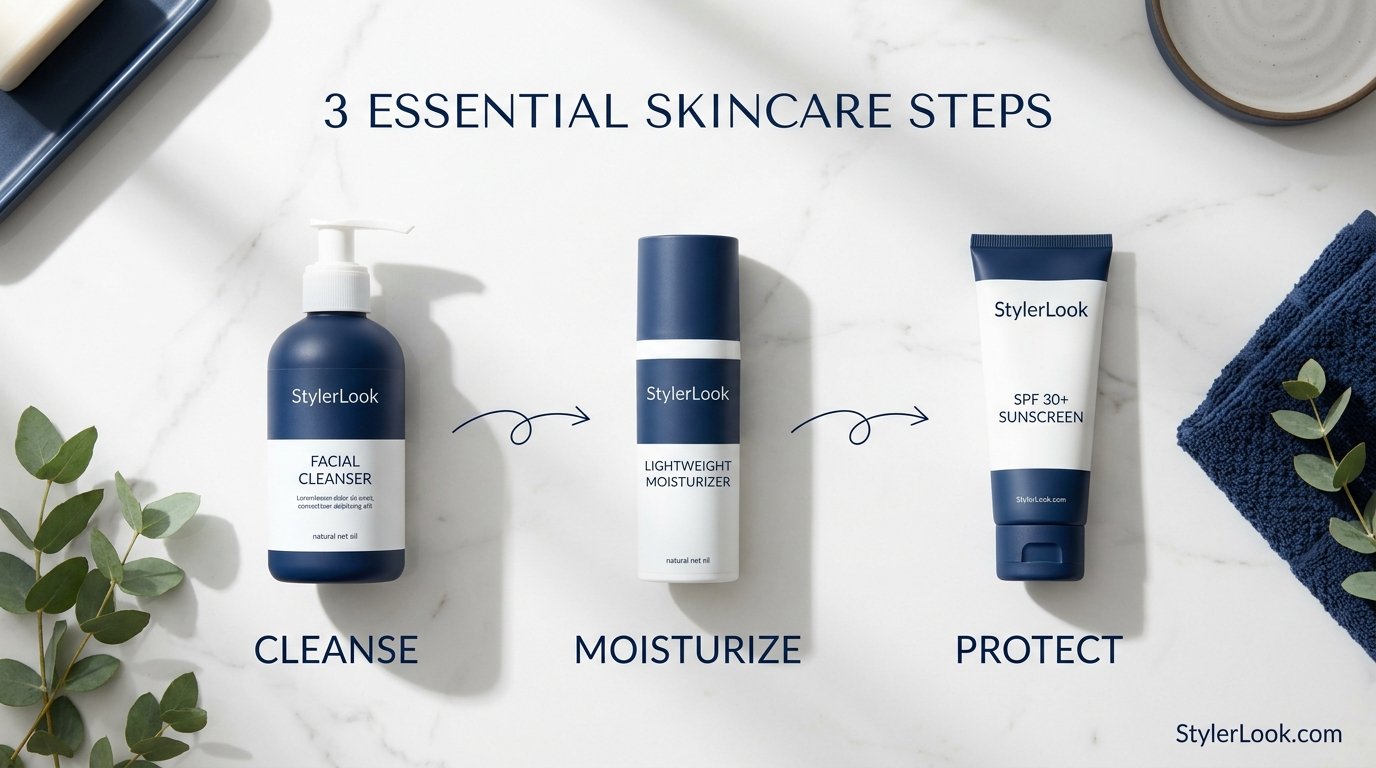
The gym track. Cleanse reasonably soon after training. Sweat, heat, and friction are a breakout recipe along the jaw, hairline, back, and chest.
Marinating in a wet shirt until evening is the mistake. A gentle wash or at least a rinse and a change of shirt beats any special product.
The outdoor track. Your sunscreen rules change from daily to operational: apply before you leave, reapply every two hours, sooner after heavy sweating.
A hat is the reliable scalp backup. Men who work outdoors should treat reapplication like a water break, scheduled, not remembered.
The office track. Dry air conditioning pulls moisture all day. A slightly richer morning moisturizer and a desk water habit fix most of it.
The travel track. The base three, decanted. Hotel soap is not a cleanser, and a skipped routine for a week shows up as a fortnight of repair.
Ages: Teens, Thirties, and After 40
Teens: the base three plus one acne active if needed. No anti aging actives, no daily scrubs, no ten step shelves.
Thirties: the base, plus a retinoid conversation if texture or early lines bother you. Sunscreen stops being optional advice and becomes the whole game.
After 40: richer moisturizer as skin dries, the retinoid as the standard night upgrade, and skin checks as maintenance.
New, changing, or non healing spots get professional eyes promptly. Men’s skin cancer outcomes worsen when lesions are found late.
The Sunscreen Coverage Map
Men’s sunscreen failure is geographic. The face gets covered; the ears, the back of the neck, and the scalp get forgotten, and they burn accordingly.
Run the map every morning: face, ears front and back, neck front and back, scalp wherever hair is thin or absent, and the skin at the beard’s edges.
Beard wearers apply before beard oil so the sunscreen reaches skin. Bald men treat the scalp as face, with a hat as backup outdoors.
Reapply on the same map. A map you run by habit beats a stronger sunscreen applied to half your head.
The Troubleshooting Matrix
|
Problem |
Likely cause |
First fix |
|---|---|---|
|
Redness right after shaving |
Dull blade, pressure, dry shave |
Fresh blade, warm prep, lighter hand, day off |
|
Bumps a day after shaving |
Hair re entering skin |
With the grain, single blade, less close |
|
Itch and flakes under beard |
Dry skin or seborrheic pattern |
Cleanse to skin, moisturize beneath, check the flake pattern |
|
Shiny forehead by noon |
Type plus skipped moisturizer |
Gel moisturizer daily, fluid SPF |
|
Breakouts along the jawline |
Ingrowns, friction, clogged pores |
Separate the cause; fix one at a time |
|
Tight, squeaky face after washing |
Stripping cleanser or bar soap |
Gentle facial cleanser, lukewarm water |
One cause, one fix, tested for a few weeks. The man who changes three products on Monday learns nothing by Friday.
The Mistakes Audit
Washing your face with bar soap. The tight feeling is a stripped barrier being misread as cleanliness.
Shaving against the grain for closeness. The closeness is real; so are the ingrowns it buys, especially on the neck.
Skipping moisturizer because you are oily. Dehydrated skin often produces more oil, and every treatment irritates faster.
Treating sunscreen as a beach product. The daily dose is the commute, the run, and the lunch walk.
Forgetting ears, neck, scalp, and under the beard. Coverage, not intent, is where men’s sun protection fails.
Accepting bumps as the price of shaving. Chronic bumps are a protocol problem with a protocol answer, up to the dermatologist line.
Buying the system before the habit. Three products used daily beat a starter empire abandoned by week two.
Men’s skincare routine basics guide covers the basics in explainer depth, and Best skincare routine for men guide handles product selection when you are ready to shop deliberately.
How to start a skincare routine guide gives the pacing calendar for your first month, and Korean skincare routine shows a lighter texture approach some men prefer for sunscreen.
For everything beyond skincare on the site, start at StylerLook.
Building the Habit: The Two Week On Ramp
Days one to seven: the base only. Cleanser in the shower, moisturizer and sunscreen beside the toothbrush, where the habits already live.
Do not add a single upgrade this week, however motivated you feel. Motivation is highest exactly when judgment is least informed.
Days eight to fourteen: add your track’s protocol deliberately. Shavers run the six shave steps as a checklist; beard wearers practice cleansing to the skin.
Notice two numbers: how your face feels at noon, and whether shaving got calmer. Those are your baseline readings for every later change.
Week three onward: the calendar switches on, one element at a time. Exfoliant nights first for most men; the retinoid conversation later, if a concern earns it.
The routine that survives is the one stored where the behavior happens. Products in a cabinet across the house are a routine that exists on paper only.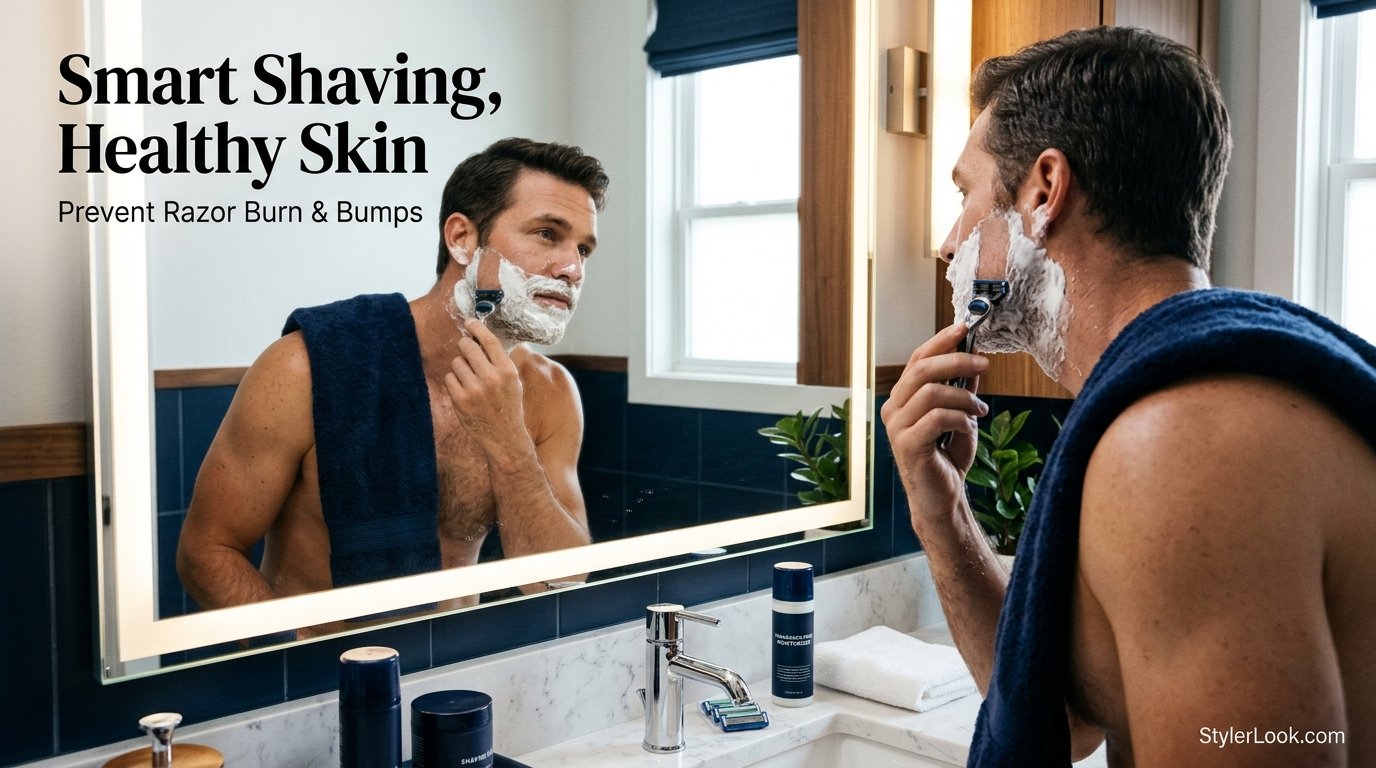
Frequently Asked Questions
What is a good skincare routine for men?
Three steps, done daily: wash with a gentle face cleanser (not bar soap), moisturize matched to your skin type, and apply broad spectrum SPF 30 or higher every morning. At night, wash and moisturize again.
That base, which the AAD’s men’s guidance supports, covers most men; treatments for specific concerns are upgrades added one at a time, and shaving is scheduled inside the routine rather than treated as a separate chore.
Do men really need a different skincare routine?
The steps are the same as anyone’s; the AAD itself says the basic elements of an effective plan remain the same, and type matters more than gendered marketing.
What is genuinely different on average is context: men’s skin tends to be thicker and oilier (Rahrovan et al. 2018 review), and most men add a daily controlled injury women do not: shaving.
A men’s routine is a standard routine with shaving engineered into it.
How many steps should a man’s routine have?
Three in the morning (cleanse, moisturize, sunscreen) and two at night (cleanse, moisturize), plus your shave on shave days. That is the whole base, and it takes about two to five minutes.
Add a fourth element only for a named concern (an exfoliant a few nights weekly, a retinoid at night), one at a time, and only after the base runs on autopilot for several weeks.
Should men wash their face twice a day?
For most men, yes: morning and before bed, with a gentle facial cleanser and lukewarm water. The morning wash clears overnight oil, which matters because male skin on average produces more sebum; the night wash removes the day’s sweat, sunscreen, and pollution.
Men with very dry or sensitive skin sometimes do better with a morning water rinse instead. Hot water and harsh soap are the enemies, not the frequency.
Can men just use bar soap on their face?
They can, and it is the most common mistake in the SERP’s own mistake lists. Bar and body soaps are formulated for tougher body skin and commonly leave facial skin tight, dry, and irritated, which men then misread as cleanliness.
A gentle facial cleanser costs little, lasts months, and is the single easiest upgrade in the whole routine. A tight, squeaky feeling after washing is a stripped barrier, not a job well done.
Do men with oily skin need moisturizer?
Yes. Skipping moisturizer does not reduce oil; it often worsens the cycle, because dehydrated skin can produce more sebum and every treatment you add will irritate faster on an unmoisturized barrier.
Choose a lightweight gel or lotion labeled oil free or non comedogenic. The AAD’s label guidance for acne prone and oily skin points to exactly those words.
Do men need sunscreen every day?
Yes, every morning, broad spectrum SPF 30 or higher, on every exposed surface: face, ears, neck, and any exposed scalp.
Ultraviolet exposure is cumulative and happens on commutes, runs, and lunch walks, not only at the beach; it drives most visible aging and raises skin cancer risk.
The men specific failure is coverage, not intent: ears, the back of the neck, the scalp, and the skin under a beard are the spots guides and dermatologists keep naming as forgotten.
How much sunscreen should a man use on his face?
About a teaspoon for the face alone in the quantification one SERP guide uses, and more when ears, neck, and scalp are exposed. Most people underapply sunscreen by half or more, which quietly turns an SPF 30 into a much weaker shield.
Apply it as the last morning step, give it a minute to set, and reapply every two hours during sustained outdoor time, sooner after heavy sweating or swimming if the label says water resistant.
Where does shaving fit in a skincare routine?
Inside it, sequenced: wash first with warm water and cleanser (softens hair, clears oil, keeps bacteria out of nicks), then shave with a moisturizing gel or cream, then rinse, then moisturize. Morning shavers run cleanse, shave, moisturize, sunscreen.
Night shavers cleanse, shave, and moisturize before bed. Treating the shave as a step with a before and after is what separates a routine from a routine plus damage.
How do I shave without irritation?
The AAD pattern, repeated by every credible guide in this research: wet skin and hair first (a warm shower is ideal), use a moisturizing shaving cream or gel, shave in the direction hair grows, rinse the blade after each swipe
Press lightly, and do not stretch the skin taut. Replace disposable or replaceable blades after five to seven shaves. Finish with moisturizer, not a stinging alcohol splash.
What causes razor bumps?
Razor bumps, medically pseudofolliculitis barbae, happen when a shaved hair, especially a coarse or curly one, curves back and grows into the skin, causing inflammation.
Shaving too closely, shaving against the grain, stretching skin taut, and multi blade razors that cut hair below the surface all raise the risk.
They are more common in men with curly hair and in deeper skin tones, where the inflammation also leaves dark marks.
How do I prevent razor bumps?
Shave less closely on purpose: with the grain, light pressure, no skin stretching, and consider a single or double blade razor, which the AAD suggests for bump prone skin.
Keep the blade fresh (five to seven shaves), soften hair thoroughly before shaving, and moisturize after. Gentle exfoliation on non shave days helps hairs exit cleanly. Persistent, painful, or spreading bumps are a dermatologist’s problem, because pseudofolliculitis can scar.
What is the difference between razor burn and razor bumps?
Razor burn is surface irritation: redness, stinging, and sensitivity right after shaving, usually from a dull blade, dry shaving, pressure, or harsh aftershave. It settles in a day or two with gentle care.
Razor bumps are individual inflamed papules around hairs that have re entered the skin, appearing a day or more later and lasting longer. Burn is a technique and product problem; bumps are a hair growth pattern problem, and they need different fixes.
How do I treat razor burn?
Cool, damp cloth on the area, then a plain, fragrance free moisturizer, and give the skin a day off from shaving if you can. Skip alcohol based aftershaves and fragranced products until it settles. Do not pick at ingrown hairs.
If redness turns painful, hot, swollen, or develops pus like spots, that suggests infection or folliculitis and deserves a clinician, not another product.
Should I exfoliate before or after shaving?
Exfoliation and shaving are both exfoliation: a razor removes a thin layer of skin by itself.
The workable pattern is to exfoliate on non shave days, or gently on a shave morning well before the razor if your skin tolerates it, two to three times weekly at most for most men
And never stack a strong chemical exfoliant and a close shave and a retinoid into the same twenty four hours while you are learning your limits.
How often should men exfoliate?
Clinic guides in this research commonly say two to three times per week, adjusted by skin type and reaction, and that range should be read as a ceiling for beginners, not a quota.
Sensitive and dry skin often lands at once weekly or less. Redness, flaking, or burning after exfoliating means the frequency or the product is wrong, as Forefront’s own guide notes; back off rather than pushing through.
What should men with beards do for their skin?
Care for the skin under the beard as skin: work cleanser through the hair down to the skin when you wash, rinse thoroughly (trapped cleanser is a common itch cause), and get moisturizer to the skin beneath
Not just oil on the hair. Apply sunscreen to exposed skin and through shorter beards where you can reach skin.
Itching, flakes, and bumps under a beard are skin signals, not beard failures, and they are covered in the beard sections of this page.
Does beard oil replace moisturizer?
No. Beard oil conditions hair and helps the skin directly beneath it, but it is not formulated as a facial moisturizer for your forehead, cheeks, and nose.
The playbook rule from the SERP’s beard specialist: use both, oil worked into the beard and down to the skin, lotion on the exposed face.
Breakouts under a beard usually trace to poor cleansing, over applied oil, or heavy butters on acne prone skin, not to beard oil itself.
How do I stop beard itch and flakes?
Start with cleansing to the skin and thorough rinsing, then moisturize the skin under the beard; new beards itch partly because sharp trimmed hair ends and dry skin irritate each other.
If flakes are oily, yellowish, and concentrated in the beard, brows, and scalp, that pattern suggests seborrheic dermatitis rather than simple dryness, and it responds to antifungal shampoos used as a beard wash a few times weekly.
Persistent cases belong to a dermatologist.
What is a good routine for men with oily skin?
The base three, tuned: a gel or foaming cleanser morning and night, a lightweight oil free moisturizer, and a fluid sunscreen that does not feel greasy, since feel decides whether you will wear it.
The first upgrade is usually salicylic acid a few nights weekly for clogged pores and jawline breakouts, or niacinamide for oil balance. Strip mining your face with harsh washes twice a day backfires; oil rebounds and irritation climbs.
What is a good routine for men with dry skin?
Cream based gentle cleansing (some men do a morning water rinse only), a richer cream moisturizer applied right after washing while skin is slightly damp, and a comfortable sunscreen.
Shaving needs extra softness here: shave after a warm shower, use a rich shaving cream, and moisturize immediately after. Exfoliation stays at the gentle, infrequent end. Tightness after washing means your cleanser is too strong, whatever the label promises.
What is a good routine for teenage boys?
Small and consistent: a gentle cleanser, a light moisturizer, and sunscreen in the morning, with one acne active (salicylic acid or benzoyl peroxide) if breakouts are the issue.
Teenage skin does not need anti aging actives, scrubs daily, or a shelf of products, and overbuilding early manufactures sensitivity. Painful, deep, or scarring acne is a dermatologist visit, where treatment outperforms anything sold over the counter.
When should men start using retinol?
When a concern justifies it, usually texture, breakouts that persist into adulthood, or visible photoaging, and for most men that conversation starts in the late twenties or thirties rather than the teens.
Start two or three nights weekly on dry skin, moisturizer after, and expect a six to eight week build. Keep it away from shave mornings while you adapt. This page is general information; prescriptions and persistent conditions belong to a dermatologist.
What changes in a man’s routine after 40?
The base stays; the emphases shift. Collagen decline and accumulated sun exposure make sunscreen the highest value step and a night retinoid the standard first upgrade.
Moisturizer often needs to go richer as skin dries with age, and skin checks become routine maintenance: new, changing, or non healing spots get professional eyes promptly, because men’s skin cancer outcomes worsen when lesions are found late.
Should men cleanse after the gym?
Yes, reasonably soon after training: sweat, heat, and friction are a breakout recipe, especially along the jaw, hairline, back, and chest. A gentle cleanse or at minimum a rinse and change out of wet gear beats marinating until evening.
Gym wipes are a compromise for the face in a pinch, not a system. Your normal night cleanse still happens; the post gym wash replaces waiting, not the routine.
Can men use the same products as women?
Yes. Ingredients do not check gender, and the AAD frames the basic elements as shared. Men’s branded products differ mainly in fragrance, packaging, texture preferences, and marketing; sometimes in useful ways (lighter sunscreen textures win adherence) and sometimes only in price.
Buy by skin type and label (oil free, non comedogenic, fragrance free where relevant), not by the color of the bottle.
Is men’s skin really thicker and oilier?
On average, yes: the Rahrovan et al. 2018 review of male versus female skin documents greater thickness, higher sebum output influenced by androgens, and different aging patterns, while stressing wide individual variation.
Averages explain why men skew oilier and why shaving dominates their routine design; they do not diagnose your skin. Your own type, observed honestly, outranks every population average when you choose textures.
What does non comedogenic mean on men’s products?
Formulated not to clog pores, based on ingredient screening; there is no strict regulatory test behind the claim, so treat it as a useful filter, not a guarantee.
The AAD’s label advice for acne prone skin is to look for oil free and non comedogenic on cleansers and moisturizers, and fragrance free for sensitive skin. Your skin’s reaction over two weeks outranks any label.
Why do I break out along my jawline?
The jawline collects shaving irritation, ingrown hairs, and clogged pores in one strip, and phone and helmet straps add friction.
Separate the causes: bumps timed a day after shaving point to technique and blade; persistent clogged pores point to cleansing and an exfoliant slot; inflamed spots under a beard edge point to trapped product and poor rinsing.
One cause, one fix, tested for a few weeks, beats a new product every Monday.
How long until a men’s routine shows results?
Comfort changes in days (less tightness, less shave irritation). Oil balance and breakouts shift over four to eight weeks. Texture, tone, and lines need the standard eight to twelve week judgment window, and sun protection pays out over years.
Men abandon routines at week two for the same reason anyone does: judging a slow process on a fast clock. Photograph monthly in the same light.
What are the biggest skincare mistakes men make?
The SERP’s own lists converge: washing the face with bar or body soap, shaving against the grain with a dull blade, skipping moisturizer because skin is oily, treating sunscreen as a beach product, and accepting razor bumps as inevitable.
Add two from the guides: exfoliating like it is a sport, and buying a ten product system before the three step base is a habit. Every one of these is a habit fix, not a purchase.
Do men need toner or aftershave?
Neither is required. The classic alcohol splash aftershave mostly delivers sting and fragrance; a moisturizer does the useful part of the job better. Toner is optional and earns a place only as a hydrating layer for dry skin.
If a product burns, smells like a nightclub, and has no job description you can state in one sentence, your routine is better without it.
How do I protect a bald scalp?
Treat the scalp as face: it is fully exposed skin. Sunscreen on the scalp every morning (sprays and sticks help through short hair; lotions suit a shaved head), reapplied outdoors, plus a hat as the reliable backup.
Scalps burn fast, peel visibly, and are a spot men forget during skin checks; new or changing scalp lesions deserve the same prompt professional look as facial ones.
Should men wear sunscreen under a beard?
Where skin is reachable, yes: beard hair blocks some ultraviolet light but not reliably or evenly, and the skin at the beard’s edges, cheeks, nose, ears, and neck takes full exposure.
Apply sunscreen before beard oil so it reaches skin, and choose a light lotion texture that spreads through hair without pilling, as the SERP’s beard playbook advises.
Can skincare help razor bumps on the neck?
The neck is the classic bump zone because hair there grows in swirls and lies flat, so mapping your neck’s growth directions and shaving with them, lightly, is the highest value fix.
Combine it with a fresh blade, thorough softening, and not chasing a baby smooth result on the neck. Gentle exfoliation between shave days helps. Bumps that scar or darken need a dermatologist, because the pigmentation risk is real.
What products does a man actually need to buy first?
Three: a gentle facial cleanser, a moisturizer matched to his type, and a broad spectrum SPF 30 or higher sunscreen he finds comfortable. Add shaving supplies he likely owns already (fresh blades, a moisturizing shave gel).
Everything else, exfoliant, serum, beard oil, waits until the base is a habit and a specific concern names itself. A starter kit is fine if its contents match that list; most kits pad it.
Is an expensive men’s skincare brand worth it?
For the base three, drugstore products perform the job; price in basic categories tracks fragrance, packaging, and branding more than outcomes.
Pay more only where it buys adherence, a sunscreen texture you will wear daily is worth more than a superior formula you skip. Judge any product at eight to twelve weeks by your skin, not by its launch story.
How do I build a routine if I hate skincare?
Design for the man you are: three steps, products kept where the behavior happens (cleanser in the shower, moisturizer and SPF by the toothbrush), and a combined moisturizer plus SPF to cut the morning to two moves.
Attach the routine to shaving and teeth, habits that already exist. A routine done daily at eighty percent beats a perfect one abandoned by Friday.
Should men do a night routine?
Yes, and it is the easiest one: wash the day off, moisturize. Night is also where treatments live if you add them (retinoids, exfoliants on their scheduled nights), because they do not compete with sunscreen or the morning rush.
Skipping the night wash means sleeping in sunscreen, sweat, and pollution, and it is the step men who wash only once should keep if forced to choose.
Can shaving replace exfoliation?
Partly, and that cuts both ways. A razor physically exfoliates the shaved zone, which is why daily shavers often need less additional exfoliation on the cheeks and jaw, and why stacking a strong scrub or acid on a fresh shave irritates.
The forehead, nose, and (for beard wearers) the unshaven zones still benefit from a scheduled exfoliant. Count the razor as one of your exfoliation events when you plan the week.
What should a man do about dark spots from razor bumps?
Stop making new ones first: the bump protocol above, because every new inflamed bump in deeper skin tones can leave a fresh mark.
Existing marks fade slowly with daily sunscreen (non negotiable; ultraviolet light re darkens them) and gentle tone ingredients such as niacinamide or azelaic acid. Picking and aggressive scrubbing deepen them. Widespread or stubborn pigmentation is a dermatologist’s territory, where prescription options exist.
Is this medical advice?
No. This article is general information based on public guidance such as the AAD’s men’s skin care pages. It does not diagnose or treat any condition.
Persistent acne, spreading bumps, changing moles, and other medical concerns need your own clinician, and no routine on a webpage substitutes for one.
Conclusion
A skincare routine for men is not a smaller version of someone else’s routine.
It is the same three steps, rebuilt around the razor: shave sequenced inside the morning, tracks for shavers and beard wearers, and a calendar that keeps exfoliation, treatments, and blade changes from colliding.
Start with the base for two honest weeks. Add your track’s protocol, then the calendar, then one upgrade at a time. When your skincare routine for men runs on autopilot, it is finally working.
That is the whole system: small, scheduled, and built to survive real mornings.
