

How to build a skincare routine from scratch begins with a surprise: you probably are not starting from zero.
Most beginners own something their skin already tolerates. The build starts by keeping that, not replacing it.
Then come three basics: a gentle cleanser, a moisturizer for your skin type, and sunscreen.
Run those for a few weeks. Add one product at a time after that, for one concern.
That schedule, not any product, is what separates routines that work from drawers of abandoned bottles.
The framework follows American Academy of Dermatology skin care basics, with leading beginner guides woven through.
One boundary up front: this is general information, not medical advice. Skin conditions belong to a dermatologist.
Stylerlook organizes its routine library the same way, basics first, which keeps this page easy to extend later.
Step Zero: Audit the Shelf You Already Have
Before buying anything, line up everything you currently put on your face. Answer honestly per product.
Does your skin tolerate it? No stinging, no rash, no breakouts you can trace to it.
Tolerated products are data. They are the known quantities every experiment needs as a control.
Skin Optimizer beginner guide makes this the first move: keep what works, and fill the missing basic first.
The Audit Outcomes
- Tolerated cleanser or moisturizer: keep it, it becomes part of the build
- Products that sting or break you out: retire them today, they are not basics
- Products you never use: ignore them, an unused product is not a routine step
- Nothing at all: a true zero start, which the next steps handle directly
Only after the audit do you know what you actually need to buy. Usually it is one or two basics.
Know Your Skin Type Before You Spend
Skin type decides textures, and textures decide whether the basics feel right or wrong.
Buying before typing is how beginners end up with a rich cream on oily skin, then quit.
The Wash and Wait Test
- Cleanse gently with lukewarm water and a mild cleanser
- Pat dry and apply absolutely nothing
- Wait about an hour and observe in good light
- Read the result from the table below
|
What You See After an Hour |
Likely Type |
|---|---|
|
Tight, flaky, no shine |
Dry |
|
Shine all over |
Oily |
|
Shine in the T zone only |
Combination |
|
Comfortable, no shine, no tightness |
Normal |
|
Stinging, redness, reactivity |
Sensitive (a trait any type can carry) |
Self typing is approximate. When the result is unclear, build for sensitive and adjust later.
The Three Basics: Your Whole Routine for the First Weeks
A complete routine is three products. Dermatology guidance and every serious beginner guide agree.
The Obviously Skincare three step starter guide puts it at two minutes, morning and night, which is why it survives real life.
Basic One: Gentle Cleanser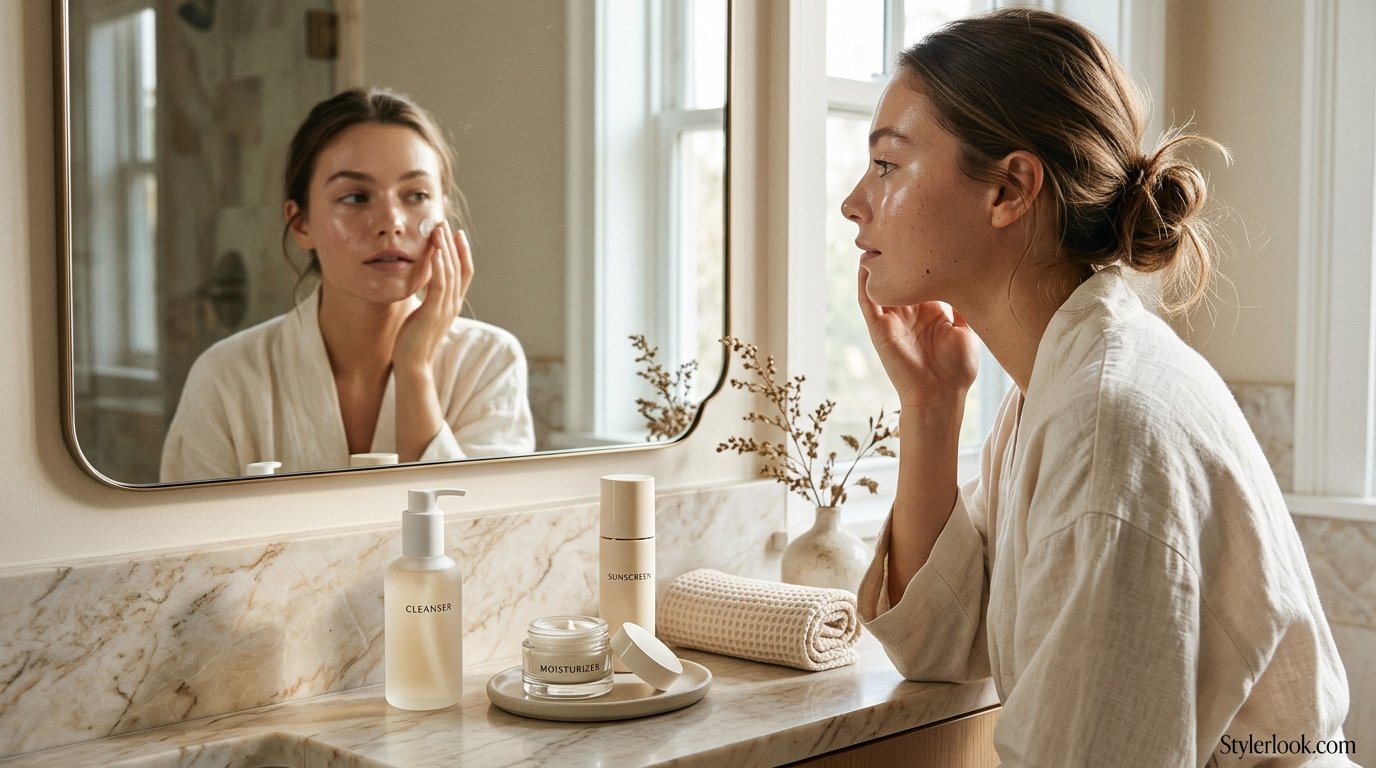
Its job is removal: the day, the sunscreen, the sweat, lifted without stripping the barrier.
Choose mild and fragrance free. Cream cleansers suit dry and sensitive starters, gentle gels suit oily skin.
The test is the tightness check: skin that feels tight or squeaky after washing was over cleansed.
Wash twice daily and after heavy sweating, with lukewarm water and fingertips, per AAD guidance.
Basic Two: Moisturizer Matched to Type
Moisturizer traps water and supports the barrier. Apply it after cleansing, while skin is slightly damp.
|
Skin Type |
Texture That Fits |
|---|---|
|
Oily |
Gel or light lotion |
|
Normal or combination |
Lotion, light cream on dry zones |
|
Dry |
Cream, richer at night |
|
Sensitive |
Fragrance free cream |
Every type needs this step, including oily skin. Skipping moisturizer often drives more oil, not less.
Basic Three: Sunscreen Every Morning
Broad spectrum SPF 30 or higher, water resistant where your day demands it, applied last.
Dermatologists treat sun protection as the highest impact step in any routine, beginner or advanced.
Use enough to matter: roughly two finger lengths for the face is the common teaching measure.
Reapply about every two hours outdoors, and after swimming or sweating, as the American Academy of Dermatology skin care basics directs.
What Morning and Night Look Like
The two routines are nearly twins. Sunscreen is the only morning exclusive at the basics stage.
Morning: rinse or gentle cleanse, moisturizer, sunscreen last.
Night: gentle cleanse to remove the day, moisturizer, done.
The Morning skincare routine guide and the Nighttime skincare routine guide detail each half when you want them separately.
The How to start a skincare routine guide covers the same ground from the starting angle. This page owns the build schedule.
The Build Calendar: Weeks 1 to 6 and Beyond
Here is the part most guides skip: when things happen, week by week.
|
Phase |
What You Do |
What You Judge |
|---|---|---|
|
Weeks 1 to 2 |
Three basics only, twice daily |
Comfort, tightness, any stinging |
|
Weeks 3 to 4 |
Same basics, no changes |
Tolerance, hydration, routine habit formed |
|
Week 5 onward |
First upgrade, patch tested, for one concern |
That concern only |
|
Every addition after |
One product, one window |
Reaction traceable to one cause |
The Judging Windows, Printed Honestly
Guides disagree on the exact weeks, and this page prints the strands instead of hiding them.
One leading guide says run the basics 2 to 4 weeks before adding anything at all.
An esthetician framework says judge results over 4 to 6 weeks, because skin renews on its own schedule.
Addition spacing strands run from 1 to 2 weeks per product to 2 to 4 weeks between additions.
The principle underneath never changes: weeks, not days, and one variable at a time.
Layering Order: Thinnest to Thickest, SPF Last
When upgrades arrive, order decides whether they reach the skin or sit on top of each other.
- Cleanser
- Toner or essence (optional, water based)
- Serum or treatment (optional, targeted)
- Eye cream (optional)
- Moisturizer
- Sunscreen (morning only, always last)
The Skincare routine order guide walks the full order with product category detail when your routine grows.
Water based layers go under creams. An oil or heavy cream applied early blocks everything after it.
Patch Testing the AAD Way
New products are guests until proven. The patch test is how a guest earns trust.
The protocol carried across the best sources, including Bloom Her Life beginner routine, comes from the AAD.
The Protocol
- Choose a small test spot, about the size of a quarter
- Use the underside of the arm or the bend of the elbow
- Apply the product twice daily
- Continue for 7 to 10 days before broader use
- Watch for redness, itching, burning, or bumps
No reaction is reassurance, not a guarantee. A home test is not medical allergy testing.
The Shortcut, Demoted
Some guides suggest 24 to 48 hours behind the ear as a patch test. It catches immediate reactions only.
That shortcut conflicts with the AAD protocol, so this page does not recommend it for a new build.
For actives like retinol or vitamin C, the full 7 to 10 days matters most of all.
Adding Upgrades: One Concern, One Product, One Window
After the judging window, name one concern. Not three. The upgrade exists to serve it.
|
Your One Concern |
The First Addition Most Guides Suggest |
|---|---|
|
Dryness and tightness |
A hydrating serum or essence layer |
|
Oiliness and breakouts |
A gentle BHA product, low frequency |
|
Dullness and uneven tone |
A morning vitamin C serum |
|
Texture and flakes |
A gentle chemical exfoliant, weekly |
|
Fine lines (later) |
A retinoid, started slowly at night |
Each addition is patch tested first, slotted into the layering order, and judged over its window.
If two concerns compete, treat the one that bothers you daily first. The other keeps its place in line.
What Not to Buy Yet
Beginner budgets die on premature upgrades. These purchases wait until the basics are judged.
- Retinoids: powerful, irritating when rushed, and pointless before sunscreen is habitual
- Strong acid peels: exfoliation arrives gently and weekly, not as a starter peel
- Eye cream: your moisturizer covers the beginner phase for most people
- Toner for its own sake: it needs a job, usually hydration, before it earns a slot
- A full matching set: matching packaging is not a routine strategy
The Best skincare routine guide compares complete routine philosophies when you are ready to choose a direction.
Kits and Bundles: Buy the Box, Unbox on the Schedule
Starter kits are genuinely convenient: matched basics, one purchase, often a fair price.
They carry one structural tension: the box hands you everything on day one.
The build method says stagger introductions so reactions stay traceable to a single product.
The resolution is simple: buy the bundle if it suits your budget, then unbox it on the calendar.
Basics in week one. The serum in week five. The exfoliant when its turn comes.
Budgeting the Build
The basics are old, unpatented, and inexpensive. Pharmacy brands carry all three well.
Spend in impact order: moisturizer and sunscreen first, cleanser third, upgrades last and singly.
A realistic starter shelf costs less than one prestige serum, and outperforms it for a beginner.
Money returns later as texture and pleasure upgrades, once the physiology is already working.
One more budgeting truth deserves its own line: samples and travel sizes are research tools. A week of a moisturizer in a small tube tells you more than an hour of reviews.
Buy the full size only after the sample survives your patch test and your mornings. That habit alone halves most beginners’ wasted spend across the first year of a routine.
Troubleshooting a New Routine
Breakouts After Starting
First suspect is the newest product. Subtract it before adding anything anti breakout.
Learn the purging distinction: a temporary flare in your usual breakout zones as actives speed turnover.
A true breakout shows in new areas, often with irritation. When in doubt, return to the basics.
Stinging and Burning
Stinging on basics usually means an irritated barrier: over cleansing, hot water, or fragrance.
Simplify to the gentlest three, lukewarm water, fragrance free, and give it a few weeks.
Burning, swelling, or blistering is different: stop the product and consider professional advice promptly.
Nothing Is Changing
Comfort should shift in days. Visible change runs on the renewal cycle, measured in weeks.
Photograph monthly in the same light. Daily mirror checks measure mood, not skin.
If four to six honest weeks change nothing, the issue may be a condition, not a routine.
The Routine Feels Like a Chore
Shrink it before you abandon it. The two minute version is a complete routine, not a failure.
A dermatologist line quoted via the AAD says it plainly: more is not more, consistency wins.
The Gentle skincare routine for dry sensitive skin guide shows the calmest possible version for skin that protests everything.
Who This Build Serves Best
Total beginners with an empty or chaotic shelf get the full calendar exactly as written.
Restarters who abandoned a ten step routine keep the audit and the calendar, skipping nothing.
Teenagers run the three basics only, with strong actives firmly postponed, as the Skincare routine hub also advises.
Men run the minimal build in the Mens skincare routine guide, with shaving counted as exfoliation days.
Late starters at 40 or 50 run the identical build. Only the concern list changes at upgrade time.
Partners and parents building for someone else follow the same card. Buy the basics, not the upgrades, and gift the calendar with them.
Gifted routines fail when they arrive as ten bottles and no schedule. Three basics plus this page’s calendar is the gift that gets used.
Layering Traditions, Borrowed Later
The Korean skincare routine guide popularized many thin layers, and its logic is sound once a base exists.
Borrow its layers as upgrades on the calendar, never as a day one shopping list.
Ten new products at once make reactions untraceable and adherence unlikely. That is the whole objection.
Mistakes That Wreck New Routines
- Buying everything at once and starting it all the same evening
- Starting retinol in week one and calling the irritation purging
- Judging products in days, then churning the whole shelf monthly
- Skipping sunscreen or using a pea sized amount of it
- Copying a routine built for a different skin type
- Treating stinging as proof a product is potent and working
Key Takeaways
- Step zero is the audit: keep tolerated products, buy only the missing basic
- Skin type first: the wash and wait test decides textures before money moves
- Three basics are complete: cleanser, moisturizer, SPF 30 or higher
- The calendar is the method: basics judged over weeks, additions one at a time
- Patch test the AAD way: small spot, twice daily, 7 to 10 days
- SPF is the highest impact habit and the last morning step, always
- Troubleshoot by subtraction: remove the newest suspect before adding anything
- Consistency beats complexity: two minutes twice a day outperforms ten steps sometimes
Choosing Each Basic, Category by Category
Cleanser Formats
Cream and milk cleansers rinse clean without foam drama and suit dry, normal, and sensitive starters.
Gel cleansers suit oily and combination skin, provided the finish is comfortable, never squeaky.
Foaming cleansers are not banned, but their tightness risk makes them a poor default for beginners.
Micellar water works for makeup removal and travel, though most skin prefers it rinsed afterward.
Moisturizer Ingredients Worth Recognizing
Glycerin and hyaluronic acid pull water into the surface. They are the hydration workers.
Ceramides support the barrier mortar, valuable for dry and sensitive builds especially.
Petrolatum and dimethicone seal. A night cream containing them forgives many beginner errors.
Fragrance is the ingredient to skip while learning, because reactions muddy your data.
Sunscreen Types
Mineral sunscreens (zinc oxide, titanium dioxide) sit on the skin and can leave a cast.
Chemical sunscreens absorb and feel lighter, which helps beginners actually apply enough.
Hybrid formulas split the difference and dominate beginner friendly shelves now.
The best type is the one you will apply in full amount daily. Finish beats formula here.
Routine Cards for Four Skin Types
The Dry Build
Cream cleanser at night, water rinse mornings, cream moisturizer twice daily, SPF over it.
First upgrade when judged: a hydrating serum under the cream, sealed well.
The Oily Build
Gentle gel cleanser twice daily, light lotion or gel moisturizer, matte friendly SPF.
First upgrade when judged: a gentle BHA a few nights a week for congestion.
The Combination Build
Gentle cleanser, lotion overall with cream on dry zones, SPF across everything.
First upgrade when judged: target by zone, BHA on the T zone only, hydration on cheeks.
The Sensitive Build
Fragrance free everything, the longest judging windows, full patch tests for every addition.
First upgrade when judged: none for a while. A calm quarter beats an ambitious month.
The First Month: What It Actually Feels Like
Days 1 to 3: the routine feels almost too simple. That simplicity is the design, not a gap.
Week 1: tightness patterns reveal your cleanser verdict. Comfort is the first real metric.
Week 2: the habit forms or frays here. Move products beside the sink if mornings keep skipping.
Week 3: sunscreen amount usually improves, and with it, the first visible calm in tone.
Week 4: judge against your day one photograph, same light, same angle, no filter.
Boredom at week four is success wearing a disguise. Boring skin is the platform upgrades need.
If week four instead brings new irritation, do not push through to keep the calendar pretty. Pause, subtract to the tolerated set, and restart the count when the skin is calm again. The calendar serves the skin, never the reverse.
Worked Examples: Three Beginners
The Empty Shelf Student
Owns nothing, budget small. Buys pharmacy cleanser, moisturizer, and SPF in one trip.
Runs the calendar, adds a hydrating essence in week five because winter tightness is the named concern.
Total first month spend: three basics. Total products reacted to badly: zero, because nothing raced.
The Drawer Full Restarter
Owns eleven products, skin unpredictable. The audit keeps two tolerated items, retires three suspects.
Basics rebuilt around the kept pair. By week six, reactions finally have single authors again.
The restarter’s lesson travels well: your data was never bad, it was unseparated.
The Ambitious Upgrader
Basics solid for a year, wants visible change. Names one concern: dark spots from old breakouts.
Adds vitamin C in the morning window first, judges six weeks, then considers a night retinoid.
Ambition survives because it was scheduled, not because the products were stronger.
Storage, Expiry, and Hygiene Basics
Check the period after opening symbol (a small jar with 6M or 12M) on every product.
Expired sunscreen is not sunscreen. Replace it on schedule, not when the tube empties.
Keep products out of steamy bathroom heat where possible, and close lids promptly.
Wash hands before applying, and never share eye area products or lip products.
Pumps beat open jars for hygiene; if you use a jar, a clean spatula beats fingers.
When Building Stops and Diagnosis Starts
A routine is cosmetic care. Some presentations are medical from the first day.
Persistent or scarring acne, spreading rash, eczema patches, and suspicious changing spots qualify.
So does any reaction with swelling or blistering, at any point in the build.
The dermatologist visit is not the routine failing. It is the routine knowing its border.
Reading a Label in Sixty Seconds
Labels look technical, but a beginner needs only four passes over the box.
Pass one: the job. Does the front say cleanser, moisturizer, or sunscreen, plainly and singly?
Pass two: the fit. Does it name your skin type or the texture you chose in the type table?
Pass three: the flags. Fragrance free if sensitive, noncomedogenic as a soft filter if breakout prone.
Pass four: the SPF check. Broad spectrum and 30 or higher, or it is not your morning finisher.
Ingredient lists reward study later. At the start, job, fit, flags, and SPF prevent most bad buys.
Adapting the Build to Real Life
Climate and Season
Dry winters push the build toward richer moisturizer and gentler cleansing, sometimes a morning rinse only.
Humid summers push toward lighter textures and stricter sunscreen reapplication discipline.
Change one seasonal variable at a time, judged like any other addition.
Hard Water and Travel
Hard water makes cleansers work harder and skin feel tighter, so less cleanser, more moisturizer compensates.
Travel shrinks the build to the three basics in small tubes, and the calendar simply pauses.
Hotel air and cabin air are dry air: the night cream earns its luggage space first.
Workouts and Sweat
Cleanse gently after heavy sweating, as AAD washing guidance directs, then re moisturize.
Outdoor training means sunscreen reapplication is part of the workout kit, not an afterthought.
Shift Work and Broken Sleep
Your morning is whenever you wake. Anchor the routine to waking and sleeping, not to clock time.
Sunscreen follows daylight exposure, whenever yours happens. The calendar does not care about your rota.
The Build, On One Card
Step zero: audit the shelf, keep what your skin tolerates, retire what it protests.
Step one: wash and wait, name your skin type, choose textures from the table.
Step two: three basics, twice daily, judged over weeks 2 to 6 by strand and by skin.
Step three: patch test every newcomer, 7 to 10 days, small spot, twice daily.
Step four: one concern, one product, one window, in the thinnest to thickest order.
Always: sunscreen last in the morning, subtraction before addition when trouble starts.
Pin that card mentally at the shelf. Most beginner money is lost off the card, not off the skin.
Frequently Asked Questions
1. How do I build a skincare routine from scratch?
Audit what you own and tolerate, identify your skin type, then run three basics (gentle cleanser, moisturizer, SPF 30+) for the first weeks.
Add one patch tested product at a time for one concern, judging each stage over weeks.
2. What are the three basics of a skincare routine?
A gentle cleanser, a moisturizer matched to your skin type, and broad spectrum SPF 30 or higher in the morning.
Dermatology guidance recommends the same foundation, and everything else is an upgrade added later for a named concern.
3. How do I know my skin type?
Use the wash and wait method: cleanse gently, apply nothing, observe after an hour.
Tight and flaky means dry, shine everywhere means oily, T zone shine means combination, and easy reactivity suggests sensitivity.
Self typing is approximate.
4. How many products do I need to start?
Three.
Cleanser, moisturizer, and sunscreen form a complete routine, and consistency with three beats a ten step routine done occasionally.
Serums and treatments arrive later, one concern at a time.
5. What order do skincare products go in?
Thinnest to thickest: cleanser, water based layers like toner and serum, then moisturizer, with sunscreen always last in the morning.
At night the same order simply ends at moisturizer or an optional oil.
6. How long should I use the basics before adding products?
The guides disagree, printed here as strands: one says 2 to 4 weeks on the basics before adding, an esthetician framework says 4 to 6 weeks because skin renews on its own schedule.
The unit is always weeks.
7. How often should I add a new product?
One at a time, with a judging window between additions.
Strands range from 1 to 2 weeks per addition to 2 to 4 weeks between additions for actives.
One variable at a time keeps reactions traceable.
8. How do I patch test a new product?
Follow the dermatology protocol: a small quarter sized spot, such as the underside of the arm or the elbow bend, product applied twice daily for 7 to 10 days before broader use.
No reaction reassures but never guarantees.
9. Is the 24 to 48 hour patch test enough?
It is a shortcut found in some guides, and it conflicts with the 7 to 10 day protocol above.
The short test catches immediate reactions only.
For a new build, especially actives, the full protocol is the safer standard.
10. Do I need a toner as a beginner?
No.
Modern hydrating toners can add a water layer for dry skin later, but no beginner basic depends on one, and astringent toners are unhelpful for most starters.
Add one only when it has a clear job.
11. Do I need an eye cream to start?
No.
Eye cream is among the most postponable products in skincare.
Your moisturizer, applied gently around the eyes, covers the beginner phase for most people.
Buy the dedicated product later for a specific concern.
12. When should a beginner add a serum?
After the basics have run their judging window and feel automatic, and only for one named concern like hydration or dullness.
A serum without a concern is decoration.
Patch test it and slot it before moisturizer.
13. When should I start exfoliating?
After the basics, gently and at low frequency.
One guide calls exfoliation the sensible first addition from week two if skin is comfortable.
Chemical options beat scrubs for beginners: AHA for dry types, BHA for oily.
14. Can a beginner use retinol?
Eventually, not first.
Retinol joins a stable routine: basics judged, barrier calm, sunscreen habitual.
Then start low and slow at night, patch tested and buffered.
Week one retinol is how beginners manufacture irritation and quit.
15. Can a beginner use vitamin C?
Yes, as a later morning addition once the basics are stable, for brightness under sunscreen.
It is an upgrade, not a basic, and sensitive starters should patch test and begin with gentler forms.
16. What if my new routine breaks me out?
Suspect the newest product first and subtract it rather than adding an anti breakout product.
Purging flares in your usual zones as turnover speeds up.
New areas plus irritation suggest a true breakout and a return to basics.
17. Why does my skin sting when I start a routine?
Usually an irritated barrier: over cleansing, hot water, or a fragranced formula.
Simplify to gentle fragrance free basics with lukewarm water and let it settle for a few weeks.
Burning or swelling means stop and seek advice.
18. Should I throw away products I already own?
No.
Keep anything your skin already tolerates, especially a cleanser or moisturizer, and buy only the missing basic.
Replacing tolerated products resets your skin data to zero and wastes your one advantage.
19. What if I can only afford two or three products?
Buy in impact order: moisturizer and sunscreen change skin most, with a gentle cleanser third.
Many people already own a tolerable cleanser.
Pharmacy brands carry all three cheaply because the ingredients are old and unpatented.
20. Is a starter kit or bundle a good idea?
It can be, for price and simplicity, with one caution: the box hands you everything on day one while the build method staggers introductions.
Buy the bundle if it suits you, then unbox it on the schedule.
21. What is the difference between a morning and night routine?
Morning protects: cleanse or rinse, moisturizer, sunscreen last.
Night repairs: a fuller cleanse, moisturizer, and any treatment you have earned.
At the basics stage they are nearly identical apart from sunscreen.
22. How should I wash my face as a beginner?
Lukewarm water, a gentle cleanser, fingertips instead of scrubbing tools, twice daily and after heavy sweating, no more.
Hot water and harsh scrubbing damage the barrier you are building.
Pat dry, moisturize while slightly damp.
23. Do I need to double cleanse?
Only if makeup or stubborn sunscreen survives your cleanser.
Dermatologist guidance notes many cleansers do not fully remove makeup, which is when a separate removal step earns its place.
Bare faced days need one gentle cleanse.
24. How much sunscreen should I use?
About two finger lengths for the face is the common teaching measure, applied as the last morning step.
Reapply roughly every two hours outdoors and after swimming or sweating.
Under applying is the most common protection error.
25. What does noncomedogenic mean, and should I care?
It means formulated to be less likely to clog pores, a useful filter for breakout prone beginners.
It is not a guarantee and the testing behind it is imperfect.
Your patch test and judging window deliver the real verdict.
26. How do I choose a moisturizer for my skin type?
Match texture to type: gel or light lotion for oily skin, lotion or cream for normal and combination, cream for dry, fragrance free cream for sensitive.
Between textures, richer at night and lighter in the morning works well.
27. How do I choose a cleanser as a beginner?
Gentle is the whole brief: mild, fragrance free, leaving skin comfortable rather than squeaky.
Cream cleansers suit dry and sensitive starters, gentle gels suit oily skin.
Tightness after washing means the cleanser failed its test.
28. Can men build this routine?
Yes.
The minimal male build is the same three basics with shaving folded in, and shaving days count as exfoliation days.
The framework is physiology, not gender marketing, and the two minute version suits most starters.
29. Can teenagers start a skincare routine?
Yes, and simpler than adults: gentle cleanser, moisturizer, sunscreen, full stop for most teens.
Strong actives and acid stacks are not starter products for young skin.
Persistent or scarring acne is a dermatologist conversation.
30. Can I start a routine at 40 or 50?
Absolutely.
The build is identical: audit, type, three basics, judged windows, one upgrade at a time.
Only the concern list changes, with hydration and sun damage taking priority among the later additions.
31. Is the 10 step Korean routine a good starting point?
As an aspiration, not a starting point.
Its layering logic is sound, but ten simultaneous new products make reactions untraceable and adherence unlikely.
Build the basics first, then borrow its layers one at a time.
32. What is skin cycling and should beginners use it?
Skin cycling rotates actives across nights with scheduled recovery.
It is an intermediate framework for routines that already contain actives.
Beginners have nothing to cycle yet, so graduate to it later if at all.
33. How do I stay consistent with a new routine?
Shrink the friction: products visible by the sink, the two minute version on hard days, weekly photos instead of daily mirror judgments.
As one dermatologist puts it, more is not more, and consistency beats a ten step routine.
34. How long until I see results from a new routine?
Comfort changes in days, while visible change runs on the skin renewal cycle, which is why judging windows sit at 2 to 4 weeks and 4 to 6 weeks across the guides.
Photograph monthly in the same light.
35. What are the most common beginner mistakes?
Buying everything at once, starting actives in week one, judging products in days, skipping or under applying sunscreen, copying a routine for a different skin type, and treating stinging as proof of potency.
36. Can I build a routine if my skin is sensitive?
Yes, with the cautious variant: fragrance free basics, the longest judging windows, the full patch test for every addition, and exfoliation and retinoids postponed the longest.
Your fast feedback makes the one at a time rule pay off most.
37. What should I do if a product irritates my skin?
Stop the newest suspect first, return to tolerated basics, and let the skin settle.
Do not add a soothing product on top of an undiagnosed reaction.
Severe or returning symptoms mean professional care, not more shopping.
38. Should I see an esthetician or a dermatologist for help?
An esthetician helps with cosmetic routine building and technique.
A dermatologist diagnoses and treats conditions like persistent acne, eczema, rosacea, and suspicious spots.
Routine questions fit either, medical questions belong to the dermatologist.
39. Are skincare routine builder apps and AI skin analysis reliable?
Treat them as organizers, not authorities.
They can hold your schedule and product list, but their skin typing and product matching are approximate and commercially influenced.
Your own judged windows produce better data than a selfie scan.
40. How does the routine change by season?
Structure stays, textures move.
Winter wants richer moisturizer and gentler cleansing, summer wants lighter textures and stricter sunscreen discipline.
Change one seasonal variable at a time, in the same judged window spirit.
41. What is the first upgrade most beginners should choose?
The one matched to your single biggest concern: hydration layers for dry types, a gentle BHA for oily and breakout prone types, vitamin C for dullness, or a weekly gentle exfoliant for texture.
One concern, one product, one window.
42. What is the single most important habit in a new routine?
Daily sunscreen, applied properly, on top of consistent basics.
Dermatologist guidance treats sun protection as the highest impact step in any routine, and every later upgrade depends on it, because actives without SPF are work undone daily.
Conclusion
A routine built from scratch is really built from patience: an honest audit, three basics on a calendar, and upgrades that arrive one at a time with their evidence in.
Start the basics this week, patch test like you mean it, and let consistency do the compounding. Your future upgrades will land on skin that is ready for them.
When your first upgrade window opens, the sister guides on Stylerlook are ready with the next layer of detail for your type and your concern.
