
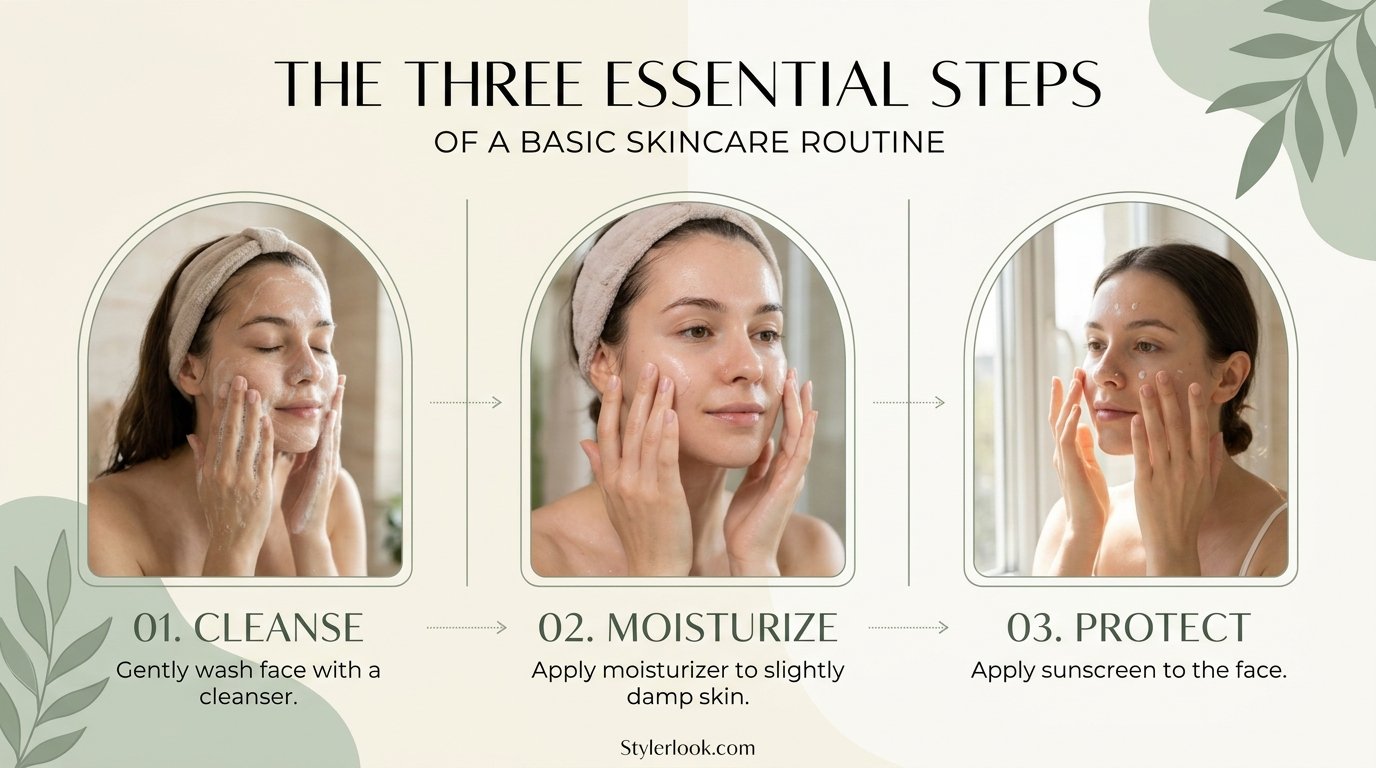
A basic skincare routine starts with the basic skincare routine itself, because the whole point of basics is that they end the research phase and start the habit.
Three products. Cleanse, moisturize, protect. Morning and night, in that order, every day, until running them feels as automatic as brushing your teeth, because that automatic feeling is the actual foundation everything else stands on.
The dermatology world agrees with the short version. The American Academy of Dermatology beginner position names those same three steps as the key to healthy skin, and notes that fewer products save money and cut the chance of irritation.
So the plan here is strict.
Learn the three steps and their order, learn the one swap that turns morning into night, then learn the admission rules that decide when anything else is allowed onto your shelf, because almost every beginner problem comes from skipping that discipline.
The Three Steps
Step 1: Cleanse
Cleansing removes the day from your face: oil, sweat, sunscreen, makeup, and city residue, and it prepares the surface so the next steps actually reach the skin instead of sitting on grime.
The technique matters more than the product. The AAD face washing guidance is short enough to memorize: lukewarm water, a gentle non abrasive cleanser, your fingertips, rinse, and pat dry with a soft towel.
Hot water and scrubbing feel thorough and behave badly. They strip the skin barrier and leave tightness that beginners misread as cleanliness, when tightness after washing is really the first warning sign of a cleanser that is too strong.
Choose by texture and temperament. Oily skin tends to like gel or gentle foaming cleansers, dry skin does better with cream or milk cleansers, and sensitive skin should start fragrance free, because fragrance is decoration your barrier never asked for.
How often: twice a day, morning and night, and after heavy sweating, per the AAD guidance. Washing more often rarely cleans better; it mostly irritates, and irritation is the tax beginners pay for enthusiasm.
Step 2: Moisturize
Moisturizer traps water in the skin and keeps the barrier supple, and the timing trick is free: apply it to slightly damp skin right after cleansing, so it seals in water that is already there.
Every skin type needs this step, including oily skin. The AAD specifically encourages moisturizing even when skin is oily, because skipping it can leave skin shiny and uncomfortable at once, which confuses beginners into washing more.
Texture is the only real choice. Gel creams suit oily skin, lotions suit normal and combination skin, and richer ceramide creams suit dry skin, especially through winter and in air conditioned rooms.
Amounts stay simple. Cover the face and neck in a thin even layer, roughly a fingertip to pea sized amount scaled by richness, and judge by comfort after ten minutes, not by shine in the first minute.
Step 3: Protect (Mornings Only)
Protection means sunscreen, the morning finisher and the one step with long term evidence behind it. Use a broad spectrum, water resistant SPF 30 or higher product on skin not covered by clothing, as the AAD recommends.
Note the honest footnote. The FDA floor for sunscreen labeling sits lower, at broad spectrum SPF 15 used as directed, so the 30 figure is the dermatology recommendation and 15 is the regulatory minimum; now you know which number is which.
Quantity decides whether the label number is real. Use the two finger rule, a stripe of sunscreen along two fingers for face and neck, applied before going outdoors and reapplied about every two hours outside, or after swimming and sweating.
Sunscreen is also the step beginners under buy. They spend on serums first and treat protection as optional, which reverses the evidence: the Daily Vitality minimalist routine guide puts the three step core first for a reason, because protection is where the payoff concentrates.
The Order Rule
Order sounds fussy until you see the logic.
The AAD sequence, as the GlowFoldr order guide lays it out, runs: wash, apply any treatment or medication, then moisturizer and or sunscreen, then makeup, and products meant to work on skin go early while products meant to seal or shield go late.
The memory version is thinnest to thickest. Watery layers first, creams after, sunscreen last among skincare in the morning, makeup after that, and brief pauses between layers keep everything from pilling.
In a basic routine the order collapses to three beats, so there is almost nothing to get wrong. Cleanser, moisturizer, sunscreen in the morning; cleanser, moisturizer at night, and the order questions beginners agonize over mostly evaporate.
Keep the site map open while you learn: the routine cluster at StylerLook connects these basics to ordering guides, builders, and skin type routines, so each question lands on its own page.
Morning and Night: The One Swap Map
Morning and night are not two routines. They are one routine with a single swap: sunscreen joins in the morning and leaves at night, while cleansing changes intensity, gentle in the morning and thorough at night.
|
Moment |
Cleanse |
Middle |
Finish |
|---|---|---|---|
|
Morning |
Gentle cleanse or a water rinse for very dry skin |
Moisturizer on damp skin |
Broad spectrum SPF 30 or higher |
|
Night |
The real cleanse: removes sunscreen, makeup, and the day |
Moisturizer, richer if skin likes it |
Sleep; no sunscreen needed |
The morning cleanse has a legitimate shortcut. Very dry or sensitive skin can rinse with water alone in the morning and save the real cleanse for night, because overnight skin produces oil and sweat, not dirt, and over cleansing is a real cost.
The night cleanse carries the responsibility. It must remove sunscreen and makeup completely, which is why the evening wash gets the full sixty seconds of fingertip attention, described step by step in the SkinOptimizer AM and PM steps.
Habits anchor better with a map like this. A dedicated walkthrough of the morning skincare routine shows the morning version expanded, and the nighttime skincare routine covers the evening one, both built on this same three step frame.
The Same Steps by Skin Type
Skin type changes textures, never steps. That sentence, memorized, prevents the most expensive beginner error: buying an entirely different routine architecture for every skin mood, when only the product weights needed adjusting.
|
Skin type |
Cleanser texture |
Moisturizer texture |
Watch for |
|---|---|---|---|
|
Dry |
Cream or milk, non foaming |
Rich ceramide cream |
Tightness after washing; add damp skin application |
|
Oily |
Gel or gentle foaming |
Light gel cream |
Skipping moisturizer; over washing to chase matte |
|
Combination |
Gentle gel |
Lotion, richer only on cheeks |
Treating the whole face like its oiliest zone |
|
Sensitive |
Fragrance free cream |
Fragrance free cream, few ingredients |
New products too often; fragrance anywhere |
Dry skin lives the basics hardest in winter. A dedicated skincare routine for dry skin builds the richer version in full, while the three steps themselves stay exactly where they were in July.
Sensitive skin needs the frame and the brakes together. The gentle skincare routine for dry sensitive skin pairs the gentle textures with the slow introduction pace sensitive skin demands, which is the admission system doing double duty.
Oily beginners make one classic error: washing three times a day and skipping moisturizer, then wondering why skin feels both greasy and tight. The fix is boring and total: wash twice, moisturize lightly, protect daily.
Combination skin is two zones sharing one face. Gel cleanser for all of it, lotion for most of it, and a dab of richer cream only where cheeks feel dry, which is zoning, not a second routine.
The Admission Rules for Add Ons
Rule 1: The base must run stable first
Four weeks of basics, run without drama, is the entry ticket for add ons. Skin that is calm on three products can teach you something about a fourth; skin that is already irritated teaches nothing except noise.
Rule 2: One at a time, about two weeks apart
New products enter singly, with roughly two weeks before the next, so any reaction has exactly one new suspect. Starting vitamin C, an acid, and a retinoid in the same week is how beginners manufacture mysteries.
Rule 3: Patch test first
Try each new product on a small area for seven to ten days before full use, the testing window attributed to AAD guidance in the order guides. Jawline or behind the ear works; a reaction there stays small and private.
Rule 4: Budget the exfoliation
Exfoliation is the most overdone category in beginner skincare. Cap it at one to three sessions a week, counted across every product that exfoliates, including cleansers and toners with acids hiding in the ingredient list.
The queue order
Add ons line up by gentleness: a hydrating toner if skin wants one, then a starter serum like niacinamide or vitamin C, then a measured exfoliant, and retinol last, at night, well after the base is boring and stable.
None of this is timidity. It is experimental method wearing a bathroom mirror: change one variable, observe, record, and the skincare routine builder approach of structured routine building follows the same logic with software instead of a notebook.
The Judging Clock
Results arrive in layers, and judging everything at week two is the classic beginner own goal. Comfort and hydration can improve within the first weeks, texture takes longer, and visible tone or aging changes take longest of all.
One routine guide stages it roughly: hydration in about two to four weeks, smoother texture around six to eight, and anti aging change at twelve weeks or more, a useful expectation set printed here as that guide’s strand.
Now the honesty clause, which this topic owes beginners. A careful counterpoint in the Skin-Care-Routine Life mistakes guide argues there is no universal clock: how long a product needs depends on the ingredient, the concern, and its directions, and no single renewal number verdicts everything.
Skin turnover is real but variable: roughly a 28 day cycle in younger adults, stretching longer with age, which is why a full month of basics is the minimum honest trial and why weekly product swapping guarantees confusion.
Judge with evidence, not mood. Same light, same mirror, a photo every two weeks, and three written notes: tightness, comfort, breakouts. Memory edits; photographs and notes do not.
Beginner Mistakes and the Restart Protocol
The error canon is short and repetitive: over exfoliating, stacking actives in one week, skipping sunscreen while buying serums, washing too often, and judging too fast. Every mistakes guide in this space is really describing those five habits.
Over exfoliation announces itself clearly: redness, stinging when gentle products touch skin, flaking, and a raw feeling. The cause is arithmetic, acids in the cleanser plus an acid toner plus a scrub equal exfoliation happening daily in disguise.
The restart protocol is the antidote, and it is just the basics with intent: stop all extras, run cleanser, moisturizer, and morning sunscreen for two to four weeks, and let the barrier rebuild without interference or new experiments.
If stinging, peeling, or burning persists around four weeks into the reset, that is a clinician’s territory, not a shopping problem. Persistent acne, eczema, or rosacea likewise belong with a dermatologist from the start, alongside the basics, not instead of them.
Budget and Buying Order
Buy in this order: cleanser first, moisturizer second, sunscreen third, because that sequence means a tight budget still produces a complete routine after the second purchase and a protected one after the third.
Drugstore basics are fully respectable. The three steps are simple formulations, and extra money mostly buys texture, finish, and pleasure.
Those upgrades matter for sunscreen compliance but do not change what the steps do, a point the how to start a skincare routine walkthrough makes when it sequences a first routine sensibly.
Spend the upgrade money where it changes behavior. A sunscreen you enjoy wearing gets used at full quantity daily; a cleanser you find elegant mostly gets used the same way regardless, so the protection step earns the splurge first.
Total daily cost stays low because basics are used in small amounts and replaced slowly. The budget failure is never the three products; it is the drawer of abandoned extras bought before the admission rules existed.
Technique Details That Make Basics Work
The wash itself deserves thirty honest seconds. Wet with lukewarm water, work the cleanser with fingertips in small circles for about sixty seconds at night, rinse fully, and pat dry instead of rubbing, which is friction your barrier pays for.
Moisturizer goes on damp, not dripping skin. A quick pat until the surface is no longer wet, then cream immediately, traps the most water with the least mess, and the order explainer at skincare routine order covers how this timing interacts with any treatment layer later.
Sunscreen technique fails quietly at the edges: ears, neck, and the hairline get skipped, and the backs of hands age in public while faces get protected. Cover the whole exposed map, not just the cheeks that tan visibly.
Makeup sits after sunscreen, with a short settle pause between them. Two minutes is plenty, and the patience prevents the pilling that makes beginners blame good products for a sequencing problem.
The Sink Card and the Five Minute Reality
Print the routine where it happens. A small card at the sink, AM: cleanse, moisturize, SPF; PM: cleanse, moisturize, beats any app notification, because tired mornings run on environment, not intentions.
Time the routine once and relax. The morning version runs about two minutes including sunscreen settling, the night version about three with a real cleanse, and five minutes a day is the entire cost of the system this whole topic is about.
Consistency compounds quietly. A three step routine done ninety percent of days for a year outperforms a ten step routine done brilliantly for three weeks and abandoned, which is the real argument for basics stated as arithmetic.
When Basics Are the Whole Answer, and When They Are Not
For many people the basics are not a starter phase at all. Calm, comfortable, protected skin is a legitimate endpoint, and the entire add on industry is optional from that position, a freedom worth stating plainly to beginners.
For specific concerns, basics are the floor, not the treatment. Acne that scars, spreading eczema, rosacea flushing, changing moles, and melasma all deserve professional assessment, with the routine adjusted around medical advice rather than the other way around.
That division is the honest shape of this topic: three steps everyone can run tonight, a disciplined door for everything else, and a clear line where self care ends and care begins.
Worked Examples: Three Beginners, One System
Consider the total beginner with an empty shelf and forty dollars. Week one buys a gentle cleanser and a moisturizer; week three adds sunscreen when the habit feels real. By week six the routine runs itself, and the first serum decision arrives with data instead of hope.
Consider the routine refugee, arriving with nine products and irritated skin. The prescription is subtraction: extras into a drawer, basics only for three weeks, then one product returns every two weeks through the patch test gate. Most refugees discover their skin needed less, not more.
Consider the parent and teenager sharing one bathroom. The family shelf holds the gentle cleanser and plain moisturizer both can use, the teenager gets their own sunscreen they actually like, and the actives, if any exist, live on the adult’s side with names on them.
Seasons, Travel, and Real Life Adjustments
Basics bend by season without breaking. Winter asks for a richer moisturizer and gentler morning cleansing; summer asks for lighter gel textures and honest sunscreen reapplication after sweat, while the step order never moves a millimeter.
Travel compresses the system beautifully. Three products fit any carry on, the night cleanse doubles after long flights, and hotel water hardness is answered by the same damp skin moisturizing trick that works at home, which is the point of learning principles instead of product lists.
Schedules bend too. Shift workers simply rename their waking hours as morning and their sleeping hours as night; sunscreen follows outdoor exposure, not the clock, and the cleanse follows the day, not the calendar date.
The Concern Queue: One Goal at a Time
After the base stabilizes, concerns line up and wait their turn. Dryness first if it persists, then breakouts, then tone, then texture, because chasing all four simultaneously guarantees none of them gets a clean trial or a fair verdict.
Write the queue down. A dated note, one concern, one product, one review date, converts skincare from a mood into a project, and projects finish while moods just spend. Review dates belong at four to eight week marks, never at weekly mirror sessions.
What Good Skin Feedback Looks Like
Learn the vocabulary of calm: skin that feels like nothing in particular most of the day, products that disappear without comment, makeup that sits evenly, and mornings that look like yesterday. Boring feedback is the signature of a working basic routine.
Noise has a vocabulary too: afternoon tightness, random stinging, shiny yet flaky patches, and breakouts migrating to new territory. Each phrase maps to a lever, cleanser strength, product pace, moisturizer weight, or a product that needs retiring.
The Long Game: Why Basics Outperform Hauls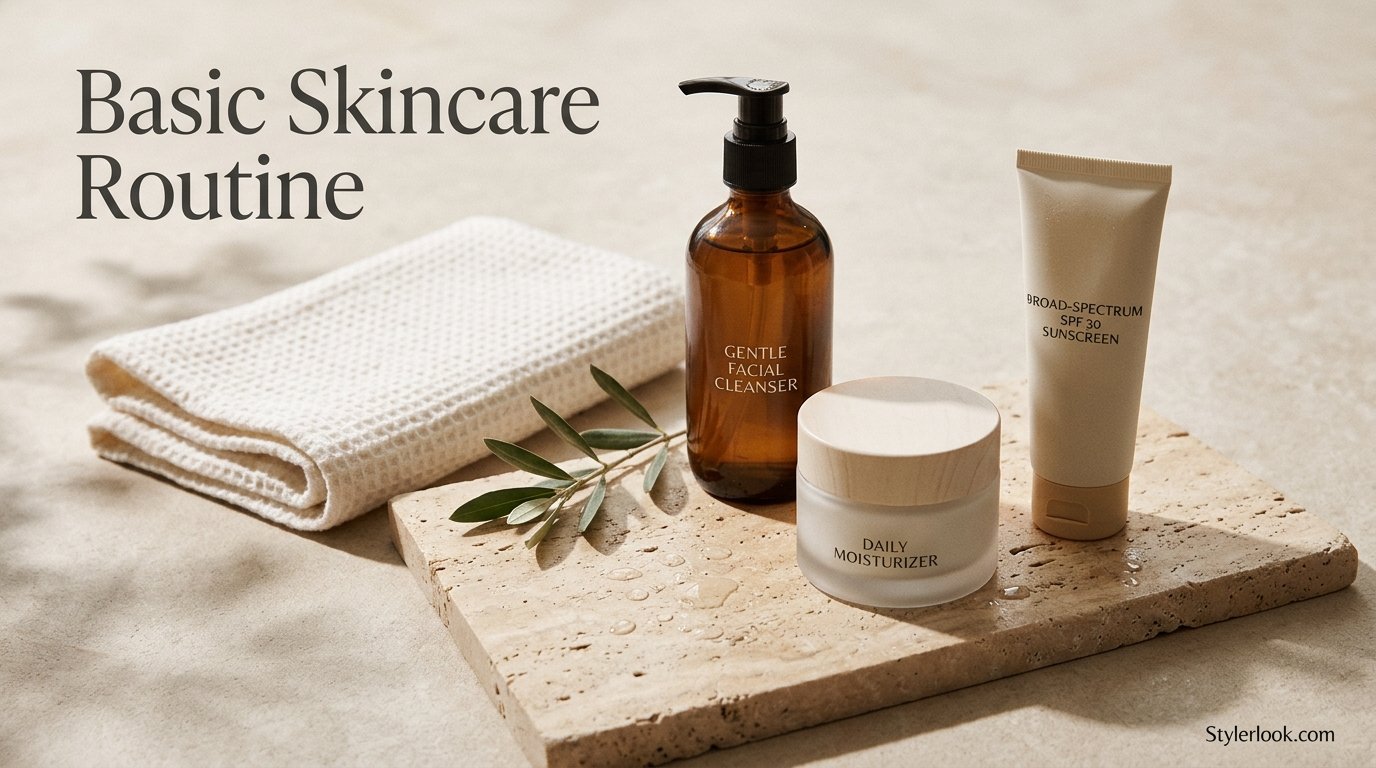
Compounding works on skin like it works on savings. Sunscreen worn daily for years is the single largest lever in how skin ages visibly, and it only compounds if the routine around it stays simple enough to survive busy seasons, travel, grief, and joy alike.
That survivability is the hidden metric. Rate any routine by its worst week performance, the week of deadlines, illness, or newborns.
The routine that survives that week is the one still running in December, quietly outperforming every ambitious system that collapsed in March.
Hygiene and Handling Basics
Clean hands before the routine, always. Fingertips are the application tool the AAD guidance assumes, and unwashed hands quietly undo the point of a gentle cleanser by delivering the day’s grime directly to a freshly washed face.
Towels and pillowcases join the system loosely. A clean towel for the face, changed often, and a pillowcase washed weekly, reduce the background noise your basics get blamed for, especially for breakout prone beginners conducting product trials.
Partners, Mirrors, and Motivation
Share the system, not the experiments. Households run best when the basics are common property and the add ons are labeled personal property, so nobody’s retinol trial becomes somebody else’s mystery irritation at the shared sink.
Motivation follows the calendar, not the mirror. Tick the days for the first month, because a visible streak protects the habit through the flat middle weeks when skin looks unchanged and enthusiasm goes looking for a new product to buy instead.
Reading Labels Like a Beginner Should
Three label habits cover most beginner needs. Check the product type and texture first, gel versus cream; scan for fragrance if your skin is sensitive; and confirm sunscreens say broad spectrum with an SPF number you can read without squinting.
Ignore the front panel poetry. Words like natural, clean, and dermatologist inspired carry no standard meaning on basics, while the boring back panel, directions, quantity, and expiry, carries the information your routine actually runs on.
Quantities on labels teach the routine too. Sunscreen bottles sized for the body remind you the face amount is generous; cleanser sizes reveal how long a gentle wash should last, usually months, which quietly confirms how little product each wash needs.
The Starter Week, Day by Day
Days one and two run the night cleanse and moisturizer only, introducing products at the calm end of the day.
Days three and four add the morning rinse or cleanse, and day five adds sunscreen. The full system assembles itself inside a week without a single overwhelming morning.
By the second week the order stops needing thought, which is the milestone that matters.
Products line up at the sink in running order, the calendar gets its ticks, and attention moves from remembering steps to noticing skin, the exact shift the admission rules were designed to protect.
A Note on Products Shown in Videos
Social feeds teach routines at haul speed, unboxing ten products in ninety seconds. Treat every such shelf as entertainment until it passes your admission rules, because the creator’s skin, climate, budget, and sponsorships are not yours, and their week three update rarely gets filmed.
The useful content hides in the boring videos instead: the dermatologist washing a face slowly, the pharmacist pointing at two shelves, the creator six months later still using the same three bottles. Boredom, in this category, is a quality signal.
Frequently Asked Questions
1. What is a basic skincare routine?
A basic skincare routine is three steps: cleanse, moisturize, and protect with sunscreen in the morning.
Run them in order, morning and night, with sunscreen as the only difference between the two shifts.
2. What are the 3 basic steps of skincare?
Cleanse, moisturize, protect. The AAD beginner position names those three as the key steps for healthy skin.
Everything else, toners, serums, exfoliants, is an add on that enters later under rules.
3. What order should a basic skincare routine follow?
Cleanse first, moisturizer second, sunscreen last in the morning. The general application order runs wash, treatment if any, moisturizer and or sunscreen, then makeup, thinnest to thickest throughout.
4. How many products do I need for a basic routine?
Three products cover the basics. One gentle cleanser, one moisturizer matched to your skin type, and one broad spectrum sunscreen.
Optional extras wait until this base has run calmly for about a month.
5. Do I need a toner in a basic skincare routine?
No, toner is optional, not a basic. The core three steps work without it.
A hydrating toner can be the first add on later if skin enjoys it, admitted under the same rules as everything else.
6. What is the difference between a morning and night basic routine?
The night version drops sunscreen and deepens cleansing. Morning protects against the day ahead; night removes the day instead.
Same steps, one swap, which is what makes the habit easy to keep.
7. How often should I wash my face?
Twice a day, plus after heavy sweating. That is the AAD guidance beginners should default to.
Washing more often rarely cleans better; it mostly irritates and strips the skin barrier.
8. Can I wash my face with water only in the morning?
Yes, many dry and sensitive beginners can. Overnight skin makes oil and sweat, not dirt, so a water rinse preserves comfort.
Keep the real cleanse for night, and cleanse fully in the morning if you wake up oily.
9. How do I wash my face properly as a beginner?
Lukewarm water, gentle cleanser, fingertips, sixty seconds. Rinse fully and pat dry with a soft towel.
Skip hot water, scrub brushes, and washcloth friction, which cost the barrier more than they clean.
10. What moisturizer should a beginner use?
Start with texture, not brand. Gel cream for oily skin, lotion for normal or combination, richer ceramide cream for dry skin.
Apply to slightly damp skin and judge comfort ten minutes later.
11. Does oily skin need moisturizer?
Yes, oily skin still needs moisturizer. The AAD encourages it for everyone.
Choose a light gel cream; skipping moisturizer often leaves skin shiny and tight at once, which tricks people into over washing.
12. When should sunscreen be applied in a routine?
Sunscreen is the last skincare step of the morning. It goes on after moisturizer and before makeup, so its protective film sits undisturbed on top of everything else.
13. How much sunscreen should I use on my face?
Use the two finger rule. A stripe of sunscreen along your index and middle fingers covers face and neck for most adults.
Less than that delivers less than the SPF number on the label.
14. Can I skip sunscreen on cloudy days or indoors?
Clouds and windows still pass UVA. Daily broad spectrum sunscreen is the AAD default for exposed skin outdoors.
If you sit beside bright windows all day, the same habit covers you without a second thought.
15. How long does a basic skincare routine take to work?
Comfort and hydration can improve within weeks. Texture and tone take longer, roughly six to eight weeks or more in guide timelines.
Judge at a month minimum, and remember no single clock verdicts every product.
16. Why is my new routine making my skin worse?
Usually a pace problem, not a product problem. Too many new actives, over exfoliation, or daily switching irritate skin fast.
Drop to the three basics for two to four weeks and reintroduce one product at a time.
17. What is purging and how is it different from breaking out?
Purging appears where you usually break out, then settles. It follows new exfoliants or retinoids as congestion clears faster.
Breakouts in new places, or worsening past a month, signal a product problem instead.
18. How do I know if a product is irritating my skin?
Stinging, redness, and new tightness are the tells. Especially stinging from products that used to feel fine.
Stop the newest product first, return to basics, and let the barrier settle before testing anything else.
19. When can I add a serum to my basic routine?
After about four calm weeks on the basics. Skin that runs quietly on three products can show you what a fourth does.
Add one serum, wait two weeks, and only then consider the next.
20. What should the first add on product be?
A gentle serum like niacinamide or vitamin C. Or a hydrating toner if dryness is your main complaint.
Retinol and strong exfoliants queue last, once the base and your patch testing habit are solid.
21. How do I patch test a new skincare product?
Apply a small amount to one area daily for seven to ten days. Jawline or behind the ear works well.
No reaction after the window means wider use; any reaction stays small and easy to read.
22. How often should a beginner exfoliate?
One to three times a week at most. Count every exfoliating product, including acid cleansers and toners, toward the total.
Daily exfoliation is the fastest beginner route to a damaged barrier.
23. Can I use retinol as a beginner?
Not in the first month, and not casually. Retinol queues last among add ons, at night, started slowly, after the base is stable and patch tested.
Pregnant readers should ask a clinician before any retinoid.
24. What basic routine suits dry skin?
Cream cleanser, rich ceramide moisturizer, gentle sunscreen. Moisturize on damp skin, consider a water only morning rinse, and keep exfoliation rare.
The dedicated dry skin routine builds this version in full.
25. What basic routine suits oily skin?
Gel cleanser, light gel moisturizer, comfortable sunscreen. Wash twice, never three times, and moisturize lightly instead of skipping.
Matte all day is the wrong target; calm and protected is the right one.
26. What basic routine suits combination skin?
Gel cleanser, lotion overall, richer cream only on dry zones. Combination skin is two climates sharing one face.
Zoning the moisturizer handles both without buying a second routine.
27. What basic routine suits sensitive skin?
Fragrance free everything, few ingredients, slow introductions. Cream textures, patch testing without exceptions, and new products spaced wider apart.
Persistent redness or flushing deserves a dermatologist alongside the basics.
28. What basic skincare routine should a teenager follow?
The same three steps, gently, with no actives pileup. Cleanser, moisturizer, sunscreen, introduced slowly.
Teen skin rarely needs exfoliant stacks or anti aging products, and irritated teen skin usually traces back to copying adult routines.
29. Is a basic routine different for men?
The steps are identical; only marketing differs. Men benefit from the same cleanse, moisturize, protect order, often with simpler fragrance free shelves.
Beards just need cleanser and moisturizer worked through to the skin beneath.
30. How much should a basic skincare routine cost?
Three drugstore products can cost less than one serum. Cleanser, moisturizer, and sunscreen are simple formulations bought slowly and replaced slowly.
The expensive mistake is the drawer of extras, not the basics.
31. What should I buy first if my budget is small?
Buy cleanser, then moisturizer, then sunscreen. That order means a tight budget still yields a complete routine after two purchases and a protected one after three.
Upgrade the sunscreen first later.
32. Drugstore or expensive products for basics?
Drugstore basics are fully respectable. Extra money mostly buys texture, finish, and pleasure.
Those matter for sunscreen you wear daily at full amount, and matter much less for a cleanser rinsed off in a minute.
33. How long should the whole routine take each day?
About five minutes a day in total. Roughly two minutes in the morning including sunscreen, three at night with a thorough cleanse.
The time cost is tiny; the consistency is the entire game.
34. Can I wear makeup over a basic routine?
Yes, makeup goes on after sunscreen. Give the sunscreen a short settle pause, around two minutes, so makeup applies smoothly without pilling and the protective film stays even.
35. Do I need to double cleanse in a basic routine?
Only when the night cleanse must remove makeup or heavy sunscreen. A cleansing oil or balm first, then your gentle cleanser.
On bare skin days, one gentle cleanse is enough.
36. What if my skin feels tight after cleansing?
Your cleanser is too strong for you. Tightness after washing is a product verdict, not cleanliness.
Switch to a gentler cream or gel formula and wash with cooler water before changing anything else.
37. What if my moisturizer stings?
Stop it and simplify. A basic moisturizer should feel like nothing after a minute.
Stinging suggests irritation or a compromised barrier; return to the blandest option you own and let skin settle.
38. How do I restart after ruining my skin barrier?
Stop all extras and run the three basics. Gentle cleanser, plain moisturizer, morning sunscreen, for two to four weeks.
Reintroduce one product at a time afterward.
Stinging persisting at four weeks means a clinician.
39. How often should I replace my basic products?
Replace on emptiness and on dates, not vibes. Note the opening date on each bottle.
Sunscreen past its expiry underperforms, and cleansers or moisturizers that change smell or texture should be retired.
40. Does a basic routine help with acne or dark spots?
Basics support skin while real treatment does the work. They keep acne prone or spot prone skin calm and protected, which helps prescribed or chosen treatments do their job.
Scarring acne and stubborn pigmentation deserve professional care.
41. When should a beginner see a dermatologist?
When basics plus patience are not enough. Scarring acne, spreading eczema, rosacea flushing, changing moles, or irritation persisting through a month of basics all deserve professional assessment, sooner rather than later.
42. Can I share basic skincare products with family?
Share only the true basics, and carefully. A gentle cleanser or plain moisturizer at a family sink is reasonable; actives, exfoliants, and anything prescribed are personal.
When in doubt, keep products individual.
Conclusion
A basic skincare routine earns its name twice over: basic in steps, and basic in the sense of foundational. Cleanse, moisturize, protect, in order, morning and night, with textures fitted to your skin type and sunscreen closing every morning.
Hold that base for a month before judging or expanding it. Then let add ons queue politely under the admission rules, one at a time, patch tested, weeks apart, and let photographs and notes deliver the verdicts your memory would fudge.
Start tonight with what you own. Run the three steps, write the opening date on each bottle, and let consistency do the compounding, because in skincare the boring routine performed daily beats the brilliant one abandoned by February, every single time.

2 thoughts on “Basic Skincare Routine: Cleanse, Moisturize, Protect, in That Order”