

Skincare routine for dry skin starts with a reframe: dry skin is a barrier problem, not a product shortage.
Your skin is losing water through a damaged surface layer faster than any serum can replace it.
So the routine below is barrier first. Every step either stops water escaping or it earns a question mark.
Three products form the complete core: a gentle cleanser, a ceramide rich cream, and daytime sunscreen.
Everything else, serums, toners, oils, is an upgrade, added only when the core is working.
The guidance follows American Academy of Dermatology dry skin tips, with named dermatologist routines and label research woven in.
One boundary up front: this is general information, not medical advice. Persistent dryness belongs to a dermatologist.
Stylerlook keeps its routine library organized the same way, core first and upgrades after, so this page slots straight in.
The Short Answer: Three Products Are the Routine
A complete skincare routine for dry skin fits in one sentence. Cleanse gently, moisturize on damp skin, protect.
Morning means sunscreen over the cream. Night means a richer cream and, for very dry skin, a seal.
That is the minimum viable routine. It is not a compromise version. It is the routine itself.
What the Upgrades Actually Add
- Humectant serum adds water depth under the cream
- Hydrating toner or essence adds a thin water layer for very dry skin
- Face oil adds comfort and softness over the cream
- Gentle exfoliant lifts the flakes that block absorption
Each upgrade solves a specific problem. If you cannot name the problem, skip the product.
Dry Skin Versus Dehydrated Skin
These two get confused constantly, and the confusion buys the wrong products.
Dry skin lacks oil. It is a skin type, often lifelong, producing little sebum of its own.
Dehydrated skin lacks water. It is a temporary condition, and even oily skin can have it.
Dehydrated skin often feels tight yet looks shiny, with fine surface flakes over an oily base.
Dry skin feels rough and tight everywhere, drinks up products, and rarely looks shiny at all.
The Fix Follows the Diagnosis
Dry skin needs lipids and occlusion: creams, oils, and seals that replace missing oil.
Dehydrated skin needs water and humectants, plus a seal to keep the water from leaving.
Many people have both at once, which is why the routine below covers water and oil together.
The Three Jobs: What Every Product Is Doing
Moisturizers do three jobs, a framing the Cleveland Clinic uses and Next Fit Life dry skin routine carries.
Understanding the jobs turns label reading from guessing into checking.
Job One: Humectants Pull Water In
Humectants attract water into the surface layer. Glycerin and hyaluronic acid are the famous pair.
They work best on damp skin, where there is surface water available to pull in.
In dry air, a humectant alone can backfire, because there is little environmental water to draw on.
Job Two: Emollients and Ceramides Repair
Emollients smooth the rough surface. Ceramides rebuild the mortar between skin cells.
A 2019 research review found dry skin severity tracks ceramide levels in the stratum corneum.
A 2022 review found ceramide formulas improved water loss, hydration, and skin pH in dry skin.
The Food Health evidence based dry skin guide gathers that literature, including the note that ceramides 1, 3, and 6-II carry strong data.
Job Three: Occlusives Seal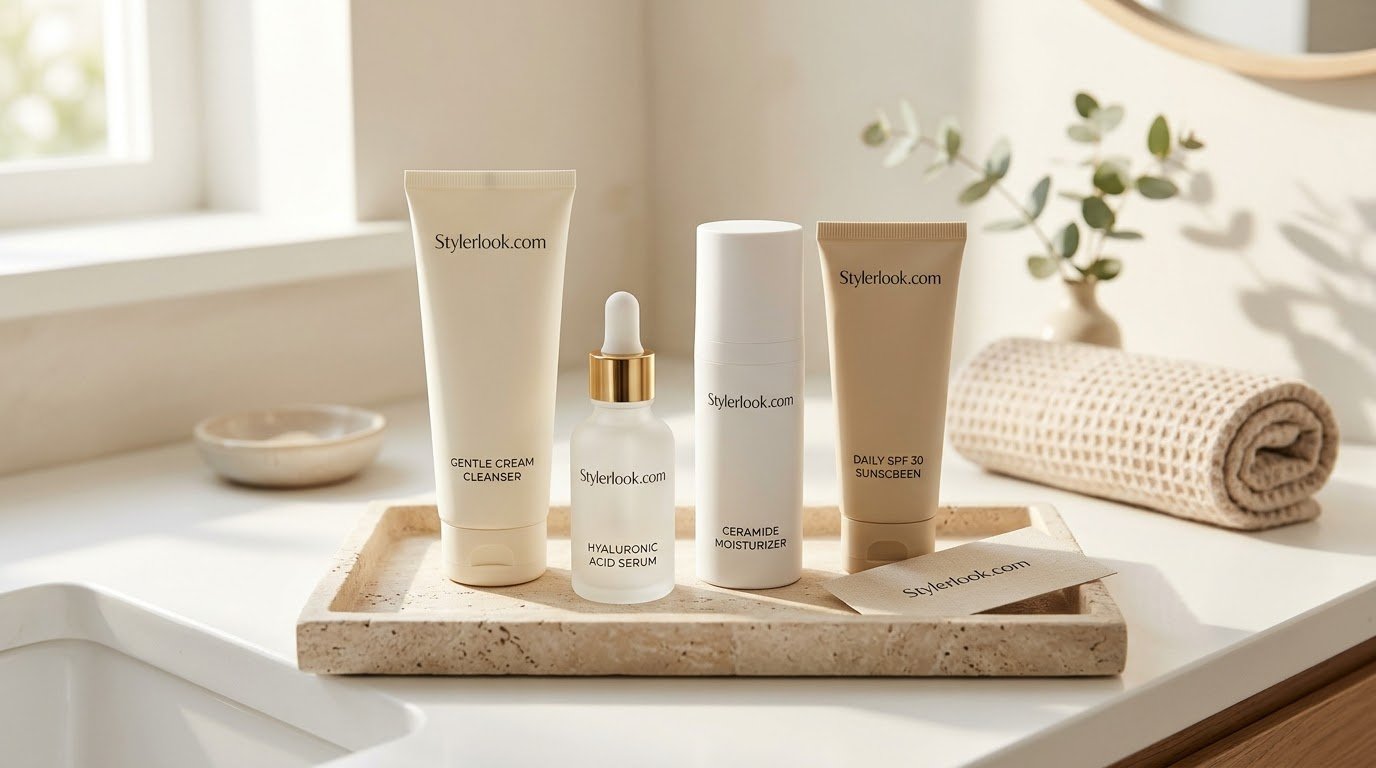
Occlusives sit on top and slow evaporation. Petrolatum and dimethicone are the proven pair.
This is the job most failing routines miss. Water pulled in and never sealed simply leaves.
|
Job |
What It Does |
Label Names |
|---|---|---|
|
Humectant |
Pulls water in |
Glycerin, hyaluronic acid |
|
Emollient and lipid |
Smooths and repairs |
Ceramides, squalane, shea |
|
Occlusive |
Seals water in |
Petrolatum, dimethicone |
The Morning Routine, Step by Step
Morning is protection: keep last night’s repair in, and defend it through the day.
The Morning skincare routine guide covers morning structure generally. Here it is tuned for a dry barrier.
Step 1: Cleanse, or Honestly Skip It
Many dry skin routines cleanse properly at night and rinse with water only in the morning.
Dry skin makes little overnight oil, so a morning cleanser often strips what the night rebuilt.
If you wake with heavy night layers or an oily T zone, a gentle cream cleanser is fine.
Judge by the tightness test: if your face feels tight after washing, the cleanser is wrong.
Step 2: Humectant Layer on Damp Skin
Pat, do not rub, and leave the skin slightly damp. This dampness is a routine ingredient.
Press in a hyaluronic acid or glycerin serum, two or three drops, no waiting ritual required.
An alcohol free hydrating toner or essence can play this role for very dry skin instead.
Step 3: Ceramide Cream
Apply a ceramide rich cream while the serum layer is still settling.
Creams beat lotions here for a structural reason: more lipid, less water, so they seal longer.
Step 4: Sunscreen, the Non Negotiable
Finish with broad spectrum SPF 30 or higher, the floor in the American Academy of Dermatology dry skin tips.
A moisturizing sunscreen, ideally with humectants or ceramides, does protection and comfort together.
Give it a few minutes to set before makeup, and reapply through the day as normal.
The Night Routine, Step by Step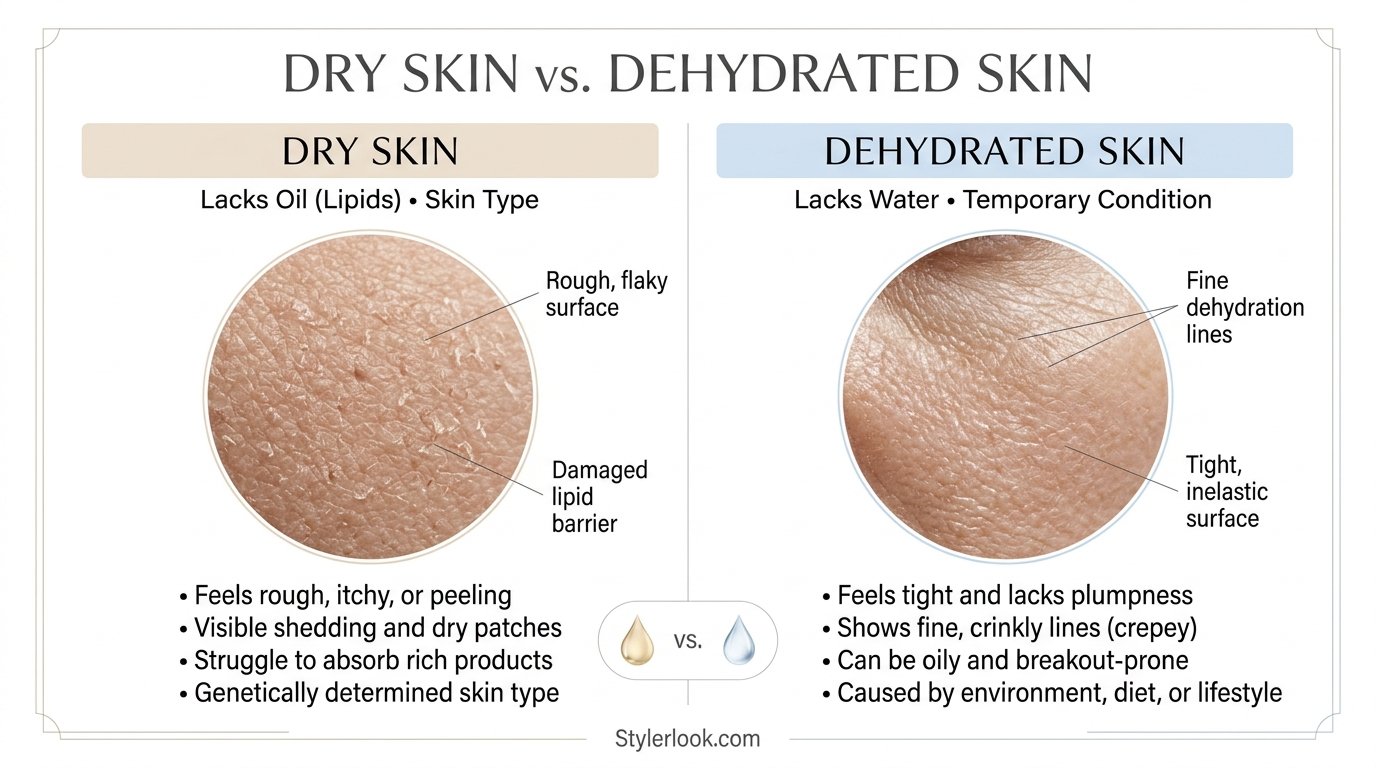
Night is repair: remove the day gently, then rebuild with richer layers and time.
The Nighttime skincare routine guide lays out night structure. The dry skin version adds sealing discipline.
Step 1: Remove the Day Gently
Use a cream or balm cleanser, brief and lukewarm, to lift sunscreen and makeup.
Double cleansing belongs to makeup heavy nights only, and both cleanses stay gentle.
Twice daily double cleansing is an oily skin habit that dry skin usually regrets.
Step 2: Water Layers Again
Repeat the damp skin humectant layer. Night skin loses the most water, dermatologists note.
This is also where a hydrating essence earns its keep on very dry faces.
Step 3: The Richer Cream
Night cream can be thicker than the morning cream, the richest texture your skin accepts.
Look for the three jobs on one label: humectant, ceramides, and an occlusive near the top.
Step 4: Seal the Driest Zones
For very dry skin, finish with slugging: a thin petrolatum layer over the driest areas.
Dermatologists quoted in brand education endorse slugging for overnight moisture loss specifically.
Keep it to dry zones, skip acne prone areas, and accept the pillowcase trade off.
The Routine Ladder
One routine does not fit every dry skin. Climb only when the rung below is stable.
|
Rung |
Morning |
Night |
Who It Serves |
|---|---|---|---|
|
Minimum |
Rinse, cream, SPF 30+ |
Cleanse, cream |
Beginners, the overwhelmed |
|
Full |
Cleanse or rinse, serum, cream, SPF |
Cleanse, serum, rich cream |
Most dry skin |
|
Winter |
Full, cream upgraded |
Full plus slugging |
Cold months, heated homes |
|
Sensitive |
Rinse, cream, SPF, no actives |
Cleanse, cream, spot seal |
Stinging, reactive skin |
The How to start a skincare routine guide helps if even the minimum rung feels new. Start there without shame.
The Damp Window and Other Rules That Matter More Than Products
Products get the attention. Rules do the work. These five outperform most purchases.
Rule One: Moisturize While Damp
The sources disagree on the exact minute, and this page prints the disagreement honestly.
One guide says within about two minutes of washing. A Cleveland Clinic strand says three.
A dermatologist quoted in brand education says within five minutes of bathing, patting dry first.
|
Source Strand |
The Window |
|---|---|
|
Routine guide strand |
About 2 minutes |
|
Cleveland Clinic strand |
About 3 minutes |
|
Dermatologist quote strand |
Within 5 minutes |
The rule underneath is one: apply while the skin is still damp, trapping that water.
Rule Two: Creams and Ointments Over Lotions
The dermatology guidance is blunt: people with dry skin should start with a cream or ointment.
Lotions carry more water and less lipid, so they evaporate faster and seal less.
Rule Three: Fragrance Free, Not Merely Unscented
Fragrance free means no fragrance ingredients were added. That is the label to trust.
Unscented products may contain masking chemicals that hide scent, and those can irritate dry skin.
The distinction appears in the American Academy of Dermatology dry skin tips and matters on every step, sunscreen included.
Rule Four: Respect the Shower
Keep showers to five to ten minutes in warm water, not hot, per dermatology guidance.
Hot water strips surface lipids efficiently, undoing the night cream before the day starts.
Pat dry instead of rubbing, then moisturize immediately, while the damp window is open.
Rule Five: One Change at a Time
Introduce one new product a week, so reactions have an identifiable author.
Barrier repair is boring by design. The routine that works is the one repeated.
Reading Labels Like a Formulator
Labels reward readers. Avina moisturizer label analysis analyzed moisturizer labels at catalog scale for its picks.
Its method transfers: check six things before any dry skin product earns a place.
The Six Label Checks
- Texture first: cream or ointment for dry skin, not lotion or gel
- A humectant present: glycerin or hyaluronic acid on the list
- Ceramides listed, ideally with cholesterol and fatty acids alongside
- An occlusive present: petrolatum or dimethicone for the seal
- Fragrance free stated, not just unscented
- No drying alcohol high in the formula
One caution from that analysis: ingredient position is not a percentage. Order informs, never proves.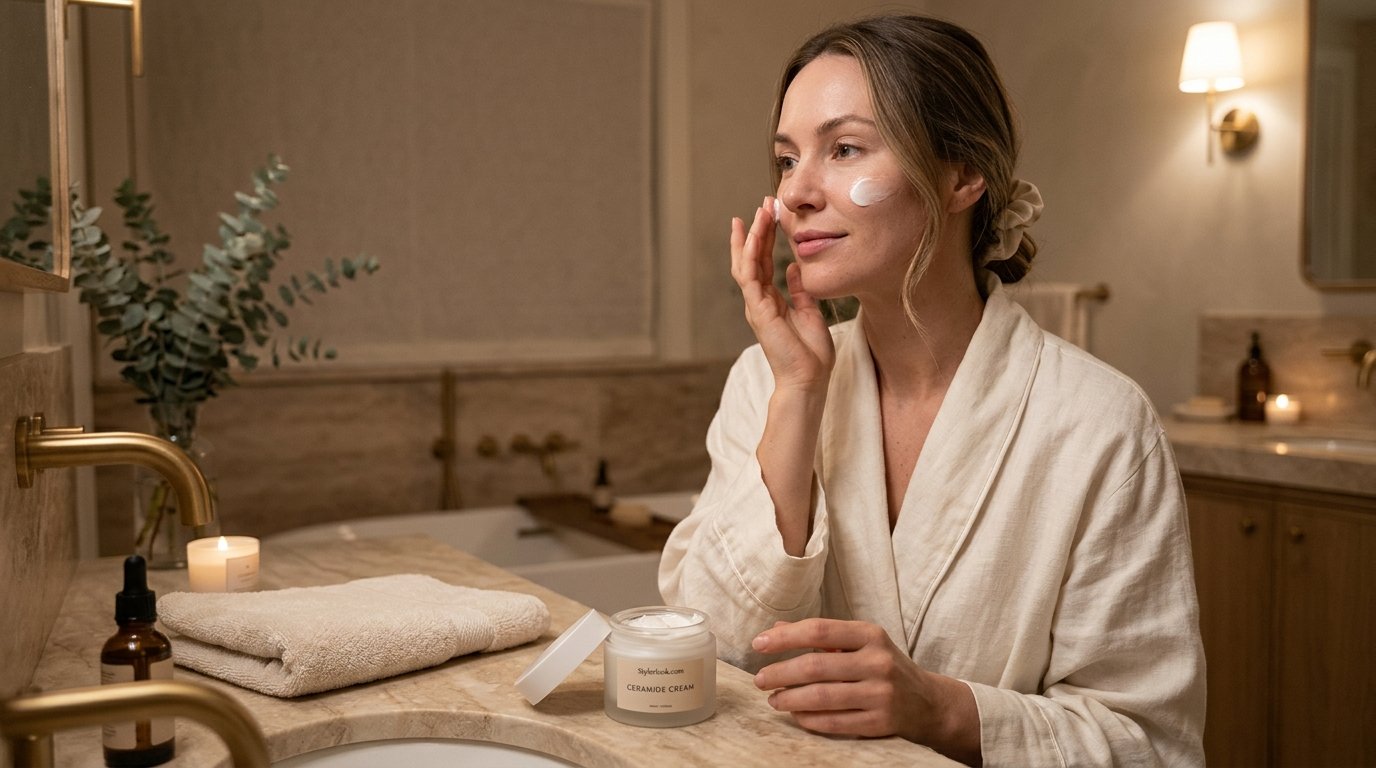
Actives on Dry Skin: A Protocol, Not a Step Number
Dry skin can use actives. It just cannot absorb them at full speed from day one.
Retinol: Buffered and Slow
Start two or three nights a week, pea sized, at night only, on fully dry skin.
Buffer it: moisturizer before, or sandwich the retinol between two moisturizer layers.
Clinician guidance in this research reduces frequency further in winter, buffered the same way.
Stinging and peeling are instructions to slow down, not badges of progress.
The Skincare routine order guide shows where a treatment slot sits when the barrier is ready for one.
Vitamin C: Tolerance Is the Gate
Morning vitamin C under moisturizer and SPF suits many dry faces, derivatives gentler than pure forms.
If it stings persistently, drop it. No antioxidant outranks a calm barrier.
Exfoliation: Less Than the Internet Says
Flakes are a dryness symptom first and an exfoliation request second.
Moisturize and seal for a week before deciding your skin needs resurfacing at all.
When you do exfoliate, once or twice weekly, favor lactic acid or PHA for dry skin.
Layering Traditions, Borrowed Carefully
The Korean skincare routine guide popularized thin layering: many light hydration layers, sealed at the end.
That logic suits dry skin well, because it performs the three jobs slowly and gently.
Borrow the layering, keep the ladder. Add Korean style layers as upgrades to a working core.
The Best skincare routine guide compares full routine philosophies if you want the wider map before choosing.
Troubleshooting: When the Routine Is Not Working
Failure is information. Change one variable at a time, a week each, and the cause shows itself.
Still Dry After Moisturizer
- Cream applied to dry skin instead of damp: fix the timing first
- A lotion where a cream is needed: upgrade the texture
- Humectant with no occlusive over it: add the seal
- Hot, long showers undoing the work daily: shorten and cool them
- Indoor heating pulling moisture for eight hours: run a humidifier
Everything Stings
Stinging on application signals a compromised barrier letting products in too fast.
The response is subtraction: pause actives and exfoliants, simplify to cleanser, cream, and SPF.
The Gentle skincare routine for dry sensitive skin guide is built for exactly this season of skin.
Persistent burning or rash is not a product problem to shop through. See a dermatologist.
Makeup Clings to Flakes
Fix the night before: sealing at night and damp application in the morning do the work.
Choose hydrating formulas, let sunscreen set, and skip heavy powder on flaky zones.
Seasonal Adjustments
Winter is a different routine, not a stronger one. Richer cream, more frequent moisturizing.
An NHS strand, UK guidance flagged as such, suggests emollients two to four times daily in winter.
Actives retreat in winter: lower retinoid frequency, everything buffered, exfoliation gentler.
Summer reverses the texture, lighter layers and diligent SPF, while the structure stays identical.
A bedroom humidifier helps in heated months, adding moisture to the air skin sleeps in.
Travel deserves a line of its own, because cabin air and hotel heating punish dry skin. Pack the cream, seal on overnight flights, and treat the trip as a winter week.
Variants for Real Lives
Dry and Sensitive
The sensitive rung of the ladder applies: fragrance free everything, actives parked, patch tests always.
Introduce products a week apart, and treat every sting as data, not weakness.
Dry Skin After 40 and in Menopause
Estrogen decline reduces skin lipids, so mature dry skin needs richer creams, applied more often.
A clinician strand in this research names the richer night cream as the single biggest help.
Men With Dry Skin
The Mens skincare routine guide trims this to a minimal male version that still covers the three jobs.
Shaving counts as exfoliation, so shaving days are not acid days. Cream goes on damp, post shave.
On a Budget
This category is kind to budgets, because the evidence ingredients are old and inexpensive.
Glycerin, petrolatum, and house brand ceramides carry the routine at pharmacy prices.
Spend on the cream and sunscreen used daily. Save on toner and serum, the optional layers.
Mistakes That Keep Dry Skin Dry
- Cleansing twice daily with a foaming wash because it feels thorough
- Chasing flakes with scrubs instead of sealing the night before
- Layering actives onto a stinging barrier and calling it purging
- Swapping products every few days, so nothing gets its four weeks
- Buying unscented when the label needed to say fragrance free
- Treating a medical dryness (eczema, thyroid, psoriasis) as a shopping problem
Your First Week, Day by Day
Days one and two: park the actives. Night cleanse, cream on damp skin, SPF mornings.
Days three and four: add the humectant serum under the cream if tightness persists.
Days five to seven: add spot slugging on the driest patches at night.
Photograph day one. Judge tightness and flakes at day seven, the full routine at week four.
The Skincare routine hub keeps the wider framework if you want the general map beside this page.
The Evidence, Graded Honestly
Skincare content loves certainty. This page grades its own claims instead, strand by strand.
Anchored in guidance: the AAD rules used here, fragrance free, creams over lotions, damp application.
Review level support: the ceramide findings, from published reviews rather than any single product trial.
Single strands, labeled: the 93 percent improvement figure from one ceramide routine study in older adults.
That figure describes one study population, elderly patients with dry skin, not a promise for you.
Clinician practice strands: winter retinoid reduction and richer night cream for mature skin.
Practice strands are experienced judgment, worth following cautiously, never quoted as trial results.
Zones the Face Routine Forgets
Eyelids and Lips
Eyelid skin is the thinnest on the face and often the first zone to go dry.
Dermatologist commentary in this research specifically endorses slugging for dry eyelids and chapped lips.
Use plain petrolatum there, no actives nearby, and let the gentlest zone set the gentlest rules.
The Nose and Chin Creases
Flakes gather where sebum and dryness mix, the nose wings and chin crease especially.
These zones tolerate the seal but may clog with heavy layering everywhere else on the face.
Spot seal them at night rather than slugging the whole face by default.
Neck and Chest
The neck shows dryness early and forgives slowly, so extend the cream, not the actives, downward.
Sunscreen belongs there too, since the neck collects the sun the face gets credited for.
Cleanser Types, Decoded for Dry Skin
Cream and lotion cleansers are the default: low foam, lipid friendly, rinsed without squeak.
Cleansing balms and oils excel at makeup removal nights and suit the double cleanse exception.
Micellar water works as a gentle remover, though dry skin often prefers it rinsed off.
Foaming gel cleansers are the usual suspects behind the tightness test failing every morning.
The label word that matters most is not the format. It is fragrance free, again.
Serum Types, Decoded for Dry Skin
Hyaluronic acid serums are the water layer, used on damp skin and always sealed after.
Glycerin heavy essences do similar work, often cheaper, with less marketing around them.
Niacinamide serums support the barrier and calm redness at moderate strengths for most users.
Peptide and ceramide serums exist, though the cream usually delivers those lipids more economically.
One serum, chosen for one job, beats a shelf of overlapping bottles every time.
Hands, Body, and the Routine’s Borders
The face routine’s rules scale to the body with cheaper, bigger textures.
Moisturize the body within the same damp window after bathing, cream or ointment based.
Hands need reapplication after washing, the frequency point the NHS strand makes for emollients.
A tube by the sink outperforms a perfect jar in the bathroom cabinet, every winter.
Trends, Translated
Slugging is petrolatum sealing, an old dermatology habit with a new social media name.
Skin cycling is scheduled rest for actives, which dry skin needed before it had branding.
Skin flooding is layered humectants on damp skin, the three jobs performed enthusiastically.
Barrier repair itself is trending language for what dermatologists have advised for decades.
Trends are safe to borrow when they translate into the three jobs and the damp rule.
They are unsafe when they add steps, strength, or frequency a dry barrier has not earned.
When the Problem Is Not the Routine
Some dryness is a symptom wearing a routine’s clothes, and shopping cannot fix it.
Eczema, psoriasis, and thyroid conditions all present as persistent dryness among their signs.
Cracking, bleeding, spreading rash, or dryness arriving with other new symptoms ends the routine experiment.
That is the dermatologist’s territory, and going early is competence, not defeat.
The Routine, On One Card
Morning: rinse or gentle cleanse, humectant on damp skin, ceramide cream, SPF 30 or higher.
Night: gentle cleanse, humectant on damp skin, richer cream, petrolatum seal on dry zones.
Weekly: one gentle exfoliation at most, and only when the barrier is calm.
Always: fragrance free, warm not hot water, one change at a time, judge at four weeks.
Print that card mentally before buying anything. Most routines fail off the card, not off the shelf.
The Routine at Three Budgets
The three jobs do not scale with price. They scale with label literacy and consistency.
The Pharmacy Build
Gentle cream cleanser, one house brand ceramide cream, moisturizing SPF, and plain petrolatum.
That build covers every job and every rule in this page for the least money possible.
It is the build to choose when the budget is real and the barrier is unhappy.
The Mid Shelf Build
Add a glycerin or hyaluronic serum and a dedicated richer night cream to the pharmacy base.
The gain is comfort and layering pleasure, not a different category of result.
The Enthusiast Build
Add the essence layer, a vitamin C for tolerant mornings, and a lactic exfoliant used weekly.
The gain is refinement on a calm barrier. On an unhappy one, it is a liability list.
Notice what never changes across budgets: fragrance free, damp application, cream texture, the seal.
Money buys texture and elegance here. The physiology stays free, which is the good news.
The Four Week Assessment
Barrier repair needs a measurement habit, or every bad morning restarts the product search.
Week one: judge only tightness after washing. It should soften within days of correct cleansing.
Week two: judge flaking. Sealed, damp moisturized skin usually sheds less visibly by now.
Week three: judge tolerance. Products that stung on day one should sting less or not at all.
Week four: judge the whole picture against the day one photograph, in the same light.
If nothing moved in four honest weeks, the problem is probably not the routine anymore.
That is the moment the dermatologist conversation starts, with a month of clean data to show.
Key Takeaways
- Barrier first beats product first: stop the water loss before adding hydration depth
- Three jobs organize everything: humectants pull in, ceramides repair, occlusives seal
- Damp skin is an ingredient: moisturize while the surface is still wet from washing
- Cream over lotion, fragrance free over unscented, warm water over hot
- Three products complete the routine: cleanser, cream, and SPF or a night seal
- Actives are protocols: retinol buffered and slow, exfoliation weekly at most
- Troubleshoot by variable: timing, texture, sealing, shower, and air, one at a time
- Four weeks is the judging period, and stubborn dryness after that is a doctor visit
Frequently Asked Questions
1. What is the best skincare routine for dry skin?
A barrier first routine: gentle cleanser, a humectant layer on damp skin, a ceramide rich cream, and SPF 30+ by day.
At night, the same base with a richer cream and an occlusive seal for very dry skin.
2. How many steps does a dry skin routine need?
Three steps are the routine: cleanse, moisturize, protect.
Serum, toner, and face oil are upgrades for specific problems.
Seven step lists show every possible slot, not the required ones.
3. What order should dry skin products go in?
Thinnest to thickest on damp skin: cleanser, water based layers, cream, then oil or occlusive, with sunscreen last in the morning.
Humectants need sealing over them, and an early occlusive blocks later layers.
4. Should dry skin cleanse in the morning?
Often not with a cleanser.
Dry skin makes little overnight oil, so many routines rinse with water in the morning and cleanse properly at night.
Heavy night layers or an oily T zone are the exceptions.
5. What cleanser is best for dry skin?
A gentle, low foam or non foaming cream cleanser, fragrance free, that leaves skin comfortable rather than squeaky.
Tightness after washing means the cleanser is wrong, whatever the label promises.
6. Do I need a toner for dry skin?
No, but a hydrating alcohol free toner or essence can add a useful water layer for very dry skin.
Apply it to damp skin before serum and cream.
Astringent toners are the ones to avoid.
7. Is hyaluronic acid enough for dry skin?
No.
Hyaluronic acid is a humectant that pulls water in, and dry air gives it little to pull.
Apply it to damp skin and seal it with a moisturizer, or it can leave skin feeling tighter.
8. What moisturizer texture is best for dry skin?
Cream or ointment, not lotion or gel.
Dermatology guidance tells dry skin to start with a cream or ointment because richer textures carry more lipid, seal better, and last longer on the skin.
9. What is slugging and should dry skin do it?
Slugging is a thin petrolatum layer as the last night step, sealing everything beneath it.
Dermatologists endorse it for very dry zones and overnight water loss.
Skip acne prone areas and expect pillowcase trade offs.
10. Can dry skin use retinol?
Yes, as a protocol: two or three nights a week, pea sized, buffered with moisturizer before or around it, at night only.
Slow down in winter, and treat stinging or peeling as instructions to pause.
11. Can dry skin use vitamin c?
Generally yes, with tolerance as the gate.
Morning vitamin C under moisturizer and SPF suits many dry faces, with gentler derivatives for sensitive skin.
Persistent stinging means it stays optional and gets dropped.
12. How often should dry skin exfoliate?
Once or twice a week at most, favoring lactic acid or PHA.
Flakes are a dryness symptom first, so moisturize and seal for a week before deciding your skin needs resurfacing at all.
13. Why is my skin still dry after moisturizer?
Run the checklist: cream applied to dry instead of damp skin, a lotion where a cream is needed, humectant with no seal over it, hot long showers, or heated indoor air.
Change one variable weekly.
14. Why does my face sting when I apply products?
Stinging usually signals a compromised barrier letting products in too fast.
Subtract: pause actives and exfoliants, simplify to cleanser, cream, and SPF, all fragrance free.
Persistent burning deserves a dermatologist.
15. What is the difference between dry and dehydrated skin?
Dry skin lacks oil, a lifelong type producing little sebum.
Dehydrated skin lacks water, a temporary state even oily skin gets.
Dry skin needs lipids and sealing, dehydrated skin needs water plus a seal.
16. Does drinking more water fix dry skin?
Not measurably for most people.
Dryness is a surface barrier problem, water escaping outward, not a body water shortage.
Drink normally for health, and fix the barrier for the skin itself.
17. What does fragrance free versus unscented mean?
Fragrance free means no fragrance ingredients were added.
Unscented products may contain masking chemicals that hide scent and can irritate dry skin.
For dry skin routines, fragrance free is the label to trust.
18. How long does barrier repair take?
Weeks of consistency.
Comfort often improves within days, while tolerance and settled flakes take roughly three to six weeks of the same gentle routine.
Judge the routine at four weeks, not four days.
19. What SPF should dry skin use?
Broad spectrum SPF 30 or higher, in a moisturizing cream formula, ideally with humectants or ceramides.
One non US page pushes SPF 50 with an Asian rating frame, flagged here as foreign labeling.
20. Should I use hot water if my skin is dry?
No.
Keep showers to five to ten minutes in warm water, pat dry instead of rubbing, and moisturize while still damp.
Hot water strips surface lipids and undoes the night cream daily.
21. Does a humidifier help dry skin?
Yes, as environment control, especially in the bedroom at night.
Heated indoor air is very dry air, and skin loses water to it for hours.
It supports every product you already own.
22. Can dry skin use face oil?
Yes, as a finishing layer over cream, not a moisturizer substitute.
Oils like squalane add comfort but no water, so the damp skin and humectant steps still come first in the routine.
23. What ingredients should dry skin avoid?
Drying alcohols high in formulas, added fragrance, harsh foaming cleansers, strong astringents, and aggressive scrubs.
Strong acids and retinoids are not banned, they are dose controlled and barrier gated.
24. Are ceramide products worth it for dry skin?
The evidence supports the class: reviews link dry skin severity to ceramide levels and find ceramide formulas improve water loss and hydration.
Ceramides 1, 3, and 6-II carry the strongest supporting data strand.
25. Can I do a dry skin routine on a budget?
Yes.
The proven ingredients are old and inexpensive, so pharmacy brands carry a complete routine: gentle cleanser, ceramide cream, SPF, and petrolatum for night sealing, all at drugstore prices.
26. What is a good dry skin routine for sensitive skin?
Subtract first: fragrance free everything, no exfoliant or retinoid until calm, cream cleanser once daily, humectant on damp skin, rich cream, SPF by day.
Patch test everything, one product per week.
27. What is a good routine for very dry, flaky skin?
The full ladder plus sealing discipline: night cleanse, morning water rinse, humectant layers on damp skin, ceramide cream, petrolatum over the driest zones at night, and a bedroom humidifier running.
28. How should the routine change in winter?
Winter is a different routine, not a stronger one: richer cream, more frequent moisturizing, retinol reduced to two or three buffered nights, shorter cooler showers, and the humidifier on.
29. Can men use this dry skin routine?
Yes, the routine is physiology, not marketing.
The male version wins by minimalism: three core steps, cream on damp skin after shaving, and SPF.
Shaving days are not acid days.
30. Can dry skin wear makeup without flakes?
Mostly, with preparation: seal the night before, moisturize on damp skin in the morning, let sunscreen set, then use hydrating formulas and skip heavy powder on flaky zones.
31. Is the Korean skincare routine good for dry skin?
Its layering logic suits dry skin: thin hydrating layers sealed at the end perform the three jobs slowly.
Borrow the layering as upgrades to a working core rather than replacing the core.
32. What is skin cycling and should dry skin do it?
Skin cycling rotates actives across nights with scheduled recovery.
Dry skin can stretch it with more recovery nights and everything buffered.
If your skin is stinging now, recovery is the whole program.
33. Can dry skin be caused by a health condition?
Yes.
Persistent dryness can accompany eczema, psoriasis, thyroid conditions, and other issues.
A routine manages surface dryness, it does not diagnose it, so stubborn cases belong with a dermatologist.
34. Should I double cleanse with dry skin?
Only on makeup or heavy sunscreen nights, gently: a balm first, then a mild cream cleanser, both brief and lukewarm.
Twice daily double cleansing is an oily skin habit dry skin regrets.
35. Are sheet masks and overnight masks worth it for dry skin?
As occasional boosters, yes.
An overnight mask is a premixed seal, and a sheet mask is a humectant soak that still needs cream over it.
Neither replaces the daily three core steps.
36. Can hard water make dry skin worse?
It can contribute: mineral residue raises cleanser demand and irritates barrier prone skin.
Use less cleanser, lukewarm water, and moisturizer on damp skin right after.
A filter is optional equipment.
37. How do I patch test a new product?
Apply a little to the inner elbow or jawline daily for several days, watching for redness, itching, or burning.
Introduce one product at a time, a week apart, so reactions have an author.
38. Can pregnancy change a dry skin routine?
Dryness and sensitivity often intensify, and retinoids are generally avoided in pregnancy.
The barrier core carries through safely, with your own clinician’s advice taking precedence over any general page.
39. Does menopause change dry skin care?
Yes, toward more lipid support: estrogen decline reduces skin lipids and water holding, so richer creams, more frequent application, and gentler actives replace what worked at thirty five.
40. What should a beginner’s first week look like?
Subtraction and sealing: night cleanse, morning water rinse, ceramide cream on damp skin twice daily, SPF each morning, petrolatum on the driest patches at night, actives parked for later.
41. When should I see a dermatologist for dry skin?
When home care fails: dryness continuing despite a proper routine, eczema or psoriasis in the picture, products that keep burning, cracked or bleeding skin, or signs of infection.
42. What is the single most important step for dry skin?
Moisturizing, done properly: a ceramide rich cream on damp skin, morning and night, sealed at night for very dry skin.
Every dermatologist voice in the research protects this step above all.
Conclusion
A working skincare routine for dry skin is barrier repair repeated daily: the three jobs covered, the damp window respected, and the ladder climbed only when the rung below holds.
Start with the minimum routine this week. Add one upgrade at a time, judge at four weeks, and let consistency do what product launches promise.
Build your routine on the ladder above, and check the sister guides on Stylerlook as your skin calms and your questions get more specific.
