

A nighttime skincare routine is the repair shift of skincare: cleanse the day off, apply one treatment, and seal everything in before sleep. Three steps, in that order, on most nights.
The mistake this page exists to prevent is ambition. Night is when the strong ingredients live, and stacking them is how calm skin becomes peeling, burning skin within a fortnight.
So this routine is planned by the week, not by the night. Exfoliation gets its night, the retinoid gets its nights, and recovery gets the rest. That calendar, plus honest timing rules, is the whole system.
One boundary first. This is general information about cosmetic care, not medical advice. Persistent acne, eczema, or rosacea belongs with a dermatologist, and retinoids carry a standing caution in pregnancy.
The Short Answer: Three Steps, One Active
Every night runs the same skeleton. What changes across the week is only which treatment, if any, occupies the middle step.
|
Step |
Job |
Typical Products |
|---|---|---|
|
Remove sunscreen, makeup, and the day |
Gentle cleanser, or balm plus cleanser |
|
One goal, one active |
Retinoid, exfoliating acid, or nothing |
|
Cut overnight water loss |
Cream, plus optional occlusive or oil |
Optional layers, a hydrating serum or an eye cream, slot between steps 1 and 2 or just before the cream. They are comfort additions, not load bearing steps.
The order rule behind the table is thinnest to thickest, the same principle the skincare routine order guide teaches for the full routine framework. Watery layers first, seals last.
If you are brand new, the how to start a skincare routine pacing applies at night with full force: cleanser and moisturizer only for the first two weeks, treatments later. Most night routine failures are pacing failures.
Why Night Is the Repair Shift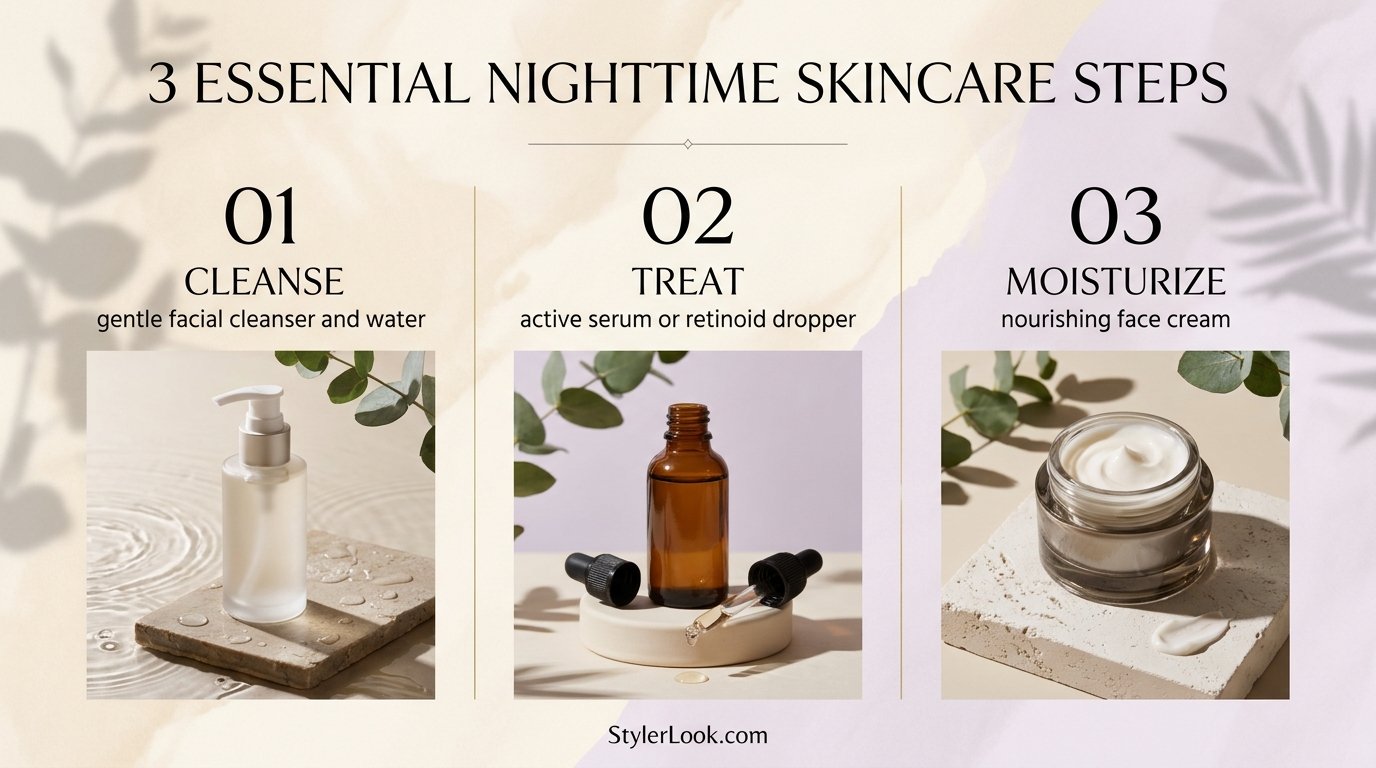
Your skin runs on a circadian rhythm, a roughly 24 hour cycle, just like the rest of the body. Daytime skin defends. Nighttime skin renews, and the research behind that split is specific.
In 1998, Yosipovitch and colleagues published measurements in the Journal of Investigative Dermatology of transepidermal water loss, skin pH, and skin temperature across a full day.
Their conclusion is the sentence this whole routine hangs on: skin permeability is higher in the evening and night than in the morning. Products penetrate more readily, and water escapes more readily too.
That single finding explains both halves of night care. Treatments work on more permeable skin, which is an opportunity. Water loss also rises, which is why the seal at the end is not optional decoration.
Reviews of circadian skin biology, including a 2019 review in the Journal of Clinical and Aesthetic Dermatology, describe repair processes such as cell renewal and DNA repair as more active at night.
Treat that as informed summary, not a stopwatch. Brand claims that collagen peaks at exact hours like 11pm to 4am go beyond what the studies pin down, and this article does not use them.
What Sleep Itself Does: The Study, With Its Limits
The most quoted sleep and skin study is the 2015 study in Clinical and Experimental Dermatology. Researchers compared 60 women, aged 30 to 49, sorted into good sleepers and poor sleepers by a standard sleep quality index.
Good sleepers, sleeping 7 to 9 hours, showed significantly lower intrinsic skin ageing scores. Poor sleepers, at 5 hours or less, had higher baseline water loss through the skin.
The striking result came after a barrier stress test. At 72 hours after tape stripping, good sleepers had 30 percent greater barrier recovery than poor sleepers, and recovered better from UV redness at 24 hours.
Now the limits, printed on purpose. The study shows association, not proof that sleep hours caused the differences. The sample was small, all women, and the work was funded by Estee Lauder.
The honest takeaway survives the caveats: chronically poor sleep travels with weaker barrier function, so the night routine and the night’s sleep are partners. Neither replaces the other.
The Nightly Routine, Step by Step
The skeleton is three steps, but each step has a right way and a common wrong way. This section is the reference version the weekly calendar then schedules.
Step 1: Cleanse the day off. This is the day’s only mandatory full cleanse. Its job is total removal: sunscreen, makeup, sweat, and city buildup, so treatments meet skin, not residue.
Use a gentle cleanser with lukewarm water and fingertips. Sixty seconds of gentle contact does the work. Skin should finish comfortable, never squeaky; squeaky means the cleanser took barrier lipids as a bonus.
Double cleanse only when the day earned it. Waterproof sunscreen, long wear makeup, or heavy buildup justify an oil cleanser or balm first, then the water based cleanser.
On light days, one gentle cleanser is enough, and nightly double cleansing can quietly strip dry or sensitive skin. Match the cleanse strength to the day’s load, not to a fixed ritual.
Step 2: Apply the night’s one treatment. After cleansing, pat the skin dry. If you use a hydrating serum or essence, it goes on now, while the skin is still slightly receptive.
Then the treatment, and only one: the retinoid, or the exfoliating acid, or a targeted serum, chosen by the calendar below. One active per night is the rule dermatologists repeat most about evenings.
The dermatologist Heather D. Rogers, MD, FAAD structures her published nighttime routine on the same three goals: cleanse, support cell turnover with a treatment, and strengthen the barrier with moisturizer. The consensus across dermatologists is unusually tight here.
Step 3: Moisturize, then seal if needed. Cream goes over the treatment once it no longer feels wet. Night moisturizer can be richer than your day cream, because nothing needs to sit on top of it.
Very dry zones can take a final seal: a few drops of face oil pressed over the cream, or a thin occlusive layer on the driest patches. Oily skin usually stops at a lightweight gel cream.
Wait a few minutes before bed after the final layer. It is a practical courtesy to your pillowcase and your products, not a medical rule. Absorbed product works; transferred product decorates linen.
The Weekly Calendar: Skin Cycling, Done Honestly
Skin cycling is the popular name for what this calendar does. The framework is associated with dermatologist Whitney Bowe, MD, and it rotates active nights against recovery nights in a repeating pattern.
Its status deserves one clear sentence. Skin cycling is a pacing framework, not a clinical guideline. Its value is arithmetic: it caps strong actives at two nights in four and builds rest in automatically.
|
Night |
Treatment |
What Happens |
|---|---|---|
|
Night 1 |
Exfoliation |
One gentle chemical exfoliant, then moisturizer |
|
Night 2 |
Retinoid |
Pea sized amount, then moisturizer |
|
Night 3 |
Recovery |
Cleanse, hydrate, moisturize only |
|
Night 4 |
Recovery |
Cleanse, hydrate, moisturize only |
|
Then |
Repeat |
The four night cycle starts again |
Read the ratio, because the ratio is the lesson. Recovery nights outnumber active nights in the classic pattern. Beginners can stretch the cycle further, taking three recovery nights after each active night.
Advanced readers compress it, running retinoid nights more often as tolerance proves out over months. The calendar bends to the skin’s response. It never bends the other way.
Exfoliation Night Rules
One product, one night, nothing stacked on top. A leave on AHA or BHA at a strength your skin has met before, followed by moisturizer. No retinoid the same night, which is the combination rule below.
Retinoid Night Rules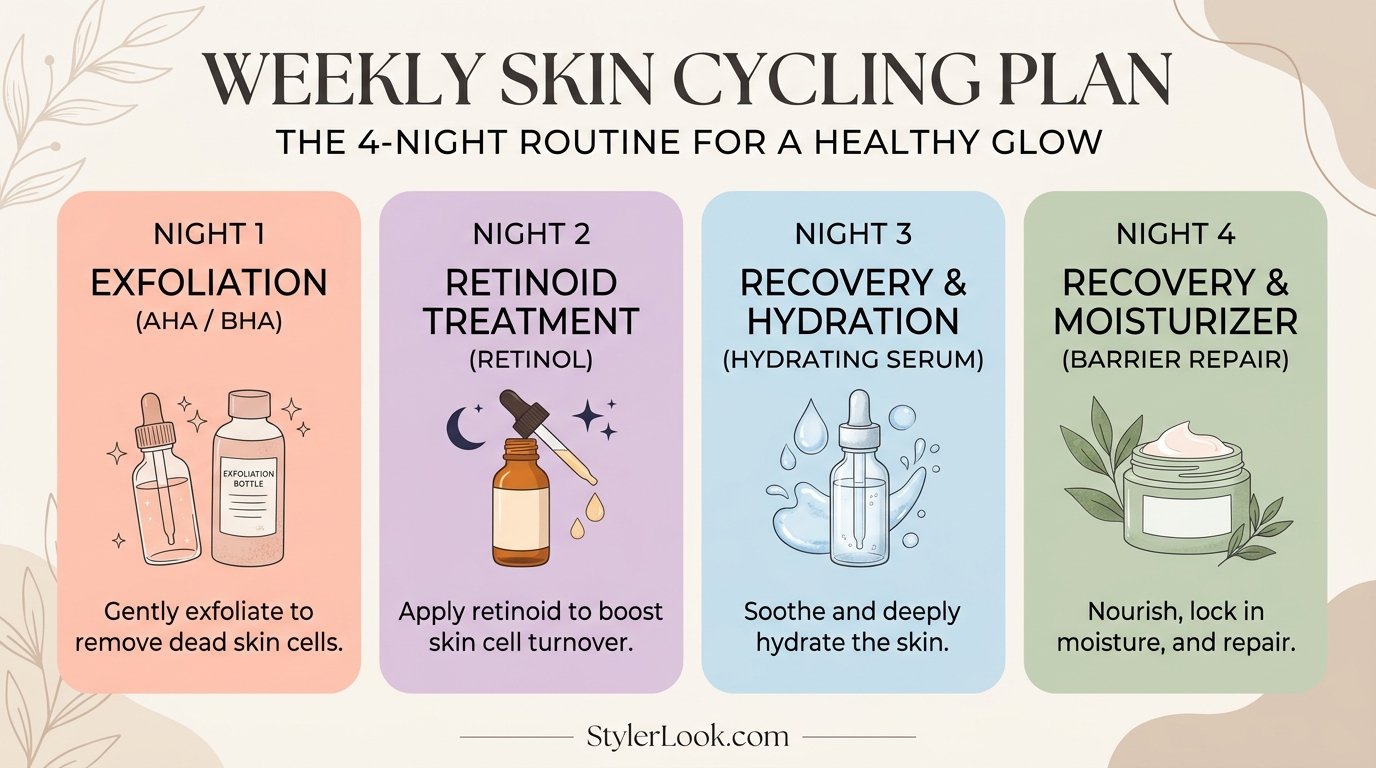
Retinoid goes on fully dry skin, a pea sized amount for the whole face. Buffering over moisturizer is the beginner and sensitive entry. The full starter system has its own section next.
Recovery Night Rules
Recovery is a treatment, not an absence of one. Cleanse, add hydration if you use it, and finish with a barrier focused cream: ceramides, glycerin, panthenol, the calm ingredients.
The gentle skincare routine for dry sensitive skin is essentially a routine built entirely from recovery nights, which is why sensitive readers often live on this pattern full time and visit actives rarely.
What Never Shares a Night: The Combination Rules
Most night routine damage is a scheduling error, not a product error. This small matrix is worth more than any single product recommendation on the page.
|
Combination |
Verdict |
Why |
|---|---|---|
|
Retinoid + exfoliating acid |
Separate nights |
The classic route to a damaged barrier |
|
Retinoid + benzoyl peroxide |
Separate, or ask a clinician |
Older formulas could deactivate; irritation adds up regardless |
|
Retinoid + hydrating serum |
Same night, fine |
Hydration buffers and supports tolerance |
|
Vitamin C + retinoid |
Usually separate shifts |
Vitamin C by day, retinoid by night keeps both comfortable |
|
Two exfoliants together |
Never |
One acid product per night is the ceiling |
|
Actives + rich moisturizer |
Same night, encouraged |
The seal is what makes actives survivable |
When in doubt, alternate. Skin keeps the benefits of both ingredients across a week and skips the inflammation of one overloaded night. The week forgives what the night does not.
Layering brands does not change the arithmetic. Even a single brand’s line, as the The Ordinary skincare routine shows, contains actives that need separate nights and pacing.
The Retinoid Starter System
Retinoids are the night shift’s headline actives, and they are night assigned for reasons: sunlight degrades several retinoids, and retinoid treated skin is more sun sensitive, which is why morning sunscreen is their partner rule.
1. Start one to two nights a week. Hold that frequency for several published weeks, not days. Published dermatologist routines commonly land near three nights weekly once tolerance is built.
2. Use a pea sized amount. That amount covers the whole face. More product does not accelerate results; it accelerates peeling. Dot it across the face and spread thinly.
3. Apply to fully dry skin. Wait until the face is dry after cleansing, because damp skin increases penetration and irritation for many users. Or apply moisturizer first as a buffer.
4. Use the sandwich when needed. Moisturizer, retinoid, moisturizer again. The sandwich is the standard sensitive skin entry and costs little effectiveness for a large gain in comfort.
5. Avoid the thin zones first. Keep retinoid away from the eye corners, the nostril folds, and the lip edges at the start. Reactions begin where skin is thinnest, almost every time.
6. Judge at 8 to 12 weeks. That is the standard evaluation window for topical treatments. Early dryness or mild flaking in the first fortnight is common; burning and raw patches are stop signals, not progress.
7. Protect the investment by day. A retinoid without morning sunscreen is a half system. The morning skincare routine owns that protection shift, and the two pages are designed as one pair.
Versions by Skin Type
The skeleton never changes. The textures, actives, and frequencies change completely, which is why one size routine lists fail real faces.
Dry Skin Nights
Balm or cream cleanser, hydrating serum on damp skin, ceramide rich cream, occlusive spots on the driest patches. Foaming cleansers and nightly acids are deleted. Dry skin also earns the right to rinse with water only the next morning.
Oily Skin Nights
Gentle gel or foaming cleanser, the night’s treatment, and a lightweight gel cream. The skincare routine for oily skin explains why oily skin still moisturizes at night: skipping it produces the tight but shiny pattern by morning.
Sensitive Skin Nights
Cream cleanser, plain fragrance free barrier cream, and the slowest active pace on the site: buffered retinoid once weekly at most, or none. Rest nights are the default state, not the exception, on this version.
Acne Prone Nights
Gentle cleanser, one acne active on its assigned nights, non comedogenic moisturizer. Adapalene, benzoyl peroxide, and salicylic acid are alternatives to schedule, not a stack to combine. Persistent acne outranks articles; a dermatologist directs that care.
Timing and Adherence: The Routine That Survives Tuesdays
Timing questions look trivial and decide everything. A perfect routine performed twice a week loses to a good routine performed nightly, so this section designs for tired humans.
There is no studied standard for how long before bed skincare must happen. The practical consensus is to finish 20 to 30 minutes before lying down, so layers absorb instead of transferring to the pillow.
The stronger move is earlier. Dermatologists quoted in editorial features describe doing the routine as soon as they get home in the evening. Products applied at 7pm work all night exactly as well.
That habit also removes the midnight negotiation, the nightly debate between the routine and exhaustion that exhaustion wins. Adherence research in every health field says the same thing: move the task earlier.
The 2 Minute Fallback Routine
Some nights the full system will not happen. The fallback floor is two steps: remove the day with a balm, micellar step, or gentle cleanser, then moisturize. Never treat a missed treatment night as a failed week.
Keep the fallback products at the sink, visible, not in a cabinet. The fallback exists for travel nights, deadline nights, and new baby nights, and using it is the system working, not cheating.
Shower Order
Run the routine after the shower, not before. Steam and hot water after products rinse value away and can irritate freshly treated skin. Cleanse in or right after the shower, then treat and seal.
The American Academy of Dermatology’s dry skin guidance shower rules travel with this section: short, warm rather than hot, and moisturizer applied while the body is still slightly damp for the body care version of the same seal.
Extras That Earn Their Minute
Four extras survive the value test because each takes under a minute and works undisturbed all night. Everything else is optional decoration and should be judged as such.
Eyes. Eye cream goes after serums, before or with moisturizer, tapped on with the ring finger. Night suits richer eye formulas. Keep strong face retinoids away from the immediate eye area unless a product is made for it.
Lips. Lips have no oil glands and lose water overnight. A plain occlusive balm applied last thing outperforms fragranced balms that quietly irritate. Persistent cracked corners deserve a clinician’s attention, not a stronger balm.
Neck and chest. Bring cleanser and moisturizer down nightly, using what is left on your hands. The neck shows sun history early and irritates faster with retinoids, so introduce actives there more slowly than the face.
Hands. A thick hand cream before bed, or petrolatum under cotton gloves for cracked hands, works for eight undisturbed hours. It is the highest return minute in the entire routine for people who wash hands all day.
Layered philosophies like the Korean skincare routine contribute here too: their hydrating layers make excellent recovery night material, used selectively rather than as a nightly ten step obligation.
Bedroom Variables: Pillowcase, Position, Air
The bedroom is part of the routine’s environment, and three variables are worth one honest paragraph each. Evidence strength varies, and each claim below is labelled accordingly.
Pillowcase hygiene is the solid one. A case collects oil, product, and bacteria nightly. Changing it once or twice a week is standard advice for breakout prone readers, and it costs nothing.
Fabric choice is the soft one. Silk and satin reduce friction on skin and hair, and many readers prefer the feel. Skin specific evidence for silk is thin, so treat it as comfort preference, not treatment.
Sleep position sits between the two. Side and stomach sleeping compress facial skin for hours, and sleep lines are a real cosmetic conversation. Back sleeping avoids the compression; whether it is worth your sleep quality is a personal trade.
Bedroom air completes the set. Heated winter air dries skin all night, and a humidifier where practical is the standard countermeasure, the same advice the AAD gives for dry skin generally.
Morning vs Night: The Two Shifts Compared
One table settles the most common confusion in the whole cluster. The two routines are different jobs, not the same routine at different hours.
|
Element |
Morning Shift |
Night Shift |
|---|---|---|
|
Goal |
Protect |
Repair |
|
Cleanse |
Rinse or gentle cleanse |
Full cleanse, double when earned |
|
Treatment |
Antioxidant or hydration |
One active: retinoid or acid |
|
Moisturizer |
Day weight cream |
Richer cream plus seal |
|
Final step |
Sunscreen, always |
Occlusive or oil, optional |
|
Failure mode |
Skipping sunscreen |
Stacking actives |
The skincare routine holds the combined framework both shifts hang from. This page owns the night: its calendar, its actives, and its recovery logic.
Mistakes That Undo the Night
- Stacking every active into one night. Retinoid over acid over a new serum, on damp skin, is the flare recipe. One active per night.
- Starting retinol nightly. Frequency is earned over weeks. Peeling by day ten means the ladder was skipped, not that the skin is weak.
- Sleeping in makeup after long days. The fallback routine exists precisely for these nights. Two minutes beats a full night of residue.
- Double cleansing on autopilot. Light days need one gentle cleanse. Over cleansing quietly strips the barrier the night is meant to rebuild.
- Judging treatments at week two. Retinoids are judged at 8 to 12 weeks. Early verdicts kill more good routines than bad products do.
- Applying the routine at midnight. Tired application is skipped application. Move it to after dinner and watch adherence transform.
- Treating recovery nights as lazy nights. Rest nights rebuild the tolerance active nights spend. Deleting them deletes the system’s safety margin.
- Copying a ten step routine wholesale. Step count is not seriousness. The best skincare routine frameworks agree the load bearing steps are few.
When a Night Routine Is Not Enough
A routine manages daily care. It does not diagnose, and some night concerns are conditions, not routine problems. Persistent acne, suspected rosacea or eczema, spreading rashes, and skin that worsens under gentle care all belong with a board certified dermatologist.
Two specific cautions close the safety section. Retinoids in pregnancy are generally avoided unless a clinician advises otherwise, so anyone pregnant should confirm treatment products with their own clinician before continuing them.
And sunburn changes the calendar on the spot: a burned night is a recovery night, whatever the schedule says. Actives on sunburned skin convert a bad day into a bad month.
More Skincare Guides on StylerLook
Start with the pairing: this page and the morning skincare routine are two shifts of one system, and reading them together settles most order questions permanently.
Men run the same night system with shaving moved to the morning where possible; the men’s skincare routine adapts the framework. And stylerlook.com keeps the full routine library, from starter pacing to skin type editions, in one place.
Frequently Asked Questions
What is a nighttime skincare routine?
An evening sequence that removes the day, treats one concern, and seals the skin overnight: cleanse, one treatment, moisturize, optional occlusive finish. Night is skincare’s repair shift, so the routine favours recovery ingredients and richer textures over protection products like sunscreen.
What is the correct order of a nighttime skincare routine?
Cleanser first, then water based layers from thinnest to thickest, then the night’s one treatment, then moisturizer, then an optional occlusive or oil last. Eye cream fits before moisturizer. Sunscreen is absent because it is a morning product.
How many steps should a night routine have?
Three steps cover most people: cleanse, treat, moisturize. Four or five suits readers adding a hydrating serum or eye cream. Beyond that, returns fall and irritation risk rises. Published dermatologist routines cluster around three to five steps, not ten.
What is the difference between a morning and a nighttime routine?
Morning protects: rinse or gentle cleanse, hydration, moisturizer, sunscreen last. Night repairs: a fuller cleanse, one treatment such as a retinoid or exfoliant, and a richer seal. Some ingredients are night assigned because sunlight degrades them or raises sensitivity, which is why the split exists.
Why does skin need different care at night?
Skin follows a circadian rhythm. A 1998 study (Yosipovitch et al., Journal of Investigative Dermatology) measured water loss, pH and temperature across 24 hours and concluded skin permeability is higher in the evening and night. Night care treats and seals.
Does skin really repair itself while you sleep?
Repair processes including cell renewal are more active at night in circadian skin research (2019 review, Journal of Clinical and Aesthetic Dermatology). Sleep matters too: in a 2015 study of 60 women, good sleepers showed 30 percent greater barrier recovery than poor sleepers.
How important is sleep itself for skin?
The 2015 study (Oyetakin-White et al.) compared good sleepers, 7 to 9 hours, with poor sleepers, 5 hours or less, among 60 women aged 30 to 49. Poor sleepers had higher ageing scores and water loss. Funded by Estee Lauder; association, not proven cause.
How long before bed should I do my skincare?
No studied standard exists. The practical consensus is finishing 20 to 30 minutes before lying down, so products absorb instead of transferring to the pillow. Several dermatologists describe doing the routine right after arriving home, which also solves the too tired problem. Consistency beats precise timing.
Do I need to double cleanse every night?
No. Double cleansing earns its place on days with waterproof sunscreen, long wear makeup, or heavy buildup. On light days one gentle cleanser is enough, and nightly double cleansing can strip dry skin. Match cleanse strength to the day’s load.
What is the right way to double cleanse?
Use an oil cleanser or balm first, on dry skin, to dissolve sunscreen and makeup. Rinse, then follow with a gentle water based cleanser. The goal is a clean surface, not a squeaky one; tightness means the method is too strong.
Which treatment should I use at night: retinol, acid, or neither?
One per night, matched to your main goal. A retinoid is the default long term choice for texture, fine lines and clogged pores. An exfoliating acid suits dullness on its own nights. Many nights should be neither, especially for beginners, when moisturizer alone is the treatment.
What is skin cycling?
A popular weekly framework associated with dermatologist Whitney Bowe, MD: one exfoliation night, one retinoid night, then two recovery nights of hydration and barrier care, repeated. It is a pacing framework, not a clinical guideline. Its value is capping strong actives at two nights in four.
How many nights a week should I use retinol?
Beginners start one to two nights a week for several weeks, then build toward three or four as tolerated. Published dermatologist routines commonly land near three nights weekly. Daily use is a destination some skin never needs. Peeling or burning means the frequency is wrong.
How much retinol should I apply?
A pea sized amount for the whole face, the standard dermatologist instruction. More product speeds irritation, not results. Dot it across the face and spread thinly, avoiding the eye corners, nostril folds and lips, where skin is thinnest and reactions start first.
Should retinol go on dry or damp skin?
Dry skin, as a tolerability rule. Damp skin increases penetration and, with it, stinging and peeling for many users. Wait until the face is fully dry after cleansing, or apply moisturizer first as a buffer. The sandwich method is the standard beginner and sensitive skin entry.
Can I use retinol and an exfoliating acid on the same night?
For most people, no. Dermatologist guidance consistently separates them onto different nights, because the combination is the classic route to a damaged barrier. Advanced users sometimes layer mild versions, but the default rule here is one strong active per night, with recovery nights between.
What are recovery or rest nights?
Nights with no exfoliants and no retinoids: cleansing, hydration and a barrier moisturizer only. Rest nights rebuild the tolerance the next active night spends. In a classic skin cycling week they outnumber active nights two to one, which shows how dermatologists weight them.
Do I need a separate night cream?
Not necessarily. A night cream is a moisturizer positioned for night: richer, without SPF. If your day moisturizer is a plain cream and your skin feels comfortable by morning, it can serve both shifts. Buy the separate cream when you wake up dry.
What does a sleeping mask do?
A sleeping mask is a final occlusive leaning layer worn overnight to cut water loss. It replaces or tops the night cream, usually two or three nights a week rather than nightly. It is a texture upgrade for dry weeks, not a treatment category.
Should face oil go before or after moisturizer at night?
After, as the last step, because oils seal rather than hydrate. Applied before cream, an oil can block the cream’s water based ingredients from reaching skin evenly. A few drops pressed over moisturizer on dry zones is the standard use; oily skin often skips oils entirely.
Where does eye cream fit in the night order?
After serums and before or alongside moisturizer, tapped on with the ring finger. Night suits richer eye formulas and beginner strength retinoid eye products. Keep strong face retinoids away from the immediate eye area unless the product is formulated for it.
Can I use vitamin C at night instead of morning?
Yes. Vitamin C usually sits in the morning, paired with sunscreen, but it is not night forbidden. People who layer it uncomfortably in the morning can move it to a retinoid free evening. Avoid stacking it against a strong acid.
How do I remove sunscreen properly at night?
Water resistant sunscreen is designed to stay on, so a splash will not clear it. Use an oil cleanser or balm first, or a gentle cleanser worked in for a full minute. Residue left nightly is a common hidden cause of clogged pores blamed on moisturizers.
What happens if I sleep in my makeup?
One night is a lapse, not a disaster: expect clogged pores, dullness and irritated eyes, then cleanse gently in the morning. As a habit it keeps the day’s pollution and oxidized makeup against skin during its most permeable hours. The fix is adherence design, not guilt.
What should a beginner’s first night routine be?
Cleanser and moisturizer only for the first two weeks. Then add one treatment night a week, retinoid or exfoliant, and build slowly. The basics first prove the skin is calm before anything ambitious is asked of it. Most routine failures are pacing failures.
What does a night routine for dry skin look like?
A balm or cream cleanser, a hydrating serum on damp skin, a ceramide rich cream, and an occlusive spot layer on the driest patches. No foaming cleanser and no nightly acids. Dry skin may also skip the morning cleanser the next day, rinsing with water only.
What does a night routine for oily skin look like?
A gentle gel or foaming cleanser, one treatment such as a retinoid or salicylic acid on its own nights, and a lightweight gel cream. Oily skin still moisturizes at night; skipping it commonly produces the tight but shiny pattern. Heavy occlusives and oils usually stay off.
What does a night routine for sensitive skin look like?
A cream cleanser, a plain fragrance free barrier cream, and treatments at the slowest pace: buffered retinoid once weekly at most, or none. Sensitive versions delete fragrance, essential oils and physical scrubs, and treat rest nights as the default rather than the exception.
What does a night routine for acne prone skin look like?
A gentle cleanser, one acne active on its assigned nights, adapalene, benzoyl peroxide or salicylic acid rather than all three, and a non comedogenic moisturizer. Pimple patches on individual spots are a reasonable overnight extra. Persistent acne belongs with a dermatologist, not a stronger stack.
How should the night routine change in winter?
Raise the seal: richer cream, an occlusive layer more nights per week, and a bedroom humidifier where practical. Indoor heating dries the air while overnight water loss continues. Winter is also when retinoid frequency often needs to drop a night, because tolerance falls with humidity.
How should the night routine change in summer?
Lighten the seal and strengthen the cleanse. Sweat and heavier sunscreen justify double cleansing more often, while a gel cream replaces the winter cream. Keep actives steady; summer changes texture and cleansing, not the treatment calendar. Sunburned nights are rest nights, always.
Do I need toner at night?
No. A hydrating toner or essence is an optional comfort layer for dry skin, applied first after cleansing. An exfoliating toner is an active and counts as the night’s one treatment if used. Astringent toners have no place in a repair focused routine.
How long should I wait between layers at night?
There is no evidence based fixed wait for most products: apply the next layer when the previous one no longer feels wet, usually under a minute. Retinoid goes on fully dry skin for tolerance, and the final layer benefits from a few minutes before the pillow.
Does my pillowcase matter for skin?
Hygiene matters more than fabric marketing. A pillowcase collects oil, product and bacteria nightly, so changing it once or twice a week is standard advice for breakout prone readers. Silk reduces friction, but its skin evidence is thin.
Can I do my routine right after dinner instead of at bedtime?
Yes, and for tired people it is the smarter design. Products applied in the early evening still work overnight; nothing requires a bedtime timestamp. Dermatologists quoted in editorial features describe exactly this habit. The best routine time is the one that survives your worst weekday.
What is a good 2 minute fallback routine for exhausting nights?
A cleansing balm or micellar step to remove the day, then moisturizer. That is the floor: do not sleep in the day’s sunscreen and makeup, and do not skip the seal. Keep the fallback products visible at the sink for these nights.
Should I shower before or after my night routine?
Before, if the shower is steamy. Steam and hot water after applying products wash value away and can irritate freshly treated skin. Cleanse in or right after the shower, then run the routine. Lukewarm and short remains the shower rule for dry and sensitive readers.
Can I use my night routine on my neck and chest?
Yes, and dermatologists encourage it: the neck and chest show sun damage early and tolerate the routine well. Use what is left on your hands, bring cleanser and moisturizer down nightly, and introduce retinoids to the neck more slowly, as neck skin irritates faster.
What about hands and lips at night?
They are the highest return extras. A thick hand cream, or petrolatum under cotton gloves for cracked hands, works undisturbed overnight. Lips take a plain occlusive balm last thing, because lips have no oil glands and lose water all night. Both take under a minute together.
Is a nighttime routine safe in pregnancy?
The cleansing and moisturizing core is cosmetic care, but retinoids are the standing pregnancy caution in skincare and are generally avoided unless a clinician advises otherwise. Individual situations differ, so anyone pregnant should confirm treatment products with their own clinician. This article is general information only.
How long until a night routine shows results?
Hydration comfort changes within days. Texture and tone from a retinoid are judged at 8 to 12 weeks, the standard evaluation window for topical treatments. Barrier gains from pacing and sealing usually show within 2 to 4 weeks. Photograph monthly in the same light to judge.
What is the biggest nighttime routine mistake?
Stacking every active into one night: retinoid over acid over a new serum, on damp skin, right before bed. The second biggest is inconsistency, running the routine only on motivated nights. Two calm steps nightly beat seven ambitious steps performed twice a week.
Conclusion
A working nighttime skincare routine is a calendar wearing a routine’s clothes: cleanse, one treatment, seal, and a week that rotates effort with recovery. Run it after dinner, keep the fallback for the worst nights, and judge treatments in weeks, not mornings.
Pair it with the protection shift by day and the system is complete: the night repairs what the morning defends. When you want the full library in one place, stylerlook.com keeps every routine, calendar, and skin type edition together.
General information only, not medical advice. Persistent acne, eczema, or rosacea, and any retinoid question in pregnancy, belong with your own clinician.

2 thoughts on “Nighttime Skincare Routine: The Right Order, the Weekly Calendar and the Timing Rules”