

Skincare routine order starts with cleanser, moves from thinnest to thickest, and ends with sunscreen in the morning or face oil at night.
Order matters because heavy creams and oils form a film, blocking lighter serums underneath. Light, water-based products need clean skin contact first, while heavier layers seal everything above them.
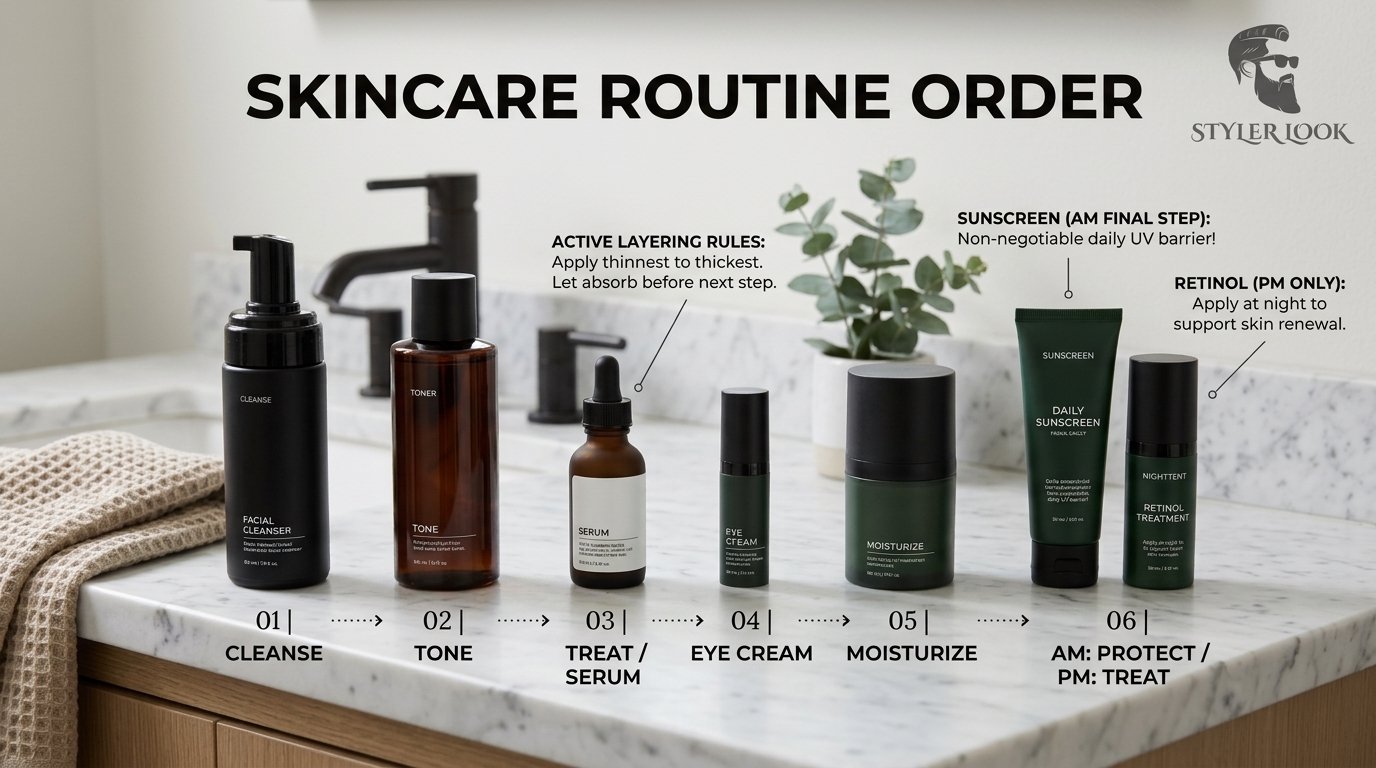
The Master Order Chart

Thinnest to Thickest Rule
Thinnest to thickest means watery products first, lotions next, creams next, and oils last. Toners and essences feel almost like water, serums feel slightly thicker, and moisturizers feel creamy. Face oil feels heaviest, so it seals other layers when used at night.
Texture, not product name, decides position when labels conflict. A thin lotion goes before a thick serum, even when the lotion is called a moisturizer. A thick serum goes after a thin essence, even when both are called serums. Touch and spread, not marketing labels, reveal true texture order.
Morning and Night Master Table
| Position | Morning | Night |
|---|---|---|
| 1 | Cleanser | Oil cleanser or micellar water, when needed, then water-based cleanser |
| 2 | Toner, optional | Toner, optional |
| 3 | Essence, optional | Essence, optional |
| 4 | Serum, such as vitamin C or hydrating serum | Treatment serum or retinoid, one active only |
| 5 | Eye cream or eye serum, position debated, see below | Eye cream or eye serum, position debated, see below |
| 6 | Spot treatment, when used, after serums before cream | Spot treatment, when used, after serums before cream |
| 7 | Moisturizer | Moisturizer, night cream counts here |
| 8 | Sunscreen, always last | Face oil, optional, always last |
| 9 | Primer, then makeup | No sunscreen, no makeup step |
Why Sunscreen and Oil Break the Rule
Sunscreen breaks the thinnest to thickest rule in the morning, because it must stay on the surface to protect skin. Moisturizer under sunscreen supports comfort, while sunscreen over moisturizer preserves an even protective film. Rubbing moisturizer over sunscreen breaks that film and reduces coverage.
Face oil breaks the rule at night in the opposite direction, because it seals everything underneath. Oil over serum blocks serum contact, while serum over oil reaches skin first and then gets sealed. Night oil last makes sense for sealing, while morning oil before sunscreen would disturb sunscreen coverage.
Morning Skincare Order Step by Step
Step 1: Cleanser First
Morning cleanser goes first, always, before any toner, serum, or moisturizer. Overnight oil, sweat, and night cream residue sit between skin and later products. Clean skin allows serums to contact skin directly, rather than sitting on residue.
Use a gentle cleanser with lukewarm water and fingertips, rinsing fully and patting dry. Dry skin may tolerate a light rinse, while oily skin usually benefits from gentle gel cleansing. Avoid harsh scrubs and hot water in the morning, since they increase dryness and redness.
Step 2: Toner, Optional, Immediately After Cleansing
Toner goes immediately after cleansing, while it remains the thinnest product in the routine. Hydrating toners add light moisture, while exfoliating toners count as treatments and should not stack with other exfoliants. Toner is optional, and skipping it never breaks a routine.
Apply toner with hands or a cotton pad, using a thin layer over the whole face. Wait briefly before serum, allowing toner to settle without pooling. Drop toner entirely when it serves no specific purpose, since extra layers increase pilling risk.
Step 3: Essence, Optional, After Toner
Essence goes after toner and before serum, as another thin hydrating layer. Essence feels slightly thicker than toner, but thinner than most serums, so its position follows texture logic. Essence suits dry skin seeking extra hydration, but it adds little when moisturizer already hydrates well.
Use essence sparingly, pressing it gently over the face rather than rubbing vigorously. Wait briefly before serum, preventing layers from mixing into a slippery film. Skip essence on busy mornings, since cleanser, serum, moisturizer, and sunscreen still form a complete order.
Step 4: Serum Before Moisturizer
Serum goes before moisturizer, on clean skin, in a thin layer. Vitamin C serum suits mornings for many people, while hydrating serum suits mornings for dry skin. Serum needs direct skin contact, so moisturizer before serum would block it with a cream film.
Apply serum in a pea-sized amount, spreading evenly without excess pooling. Wait about one minute before moisturizer, allowing serum to settle. Use only one serum at first, since stacking several serums makes order, amount, and irritation source harder to track.
Step 5: Eye Cream Position Debate
Eye cream position remains debated, with two common positions used by different guides. Some guides place eye cream before serum, treating it as a light, targeted layer. Other guides place eye cream after serum and before moisturizer, treating it as a cream layer.
Both positions work when amounts stay tiny and textures stay light. Eye cream before serum suits very light eye serums, while eye cream after serum suits creamier eye products. Choose position by texture: lighter eye product first, thicker eye product later, never both in one routine.
Step 6: Spot Treatment After Serums, Before Cream
Spot treatment goes after water-based serums and before moisturizer, so it contacts skin directly without being buried. Spot treatment under serum gets sealed and diluted, while spot treatment over moisturizer sits on top and does little. Direct contact, then cream sealing, gives spot treatment its intended position.
Apply spot treatment only to the concerned spot, not across the whole face. Wait briefly before moisturizer, allowing spot treatment to settle on the spot. Avoid spreading spot treatment broadly, since surrounding skin does not need the same targeted product.
Step 7: Moisturizer Before Sunscreen
Moisturizer goes before sunscreen in the morning, after serum, eye cream, and spot treatment. Moisturizer seals serum layers, supports barrier comfort, and creates a smooth base for sunscreen. Daytime moisturizer should feel light enough to layer well under sunscreen without pilling.
Apply moisturizer in a pea-sized to almond-sized amount, adjusting to face size and product thickness. Wait briefly before sunscreen, allowing moisturizer to settle. Thick night cream in the morning often pills under sunscreen, so daytime texture choice affects order success.
Step 8: Sunscreen Always Last
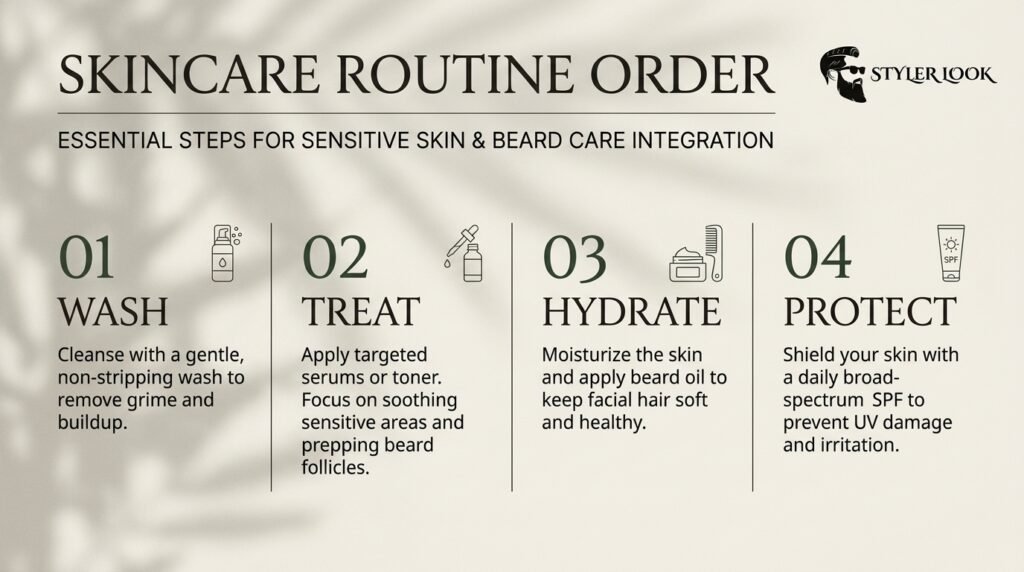
Sunscreen goes always last in the morning, after moisturizer, before primer and makeup. Sunscreen needs an even surface film, and later rubbing breaks that film. Allow sunscreen to set for a few minutes before makeup, reducing sliding and pilling.
Use enough sunscreen to cover face, ears, and neck, following label directions for amount. Two finger lengths for the face is a competitor heuristic, not an official dose, so treat it as practical guidance only. Reapply as labelled during outdoor time, swimming, or heavy sweating.
Step 9: Primer, Then Makeup
Primer goes after sunscreen, once sunscreen has set, before foundation or other makeup. Primer creates a smooth makeup base, but heavy rubbing during primer application disturbs sunscreen coverage. Press primer gently, rather than rubbing vigorously, to preserve the sunscreen film.
Foundation follows primer, applied with light pressure and minimal blending over sunscreen. Powder and setting products follow foundation, again with gentle pressure. Reapplying sunscreen over makeup remains challenging, and powder or spray formats help only when labels support that use.
Night Skincare Order Step by Step
Step 1: Removal First, Then Cleanser
Night order starts with removal, especially after makeup or water-resistant sunscreen. Oil cleanser, cleansing balm, or micellar water removes makeup and sunscreen more effectively than water-based cleanser alone. Removal comes before everything else, since later products cannot work through makeup residue.
Follow removal with a gentle water-based cleanser, rinsing fully and patting dry. Double cleansing means those two steps together, not two water-based cleanses in a row. Bare skin nights often need only one gentle cleanse, and over-cleansing increases dryness.
Step 2: Toner and Essence, Optional, After Cleansing
Night toner goes after cleansing, in the same position as morning toner. Hydrating toner suits dry night routines, while exfoliating toner counts as the night treatment and should not stack with retinoid. Essence follows toner at night, before treatment serum, when used.
Keep night toner and essence layers thin, allowing each to settle briefly. Skip both when the night routine already includes a treatment serum and rich moisturizer. Extra thin layers help only when they serve a specific hydration or treatment purpose.
Step 3: Treatment Serum or Retinoid Before Moisturizer
Night treatment goes before moisturizer, on clean skin, as the main active step. Retinoid, exfoliant, or niacinamide can each serve as the night treatment, but only one new active should start at a time. Treatment needs direct skin contact, so moisturizer before treatment would buffer it heavily.
Retinoid at night suits many adults, with slow introduction and sunscreen the next morning. Exfoliant at night suits texture concerns, but frequency must stay low at first. Niacinamide at night suits oil and redness appearance, with gentler tolerance than stronger actives.
Step 4: Eye Cream After Treatment, Before Moisturizer
Night eye cream usually goes after treatment and before moisturizer, following the same texture logic as morning. Light eye serums can go before treatment serum, but creamier eye creams go after treatment serum. Choose position by texture, keeping amounts tiny around the eye area.
Avoid applying retinoid or exfoliant directly into the eye area unless a product label specifically directs that use. Eye skin tolerates irritation less well than cheek skin, so gentle pressure and small amounts matter. Stop eye products that cause persistent stinging, swelling, or watering.
Step 5: Spot Treatment After Serums, Before Cream
Night spot treatment follows the same position as morning spot treatment: after serums, before moisturizer. Night spot treatment benefits from overnight contact under moisturizer sealing, but it still needs direct skin contact first. Spot treatment over moisturizer at night sits on top and does little overnight.
Apply spot treatment only to concerned spots, waiting briefly before moisturizer. Avoid covering the whole face with spot treatment, since surrounding skin does not need targeted treatment. Seek dermatologist guidance for painful, cystic, or scarring breakouts, rather than layering more spot products.
Step 6: Moisturizer as Night Cream Step
Night moisturizer goes after treatment, eye cream, and spot treatment, sealing earlier layers. Night cream counts as the moisturizer step, not as an extra step after moisturizer. Richer night creams suit dry skin and dry weather, while gel creams suit oily skin even at night.
Apply night moisturizer evenly, allowing treatment layers to settle first. Rich texture at night causes less pilling concern than daytime, since no sunscreen or makeup follows. Still avoid excess amount, since thick layers can feel sticky and transfer to pillows.
Step 7: Face Oil Always Last at Night
Face oil goes always last at night, after moisturizer, when used at all. Oil seals moisturizer and treatment layers, reducing overnight water loss for dry skin. Oil before serum or treatment would block those products, so night oil position matters most of all.
Use only a few drops, pressed gently over moisturizer, never poured freely. Oily skin rarely needs face oil, and adding it by default can increase congestion appearance. Stop face oil when breakouts, congestion, or greasiness increase after starting it.
Where Each Product Goes
Cleanser: Always First
Cleanser position never changes: first, morning and night, before every other product. Oil cleanser and micellar water come before water-based cleanser at night, as removal steps. Water-based cleanser follows removal, completing the first position as a two-part step.
No serum, toner, or treatment works well over unclean skin, since residue blocks contact. Cleansing first also removes sunscreen and makeup that would otherwise mix with later layers. Keep cleanser gentle, since harsh cleansing creates irritation that later layers cannot fix.
Toner: Immediately After Cleansing
Toner position is second, immediately after cleansing, when used at all. Toner feels thinnest, so it goes before essence, serum, and moisturizer. Exfoliating toner counts as a treatment, so it replaces other exfoliants that night rather than adding to them.
Hydrating toner position stays second even in long routines, since later layers grow thicker. Alcohol-based toners often increase dryness, especially for sensitive skin, so fragrance-free hydrating toners suit most routines better. Skip toner when it adds no specific benefit.
Essence: After Toner, Before Serum
Essence position is third, after toner and before serum, when used at all. Essence feels slightly thicker than toner, but thinner than serum, so texture logic places it there. Essence adds hydration, not treatment, in most routines, so it never replaces serum or moisturizer.
Press essence gently over the face, waiting briefly before serum. Essence pooling or excess amount increases pilling, especially under thicker serums. Skip essence when serum and moisturizer already provide enough hydration for comfort.
Serum: Before Moisturizer, After Thin Layers
Serum position is after toner and essence, before eye cream or moisturizer, depending on eye cream texture. Serums carry active ingredients that need direct skin contact, so they go before creams. Water-based serums go before oil-based serums, following thinnest to thickest within the serum step itself.
Use serums one at a time at first, in thin layers, waiting briefly between layers. Stacking three serums increases pilling, amount confusion, and irritation source tracking difficulty. One well-chosen serum often outperforms three overlapping serums in daily practice.
Vitamin C: Morning Serum Position
Vitamin C serum position is morning, after cleansing and thin layers, before moisturizer. Morning placement pairs vitamin C with sunscreen, since both support daytime protection appearance. Vitamin C before moisturizer allows direct skin contact, while moisturizer after seals it.
Start vitamin C on alternate mornings at first, patch testing before full-face use. Tingling can occur, especially at higher strengths or on irritated skin. Store vitamin C away from light and heat, discarding it when colour, smell, or texture changes markedly.
Niacinamide: Morning or Night Serum Position
Niacinamide serum position is morning or night, after thin layers, before moisturizer. Niacinamide layers gently under moisturizer, and it can combine with many other ingredients at low frequencies. Choose one time of day at first, rather than using niacinamide in both morning and night routines immediately.
Avoid stacking several niacinamide products at once, since total concentration becomes hard to track. One niacinamide serum, clearly labelled, keeps order logic simple. Niacinamide before moisturizer allows contact, while moisturizer after seals and supports barrier comfort.

Hyaluronic Acid: Damp Skin Serum Position
Hyaluronic acid serum position is after cleansing, on slightly damp skin, before moisturizer. Damp skin application helps hyaluronic acid spread evenly and feel comfortable. Moisturizer after hyaluronic acid seals hydration, reducing water loss that hyaluronic acid alone cannot prevent.
Hyaluronic acid alone rarely replaces moisturizer, since it needs a sealing layer above it. Dry climates may need richer moisturizer over hyaluronic acid, while humid climates may need lighter sealing. Stop when tightness increases, since layering may need adjustment.
Retinoid: Night Treatment Position
Retinoid position is night, after cleansing and thin layers, before moisturizer, for standard use. Retinoid needs direct skin contact for treatment effect, so moisturizer before retinoid buffers it. Buffering helps sensitive skin, but it trades some potency for comfort, according to one layering guide.
Start retinoid twice weekly at night, increasing only after several calm weeks. Sunscreen the next morning becomes even more important during retinoid use, since sun sensitivity increases. Seek clinician guidance for pregnancy, breastfeeding, or medical skin conditions before starting any retinoid product.
Exfoliant: Night Treatment Position, Not Stacked
Exfoliant position is night, after cleansing, before moisturizer, as the treatment step for that night. AHA and BHA exfoliants both count as treatments, so neither should stack with retinoid on the same night for beginners. Exfoliating toner position is also second, immediately after cleansing, when toner is the exfoliant form.
Start exfoliant once weekly at night, increasing only when skin stays calm for several weeks. Exfoliant overuse causes redness, peeling, and barrier damage that mimics breakouts. Sunscreen the next morning matters after exfoliant use, since sun sensitivity increases.
Eye Cream: Texture Decides Position
Eye cream position depends on texture, not on a single universal rule. Light eye serums go before face serum, while creamier eye creams go after face serum and before moisturizer. Both positions appear in different guides, so texture logic resolves the debate better than brand claims.
Use a tiny amount, about rice-grain size for both eyes combined, pressed gently with the ring finger. Avoid pulling eye skin, since eye area tolerates rubbing poorly. Skip eye cream entirely when regular moisturizer already feels comfortable around the eyes.
Spot Treatment: After Serums, Before Cream
Spot treatment position is after water-based serums, before moisturizer, morning and night. Spot treatment under serum gets diluted and sealed, while spot treatment over moisturizer sits on top without contact. Direct spot contact, then cream sealing, gives the clearest position logic.
Apply spot treatment only to concerned spots, using a clean fingertip or cotton swab. Wait briefly before moisturizer, preventing spot treatment from spreading broadly. Seek dermatologist guidance for painful, cystic, or scarring breakouts, rather than adding more spot layers.
Moisturizer: Before Sunscreen and Oil
Moisturizer position is after serums, eye cream, and spot treatment, before sunscreen in the morning and before face oil at night. Moisturizer seals earlier layers, supports barrier comfort, and creates a base for sunscreen or oil. Day cream and night cream both count as moisturizer steps, not as extra steps beyond moisturizer.
Daytime moisturizer should feel light enough to layer under sunscreen without pilling. Nighttime moisturizer can feel richer, since no sunscreen or makeup follows. Amount matters: excess moisturizer increases pilling, while too little leaves skin tight after serums.
Face Oil: Night Last, Never Before Serum
Face oil position is night last, after moisturizer, when used at all. Face oil seals all previous layers, making it the heaviest final step. Face oil before serum blocks serum contact, and face oil before sunscreen disturbs sunscreen coverage, so morning oil placement needs caution.
Morning face oil, when used, goes before sunscreen only with great care, and many routines skip morning oil entirely. Night oil suits dry skin in winter, applied in a few drops over moisturizer. Stop face oil when congestion or breakouts increase after starting it.
Sunscreen: Morning Last, Before Primer
Sunscreen position is morning last, after moisturizer, before primer and makeup. Sunscreen must stay on the surface as an even film, so later products should press gently, not rub vigorously. Primer after sunscreen, makeup after primer, completes the morning order without disturbing the film.
Sunscreen at night has no position, since sunscreen serves daytime UV protection. Night routines end with moisturizer or face oil, never sunscreen. Reapplying sunscreen during the day follows label directions, with powder or spray formats helping over makeup only when labels support that use.
Primer and Makeup: After Sunscreen Sets
Primer position is after sunscreen sets, before foundation. Waiting a few minutes after sunscreen reduces sliding and pilling during primer application. Press primer gently, using minimal rubbing, to preserve sunscreen coverage underneath.
Foundation follows primer, then powder and setting products, each with gentle pressure. Heavy blending over sunscreen disturbs coverage, so light application helps. Makeup removal at night starts the night order again, with oil cleanser or micellar water first.
Face Mask: After Cleansing, Before Serum
Face mask position is after cleansing, before serum and moisturizer, when used occasionally. Sheet masks and wash-off masks both go on clean skin, allowing mask ingredients direct contact. Rinse wash-off masks fully, then continue with serum and moisturizer in normal order.
Sheet mask essence can replace toner or serum for that routine, to avoid over-layering. Do not apply serum before a sheet mask, since mask layers would seal serum unevenly. Mask frequency should stay low, especially for clay or exfoliating masks that increase dryness.
Order Exceptions You Must Know
Sunscreen Last Exception
Sunscreen last is the most important exception, overriding thinnest to thickest in the morning. Even thin sunscreens go after thicker moisturizers, because sunscreen must remain on the surface. Moisturizer with SPF still goes in the moisturizer position, but separate sunscreen after moisturizer provides clearer coverage.
Sunscreen over face oil in the morning disturbs coverage, so morning oil should be skipped or used very sparingly. Sunscreen over primer would also fail, since primer is a makeup base, not a skincare seal. Morning order ends with sunscreen, full stop, before any makeup step.
Face Oil Last Exception
Face oil last is the night exception, overriding serum and moisturizer positions. Oil seals everything, so it goes after moisturizer, never before serum or treatment. Oil-based serums also go after water-based serums, following the same sealing logic within the serum step.
Face oil over spot treatment seals the spot, but spot treatment still needs direct contact first. Face oil over retinoid buffers retinoid, similar to sandwich method, but it also seals it heavily. Night oil suits dry skin, while oily skin usually skips it entirely.
Sandwich Method Buffer Exception
Sandwich method means moisturizer, then retinoid, then moisturizer again, buffering direct retinoid contact. Sandwich method deliberately breaks standard retinoid-before-moisturizer order for comfort. One layering guide notes sandwiching trades some potency for comfort, labelled as that guide’s explanation, not a universal rule.
Sensitive skin and beginners often tolerate sandwich method better than direct retinoid application. Use sandwich method for several weeks before trying direct application, if direct application ever feels necessary. Stop and simplify when irritation persists despite buffering and rest nights.
Double Cleansing Order Exception
Double cleansing order is oil-based first, water-based second, never reversed. Oil cleanser removes makeup and sunscreen, while water-based cleanser removes remaining residue. Reversing the order leaves oil residue over clean skin, reducing second cleanse effectiveness.
Double cleansing applies mainly at night, after makeup or water-resistant sunscreen. Morning double cleansing rarely helps, since overnight skin needs only gentle cleansing. Bare skin nights often need only one gentle cleanse, and over-cleansing increases dryness.
Wait Times Between Layers
Competitor Wait Time Guidance
Competitor guides suggest 30 to 90 seconds between layers, labelled as competitor guidance, not a strict rule. Water-based layers need about 30 to 60 seconds, while thicker creams need longer to settle. Waiting allows each layer to absorb partially, reducing pilling and mixing.
No official wait time rule exists, since product textures, amounts, and skin types vary widely. Wait until skin feels slightly tacky, not wet, before adding the next layer. Longer waits help pilling, while rushed layering increases mixing and sliding.
| Layer transition | Practical wait guide | Why waiting helps |
|---|---|---|
| Cleanser to toner | Skin patted dry, toner immediately | Thin layer spreads evenly on clean skin |
| Toner to essence | 30 seconds | Prevents pooling and mixing |
| Essence to serum | 30 to 60 seconds | Serum contacts skin, not wet essence film |
| Serum to eye cream | 30 to 60 seconds | Eye product stays in place |
| Serum to spot treatment | 30 seconds | Spot treatment contacts skin directly |
| Spot treatment to moisturizer | 30 to 60 seconds | Spot treatment settles before sealing |
| Moisturizer to sunscreen | 1 to 2 minutes | Sunscreen film forms evenly |
| Sunscreen to primer | 2 to 3 minutes | Makeup does not disturb sunscreen film |
When Waiting Matters Most
Waiting matters most before sunscreen and before makeup, since those steps disturb earlier layers most easily. Sunscreen over wet moisturizer slides and thins, while makeup over wet sunscreen pills and streaks. A few extra minutes before those steps improves coverage more than any extra product.
Waiting matters least between thin hydrating layers, where slight mixing causes little harm. Toner, essence, and hydrating serum can follow quickly when amounts stay small. Pilling signals a need for longer waits, smaller amounts, or fewer layers, in that order.
Pilling and Order Mistakes
Pilling Diagnosis Table
| Pilling pattern | Likely order cause | Fix in order terms |
|---|---|---|
| Serum balls up under moisturizer | Too much serum, or moisturizer applied too soon | Reduce serum amount, wait longer |
| Moisturizer balls up under sunscreen | Too much moisturizer, or sunscreen applied too soon | Reduce moisturizer, wait 1 to 2 minutes |
| Sunscreen pills under makeup | Makeup rubbed over unset sunscreen | Wait 2 to 3 minutes, press makeup gently |
| Face oil slides over serum | Oil applied before serum settled | Wait longer, use fewer oil drops, oil last only |
| Spot treatment disappears under cream | Spot treatment applied after moisturizer | Move spot treatment before moisturizer |
| Multiple serums roll together | Stacked serums, excess amount | Use one serum, thin layer, wait between layers |
Common Order Mistakes
- Applying moisturizer before serum, blocking serum contact with a cream film.
- Applying face oil before serum, sealing skin before treatment reaches it.
- Applying sunscreen before moisturizer, then breaking sunscreen film with moisturizer rubbing.
- Applying spot treatment after moisturizer, leaving it on top without skin contact.
- Applying primer before sunscreen, reversing makeup base and UV protection positions.
- Stacking three serums without waits, causing pilling and amount confusion.
- Using night cream in the morning under sunscreen, increasing pilling risk.
- Using face oil in the morning before sunscreen, disturbing sunscreen coverage.
- Applying exfoliant and retinoid on the same night as a beginner, increasing irritation.
- Rushing all layers in under a minute, mixing products into a slippery film.
Fixes That Preserve Order
Fix order mistakes by removing one layer, not by adding another product. Reduce amounts first, increase wait times second, and drop optional layers third. Pilling often resolves with smaller amounts alone, without changing product types.
Reorder only one step at a time when testing a fix, so the cause remains clear. Keep a simple order diary, noting step sequence, amounts, and pilling or irritation response. Order diaries prevent repeating the same layering mistake with new products later.
Order by Skin Type
Oily Skin Order Notes
Oily skin order should keep gel textures early and lightweight moisturizer before sunscreen. Gel cleanser first, optional niacinamide serum, gel cream moisturizer, then sunscreen last suits oily skin well. Face oil at night usually gets skipped, since sealing adds unnecessary heaviness.
Exfoliant at night, when used, goes before moisturizer as the treatment step, once weekly at first. Spot treatment after serum and before gel cream keeps direct contact without heavy sealing. Sunscreen texture matters for oily skin order success, since heavy sunscreen pills more easily.
Dry Skin Order Notes
Dry skin order should keep cream textures and richer sealing layers in correct positions. Cream cleanser first, hydrating toner or essence, hyaluronic acid serum on damp skin, rich moisturizer, then sunscreen last suits dry skin well. Face oil at night, after rich moisturizer, seals dry skin overnight.
Hyaluronic acid position before moisturizer matters especially for dry skin, since moisturizer seals it. Rich night cream counts as moisturizer, not as an extra step after moisturizer, unless face oil follows. Winter dry skin may need longer waits before sunscreen, since richer creams settle more slowly.
Sensitive Skin Order Notes
Sensitive skin order should stay short, with fewer layers and longer rests between active nights. Cream cleanser first, fragrance-free moisturizer, and sunscreen last form the sensitive morning order. Night sensitive order uses cream cleanser, optional gentle treatment, and rich moisturizer, with face oil only when tolerated.
Sandwich method helps sensitive retinoid order, with moisturizer before and after retinoid. Exfoliant and retinoid never share a night for sensitive beginners, since stacking increases irritation sharply. Stop and simplify immediately when burning, peeling, or persistent redness appears.
Combination Skin Order Notes
Combination skin order should use lotion textures as a middle ground, rather than separate routines for each zone. Lotion cleanser first, lotion moisturizer before sunscreen, and gel cream at night suits combination skin well. Zone-specific products can follow the same order, with gel on oily zones and cream on dry zones.
Spot treatment position stays after serum and before moisturizer, even when only one zone needs it. Face oil, when used, goes only over dry zones at night, after moisturizer, not over the whole face. Seasonal texture changes keep combination order working, lighter in humid summer and richer in dry winter.
Short Versus Long Routines
Minimal 3-Step Order
| Position | Morning | Night |
|---|---|---|
| 1 | Gentle cleanser | Gentle cleanser |
| 2 | Moisturizer | Moisturizer |
| 3 | Sunscreen, last | No third step, moisturizer ends routine |
Minimal order works well for beginners, busy mornings, and sensitive skin. Three steps cover cleansing, barrier support, and UV protection, without optional layers. Add serum only after several calm weeks, placing it between cleanser and moisturizer.
Full 10-Step Order
| Position | Morning | Night |
|---|---|---|
| 1 | Cleanser | Oil cleanser, then water-based cleanser |
| 2 | Toner | Toner |
| 3 | Essence | Essence |
| 4 | Serum | Treatment serum or retinoid |
| 5 | Eye cream | Eye cream |
| 6 | Spot treatment | Spot treatment |
| 7 | Moisturizer | Moisturizer |
| 8 | Face oil, optional, before sunscreen with caution | Face oil, optional, last |
| 9 | Sunscreen, last | No sunscreen |
| 10 | Primer, then makeup | No makeup step |
Full order suits experienced users with specific concerns, time, and tolerance for layering. Full order increases pilling, cost, and irritation source tracking difficulty, so it should never be a beginner starting point. Drop optional steps freely when time, budget, or skin comfort requires simplicity.
When Order Cannot Fix a Problem
Checklist for Professional Care
- Persistent acne that does not improve with gentle, consistent care and correct order.
- Painful, cystic, or scarring breakouts, or breakouts leaving lasting marks.
- Eczema, rosacea, or dermatitis symptoms, including persistent redness, scaling, or itching.
- Changing moles, new spots, non-healing sores, or unusual growths.
- Severe reactions to products, including swelling, blistering, or spreading rash.
- Pigmentation concerns that worsen, spread, or cause distress.
Order correction helps absorption and coverage, but it cannot diagnose or treat medical skin conditions. Delaying dermatologist care can worsen scarring or disease, especially for painful or scarring conditions. Bring product lists, order notes, and reaction photos to appointments when possible.
Frequently Asked Questions
What is the correct skincare routine order?
Correct order follows thinnest to thickest, with sunscreen last in the morning and face oil last at night. Morning order is cleanser, toner optional, serum, eye cream, spot treatment, moisturizer, sunscreen, primer, makeup. Night order replaces sunscreen with face oil last, when used.
What order should skincare go in morning?
Morning order is cleanser, toner optional, essence optional, serum, eye cream, spot treatment, moisturizer, sunscreen, primer, makeup. Sunscreen always goes last among skincare products, before primer and makeup. Serum goes before moisturizer, and spot treatment goes after serums before cream.
What order should skincare go in night?
Night order is removal when needed, cleanser, toner optional, essence optional, treatment serum, eye cream, spot treatment, moisturizer, face oil optional last. Double cleansing means oil cleanser first, then water-based cleanser, both in the first position. No sunscreen step exists at night.
Does serum go before or after moisturizer?
Serum goes before moisturizer, on clean skin, in a thin layer. Moisturizer after serum seals serum layers and supports barrier comfort. Moisturizer before serum blocks serum contact with a cream film, reducing its intended position effect.
Does moisturizer go before or after sunscreen?
Moisturizer goes before sunscreen in the morning, after serum and spot treatment. Sunscreen after moisturizer preserves an even protective film on the surface. Rubbing moisturizer over sunscreen breaks that film and reduces coverage.
Does sunscreen go before or after makeup?
Sunscreen goes before makeup, after moisturizer, as the last skincare step. Primer follows sunscreen once it sets, then foundation and other makeup follow primer. Makeup over sunscreen should press gently, not rub vigorously, to preserve coverage.
Does primer go before or after sunscreen?
Primer goes after sunscreen, once sunscreen has set for a few minutes. Primer before sunscreen would place makeup base under UV protection, reversing their intended positions. Sunscreen needs surface coverage, while primer needs a smooth base above it.
Does eye cream go before or after serum?
Eye cream position depends on texture, with both positions used by different guides. Light eye serums go before face serum, while creamier eye creams go after face serum and before moisturizer. Choose position by texture, using tiny amounts and gentle pressure.
Does face oil go before or after moisturizer?
Face oil goes after moisturizer, as the final night sealing layer. Oil before moisturizer or serum blocks earlier products with a sealing film. Morning face oil before sunscreen disturbs sunscreen coverage, so most routines skip morning oil.
Where does spot treatment go in a skincare routine?
Spot treatment goes after water-based serums and before moisturizer, morning and night. Spot treatment under serum gets diluted, while spot treatment over moisturizer sits on top without contact. Apply only to concerned spots, waiting briefly before moisturizer.
Does toner go before or after serum?
Toner goes before serum, immediately after cleansing, while it remains the thinnest product. Essence follows toner, then serum follows essence, following thinnest to thickest. Exfoliating toner counts as a treatment, so it replaces other exfoliants that night.
Where does vitamin C go in a skincare routine?
Vitamin C serum goes morning, after cleansing and thin layers, before moisturizer. Morning placement pairs vitamin C with sunscreen, since both support daytime protection appearance. Patch test first, starting on alternate mornings when skin is new to vitamin C.
Where does retinol go in a skincare routine?
Retinoid products go night, after cleansing and thin layers, before moisturizer, for standard use. Sandwich method, with moisturizer before and after retinoid, buffers sensitive skin but trades some potency for comfort. Sunscreen the next morning matters during retinoid use.
Where does a face mask go in a skincare routine?
Face mask goes after cleansing, before serum and moisturizer, when used occasionally. Sheet mask essence can replace toner or serum for that routine, avoiding over-layering. Rinse wash-off masks fully, then continue with serum and moisturizer in normal order.
How long should I wait between skincare steps?
Competitor guides suggest 30 to 90 seconds between layers, labelled as competitor guidance, not a strict rule. Wait until skin feels slightly tacky, not wet, before adding the next layer. Longer waits matter most before sunscreen and makeup, where disturbance causes coverage loss.
What happens if I apply skincare in the wrong order?
Wrong order often causes pilling, blocked serum absorption, disturbed sunscreen coverage, or wasted product, rather than immediate harm. Heavy cream before serum blocks serum contact, while moisturizer over sunscreen breaks its film. Reordering, reducing amounts, and waiting longer usually fixes order problems.
Can I apply moisturizer before serum?
Moisturizer before serum is not standard order, since cream film blocks serum contact. Sandwich method deliberately uses moisturizer before retinoid for sensitive skin comfort, trading some potency for tolerance. Standard serum order remains serum before moisturizer for most routines.
Can I apply face oil before serum?
Face oil before serum is not standard order, since oil seals skin before serum reaches it. Face oil always goes last at night, after moisturizer, when used. Morning face oil before sunscreen also disturbs sunscreen coverage, so most routines skip morning oil.
What is the thinnest to thickest rule?
Thinnest to thickest means watery products first, creams next, oils last, with sunscreen last in the morning as an exception. Light serums need clean skin contact, while heavier creams and oils seal earlier layers. Texture, not product name, decides position when labels conflict.
What is double cleansing order?
Double cleansing order is oil-based cleanser first, water-based cleanser second, at night after makeup or water-resistant sunscreen. Oil cleanser removes makeup and sunscreen, while water-based cleanser removes remaining residue. Reversing the order leaves oil residue over clean skin.
What order do I apply skincare for sensitive skin?
Sensitive skin order stays short, with cream cleanser, fragrance-free moisturizer, and sunscreen last in the morning. Night sensitive order uses cream cleanser, optional gentle treatment, and rich moisturizer, with sandwich buffering for retinoid when used. Stop and simplify immediately when irritation persists.
Does the order change in summer or winter?
Core order does not change seasonally, but textures and amounts change. Summer order uses lighter gel textures and more frequent sunscreen reapplication, while winter order uses richer creams and optional night oil. Sunscreen stays last in the morning in both seasons.
How do I fix skincare pilling caused by order?
Fix pilling by reducing amounts first, increasing wait times second, and dropping optional layers third. Reorder only one step at a time when testing a fix, so the cause remains clear. Pilling often resolves with smaller amounts alone, without changing product types.
Conclusion
Skincare routine order works when cleanser comes first, thin layers precede thick layers, spot treatment sits after serums before cream, moisturizer seals earlier layers, sunscreen ends the morning, and face oil ends the night. Texture logic, not product count, decides most positions, while sunscreen and oil exceptions protect coverage and sealing respectively. Eye cream position follows texture, sandwich buffering helps sensitive skin, and wait times before sunscreen and makeup preserve coverage.
Print the master chart, keep morning and night orders visible, and reorder only one step at a time when testing a fix. Reduce amounts, wait longer, and drop optional layers before buying new products for pilling or absorption problems. Seek dermatologist guidance for persistent or concerning skin conditions, and let correct order, not product count, carry your skincare routine order forward.

14 thoughts on “Skincare Routine Order: Morning & Night Layering”