

Best skincare routine for makeup prep is not a longer routine. It is the right routine, in the right order, with waits.
Makeup does not fail on its own. It reveals the prep underneath it, hour by hour.
Well prepped skin lets foundation glide on evenly and stay where you put it.
Poorly prepped skin give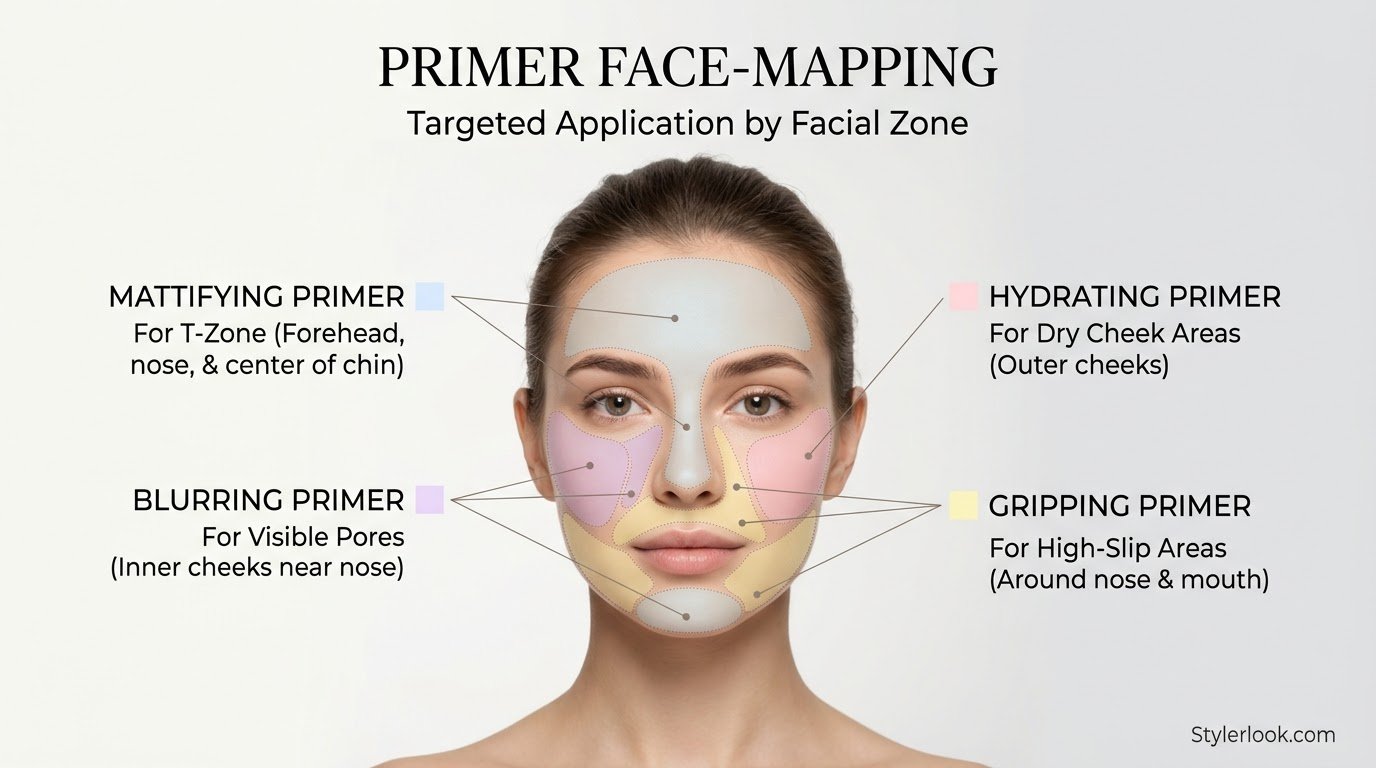 s you the three failures everyone knows: pilling, separation, and caking.
The whole method fits in five to ten minutes: cleanse, hydrate, moisturize, protect, prime.
This page adds what most guides skip: the wait times, the zone method for primer, and a diagnostic table.
One boundary up front: this is general information, not medical advice, and persistent skin reactions belong to a dermatologist.
Stylerlook organizes its routine library the same way, so this prep page sits on top of your normal skincare.
The Prep Order: Seven Steps, In Sequence
Every serious guide in this space lands on the same order. The E.l.f. Cosmetics skin prep guide states it cleanly in its own FAQ.
Skincare first, thinnest to thickest, then primer as the first makeup step, then foundation.
- Gentle cleanser, to clear overnight oil and residue
- Toner, mist, or essence (optional hydration lane)
- Serum, water based and targeted
- Eye cream, small and early
- Moisturizer, matched to your skin type
- Sunscreen, broad spectrum SPF 30 or higher, last skincare step
- Primer, by zone, as the bridge into makeup
The Skincare routine order guide walks the general layering logic behind this order for your full routine, morning and night.
Prep is a shortened morning routine, not a second routine. Steps you do not need that day simply drop out.
Step One: Cleanse Without Stripping
Morning cleansing removes overnight sebum, sweat, and night product residue. That film is what foundation breaks on.
Use a gentle cleanser and lukewarm water. Skin should feel refreshed and soft afterward, never tight or squeaky.
Dry and sensitive skin can often rinse with water only in the morning, a strand several guides share.
Oily skin benefits from the full gentle cleanse, because its overnight oil load is the separation risk.
Step Two: The Hydration Lane
After cleansing, damp skin takes hydration best. This lane is a mist, essence, or hydrating toner.
Its job is to lay down a thin water layer that your serum and moisturizer then build on.
The RMS Beauty skin prep guide builds this lane around a serum mist, one step doing the dampening and the hydrating together.
Astringent toners have no place here. Alcohol heavy toners undo the comfort the rest of prep builds.
Step Three: Serum, Thin and Targeted
Serums go on early because they are thin. Water based formulas belong directly after cleansing or toning.
A hyaluronic acid or glycerin serum is the default prep serum: it binds water to the surface layers.
Apply it to slightly damp skin and give it its short wait before anything heavier covers it.
Treatment serums with strong actives are night tools for most people. Morning prep favors hydration over treatment.
Step Four: Eye Cream, Small and Early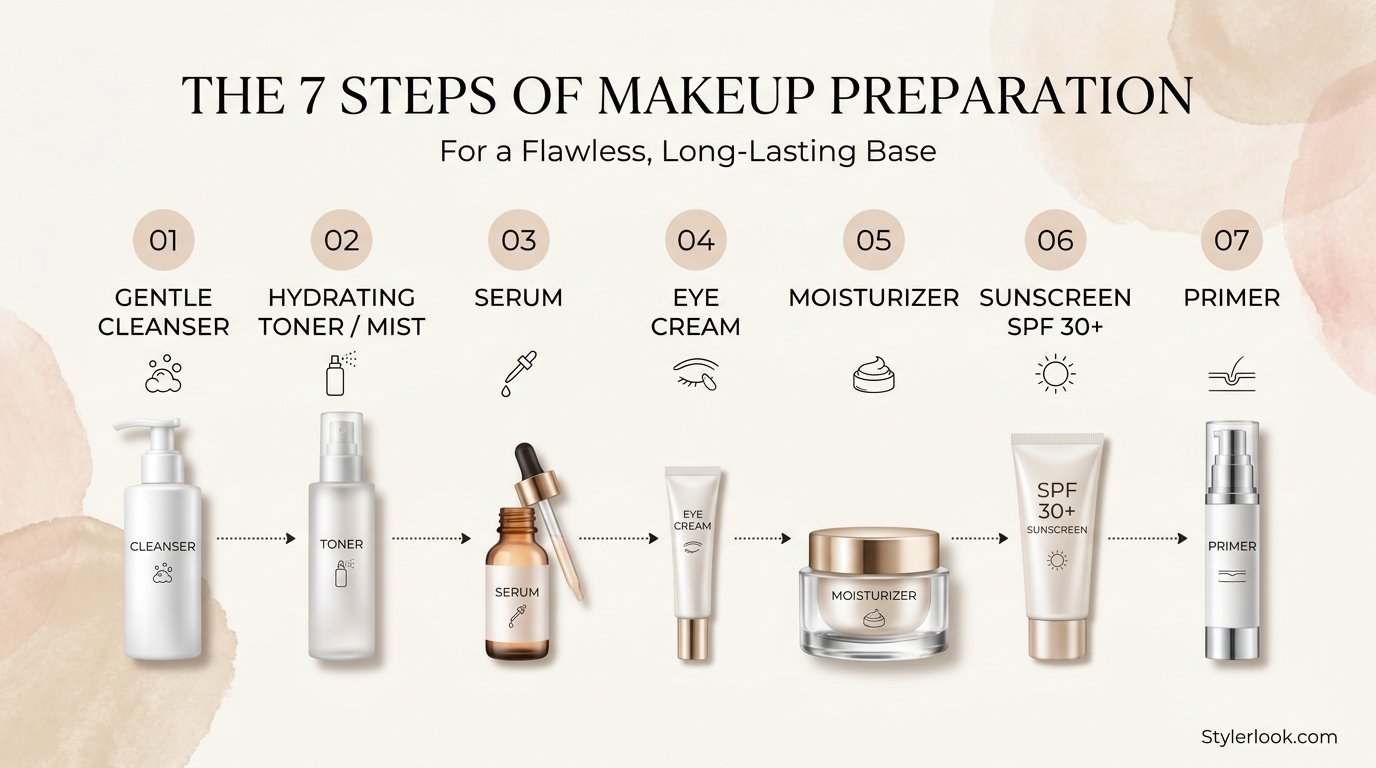
The eye area is where concealer creases first, and it needs its prep before heavier layers arrive.
Use a small amount, early in the order, and let it absorb fully before concealer comes near it.
The IPSY artist skin prep feature gives eye cream its own step, on a working artist’s insistence, which most guides fold away.
Thick eye cream plus thick concealer is the crease recipe. Thin plus thin is the fix.
Step Five: Moisturizer, the Non Negotiable
Moisturizer seals the hydration layers and gives base products a smooth, even surface to adhere to.
The artist line carried by the IPSY artist skin prep feature is blunt: moisturizer before makeup should 100 percent not be skipped.
That holds for oily skin too. Skipping it leaves skin unbalanced, and many faces produce more oil in response.
Use less than at night: a thin, even layer that absorbs to soft, not slippery.
Step Six: Sunscreen, Then Let It Set
Sunscreen is the last skincare step, broad spectrum SPF 30 or higher, per American Academy of Dermatology skin care basics.
Foundation with SPF does not replace it, because nobody applies foundation at sunscreen amounts.
Then comes the step people rush: sunscreen needs three to five minutes to set and form its film.
The Timeless Skin Care order guide makes the point precisely: brushes and sponges dragged over unset sunscreen lift the filters.
Step Seven: Primer, the Bridge
Primer is the final bridge between skincare and makeup, applied only after skincare has settled.
The E.l.f. Cosmetics skin prep guide puts it the same way: skincare first, allowing each product to absorb, then primer.
Primer is not a blanket step. The next sections give it the zone treatment it actually needs.
The Wait Is a Step
Most prep guides give an order and no clock. The clock is where makeup is saved or lost.
Layers applied back to back sit on top of each other as one thick, mobile film.
Foundation blended over that film moves it around, which is how streaks, pilling, and early separation start.
The Wait Times, Printed as Strands
Guides disagree on exact seconds, so this page prints each source’s number with its source, never merged.
|
Layer |
Wait Strand |
Source Type |
|---|---|---|
|
Serum before moisturizer |
30 to 60 seconds |
Order guide (Timeless) |
|
Serum before moisturizer |
1 to 2 minutes |
Pharmacy guide (UK) |
|
Face cream before next step |
About 60 seconds |
Brand prep guide (RMS) |
|
Moisturizer before makeup |
1 to 2 minutes |
Order guide (Timeless) |
|
Sunscreen before primer or foundation |
3 to 5 minutes |
Order guides (Timeless) |
|
Whole skincare stack before makeup |
5 to 10 minutes |
Diagnostic guide (Makeup.com) |
|
Foundation after moisturizer |
At least 1 minute to 5 to 10 |
Compiled artist table |
The pattern inside the disagreement is stable: seconds for thin layers, minutes for sunscreen.
The Readiness Test
Numbers help, but your skin gives the real signal. One order guide phrases it as a touch test.
Skin is ready when it feels soft and hydrated, not wet or sticky.
If a layer still feels slippery or tacky, wait another minute or use less product next time.
That single test prevents more pilling than any product swap in this article.
Hydrate in Layers, Seal Once
Hydration before makeup follows the same physics as the Skincare routine hub teaches for daily care.
Humectants pull water in. Glycerin and hyaluronic acid in your serum do that job.
Moisturizer seals it. One seal, matched to your type, over the water layers.
Where beginners go wrong is sealing three times: serum, cream, oil, and primer all sitting heavy.
Each extra seal is another mobile layer for foundation to skate on by midday.
How Much Is Enough
Judge by finish, not by drops. The surface should look calm and feel cushioned, not glossy wet.
Add a second thin pass only where skin still feels tight, usually the cheeks or around the nose.
That zone logic, more where dry and less where oily, runs through this whole page.
It is also why the Morning skincare routine guide matters: prep starts from skin that was cared for last night, not rescued this morning.
Primer by Zone, Not by Habit
One primer, everywhere, is the beginner error this page exists to correct.
Your face is not one surface. Oil lives in the T zone, dryness lives on the cheeks.
|
Primer Type |
Where It Goes |
What It Solves |
|---|---|---|
|
Gripping primer |
Nose, chin, anywhere makeup slides |
Wear time and adhesion |
|
Mattifying primer |
T zone only |
Shine breaking through |
|
Hydrating primer |
Cheeks and dry zones |
Foundation clinging to patches |
|
Blurring primer |
Visible pore areas |
Texture emphasis |
|
Illuminating primer |
High points, dull zones |
Flat, tired looking base |
Press primer into the zone with fingertips. A pea sized amount per zone is plenty.
Give primer a brief set before foundation, and never prime over unset sunscreen.
When You Can Skip Primer Entirely
Short wear, natural finish, balanced skin: moisturizer plus set sunscreen can carry a light base alone.
Primer earns its slot for long days, events, oil control, pore texture, or dry cheek grip.
Skipping it on a wedding day and wearing it on a grocery run is exactly backwards.
Prep Cards by Skin Type
The RMS Beauty skin prep guide carries the only full skin type prep table among the top guides. These cards extend that discipline.
The Dry Skin Card
Cream or milk cleanser, or a morning water rinse. Hydrating serum on damp skin, richer moisturizer on top.
Extra moisturizer goes only on tight zones: cheeks, around the nose, the upper lip line.
Hydrating primer where makeup clings, and foundation pressed on thinly with a damp sponge.
The Gentle skincare routine for dry sensitive skin guide shows the calmest daily base underneath this card for reactive dry skin.
The Oily Skin Card
Gentle gel cleanse, lightweight gel moisturizer, set sunscreen, mattifying primer on the T zone only.
Less skincare on the nose specifically, where sebum breaks foundation first, per the Ulta Beauty separation and pilling guide.
Thin foundation layers, blotting before powder, and powder only where shine actually appears.
The Combination Skin Card
Combination skin is the zone method’s home ground: light layers everywhere, richer cream only on dry cheeks.
Mattifying or gripping primer on the T zone, hydrating primer on the cheeks, sunscreen across everything.
One blanket product, whether cream or primer, is the combination beginner error in both directions.
The Sensitive Skin Card
Less is more: fragrance free cleanser and moisturizer, products your skin already knows well.
No new product anywhere near an important day, and exfoliation at its gentlest and least frequent.
The full cautious daily build lives in the Gentle skincare routine for dry sensitive skin guide, and prep borrows it unchanged.
The Mature Skin Card
Layered hydration, a comfortable moisturizer, and eye cream early so concealer has a smooth bed.
Thin foundation pressed, not built, because heavy layers settle into lines and announce themselves.
Heavy matte powder is the enemy here. The prep goal is plump, not coated.
Prep by Finish: Matte, Natural, Dewy
Decide the finish before you start, because prep products swap while the order stays fixed.
Matte prep leans on gel textures, T zone mattifying primer, and powder placed with intent.
Natural prep is the default card: balanced hydration, primer only where a problem lives.
Dewy prep leans on layered hydration, illuminating primer on high points, and restraint with powder.
Artists adjust the same steps by finish, for soft glam or full glam, rather than changing the order.
That is the professional habit worth copying: finish first, products second.
The Base Debate: Water Versus Silicone
You will hear a famous rule: match your bases, water based with water based, silicone with silicone.
The Makeup.com patchy makeup diagnostic teaches exactly that in its diagnostic table, as the fix for separation.
A UK diagnostic guide calls the same rule too simple, blaming film thickness and friction instead.
Both strands are printed here because the evidence genuinely splits. The practical synthesis is what matters.
Test your pair before an important day. Keep layers thin. Press, do not rub.
If one pairing always pills, change one product, not the whole routine.
When Makeup Fails: The Diagnostic Table
Pilling, separation, and caking are three different failures, and each has its own fix.
The Ulta Beauty separation and pilling guide defines them separately, and the Makeup.com patchy makeup diagnostic maps symptoms to causes. Merged, they give this table.
|
What You See |
Likely Cause |
The Fix |
|---|---|---|
|
Tiny balls while blending |
Unabsorbed layers, friction, fighting bases |
Thinner layers, real waits, press with a sponge |
|
Foundation breaking on nose and T zone |
Sebum breaking the base apart |
Less product there, gripping primer, blot before powder |
|
Thick, heavy finish in lines |
Too much product over dry texture |
Exfoliate on schedule, hydrate, build thin layers |
|
Flakes highlighted on cheeks |
Dead skin buildup under foundation |
Gentle exfoliation nights before, hydrating primer |
|
Makeup sliding by midday |
Overloaded, slippery skincare film |
Subtract a layer, extend the waits |
|
Concealer creasing under eyes |
Thick cream plus thick concealer |
Thin eye cream early, thin concealer, minimal set |
Diagnosis beats product shopping. Name the failure first, then change exactly one variable.
Why Makeup Looks Worse After Two Hours
A widely read wear diagnostic makes the point well: the problem is usually the interaction, not the foundation.
Oil production, warming unabsorbed layers, and sunscreen and foundation incompatibility do the damage together.
Every one of those causes is a prep variable, which is why this page exists.
Event Prep: The Trial Run Rule
For weddings, photos, and long days, the morning routine is the smallest part of prep.
The Week Before
Trial run the exact stack several days before: same skincare, same primer, same foundation.
Wear it for real hours, photograph it, and note where it fails. That rehearsal is the prep.
Exfoliate gently one to two nights before, never the morning of, and change nothing after the trial.
The Night Before
A proper evening cleanse and a good night moisturizer, following your Nighttime skincare routine guide, set up the morning.
Sheet masks and under eye patches belong to the event lane, used tonight or in the morning if already tested.
Nothing new on the day is the artist rule that travels furthest. New products are weekday experiments.
The Morning Of
Run the standard seven steps, with the waits respected, not trimmed because the schedule is exciting.
Apply lip balm at the very start of prep, so lips are conditioned when lipstick finally arrives.
Blot any excess balm before color. Dry, flaking lips are a prep failure no lipstick fully hides.
Occasion Lanes: Masks, Patches, and Extras
Sheet masks add a hydration surge after cleansing on event days, a habit several artist routines share.
Follow a mask with moisturizer to seal, and skip masks your skin has never met before an important day.
Under eye patches sit in the same lane: pleasant, optional, and bound by the trial run rule.
Cold tools and massage appear in artist habits as extras. No top guide makes them core steps.
Treat them as preference, never substitutes for hydration, sunscreen, and the waits.
Prep for the Looks You Actually Wear
No Makeup Makeup
Skincare does the visible work: full hydration layers, set sunscreen, spot concealer only where needed.
Primer appears only where shine or fade threatens. The order is identical, the makeup simply thinner.
Full Glam and Long Wear
Grip becomes the priority: gripping primer by zone, thin layers built patiently, powder placed surgically.
The Best skincare routine guide compares full routine philosophies when you want the daily base under glam days sorted first.
Tinted Moisturizer and Skin Tint Days
Moisturizer can merge with the tint step, but the sunscreen amount problem remains unchanged.
A dedicated SPF underneath still applies, and every wait and pilling rule applies with it.
Event Prep for Men
The same seven steps apply, with grooming folded in: prep after shaving, never before it.
The Mens skincare routine guide keeps the daily version minimal, and event prep borrows it with primer by zone added.
Glasses, Masks, and Real Life
Nose pads and mask straps are friction zones: less product there, gripping primer, patient setting.
Prep that survives a bathroom mirror but not a commute was never finished prep.
Building a Prep Kit Without Waste
Buy in problem order: moisturizer that suits your type, sunscreen you will wear, then primer for your zone.
The serum lane can start with one humectant serum. Everything else is refinement, not requirement.
Samples earn their keep here: a primer is a pairing question, and only a trial answers it.
The How to start a skincare routine guide makes the same budget point for whole routines: basics first, upgrades singly.
Seasonal Adjustments
Winter wants richer moisturizer, hydrating primer on cling zones, and serum under everything.
Summer and humidity want lighter gel layers, mattifying primer on the T zone, and blotting discipline.
Order never changes with the season. Textures move, sequence stays.
The Korean skincare routine guide layering tradition is the summer caution in reverse: thin layers work when each one is truly thin.
Prep Mistakes That Ruin Good Makeup
- Skipping moisturizer, especially on oily skin that then overproduces oil
- Foundation before sunscreen sets, dragging the protective film around
- Overloading layers that never absorb, then blaming the foundation
- One primer everywhere instead of by zone
- Exfoliating the morning of an event and covering the redness
- A brand new product on an important day
- Rubbing and buffing instead of pressing, manufacturing pilling on the spot
- Night sized moisturizer amounts under daytime makeup
Key Takeaways
- The order is fixed: cleanse, hydrate, serum, eye cream, moisturize, SPF, primer, foundation
- The wait is a step: seconds for thin layers, 3 to 5 minutes for sunscreen
- Moisturizer is non negotiable on every skin type, in daytime amounts
- Prime by zone, or do not prime at all on short, natural days
- Skin type and finish choose the textures; the sequence never changes
- Pilling, separation, and caking are different failures with different fixes
- Events run on the trial rule: rehearse the stack, change nothing on the day
- Press, do not rub, and blot before you ever add powder
Choosing Each Prep Product, Category by Category
Cleanser Formats for Prep
Gel cleansers suit oily and combination prep, provided the finish stays comfortable.
Cream and milk cleansers suit dry and sensitive prep, and double as the gentle morning option.
Micellar water handles travel and light residue days, though most skin prefers it rinsed.
Serums That Belong in Prep
Hyaluronic acid and glycerin serums are the prep defaults, because water binding is the job.
Niacinamide serums appear in artist prep for texture and tone support without heaviness.
Vitamin C can sit in morning prep for brightness, once your skin knows it well.
Strong treatment serums stay at night, where their irritation cannot disturb a makeup day.
Moisturizer Textures Under Makeup
Gel moisturizers for oily prep, lotions for normal and combination, creams for dry.
The test is the two minute finish: absorbed, cushioned, and not glossy wet.
A moisturizer that never loses its shine is a night cream wearing a day costume.
Sunscreens That Behave Under Makeup
Look for quick setting, low residue formulas, because the film is your foundation’s floor.
Tinted sunscreens can merge a step on light coverage days, with the amount rule unchanged.
The American Academy of Dermatology skin care basics criteria still govern the choice: broad spectrum, SPF 30 or higher, water resistant for active days.
The Five Minute and Ten Minute Prep Cards
The Five Minute Card
Rinse or gentle cleanse, one humectant serum, moisturizer, sunscreen with its set used as teeth brushing time.
Primer only on the nose and T zone, foundation pressed on. This card covers most weekdays honestly.
The Ten Minute Card
Full cleanse, mist plus serum layers, eye cream, moisturizer, sunscreen set in full, primer by zone.
This is the event card, and its extra minutes are nearly all waits, not products.
Where the Minutes Actually Go
Count honestly and the routine is three minutes of application and seven of absorption.
That ratio is the whole lesson: prep is a patience routine wearing a product costume.
How Prep Relates to Your Normal Routine
Prep is not a second routine competing with the Skincare routine hub. It is the morning routine, edited for makeup.
Your night routine does the repair work; prep simply presents the results well.
Skipping night care and over prepping in the morning is renovation before a photograph.
The How to start a skincare routine guide frames the same hierarchy for beginners: the daily basics carry the skin, events borrow them.
Three Faces, Prepped
The Oily Office Face
Gel cleanse, gel moisturizer, set sunscreen, mattifying primer on the T zone only.
Foundation pressed on in two thin layers, blotting paper at lunch, powder never before blotting.
The Dry Winter Face
Morning rinse, mist and serum on damp skin, cream moisturizer with extra on the cheeks.
Hydrating primer where foundation clings, damp sponge application, powder only at the nose.
The Event Face
Trial run completed on Tuesday. Ten minute card on the day, lip balm first, eye cream early.
Gripping primer by zone, foundation in sections, and a photograph taken before leaving to check the finish.
Frequently Asked Questions
1. What is the best skincare routine for makeup prep?
Cleanse gently, hydrate in thin layers, moisturize for your type, give sunscreen 3 to 5 minutes to set, then prime by zone.
Total time runs about 5 to 10 minutes on the guides behind this page.
2. What order do skincare and makeup go in?
Skincare first, thinnest to thickest: cleanser, toner or mist, serum, eye cream, moisturizer, sunscreen, then primer as the first makeup step, then foundation.
Let skincare settle before primer touches the skin.
3. How long should I wait between skincare and makeup?
By strands: serums 30 to 60 seconds, moisturizer 1 to 2 minutes, sunscreen a full 3 to 5 minutes to set, and one diagnostic source suggests 5 to 10 minutes for the whole stack.
Skin should feel soft, not wet or sticky.
4. Do I put moisturizer on before primer?
Yes, always.
Moisturizer is skincare and belongs under primer, which is the bridge into makeup.
A working artist quoted in the IPSY feature says moisturizer before makeup should 100 percent not be skipped.
5. Can moisturizer replace primer?
Sometimes.
On balanced or dry skin chasing a natural finish, moisturizer plus set sunscreen can carry a light base.
Primer earns its place for long wear, T zone oil control, pore texture, or grip on dry cheeks.
6. Why does my foundation pill?
Pilling is product balling up as layers blend.
Causes: too much unabsorbed skincare, rubbing friction, and fighting formula bases.
Fix it with thinner layers, real waits, and pressing foundation on with a damp sponge.
7. Why does makeup separate around my nose?
The nose is the oiliest, highest movement zone, and sebum breaks foundation apart there.
Use less product on the nose, a gripping or mattifying primer only there, thin pressed layers, and set lightly only if shine demands it.
8. Why does my makeup look cakey?
Caking is thickness over texture: heavy layers on dry patches or lines, often with powder stacked on top.
Fix it upstream with scheduled exfoliation, hydration layers, thinner foundation, and powder only where shine appears.
9. Should I exfoliate before makeup?
On schedule, not on the morning.
Gentle exfoliation 1 to 2 times weekly, ideally the night or two before a big makeup day.
A same morning scrub risks redness that makeup then has to hide.
10. Do I need toner before makeup?
No, it is an optional hydration lane.
A hydrating toner, essence, or mist helps dry skin take serum evenly.
Astringent toners have no place in prep, and the lane skips freely when skin already feels comfortable.
11. Do I need sunscreen under makeup?
Yes for daytime.
Foundation SPF is not enough because nobody applies foundation at sunscreen amounts.
Use a dedicated broad spectrum SPF 30 or higher, last skincare step, and give it 3 to 5 minutes to set.
12. Does primer go before or after sunscreen?
After.
Sunscreen is the final skincare step and needs its film undisturbed.
Primer sits on the set film as the first makeup step.
Skipping SPF for indoor night events is an exposure judgment, not an order change.
13. What primer is best for makeup prep?
The one matched to your zone problem: gripping where makeup slides, mattifying on the T zone only, hydrating on dry cheeks, blurring where pores show.
One brand consumer study (31 people) reported 96 percent grip agreement; treat brand studies as strands.
14. How do I prep dry skin for makeup?
Cream cleanse or a morning rinse, hydrating serum on damp skin, richer moisturizer with extra only on tight zones, set sunscreen, hydrating primer where makeup clings.
Press foundation on thinly with a damp sponge.
15. How do I prep oily skin for makeup?
Do not skip moisturizer; unbalanced oily skin often produces more oil.
Gentle cleanse, lightweight gel moisturizer, set sunscreen, mattifying primer on the T zone only, thin layers, and blotting before any powder.
16. How do I prep combination skin?
By zone: light hydration everywhere, richer cream only on dry cheeks, mattifying or gripping primer only on the T zone, sunscreen across everything.
One blanket product is the combination beginner error.
17. How do I prep sensitive skin for makeup?
Less is more: fragrance free cleanser and moisturizer, products your skin already knows, nothing new near an important day, and the gentlest exfoliation.
A reaction cannot be covered by foundation, only postponed by restraint.
18. How do I prep mature skin for makeup?
Layered humectants, a comfortable moisturizer, eye cream early so concealer has a smooth bed, and thin foundation pressed on rather than built.
Heavy powder and matte overload are what settle into lines.
19. What is the water based vs silicone based rule?
A popular rule says match bases, water with water and silicone with silicone, and one diagnostic table teaches it.
A UK guide calls the rule too simple, blaming film thickness and friction.
Synthesis: test pairs, thin layers, press rather than rub.
20. Can I use a sheet mask before makeup?
Yes, as an event lane boost after cleansing; artist routines use sheet and under eye masks this way.
Seal with moisturizer afterward, and never debut a new mask on an important day.
The trial run rule covers masks too.
21. When should I apply lip balm in prep?
Early.
Apply balm or a lip mask at the start of prep so lips are conditioned when lipstick arrives, then blot excess before color.
Flaking lips are a prep failure no lipstick formula fully hides.
22. Why does my sunscreen pill under foundation?
Usually film conflict: sunscreen over heavy unabsorbed moisturizer, or foundation rubbed over an unset film.
Use less moisturizer under SPF, never less SPF, wait the full set, and press foundation on.
Change one product if a pairing always pills.
23. How early before an event should I start prep?
The skincare takes 5 to 10 minutes on the day.
The real timeline is earlier: trial run the exact stack days before, exfoliate gently one to two nights before, and change nothing on the day itself.
24. Is primer bad for your skin?
Primer sits on the surface and is removed at night.
Choose noncomedogenic options if breakout prone, and treat a primer that stings as a failed test, not a skin verdict.
Persistent reactions belong to a dermatologist; this page is general information.
25. Can I skip primer if I use setting spray?
They do different jobs.
Primer prepares the surface before foundation; setting spray finishes, or mists before and after in the sandwich method.
Skipping primer suits short wear; long events still earn grip primer by zone.
26. How much moisturizer should I use before makeup?
Less than at night: a thin, even layer that absorbs to soft, not slippery.
Rich unabsorbed amounts are a leading cause of sliding and separation.
Add a second thin pass only on zones that still feel tight.
27. Should I wash my face right before makeup?
A gentle cleanse, or a water rinse for dry skin, is the shared guidance: remove overnight oil and residue without stripping.
A proper evening cleanse the night before is what makes the light morning option possible.
28. What is a gripping primer?
A primer formulated tacky so foundation adheres and wears longer, pressed into zones where makeup fades first, after sunscreen has set.
One timed guide suggests foundation within 1 to 2 minutes of primer for grip; settle advice elsewhere differs, printed as strands.
29. How do I stop concealer creasing under my eyes?
Prep the zone: a small amount of eye cream early, fully absorbed, then thin concealer, set with the lightest powder touch only if needed.
Thick cream plus thick concealer is the crease recipe.
30. Can I use face oil before makeup?
Dry skin can, sparingly: 2 to 3 drops pressed onto damp skin before moisturizer, with full absorption time.
On oily or combination skin it usually shortens wear.
Treat oil as a dry zone tool, not a blanket step.
31. What finish should my prep aim for?
Decide first.
Matte prep leans on gel textures and T zone mattifying primer; dewy prep leans on layered hydration, illuminating primer on high points, and powder restraint; natural sits between.
The order never changes.
32. Why does my makeup look worse after two hours?
The interaction, not the foundation: oil breaking the T zone down, overloaded skincare warming and slipping, and sunscreen and foundation incompatibility.
The fixes are prep fixes: thinner layers, real waits, zone priming, blotting before powder.
33. Should I use ice or cold tools before makeup?
Depuffing rituals appear in artist habits as optional extras, but no top guide makes them core steps and they carry no verified wear benefit.
Treat them as preference, never as substitutes for hydration and waits.
34. How do makeup artists prep skin differently?
Artists prep by zone and by finish, moisturize only where needed on some faces, use masks on event faces, and trial run products before important days.
The core agrees everywhere: cleanse, hydrate, moisturize, protect, prime.
35. Can teenagers prep skin for makeup?
Yes, with the minimum: gentle cleanse, light moisturizer, daytime sunscreen, primer optional.
Young skin rarely needs exfoliation schedules or layered serums before makeup, and heavy prep usually causes the breakouts it claims to prevent.
36. How do I prep for no makeup makeup?
Skincare does the visible work: full hydration layers, set sunscreen, spot concealer only where needed, and primer only where shine or fade threatens.
The prep order is identical; the makeup layer simply gets thinner.
37. Does skin prep matter for tinted moisturizer or skin tints?
Yes, and simpler: moisturizer can merge with the tint step, but the SPF amount problem remains, so dedicated sunscreen underneath still applies for real protection.
Pilling rules and waits apply unchanged.
38. What are the most common skin prep mistakes?
Skipping moisturizer, foundation before sunscreen sets, overloaded unabsorbed layers, one primer everywhere, exfoliating the morning of an event, a new product on an important day, and rubbing instead of pressing.
39. How do I fix pilling once it starts?
Stop adding layers.
Let everything dry, press away the balled product, and restart the area thinner.
Diagnose later: the newest or thickest layer is the first suspect, base compatibility the second.
40. Should I prep differently in winter and summer?
Textures move, order stays.
Winter: richer moisturizer, hydrating primer on cling zones, serum under everything.
Summer: lighter gel layers, T zone mattifying primer, blotting discipline, and reapplication planned around makeup.
41. Can I do skin prep the night before?
Partly.
The night before is for deep work: proper cleanse, gentle exfoliation, good night moisturizer.
Morning prep itself, cleanse or rinse, hydration, SPF, primer, still happens on the day, close to application.
42. What is the single most important prep step?
Moisturizer, on the artist evidence: the step artists refuse to skip on any skin type, because base products adhere to hydrated skin and fail on dry or unbalanced skin.
Sunscreen is its mandatory partner in daylight.
Conclusion
Best skincare routine for makeup prep comes down to respect for sequence: the right steps, in the right order, given their minutes.
Run the seven steps, prime by zone, and let the sunscreen set. Most makeup failures end there.
When something still fails, diagnose before you shop. The fix is usually a wait, a thinner layer, or one product changed.
For your next event, rehearse the stack once, then trust it. The sister guides on Stylerlook hold the daily routines underneath, ready when you want them.
