

Skincare routine for 20 year old skin is far simpler than social media claims. Dermatologists who treat this age group recommend two products every day, plus one product for your main concern.
That is the whole foundation: a mild cleanser and a real sunscreen, used daily. Everything else in this routine is an optional layer you add slowly, for a reason, one at a time.
What follows is the complete build: the morning and night routines in order, the early 20s versus late 20s split, skin type versions, a 30 day starter plan, honest budget tiers, and the myths worth dropping today.
What Your Skin Is Actually Doing at 20
At 20, your skin is near its lifetime peak. Collagen and elastin are abundant, cell turnover is fast, and the barrier repairs itself quickly. Your job is protection, not correction.
The threats are specific: sun damage accumulating invisibly, adult acne that never got the memo about graduation, and irritation caused by the products themselves.
Research keeps the collagen story honest. Biopsy studies published in the British Journal of Dermatology measured skin collagen declining gradually, at roughly 1 percent per year across adult life.
There is no cliff at age 25, whatever product marketing says. The decline is a slope that starts in early adulthood, and sunscreen is what flattens it.
Cell production slows on the same gentle slope. Fibroblasts in young adults aged 18 to 29 produced measurably more procollagen than those of donors over 80 in laboratory research.
Translation: at 20 you are defending a strong position. Every routine decision below follows from that one fact.
The Standard Dermatologists Actually Give: Two Plus One
The American Academy of Dermatology sets the baseline for this decade, through dermatologists Rajani Katta and Rebecca Baxt. Use two products daily, they advise: a mild cleanser and sunscreen.
The cleanser is chosen by skin type. Acne prone skin does well with a mild cleanser that removes oil, Dr. Katta notes, while dry skin needs a hydrating cleanser instead.
The sunscreen is broad spectrum, water resistant, SPF 30 or higher. It goes on every day you go outside, and it is the single highest value product a 20 year old can own.
Then comes the plus one: a single additional product aimed at your main concern. Not three concerns. Not a serum wardrobe. One target, one product, given time to work.
Dr. Baxt points patients to science backed ingredients for that slot: vitamin C for aging signs and dark spots, a retinoid for acne, texture and spots, matched to what your skin actually shows.
This two plus one frame is the routine. The steps below simply schedule those products across the day and add moisturizer where skin type calls for it.
Hold the frame against every trend you meet this year. If a routine cannot explain which slot each product fills, it is a shopping list wearing a lab coat.
The Morning Routine, Step by Step

Morning is protection shift. You are preparing skin for UV, pollution, makeup and the day, in that order of importance.
Step 1: Cleanse gently, or rinse
Wash with a mild cleanser and lukewarm water, using fingertips, never a scrubbing motion. The American Academy of Dermatology washing guidance is consistent: gentle, warm not hot, no abrasion.
Dry or sensitive skin can skip the morning cleanser and rinse with water alone. Oily and acne prone skin usually prefers the wash. Night cleansing is the non negotiable one.
Skin should feel comfortable afterwards, never squeaky. That tight, squeaky feeling means the cleanser stripped oils your barrier needed, and dermatologists in this space warn against it explicitly.
Step 2: Your concern serum, if it is a morning product
If your one concern product is vitamin C, this is its slot. Dr. Baxt’s instruction is precise: apply it after washing your face in the morning, before sunscreen.
Vitamin C is an antioxidant: it helps defend against the free radical damage that UV and pollution generate, and the AAD credits it with reducing skin aging signs and dark spots.
A niacinamide serum also fits here if oil control and marks are your concern instead. Choose one morning serum. Two serums is how a simple routine quietly becomes a chemistry experiment.
Step 3: Moisturize, matched to your skin type
Apply moisturizer while skin is still slightly damp; dermatology guidance notes this locks in water and helps the product spread and absorb.
Texture follows skin type. Oily skin gets light gels and lotions. Dry skin gets creams, which hold more water than lotions. Combination skin usually lands on a gel cream middle.
Acne prone readers should look for the words non-comedogenic on the label, the AAD’s standing selection advice for skin that clogs easily.
Step 4: Sunscreen, the step that matters most
Finish with broad spectrum SPF 30 or higher, applied generously. The two finger rule, a line of sunscreen along your index and middle fingers, approximates the amount a face and neck need.
Apply it before heading outside and reapply about every two hours during outdoor time, sooner after swimming or heavy sweating. That reapplication habit is where real protection lives.
SPF inside makeup or moisturizer is not the plan. Nobody applies foundation at the thickness sunscreen is tested at. Treat SPF makeup as a bonus layer over a dedicated sunscreen.
The full layering logic, thinnest to thickest with sunscreen last, is laid out in the site’s skincare routine order guide for readers who like the complete framework.
The Night Routine, Step by Step
Night is repair shift: remove the day, deliver the treatment, seal with moisture. Three to four steps, five unhurried minutes.
Step 1: Remove makeup and sunscreen first
Water resistant sunscreen and makeup need a removal step before washing. Micellar water on pads or a cleansing balm melts them so the cleanser can do its actual job.
This two stage wash is the double cleanse, borrowed from the Korean skincare routine tradition. It is for makeup and sunscreen days only; bare skin needs one gentle cleanse.
Step 2: Gentle cleanse
Wash with the same mild cleanser from the morning. Sixty seconds, fingertips, lukewarm water, pat dry. This is the cleanse that actually cleans skin and pores.
Step 3: Your concern product, night edition
Night is where retinoids and exfoliating acids live, on the nights you use them. Apply to fully dry skin, which reduces irritation for beginners.
Only one active treatment per night. Retinoid night, exfoliation night and plain recovery nights rotate; stacking them is the fastest route to a damaged barrier at any age.
Step 4: Moisturize and seal
Finish with moisturizer, a richer layer than the morning if your skin runs dry. On retinoid nights, applying moisturizer before and after the retinoid, the sandwich method, buffers irritation while you adapt.
Then stop. The discipline of this routine is what it leaves out: no toner ritual, no essence ladder, no eye cream obligation. Additions must argue their way in.
Morning vs Night: The Routine at a Glance
|
Time |
Step 1 |
Step 2 |
Step 3 |
Step 4 |
|---|---|---|---|---|
|
Morning |
Gentle cleanse or water rinse |
Vitamin C or niacinamide serum (optional) |
Moisturizer by skin type |
Broad spectrum SPF 30+ |
|
Night |
Makeup and SPF removal (if worn) |
Gentle cleanse |
One treatment, on its scheduled nights |
Moisturizer, richer if dry |
Read the table as two shifts with different jobs. Morning defends; night repairs. Products that protect (SPF, antioxidants) belong to the day, and products that renew (retinoids, acids) belong to the night.
Early 20s vs Late 20s: What Actually Changes
One routine does not fit a whole decade. The split that matters is around the mid 20s, when oil patterns settle and the first prevention questions arrive.
|
Early 20s (about 18 to 24) |
Late 20s (about 25 to 29) |
|
|---|---|---|
|
Skin behavior |
Oilier, teen patterns fading, acne common |
Oil settles, first fine lines from expression and sun |
|
Core routine |
Cleanser, moisturizer, SPF |
Identical core, no changes needed |
|
Concern product |
Usually acne focused: salicylic acid or niacinamide |
Often vitamin C, or a gentle retinoid if desired |
|
Exfoliation |
1 to 2 times weekly, gentle |
Same; consistency over strength |
|
Anti aging framing |
Sunscreen is the entire program |
Sunscreen plus optional antioxidant or retinoid |
|
Biggest risk |
Over treating acne, trend stacking |
Buying correction products for a prevention job |
Notice what the table refuses to do: it does not prescribe escalating strength with birthdays. A calm 27 year old routine looks almost identical to a calm 21 year old one.
Know Your Skin Type First
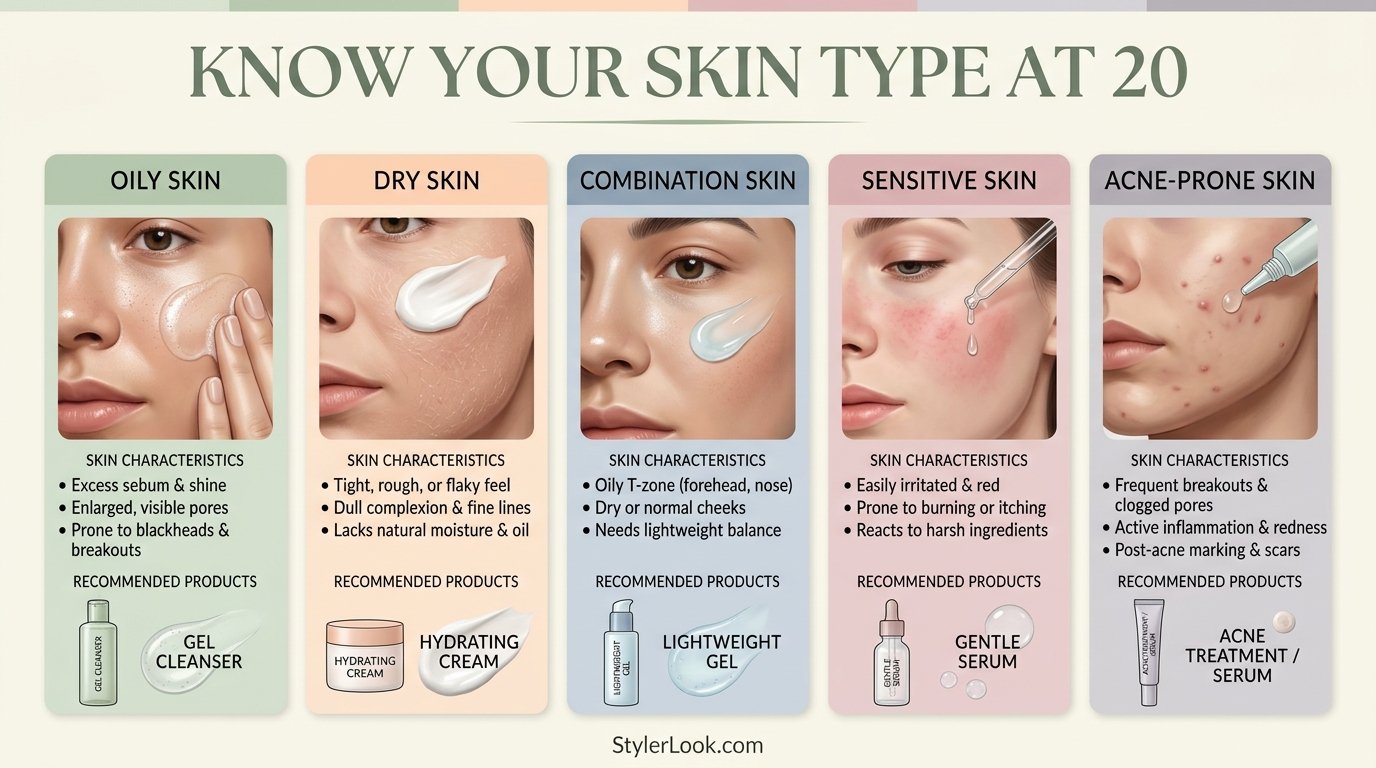
Every product choice in this routine hangs on one diagnosis you make at home. Wash your face, wait an hour, and observe: shine everywhere means oily, shine only in the T-zone means combination.
Tightness or flaking means dry. Stinging and flushing with new products suggests sensitivity, which can overlay any type. Mostly comfortable means normal, the easiest type to serve.
|
Skin type |
Cleanser |
Moisturizer texture |
Best first concern product |
|---|---|---|---|
|
Oily |
Gentle foaming or gel |
Light gel or lotion |
Niacinamide or salicylic acid |
|
Dry |
Cream or hydrating cleanser |
Cream |
Hydrating serum, then vitamin C later |
|
Combination |
Gentle gel |
Gel cream |
Niacinamide |
|
Sensitive |
Cream cleanser, fragrance free |
Cream, fragrance free |
Azelaic acid or niacinamide, slowly |
|
Acne prone |
Mild oil removing cleanser |
Non-comedogenic lotion |
Salicylic acid or adapalene path |
Reassess twice a year. Skin type drifts with seasons, hormones, city moves and age itself, and a routine built for last year’s skin quietly stops fitting.
For the broader framework behind these choices, the site’s skincare routine hub maps the full routine architecture by type and goal.
The One Concern Product: Match the Ingredient to the Goal
The concern slot works when it is chosen by goal, not by hype. Use this matching table, pick one row, and give it a full 6 to 12 weeks.
|
Your main concern |
Ingredient to start with |
When |
Notes |
|---|---|---|---|
|
Dark spots, dullness |
Vitamin C serum |
Morning |
Before sunscreen; brightens over weeks |
|
Oil, visible pores, marks |
Niacinamide |
Morning or night |
Best tolerated beginner active |
|
Blackheads, congestion |
Salicylic acid |
Night, few times weekly |
Oil soluble; works inside pores |
|
Breakouts, texture |
Adapalene or gentle retinol |
Night |
See the retinoid decision guide below |
|
Redness, sensitivity with marks |
Azelaic acid |
Morning or night |
Gentle; suits reactive skin |
|
Dehydration, tightness |
Hyaluronic acid or glycerin serum |
Either |
Apply to damp skin, seal with moisturizer |
Introduce one product at a time, with several days between first uses. If two new products start together and your skin reacts, you will never know which one did it.
Patch test first: a small amount on the inner arm or jawline for several days. It is unglamorous, dermatologist standard, and the cheapest insurance in skincare.
Product led systems can organize this slot well when kept to one active at a time; the site’s The Ordinary skincare routine shows how a budget product lineup handles that discipline.
The Retinoid Decision Guide
Retinoids are the most argued about product in this age group, so here is the decision made plainly.
What they are: vitamin A derivatives. The family runs from gentle cosmetic retinol through adapalene (sold over the counter for acne in the US) to prescription tretinoin.
What they do, per the AAD: treat mild fine lines and wrinkles, acne and dark spots, and improve skin texture. That is a concern product résumé, not a starter kit item.
|
Retinoid at 20 something |
Pros |
Cons |
|---|---|---|
|
Reasons to start |
Acne that needs more than basics; early texture and spot concerns; long term collagen support |
Irritation, peeling and purging in the first weeks |
|
Reasons to wait |
Skin is calm and clear already; routine not yet consistent; budget stretched thin |
Requires nightly discipline and daily SPF to make sense |
|
Hard stop |
Never use while pregnant, trying to conceive, or breastfeeding |
Sun sensitivity rises; skip if you will not wear sunscreen |
How to start, if you start: low strength, two or three nights a week, pea sized amount for the whole face, moisturizer sandwich if sensitive. Increase frequency only as fast as calm skin allows.
When results judge themselves: give it 12 weeks. Retinoids are the slowest acting common active, and quitting at week three is the standard beginner error.
The honest default: a 20 year old with calm skin can skip retinoids entirely and lose nothing this decade. Sunscreen plus consistency outperforms an abandoned retinoid every time.
Acne at 20 Is Normal: The Data and the Response
If you still break out at 20, you are in the statistical majority, not behind schedule. A prevalence study in the Journal of the American Academy of Dermatology surveyed 1,013 adults.
It found 50.9 percent of women and 42.5 percent of men reported acne during their 20s. The figures fall with each decade after, to about a third of women in their 30s.
Among premenopausal women in the same research, 62.2 percent reported acne worsening around menstruation. Hormonal rhythm is a feature of this decade’s skin, not a personal failure.
The routine response: keep the core boring and consistent. Add one acne active in the concern slot: salicylic acid for congestion, benzoyl peroxide for inflamed spots, or the adapalene path for persistent cases.
Do not declare war. Harsh teen style regimens, daily scrubs and astringents, strip adult skin and rebound into more oil and more irritation. Skin should never feel punished into clarity.
Escalate correctly: acne that is painful, deep, scarring, or unchanged after 12 weeks of consistent care belongs with a dermatologist, who has prescription tools no shelf can match.
Exfoliation Rules for Young Skin
Exfoliation removes dead surface cells and helps congestion, glow and product absorption. It is a weekly tool, not a daily identity.
Frequency: once or twice a week for most 20 something skin. Choose a chemical exfoliant (an AHA like glycolic or lactic acid for surface dullness, or BHA salicylic acid for oily pores) over gritty physical scrubs.
Never stack an exfoliation night with a retinoid night while learning. Alternate them, with plain recovery nights between, the scheduling logic behind skin cycling.
The AAD’s warning is specific to your generation: social media trends drive over exfoliation, which damages the barrier and can even create new sensitivities to products. More acid is not more glow.
Stop signals: stinging from products that never stung, shine that is actually dehydration, tightness after washing. Those mean the schedule is too aggressive, whatever the bottle suggests.
The 30 Day Starter Plan
Habits beat hauls. Build the routine one layer per week, so your skin and your discipline adjust together.
|
Week |
Morning |
Night |
Goal |
|---|---|---|---|
|
Week 1 |
Cleanser or rinse, moisturizer, SPF |
Removal if needed, cleanser, moisturizer |
Lock the core; no actives yet |
|
Week 2 |
Same core, daily without misses |
Same core |
Consistency streak; note skin responses |
|
Week 3 |
Add the concern product in its slot |
Continue core |
One active only, patch tested |
|
Week 4 |
Full routine |
Add weekly exfoliation night if planned |
Review: calm, clearer, sustainable |
Track simply: a phone note with three words a day (oil, calm, spots) beats any app. Patterns you can see are decisions you can make.
By day 30 you own a routine you actually do, which outperforms the 10 step routine you abandoned by day nine. The best skincare routine guide on this site builds from here into goal specific upgrades.
What It Costs: Budget Ladders
Prices below are typical US drugstore to mid range shelf prices at the time of writing, given as planning ranges, not quotes. The structure matters more than the numbers.
|
Tier |
Cleanser |
Moisturizer |
Sunscreen |
Concern product |
Total shelf |
|---|---|---|---|---|---|
|
Starter (drugstore) |
$8 to $14 |
$10 to $16 |
$10 to $18 |
$10 to $20 |
About $40 to $65 |
|
Mid range |
$15 to $25 |
$18 to $30 |
$16 to $28 |
$20 to $40 |
About $70 to $120 |
|
Splurge |
$30+ |
$40+ |
$30+ |
$50+ |
$150 and up, optional |
Where money matters: a sunscreen texture you enjoy wearing daily, because compliance is the active ingredient. Where it does not: cleansers, which rinse off in a minute.
Replace products when they empty, roughly every two to three months for daily items. A routine’s true cost is the monthly burn rate, and the starter tier burns about $15 a month.
Mistakes That Wreck Young Skin
Mistake one: copying influencer routines. Ten products chosen by ten different sponsors is not a routine; it is a reaction waiting for a face. The AAD’s trend caution exists for exactly this pattern.
Mistake two: exfoliating daily. Covered above, repeated here because it is the most common self inflicted injury in this age group.
Mistake three: product churning. Judging products at week two, swapping monthly, never giving the 6 to 12 week window. Skin cannot show you results on a schedule shorter than its own turnover.
Mistake four: skipping sunscreen while using actives. Retinoids and acids raise sun sensitivity. Actives without SPF is borrowing improvement and repaying it in spots.
Mistake five: sleeping in makeup and sunscreen. Night removal is the one step with no substitute. Every recovery story in skincare starts with this omission.
Mistake six: tanning for a base or for prom season photos. The AAD’s wording is blunt: a tan is damage, and indoor tanning multiplies the harm. There is no healthy tan from UV.
The barrier reset, when you have already overdone it
Strip back to cleanser, moisturizer, sunscreen for two full weeks. No actives, no exfoliation, no new products. Bland and boring is the treatment.
Reintroduce one product per week afterward, watching for the stinging that says the barrier is not ready. If redness, rash or swelling persists, that is a dermatologist visit, not another reset.
Myths and Trend Checks
Myth: collagen collapses at 25, so buy anti aging now. The measurement studies show a gradual slope from early adulthood, roughly 1 percent per year on average. Prevention is sunscreen, not a wrinkle cream at 21.
Myth: eye cream is essential in your 20s. The eye area needs sunscreen, sunglasses and sleep. A separate eye cream is a preference some enjoy, not a gap in this routine.
Myth: SPF in your foundation covers you. Application thickness makes it a bonus, not a base. Dedicated sunscreen first, makeup over it.
Myth: natural means gentler. Clean and natural are marketing words without a standard definition. Essential oils irritate plenty of faces; lab made ceramides repair plenty of barriers. Judge ingredients, not adjectives.
Myth: pores open and close. Pores have no muscles; they appear larger when clogged or when skin loses firmness. Cleansing and sun protection manage the appearance; no product performs carpentry.
Myth: you can spot reduce oil with toner. Alcohol heavy toners dehydrate the surface and can trigger rebound oil. The mattifying effect is an afternoon loan with interest.
Men in Their 20s: Same Rules, Two Adjustments

The core routine is identical for men: cleanser, moisturizer, SPF, one concern product. Skin biology does not sell gendered editions of the basics.
Adjustment one is shaving: shave after cleansing on softened skin, moisturize after, and schedule exfoliation away from shave mornings to limit irritation.
Adjustment two is oil and habit: male skin tends to run oilier, so gel textures fit well, and the routine must survive a gym bag and a shared bathroom shelf.
The site’s men’s skincare routine builds the full male version with shaving integrated step by step.
Habits Around the Routine
Sleep is a skincare product. Barrier repair runs at night, and short sleep shows on skin by morning. The routine cannot outrun a 4 a.m. habit.
Change the pillowcase weekly, more often during breakouts. It is the surface your treated skin presses into for eight hours.
Gym rule: rinse or cleanse after workouts, not before and after both. Sweat sitting under sunscreen and makeup for hours is congestion in progress.
Hands off your face. Picking converts a three day spot into a three week mark. Post acne marks are this decade’s most self extended skin problem.
Makeup order: skincare, sunscreen, a few minutes to set, then makeup. At night, removal is step zero, always.
Results Timeline: What Improves, and When
Routines fail socially before they fail chemically: people quit in the silent weeks. This timeline, aligned with dermatology’s standard 6 to 12 week evaluation window, tells you what to expect and when.
|
Timeframe |
What you may notice |
What it means |
|---|---|---|
|
Days 1 to 7 |
Comfort changes: less tightness, less sting |
Hydration and gentleness working first |
|
Weeks 2 to 4 |
Fewer new clogged pores, calmer mornings |
Cleansing and consistency taking hold |
|
Weeks 6 to 8 |
Marks fading at the edges, texture smoothing |
Concern product producing visible change |
|
Weeks 10 to 12 |
Fair judgment point for acne and spots |
One full evaluation window completed |
Judge at week 12, not week 2. Cell turnover at 20 runs on a roughly monthly cycle, and dark spots and acne patterns need several cycles to declare themselves changed.
If week 12 shows nothing at all, change one variable: the concern product, not the whole routine. The core stays; the experiment continues with better data.
When to See a Dermatologist

Build the relationship before you need it urgently. The AAD frames the 20s as the decade to start, and its guidance lists clear triggers.
See one for acne that scars, hurts, or ignores 12 weeks of consistent care. See one for rashes, eczema patterns, or reactions that spread rather than settle.
See one for any mole that changes, grows, itches or bleeds, and for a baseline skin check if you are fair, freckled, or a former tanning bed user.
A dermatologist also ends expensive guessing. One visit can replace a year of trial and error spending on the wrong concern product.
Frequently Asked Questions
What is a good skincare routine for a 20 year old?
Cleanser and sunscreen daily, moisturizer matched to skin type, and one targeted product for your main concern. That is the dermatologist endorsed core; everything else is optional layering added slowly.
How many skincare products does a 20 year old actually need?
Two daily essentials per dermatologists: a mild cleanser and SPF 30+ sunscreen. A moisturizer plus one concern product completes most routines at three to four products total.
Should a 20 year old use retinol?
It is optional, not required. Retinoids suit concerns like acne, dark spots and texture. If used, start low strength two or three nights a week, and never while pregnant or trying to conceive.
What age should you start anti aging skincare?
Prevention starts with sunscreen at every age. Antioxidant serums suit the early 20s; gentle retinoids typically enter in the mid to late 20s, or earlier when acne makes them useful.
Do 20 year olds need vitamin C serum?
Not mandatory, but it is the most commonly recommended first serum at this age: antioxidant protection in the morning and help with dark spots, applied after cleansing and before sunscreen.
What is the correct morning routine order for a 20 year old?
Gentle cleanse or a water rinse for dry skin, vitamin C serum if used, moisturizer, then broad spectrum SPF 30 or higher as the last step before makeup.
What is the correct night routine order?
Remove makeup and sunscreen first if worn, then gentle cleanser, then your treatment product on its scheduled nights, then moisturizer. Thin to thick is the layering rule.
How often should a 20 year old exfoliate?
Once or twice a week is the common guidance for chemical exfoliants. Daily exfoliation is the most frequent young skin mistake and a leading route to a damaged barrier.
Can a 20 year old damage their skin barrier?
Yes. Over exfoliating, stacking actives from social media trends and scrubbing are the usual causes. Signs include stinging with plain moisturizer, redness, tightness and new sensitivity.
Why do I still have acne at 20?
Adult acne is the norm: a JAAD prevalence study found 50.9 percent of women and 42.5 percent of men reported acne in their 20s. Hormones, stress and products all contribute.
What helps hormonal acne in your 20s?
Consistent gentle basics plus one acne active such as salicylic acid, given 6 to 12 weeks. Persistent, painful or scarring acne deserves a dermatologist and prescription options.
Does a 20 year old need eye cream?
No. Sunglasses, sunscreen and sleep do more at this age. Regular moisturizer works around the eyes for most people; eye cream is an optional preference.
Is toner necessary for young skin?
No. Modern gentle cleansers do not need an astringent toner after them. Hydrating toners are optional comfort products; alcohol heavy toners are best skipped entirely.
Should a 20 year old double cleanse?
Only when there is something to remove: makeup or water resistant sunscreen. An oil cleanser or micellar step first, then the gentle cleanser. Bare skin days need one cleanse.
How much should a 20 year old spend on skincare?
A complete drugstore core routine typically lands around $40 to $65 for the shelf. Expensive is not more effective at this age; sunscreen consistency is what pays.
Can I use the same products morning and night?
Mostly yes: cleanser and moisturizer work both times. Sunscreen is morning only; retinoids and stronger exfoliants are night products by design.
What moisturizer is best for a 20 year old?
One matched to skin type: light gels for oily skin, lotions for normal or combination, creams for dry. Look for non-comedogenic on acne prone skin.
What sunscreen should a 20 year old use?
Broad spectrum, SPF 30 or higher, water resistant, in a texture you will actually wear daily. Apply before going outside and reapply about every two hours outdoors.
Does a 20 year old need anti wrinkle cream?
No. Rich anti wrinkle creams target problems young skin does not have. Daily SPF is the real anti aging step of your 20s, plus never tanning.
When should a 20 year old start seeing a dermatologist?
Any time a condition needs diagnosis or ignores basics: persistent acne, eczema, reactions, or suspicious and changing moles. The 20s are the decade to build that relationship.
Is skin cycling good for 20 year olds?
It can help beginners ration actives across nights, which prevents overuse. It is a scheduling tool, not a requirement; simple consistency beats complicated calendars.
Can a 20 year old use glycolic acid?
Yes, gently: low percentages once or twice weekly for dullness or congestion. Do not stack it with a retinoid on the same night while learning tolerance.
What is prejuvenation?
The industry term for preventive skincare in young adults: protecting collagen and preventing damage, mainly with sunscreen, instead of correcting later. Dermatologists endorse the sunscreen core, not product maximalism.
Do collagen supplements help a 20 year old’s skin?
Evidence is limited and mostly studied in older adults. At 20, collagen sits near its peak; protecting it with sunscreen matters far more than supplementing it.
How fast does collagen decline in your 20s?
Skin collagen declines gradually at roughly 1 percent per year across adult life, measured in biopsy studies since 1975. There is no sudden switch at 25; that number is a marketing convention.
Should a 20 year old worry about fine lines?
Expression lines at 20 are normal and mostly reflect dehydration and expression, not damage. Hydration, sleep and sunscreen address them; aggressive anti aging actives are unnecessary.
Can skincare products expire or go bad?
Yes. Follow the period after opening symbol, store products away from steamy heat where possible, and replace sunscreen by its expiry date because protection degrades.
Is natural or clean skincare better for young skin?
Clean is a marketing term without a standard definition. What matters is ingredient function and your skin’s tolerance, natural or synthetic alike.
Do men in their 20s need a different routine?
The core is identical: cleanser, moisturizer, SPF, one concern product. Shaving care and typically oilier skin are the practical differences, not different rules.
How long before a new routine shows results?
Give products 6 to 12 weeks of consistent use. Skin turnover at 20 runs roughly monthly, and acne or dark spot changes need several cycles to judge fairly.
What skincare should a 20 year old avoid?
Indoor tanning, harsh scrubs and astringents, daily strong exfoliants, copying multi active influencer routines, and any product that keeps stinging or burning.
Can I skip morning cleansing?
Dry or sensitive skin often does well with a water only rinse in the morning; oily skin usually prefers the gentle cleanser. Night cleansing is the non negotiable one.
Should a 20 year old use face masks?
Optional, once a week at most for most people: clay for oil, hydrating for dryness. Masks supplement the daily core; they never substitute for it.
Does diet affect skin at 20?
Dermatology guidance treats diet claims cautiously. Individual triggers exist, but no food rule replaces the basics, and extreme restriction diets are not skincare.
What is the difference between retinol and retinoid?
Retinoid is the family name for vitamin A derivatives. Retinol is the gentler over the counter member; adapalene and tretinoin are stronger members with different rules.
Can a 20 year old use niacinamide and vitamin C together?
Modern formulations generally allow it, and niacinamide is one of the best tolerated beginner actives for oil and marks. Introduce one new product at a time regardless.
How do I patch test a new product?
Apply a small amount to a discreet area such as the inner arm or jawline daily for several days, and watch for reaction before full face use.
Is SPF in makeup or moisturizer enough?
Usually not, because nobody applies makeup at the tested thickness. A dedicated sunscreen layer is the reliable route; SPF moisturizer is a bonus, not the plan.
What order do skincare and makeup go in?
Skincare first, sunscreen last among skincare, then makeup after the sunscreen sets for a few minutes. At night, makeup removal is step zero.
Should a 20 year old use a separate night cream?
Not required. The daytime moisturizer works at night for most young skin, though dry skin may enjoy a richer cream. Sunscreen is never a night product.
What if my skin gets worse when I start a routine?
Simplify back to cleanser, moisturizer and sunscreen for two weeks. Persistent worsening, stinging or rash means stop the new product and consider a dermatologist.
How do I build a routine on a student budget?
Buy the core three first from drugstore lines, one at a time. Add a single concern product only after a month of consistency. Skip toners, eye creams and masks.
Conclusion
Skincare routine for 20 year old skin is a small promise kept daily: cleanse gently, moisturize by type, wear the sunscreen, and aim one product at one concern.
Your skin at 20 is an asset in its prime, and the data backs the calm approach: collagen declines on a gentle slope, acne is a majority experience that responds to patience, and barriers thrive on restraint.
Start with the 30 day plan, keep the shelf short, and let consistency do what hauls cannot. Your 30 year old self is the beneficiary of every ordinary morning you protect this year.
Ready to build your shelf? Start with the core three this week, then explore the StylerLook skincare and style library for the next layer when your routine feels automatic.
