
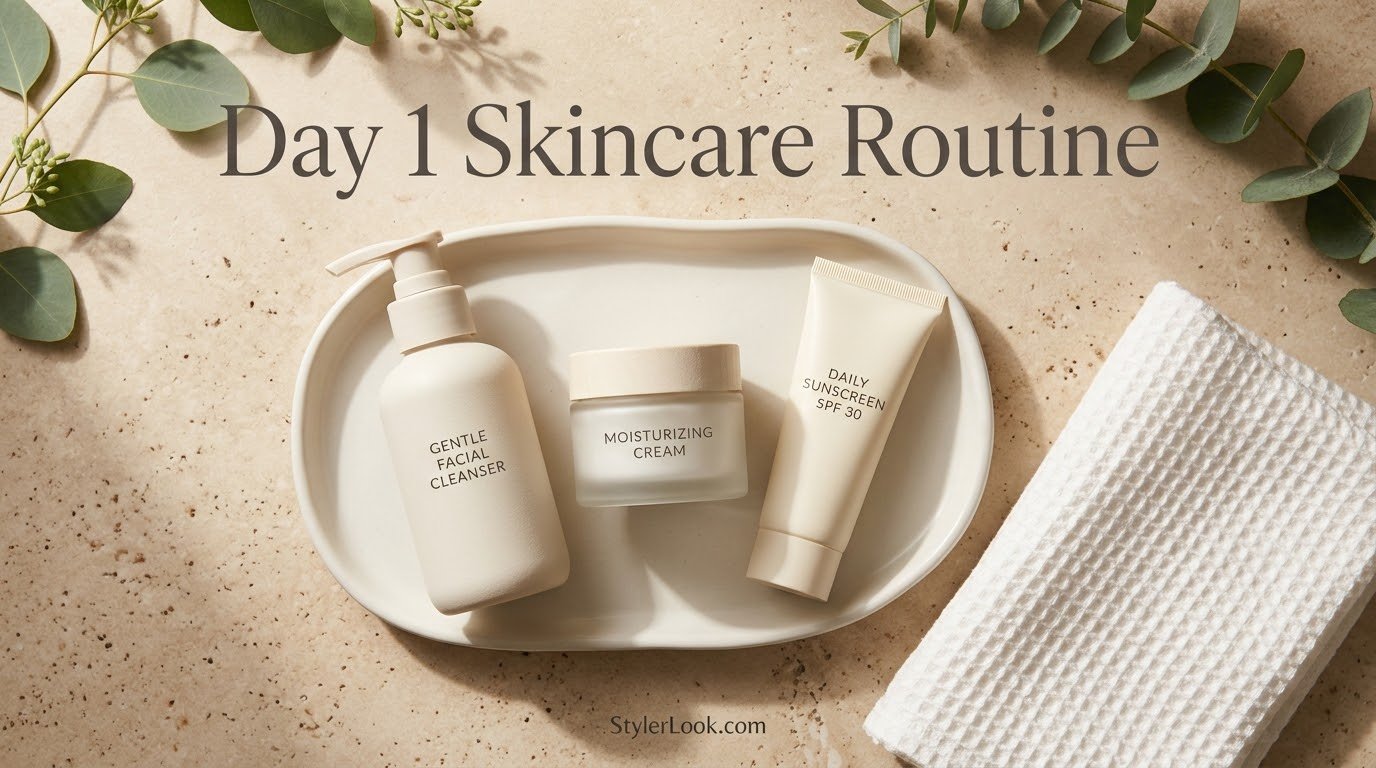
day 1 skincare routine work is mostly measurement, not treatment. Your
skin will not change today, and it is not supposed to.
Day 1 decides three things every later day depends on. Your skin type,
your baseline record, and the start of your patch test clock.
The routine itself stays deliberately small. Three gentle products,
used kindly, morning and night, and nothing else yet.
This page walks the first 24 hours in order. **What to test, what to
photograph,** what to apply, and what to leave in the box.
Everything here is general information, not personal advice. Persistent
or severe skin problems belong with a dermatologist, not a routine.
The Short Answer: Day 1 Measures, It Does Not Treat
A good first day produces information. A skin type you can name, a
baseline you can compare against, and two clocks visibly running.
The products are the classic foundation. **A gentle cleanser, a
moisturizer, and broad spectrum sunscreen** at SPF 30 or higher.
That foundation comes straight from the American Academy of Dermatology skin care basics. Cleanse,
moisturize, protect, in that simple order.
Day 1 adds no actives at all. No acids, no retinol, no serums, because
a reaction among several new products has no traceable cause.
Judge day 1 by comfort and records, not by the mirror. Visible change
runs on a slower clock, explained below.
Morning Tasks: The Skin Type Test and the Baseline
Before the first routine, run the wash and wait test. It takes an
hour and decides which product versions your skin actually wants.
1. The wash and wait skin type test
Wash your face with a gentle cleanser and lukewarm water. Pat dry
with a soft towel and apply absolutely nothing afterward.
Wait one hour, then read your skin honestly. **Shine across the whole
face** points oily; tightness and flakes point dry.
Shine only on the forehead, nose, and chin points combination. Comfort
with no strong signals points normal, the easiest verdict of all.
The method comes from the Obviously Skincare beginner guide, whose guide builds its whole
routine on knowing this before buying anything.
2. The baseline photo and the two line log
Take one photograph in plain daylight, no filter, front facing. It
feels pointless today and becomes evidence in six weeks.
Write two lines beside it. How the skin feels this morning, and what
you used, even if the entry is just cleanser and moisturizer.
The log is your memory with dates. Every later judgment, keep or
discard, gets made against this record instead of a mood.
3. Start the patch test clock
Choose one product to test first, usually the moisturizer. Apply a
small amount to one discreet area, such as behind the ear.
The AAD protocol, as the BloomHerLife beginner routine quotes it, tests a new product on a
small area twice daily for seven to ten days.
Day 1 starts that clock. A product that passes its window joins the
routine; one that stings or reddens does not, whatever it cost.
The Day 1 Morning Routine, Step by Step
With the measuring done, the morning script is short. Three steps,
about two minutes, in a fixed order.
1. Cleanse gently, or rinse
Wash with your gentle cleanser and lukewarm water. Hot water feels
good and strips the oils your barrier needs.
Very dry skin may prefer a plain water rinse some mornings. That is a
judgment the type test helps you make.
Your cleanser passes if skin feels clean and comfortable. Tight,
squeaky, or stinging means the cleanser is too harsh for you.
2. Moisturize on slightly damp skin
Apply moisturizer while skin is still a little damp. The dampness
helps the layer sit comfortably and reduces how much you need.
Match texture to the morning’s verdict. Gels suit oily skin, creams
suit dry skin, and lotions sit between for combination and normal.
Even oily skin moisturizes. Skipping it is the beginner error that
most often masquerades as a product problem later.
3. Sunscreen, last and generous
Finish with broad spectrum SPF 30 or higher, the floor the AAD
recommends for daily protection.
Use a generous amount for face and neck. Two finger lengths is the
common measuring trick for the face alone.
Reapply roughly every two hours outdoors, and after swimming or heavy
sweating. Cloudy light still counts as daylight.
These same three steps appear as the standing routine in the basic skincare routine guide.
This page adds only what makes today different from every later day.
The Day 1 Night Routine, Step by Step
The night script has two steps. Its job is removal and recovery, not
treatment, however tempting the new bottles look.
1. Cleanse the day off
Cleanse once, thoroughly and gently. **Sunscreen, sweat, and the day’s
grime** all leave with this single wash.
Makeup wearers remove makeup first, then cleanse. One honest cleanse
after removal beats a rushed double routine on day 1.
Give the wash about a minute of gentle contact. Rushing the cleanse
is how residue survives to irritate overnight.
2. Moisturize and stop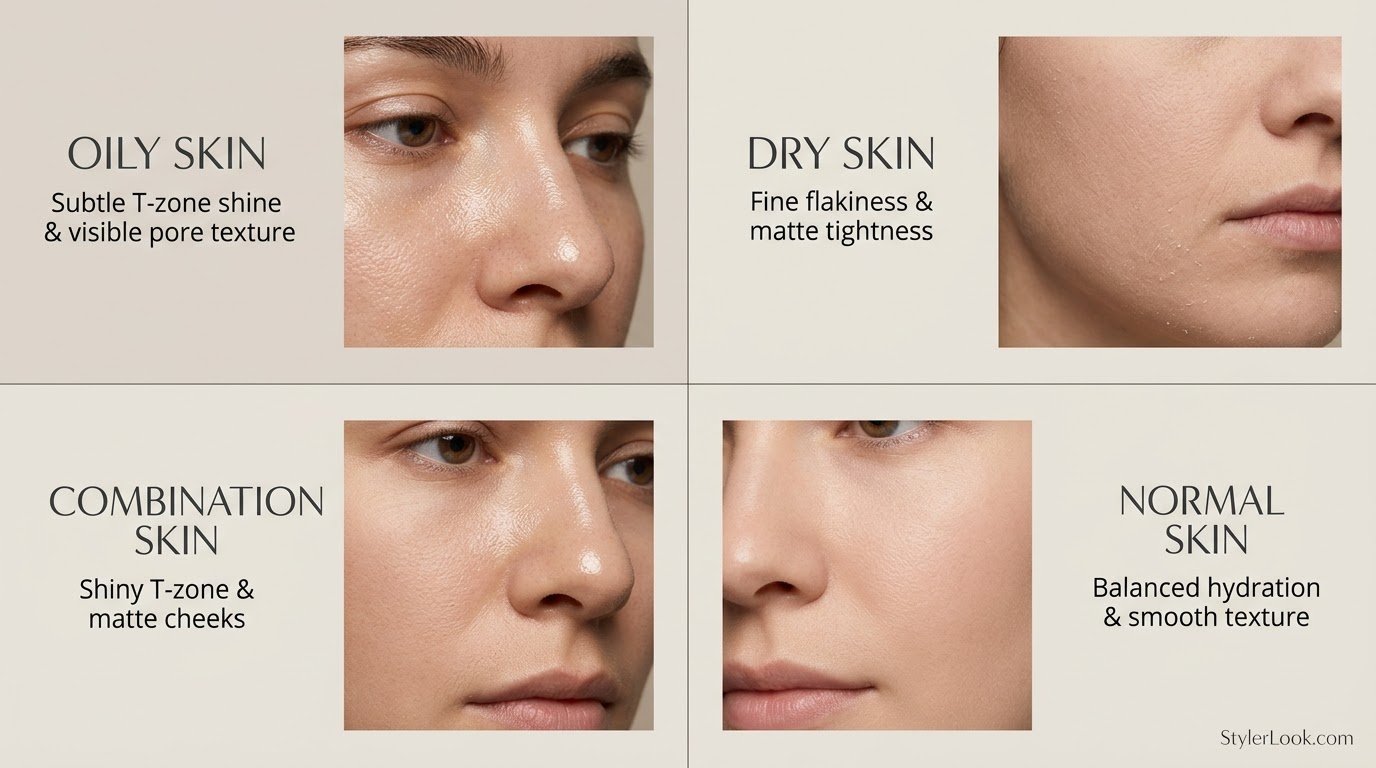
Apply the same moisturizer and stop there. No serum layer, no spot
treatment, no experimenting with the waiting shelf.
Night 1 sets the routine’s tone. A calm, boring evening is the goal
the whole first week is built on.
Wash your hands before you begin, both scripts. Clean hands are the
unphotographed basic every routine quietly depends on.
The Not Yet List
Everything not in the three basics waits. The list is specific, and
each item has an unlock condition rather than a ban.
Exfoliating acids wait for comfortable basics. They are the sensible
first addition later, started once weekly at most.
Retinol waits much longer. It asks for an established routine, a low
starting strength, and patience most day 1 routines have not built yet.
Vitamin C and serums wait for a reason to exist. A serum answers a
named concern, and day 1 has not named one yet.
Toner waits indefinitely. It is optional equipment in modern routines,
useful for some, necessary for almost nobody at the start.
The Two Clocks That Start Today
Day 1 starts two clocks, and confusing them causes most beginner
quitting. Print them beside the routine and respect both.
|
Clock |
Length |
What it governs |
|---|---|---|
|
Patch clock |
7 to 10 days per product |
When a tested product may join |
|
Tolerance clock |
2 to 4 weeks of basics |
When any addition is considered |
|
Results clock |
About 4 to 6 weeks |
When visible change is judged |
|
Judgment window |
Up to 2 to 3 months (one guide’s strand) |
Final keep or discard calls |
The tolerance figure follows the careful guides: two to four weeks
of basics before adding anything new.
The results clock is one skin cycle, roughly four to six weeks.
Comfort can improve within days; appearance follows the slower clock.
What Day 1 Should Feel Like
Expect comfort, not transformation. Skin may feel cleaner, calmer,
and better moisturized by tonight, and that is the whole report.
Notice small signals and log them. Tightness after cleansing, shine
by midday, dryness at the cheeks by evening.
None of these need fixing today. They are readings, and readings are
exactly what a measurement day exists to collect.
If everything feels neutral, celebrate correctly. A boring day 1 is
the strongest predictor of a routine still running at day 60.
Day 1 Mistakes That Cost Beginners
Starting everything at once is the classic. Five new products plus a
reaction equals no idea which product to drop.
Skipping the type test is the expensive one. The wrong textures get
bought first and blamed on the skin later.
Chasing a day 1 result is the quiet one. Scrubbing, layering, and
extra steps all enter through disappointment with a normal first day.
Trusting precise sounding statistics is the modern one. This niche
contains pages inventing study percentages wholesale; this page prints
none it cannot source.
A Note on Skin Cycling’s Day 1
One confusion deserves a direct answer. **Skin cycling also numbers its
days,** and its day 1 means an exfoliation night inside an existing routine.
That is not this page’s day 1. A beginner has no cycle yet, and
exfoliation is on this page’s not yet list for weeks.
If your search meant the cycling method, start from the basics anyway.
Every advanced method assumes the foundation this page builds.
Reading the Type Test, Type by Type
1. The oily read
Shine everywhere at one hour, including the cheeks, reads oily. Your
versions are a gel cleanser and a lightweight moisturizer.
Resist the stripping instinct. Harsh cleansers provoke tightness that
beginners misread as cleanliness, then chase with more washing.
2. The dry read
Tightness, dullness, or fine flakes read dry. Your versions are a
cream cleanser and a richer moisturizer, applied to damp skin.
Your morning cleanse may become a rinse on some days. Dry skin often
prefers its washing concentrated in the evening.
3. The combination read
A shiny T zone over comfortable cheeks reads combination, the most
common verdict. Middle textures are your starting point.
Resist buying two of everything. One balanced set first; zone
adjustments are week three refinements, not day 1 purchases.
4. The sensitive overlay
Any type can carry a sensitive overlay. Stinging, flushing, or a
history of reactions adds fragrance free versions and slower clocks.
Sensitive skin lengthens the patch window willingly. **The seven to ten
days** are a minimum, and caution is a feature here, not a delay.
Later, when products multiply, the skincare routine order guide becomes useful. On
day 1 the order is simply the order of the three steps themselves.
The Waiting List: Owning Products Without Using Them
Many beginners start day 1 already owning a shelf. Gifts, hauls, and
old routines leave serums and treatments waiting.
Write the waiting list down. Name each product, its job, and the
concern it claims to answer, in the order you might introduce them.
The list converts temptation into a queue. Each product waits for a
patch test, a gap after the previous addition, and a calm skin report.
Anything expired, unsealed for years, or unidentifiable goes out
today. Day 1 is the right day for that small, satisfying purge.
Starter Kits, Judged Honestly
A kit is a box of someone else’s decisions. **Judge it by the day 1
rules** before the packaging persuades you.
A good kit contains the three basics in gentle versions. **A serum
scheduled for immediate use** is the tell of a kit built for sales.
Kits shine on price and simplicity. One purchase, three steps, and
versions chosen for the average beginner rather than your tested type.
The hybrid most beginners land on: kit basics now, then individual
replacements matched to your type as each bottle empties.
Setting Up the Shelf and the Schedule
Put the three products where the routine happens. Visibility is the
habit technology that actually works on tired mornings.
Anchor the scripts to existing habits. After brushing teeth is the
classic anchor, morning and night, because it never moves.
Decide the evening time honestly. A routine done at nine beats a
perfect routine planned for midnight and skipped by eleven.
Keep the log where the products live. Two lines take twenty seconds
when the notebook is already in your hand.
Days 2 to 7, Briefly
Days 2 through 7 repeat the scripts without variation. Repetition is
not a failure of imagination; it is the experiment’s control condition.
Collect readings daily. Morning comfort, midday shine, evening feel,
each in a few words, builds the week’s evidence.
Resist mid week edits. A tight day three is data for the log, not a
reason to buy a new cleanser by day four.
By day 7 the patch clock delivers its first verdicts. **Products that
passed** may join; the routine itself stays the three basics regardless.
The week ends with a comparison. Baseline photo beside a fresh one,
same light, mostly to prove how little a week shows and how much it teaches.
The Day 1 Clinic: Six Problems, Six Fixes
Problem one: everything stings, even the basics. The fix is stopping
to the gentlest single product and treating the reaction as information,
not a challenge to push through.
Problem two: the cleanser leaves you squeaky. The fix is a gentler
formula, because squeaky is stripped, and stripped is the opposite of clean.
Problem three: you cannot name your type. The fix is repeating the
test on a normal day, since weather, exercise, and hormones all move readings.
Problem four: the haul is calling from the shelf. The fix is the
waiting list, written down, with dates penciled beside each product.
Problem five: nothing looks different and motivation dips. The fix is
the clocks, reread: the results clock promised nothing yet, and it is
keeping its promise exactly.
Problem six: a friend swears by ten steps. The fix is the dermatology
consensus quoted in beginner guides: consistency outperforms complexity,
in the words attributed to dermatologist Marisa Garshick.
The Trust Passage: Numbers in This Niche
Skincare percentages deserve suspicion. **This research found guides
inventing** study figures, journal names, and expert attributions wholesale.
The defense is sourcing discipline. **Guidance here traces to the AAD’s
published basics** and to named, checkable protocols, or it is labeled opinion.
Where guides disagree, this page prints the range. Two to four weeks
for the tolerance clock is a range because honest sources give one.
General information is the frame throughout. Your skin’s specifics
belong to your own observation log and, when needed, a professional.
The Long View: From Day 1 to Day 60
|
Stage |
When |
What changes |
|---|---|---|
|
Measurement day |
Day 1 |
Type named, baseline taken, clocks started |
|
Repetition week |
Days 2 to 7 |
Scripts only, readings logged |
|
Patch verdicts |
Days 7 to 10 |
Tested products may join the basics |
|
Tolerance window |
Weeks 2 to 4 |
Basics alone, comfort assessed |
|
First addition |
After week 2 to 4 |
One product, patch tested, if skin is calm |
|
Results judgment |
Weeks 4 to 6 |
First honest comparison against baseline |
|
Full judgment |
Months 2 to 3 |
Keep or discard calls on the routine |
The table is a map, not a promise. Sensitive skin runs slower, calm
skin may run exactly to schedule, and both are normal.
Notice what the map protects. No week contains a shopping spree, and
no judgment happens before its evidence exists.
Day 60’s routine still rests on the same three basics. **Everything
added since** is a guest in a house day 1 built.
Day 1 Variants: Makeup, Sensitivity, and Sport
Makeup wearers change only the evening. Removal first, then the same
gentle cleanse; the morning script is identical to everyone’s.
Sensitive starts change the versions, not the steps. Fragrance free
basics, longer patch windows, and a lower tolerance for experimentation.
Athletes and heavy sweaters change the timing. A rinse or cleanse
after training protects the evening script from doing double duty.
Teen beginners change the supervision, not the science. The same
three basics, the same clocks, with an adult helping read the signals.
What Day 1 Costs
The honest budget is three products. Drugstore versions of a gentle
cleanser, a moisturizer, and an SPF 30 sunscreen cover most beginners fully.
Spend first on the sunscreen you will wear. **The best SPF is the one
applied generously** every morning without resentment or rationing.
Spend second on the moisturizer’s texture. Daily comfort is what
keeps the routine alive through the tolerance clock’s quiet weeks.
The cleanser is where beginners overspend most. Gentle and affordable
beats luxurious here, because its job is brief and mostly mechanical.
Technique Details That Matter on Day 1
Amounts beat brands at this stage. **A pea to dime sized cleanser
portion,** worked gently, cleans a face without waste or stripping.
Moisturizer goes on in a thin, complete layer. More product is not
more protection; coverage and consistency do the work.
Sunscreen is the exception: generous is correct. Under applying is
the most common reason a good SPF underperforms its label.
Pat skin dry instead of rubbing. The towel is a tool, and gentle
handling is the day 1 technique nobody sells because it is free.
Give each layer a breath. **A few seconds between moisturizer and
sunscreen** helps the finish sit evenly instead of pilling.
Finish the evening with observation, not product. **Thirty seconds of
reading your skin** closes the measurement day properly.
Your Day 1 Checklist
1. Morning, before the routine
Run the wash and wait test, take the baseline photo, and write the
first two log lines before any product decisions harden.
2. Morning routine
Cleanse gently, moisturize on damp skin, and finish with broad
spectrum SPF 30 or higher, applied generously and last.
3. Midday
Start one patch test and note the date in the log. The seven to ten
day window now runs whether you watch it or not.
4. Evening routine
Remove the day, cleanse once, moisturize, and stop. The waiting shelf
stays closed on night 1 by design.
5. Before bed
Log the day’s readings in two lines. Comfort, tightness, shine, and
anything unexpected, recorded while the memory is exact.
Five blocks, one day, nothing heroic. That restraint is the routine
every later week will be grateful you kept.
When Day 1 Is a Restart
Restart beginners carry an advantage and a scar. They know products,
but they are usually restarting because something went wrong.
The restart day 1 is stricter, not looser. Back to the three basics,
clocks restarted, and the offending shelf quarantined until calm returns.
Keep the old log if one exists. A reaction history is the most
valuable data a restart owns, and it guides every reintroduction.
Reintroduce former products as if they were new. **Patch test, gap,
observe,** in the order of need rather than affection.
A restart that respects the clocks rarely repeats itself. **The second
routine** is built by evidence the first one never gathered.
Reading Labels on Day 1
Labels reward a beginner’s attention in three places. The directions
state frequency honestly, and day 1 follows them literally.
The ingredient list’s top lines matter most. The first ingredients
dominate a formula, whatever the marketing names on the front.
Expiry and period after opening marks protect the basics. **An old,
opened sunscreen** is not a saving; it is an unknown.
Fragrance is a label fact worth noting. Sensitive starters choose
fragrance free versions first, because one variable less is one mystery less.
Claims are the label’s weakest layer. Miracle language on a cleanser
is decoration, and day 1 has been warned about decoration dressed as data.
Why Two Minutes Is Enough
The two minute routine offends the imagination. **Surely skin deserves
more** than a wash, a cream, and a sunscreen, the beginner thinks.
Dermatology’s beginner guidance keeps landing on the same answer. **The
foundation is small** because skin health rests on protection and barrier
care, not on step count.
Length returns later for pleasure, not necessity. A longer routine
built on a working foundation is a hobby; the same routine built on
nothing is a lottery ticket.
Day 1 chooses the foundation’s odds. Every calm week compounds, and
the ten step routines that survive all began as three steps that worked.
That is the honest sales pitch for restraint. **Nothing about it
photographs well,** and everything about it works.
The Household Around Day 1
Routines live in shared bathrooms. A partner’s products crowd the
shelf, and their ten steps can make your three feel like surrender.
Hold the line kindly. Your clocks are yours, and borrowing a
partner’s active on day 3 is starting it untested, whatever its pedigree.
Gifted products join the waiting list like everything else. **A generous
gift earns a patch test,** not an exemption from the rules.
Parents guiding a teen read the same signals. **Tightness, stinging, and
enthusiasm** all report honestly when a young beginner is asked daily.
The household’s role is mostly patience. **Nobody comments on a week one
face** that is busy being measured, not judged.
Keeping the Record Beyond Day 1
The baseline habit scales quietly. One photo a week, same light,
same angle, same expression, builds the only honest progress album.
Filters are banned from evidence. A filtered comparison proves the
filter works, and day 1 was promised better data than that.
Keep log entries brutally short. A record you dread writing is a
record that stops, and a stopped log judges nothing.
Note the context lines too. Travel, illness, poor sleep, and weather
all move skin readings, and future you deserves the footnotes.
At the judgment window, spread the record out. **Six weeks of dated
evidence** ends arguments that memory alone would lose nightly.
That evidence habit is day 1’s longest gift. The routine may evolve
for years, but it will always be judged the way day 1 taught you.
Day 1 in Different Seasons
A winter day 1 reads drier than the skin’s average. **Start textures one
step richer** and let the type test speak again in milder weather.
A summer day 1 reads oilier and sweatier. **Lighter textures and the
full sunscreen discipline** matter more than any other adjustment.
Season changes retest the type verdict. Skin type is a tendency,
not a birth certificate, and the wash and wait test is cheap to rerun.
The clocks never change with weather. **Patch windows and tolerance
weeks** hold in every season, because reactions ignore the calendar.
Buy for the season you are in. Next season’s skin will file its own
readings when its day 1 equivalent arrives.
A Final Word on Patience
Patience is the routine’s active ingredient. **Every protocol in this
page** is a way of giving skin the time it biologically requires.
The industry sells speed because speed is sellable. **Skin sells
nothing,** and it keeps the calendar it has always kept.
Your job on day 1 is alignment, not force. **Measure honestly, apply
gently,** record faithfully, and let the clocks run.
Beginners who master that trade stories later. Their before and after
is a logbook, not a filter, and their routine still exists at month six.
That is who this page is written for. **Start smaller than your
ambition,** and let evidence do the growing.
One More Measurement: How You Sleep Tonight
Sleep is the routine’s silent partner. A fresh pillowcase on night 1
is a restart ritual with a hygiene argument behind it.
Note the night’s sleep in the log’s margin. Poor sleep moves readings
for days, and unexplained dullness often files its explanation there.
Wake to the same scripts tomorrow. Day 2’s only assignment is proving
day 1 was not a performance but a practice.
The Day After This Page
Tomorrow needs no new instructions, and that is the point. **The
beginner who wakes to an identical script** is already doing the thing
that works.
Keep this page bookmarked for the judgment days. **Its clocks and
checklists** answer the week three doubts better than any new purchase.
When the first addition finally earns its place, it enters a routine
with records. That is the entire difference between this start and
the ones that were abandoned by February.
A Note Before You Close the Tab
Bookmark the schedule card mentally: **test, photograph, patch, cleanse,
moisturize, protect,** and the same kind evening to close the day.
Everything else in skincare can be learned later, in order. **Today was
for foundations,** and foundations are finished now.
Frequently Asked Questions
1. What do I do on day 1 of a skincare routine?
Measure first, then apply the basics. Run the type test, take a baseline photo, start a patch test, then cleanse, moisturize, and protect.
2. What is a day 1 skincare routine?
It is the first 24 hours of a new routine. Its work is measurement: skin type, baseline, patch clock, and three gentle products only.
3. How many products do I need on day 1?
Three products only. A gentle cleanser, a moisturizer matched to your type, and broad spectrum SPF 30 or higher for the morning.
4. What are the three products a beginner starts with?
Cleanse, moisturize, protect. The foundation the American Academy of Dermatology sets out, matched in texture to your skin type.
5. How do I find my skin type on day 1?
Use the wash and wait test. Cleanse, apply nothing, and read your skin one hour later for shine, tightness, or comfort.
6. What is the wash and wait skin type test?
Wash, wait, and read. After one bare hour, shine suggests oily, tightness suggests dry, a mixed read suggests combination skin.
7. What should my day 1 morning routine be?
Cleanse gently, moisturize, then sunscreen. Broad spectrum SPF 30 or higher goes last, in a generous amount, every morning.
8. What should my day 1 night routine be?
Cleanse, then moisturize, then stop. Night 1 removes the day and restores moisture; treatments and serums all wait.
9. Do I cleanse in the morning on day 1?
Yes, gently, for most skin. Very dry skin may prefer a plain water rinse some mornings; the type test informs that judgment.
10. Can I use retinol on day 1?
No, retinol waits. It needs an established routine and a low starting strength; day 1 has neither, so it stays boxed.
11. Can I use vitamin C or acids on day 1?
No, they wait too. Actives enter one at a time after the basics feel comfortable, so any reaction has a traceable cause.
12. Do I need a toner or serum on day 1?
Neither is needed on day 1. Toner is optional equipment, and a serum answers a named concern that day 1 has not named yet.
13. Should I exfoliate on day 1?
Not on day 1. Exfoliation is the sensible first addition later, once the basics are comfortable, started gently and infrequently.
14. How do I patch test a new product?
Test one product on a small area. A discreet spot such as behind the ear, watched for stinging, redness, or bumps.
15. How long should I patch test before using a product?
Seven to ten days, twice daily. That is the AAD protocol quoted in beginner guides before a product is used widely.
16. Can I start all my new products on the same day?
No, start one at a time. Several new products plus a reaction leaves no way to know which product to drop.
17. What if I already bought lots of products?
Build a waiting list, not a pile. Introduce the products one by one, each patch tested, in the order your skin needs them.
18. My face feels tight after cleansing, what does that mean?
Your cleanser is likely too harsh. Tight or squeaky after washing is the classic signal; switch to a gentler formula.
19. What if a product stings on day 1?
Stop that product and simplify. Return to the gentlest basics, log the reaction, and let the skin settle before testing anything else.
20. What should I expect to see on day 1?
Expect comfort, not change. Cleaner, calmer, better moisturized by tonight is a successful day 1; appearance runs on a slower clock.
21. When will I see results from my new routine?
About one skin cycle. Four to six weeks is the honest window for visible change; comfort often improves within days.
22. How long should I run the basics before adding products?
Two to four weeks. The careful guides run the basics alone for that long before considering any addition.
23. What happens on days 2 to 7 of a new routine?
More of the same, deliberately. The scripts repeat while the patch and tolerance clocks run; readings go in the log.
24. What is the first product to add after the basics?
A gentle exfoliant, for most beginners. Added once the basics are comfortable, infrequently at first, and patch tested like everything else.
25. Is a starter kit a good way to begin?
Only if its contents respect day 1. A kit with a serum for immediate use contradicts the one at a time rule; read it critically.
26. What sunscreen should a beginner use on day 1?
Broad spectrum, SPF 30 or higher. The AAD floor for daily use, in a texture you will actually wear every morning.
27. How much sunscreen should I apply?
Be generous on face and neck. Two finger lengths is the common measuring trick for the face alone.
28. Do I need sunscreen on a cloudy day or indoors?
Yes on cloudy days. Daylight reaches skin through cloud; sunscreen is a morning habit, not a weather decision.
29. What water temperature should I wash my face with?
Lukewarm, always. Hot water feels good and strips the natural oils your skin barrier needs; comfort is the guide.
30. Should I double cleanse on day 1?
Not on day 1. Remove makeup first if you wear it, then one honest gentle cleanse is enough for the first night.
31. I wear makeup, what changes on day 1?
Remove it before cleansing. Makeup and sunscreen come off first, then the gentle cleanse, then moisturizer, in that order.
32. Day 1 skincare routine for sensitive skin, what changes?
Fragrance free and fewer variables. Choose the gentlest versions of the three basics, patch test carefully, and add nothing extra.
33. Day 1 skincare routine for oily skin, what changes?
Lightweight textures carry the day. A gel cleanser and a lighter moisturizer suit oily skin; sunscreen still finishes the morning.
34. Day 1 skincare routine for dry skin, what changes?
Richer textures and damp application. A cream cleanser and moisturizer applied to slightly damp skin support dry skin from day 1.
35. Is day 1 of skin cycling the same thing?
No, they are different uses of day 1. Skin cycling’s day 1 is an exfoliation night inside an existing routine, not a beginner’s first day.
36. What is a baseline photo and why take one?
It is your comparison record. One plain daylight, filter free photo taken today makes progress visible and judgments honest later.
37. Should I keep a skincare log from day 1?
Yes, two lines are enough. Morning and night readings, dated, turn later keep or discard decisions into evidence instead of moods.
38. What are the biggest day 1 skincare mistakes?
Starting everything at once, skipping the type test, chasing a visible result, and trusting invented statistics pages.
39. Can a beginner routine really take only two minutes?
Yes, about two minutes each. Three steps, kindly done, is the design; the measurement tasks are the only longer part of day 1.
40. What if my skin gets worse in the first week?
Simplify and watch it. Return to the gentlest basics, log symptoms, and give the tolerance clock time before changing anything.
41. When should a beginner see a dermatologist?
See one for persistent or severe problems. Painful, spreading, or non improving issues need a dermatologist, not more products.
42. Where do I learn the full routine steps and pacing?
The companion guides carry them. The basic routine owns the steps, and the start guide owns pacing beyond this first day.
Conclusion
day 1 skincare routine success looks almost disappointingly plain. A type you can name, a photograph in your phone, a patch test quietly running, and skin that feels comfortable tonight.
Trust the clocks you started. The basics earn their weeks, additions arrive one at a time, and the results clock delivers what day 1 marketing never could.
When the first day feels solid, the how to start a skincare routine guide carries the pacing from here, and the skincare routine builder assembles the fuller routine when your skin is ready for one.
Start at the StylerLook home page for the rest of your routine library. Your day 60 skin is being decided by how gently you treat day 1.
