
A diy skincare routine at home works when it stays in its lane: fresh kitchen ingredients for a weekly comfort mask, sorted by mechanism, never asked to do a formulated product’s job.
The internet will hand you two bad versions of this routine. Recipe sites print anything, including lemon juice brightening masks. Safety sites refuse everything, including the oatmeal your grandmother used.
This page takes the defensible middle, and it can be stated in one line. DIY the treat, formulate the foundation, and sort every ingredient before it touches your face.
The sorting system is called the pantry divide, and it takes ten seconds per ingredient. Ask what the ingredient does, and whether anyone can know its strength. Gentle answers pass; chemical attacks and untestable jobs fail.
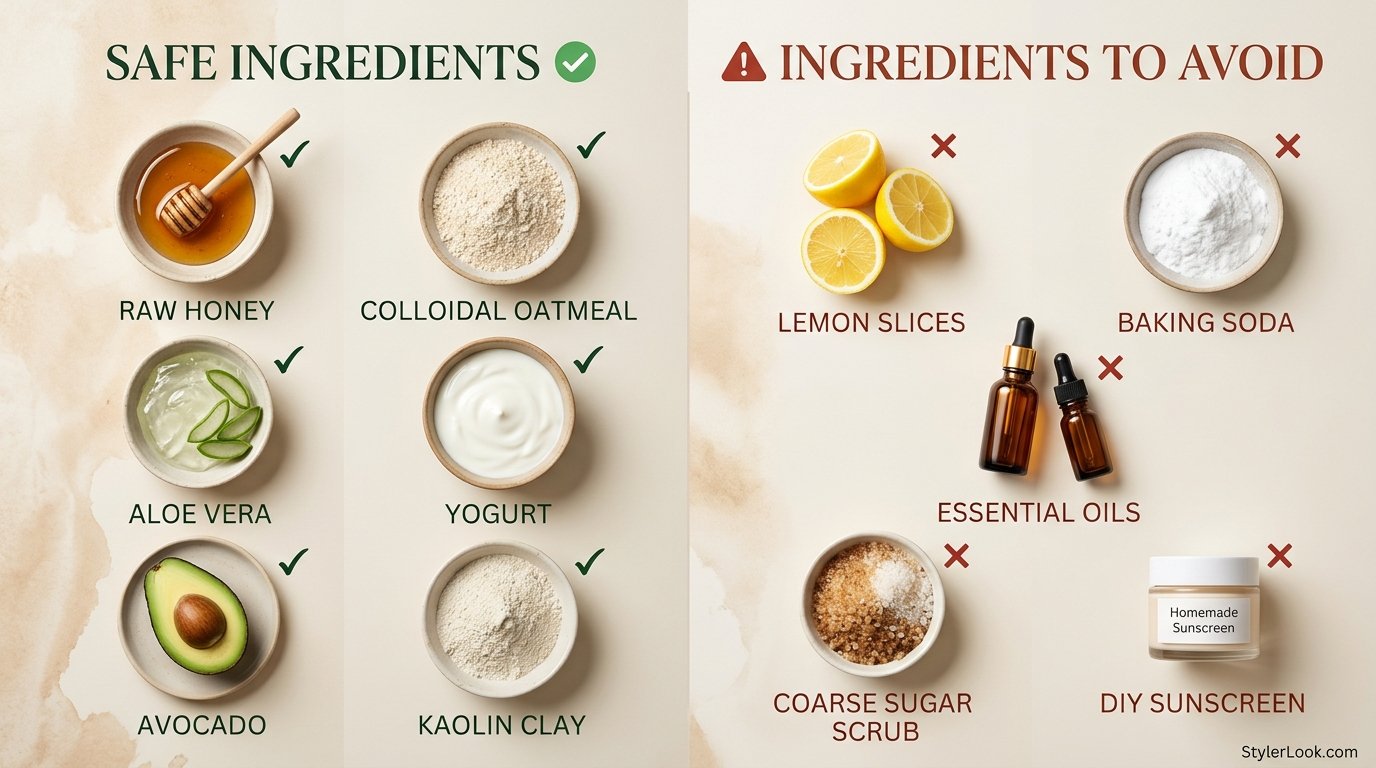
What passes is a short, honest list. Honey, colloidal oatmeal, and aloe vera carry actual evidence. Yogurt and avocado support them. Everything else is judged case by case, and several famous names fail.
What never passes is equally clear. Sunscreen is never DIY, because SPF cannot be tested in a kitchen. Lemon, baking soda, and undiluted essential oils fail on chemistry, whatever the video promised.
The Pantry Divide: Sort by Mechanism, Not by Natural
The divide’s first lesson is that natural is not a safety category. Lemon juice is perfectly natural and perfectly capable of burning you. A formulated vitamin C serum is synthetic and measurably gentler.
Judge by mechanism instead. Safe DIY ingredients work physically and mildly: they hold water on the surface, lay down softening fats, or calm the surface while they sit.
Unsafe ones work by attacking: strong acids, strong alkalis, phototoxic plant compounds, abrasive grit, or oils concentrated enough to injure. Attack has a place in skincare, in tested products with printed strengths.
The second test is knowability. A formulated acid prints its percentage and its pH. A lemon prints nothing; its acidity varies by fruit, season, and ripeness, and you wear the variance.
An ingredient that fails either test does not get a smaller dose or a shorter timer. It gets a formulated swap, listed beside every refusal in the never section below.
The divide also explains why the same pantry produces both lists. Oats soothe and sugar scrubs; both are breakfast. The food category is irrelevant. The mechanism is the whole question.
|
Ingredient |
Mechanism |
Verdict |
|---|---|---|
|
Honey |
Humectant, antimicrobial strands |
Safe side |
|
Colloidal oatmeal |
Avenanthramide soothing |
Safe side |
|
Aloe vera |
Light hydration |
Safe side |
|
Yogurt |
Very mild lactic acid, fats |
Safe side |
|
Kaolin clay |
Gentle oil absorption |
Safe side |
|
Lemon juice |
pH 2 to 3, phototoxic compounds |
Never |
|
Baking soda |
pH about 9, alkaline attack |
Never |
|
Undiluted essential oils |
Concentrated irritants |
Never |
|
Sugar and salt scrubs |
Abrasion |
Never as scrubs |
|
Homemade sunscreen |
Untestable protection |
Never |
The Evidence Trio: Honey, Oatmeal, Aloe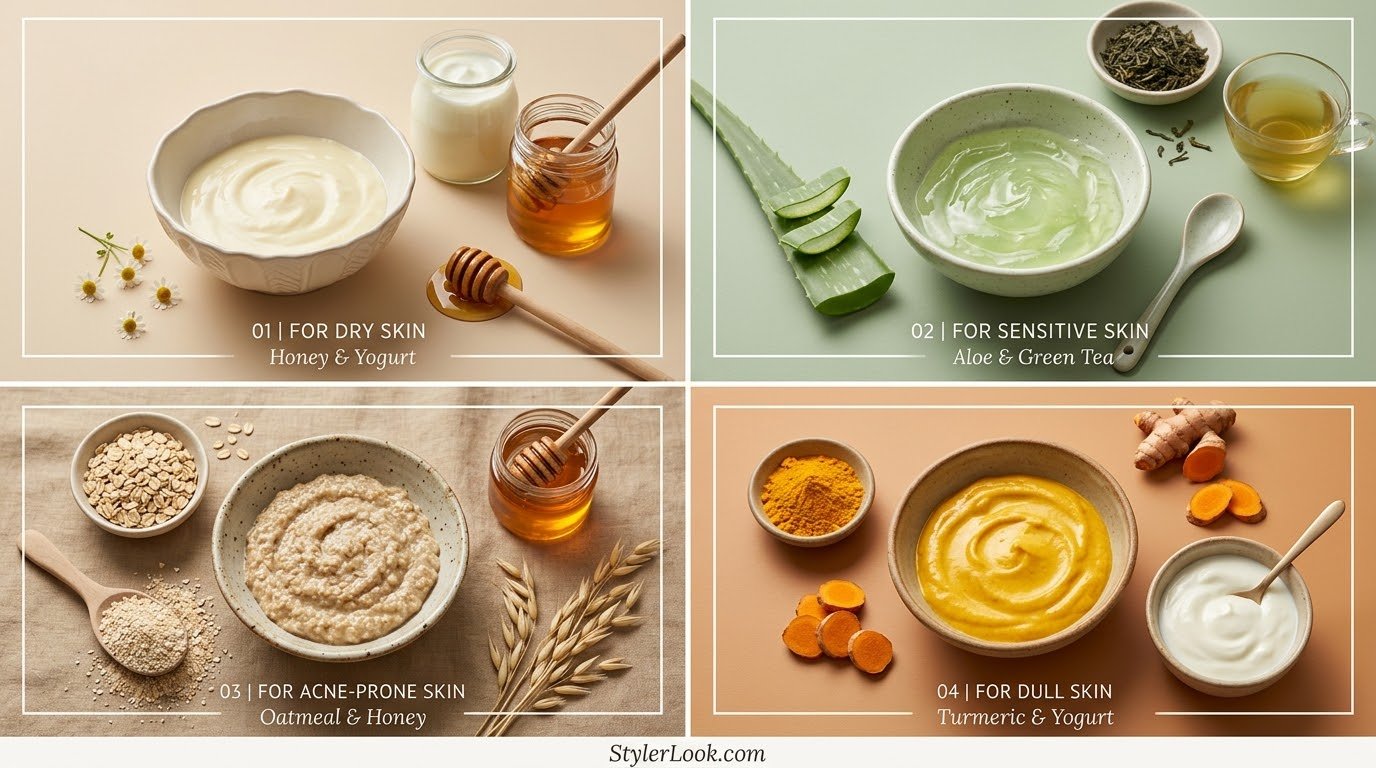
Honey earns its place on evidence, not folklore. It is a true humectant, drawing water into the surface layers, and it carries genuine antimicrobial activity, reviewed in the cosmetic dermatology literature.
That combination explains its double life in the recipes below. Honey hydrates dry skin and comforts blemish prone skin in the same ingredient, a rare profile in any pantry.
Colloidal oatmeal is the trio’s calm specialist. Oats milled fine enough to disperse in water deliver compounds called avenanthramides, with documented anti inflammatory activity. The ingredient is used in over the counter eczema products.
Grinding matters here. Fine oats soothe; coarse flakes scratch. Blitz rolled oats until they vanish into warm water without grit, or buy the milled product sold for baths.
Aloe vera completes the trio as the light hydrator. Its gel is mostly water with a soothing reputation most irritated skin tolerates well, which is why it anchors the sensitive skin recipe.
Aloe also teaches the trio’s limit. It comforts and hydrates the surface; it does not treat conditions. Redness that persists belongs to formulated care and, when it lingers, to a dermatologist.
Healthy and Cute’s evidence graded DIY face mask guide makes this same grading in print, evidence first, recipes second. It is the model this page follows, extended here with the full divide and the routine around the masks.
The Supporting Cast: Yogurt, Avocado, Tea, Clay
Yogurt supports through chemistry you can name. Its lactic acid is a genuine alpha hydroxy acid at a very mild, food level strength, and its fats soften while the acid works.
That mildness is the point. Yogurt gives the gentlest exfoliation a kitchen can offer, suitable as an introduction to how acids feel before any formulated acid enters the routine.
Avocado is the emollient: rich fats, including oleic acid, that fill the tiny gaps between surface cells. Paired with honey’s water drawing, it makes the classic dry skin mask coherent.
Green tea, brewed and fully cooled, works as a compress and a clay mixer. Its role is comfort and calm, and its discipline is temperature: hot tea on a face is a burn, not a treatment.
Kaolin clay is the gentlest clay, the one mask collections recommend across skin types. It absorbs surface oil without the stripping aggression of stronger clays, and it mixes with tea or water.
Each supporter passes the divide the same way the trio does. Mild mechanism, knowable behavior, and a job description written in comfort rather than cure.
Four Recipes, Matched to Your Skin Today
Recipes begin only after the sort. Read your skin this morning, choose the matching session, and let the hygiene rules in the next section govern every step.
1. The dry skin session: honey and yogurt
Mix two tablespoons of plain yogurt with one tablespoon of honey into a smooth paste. The yogurt’s fats and mild acid meet the honey’s water drawing in one layer.
Wear it 15 to 20 minutes, then rinse with lukewarm water and moisturize. Skin should feel softer and calmer, not tight; tightness means the session ran long.
2. The sensitive skin session: aloe and green tea
Stir two tablespoons of aloe vera gel into one tablespoon of fully cooled green tea. Fifteen minutes is enough; there is nothing in this mask to sting, which is its entire design.
This is also the post sun comfort session, with one boundary stated plainly. It soothes the feeling of a hot face; sunburn itself gets real care, and blistering gets a professional.
3. The acne prone comfort session: oatmeal and honey
Blend two tablespoons of finely ground oatmeal with one tablespoon of honey and a few drops of warm water. The oats calm while the honey hydrates, a deliberate non attack on reactive skin.
Keep the framing honest. This session comforts; it does not treat acne. Breakouts that persist need formulated actives and often a dermatologist, and no mask should delay that.
4. The dull skin session: turmeric and yogurt
Whisk one teaspoon of turmeric into two tablespoons of yogurt, and set a timer for ten minutes maximum. Turmeric’s traditional brightening role comes with staining, so the clock is part of the recipe.
Rinse thoroughly, expect a temporary yellow cast on paler skin, and moisturize. Never run this one before an event, and never let it drift toward the lemon versions circulating online.
|
Skin today |
Session |
Time |
|---|---|---|
|
Dry |
Honey and yogurt, or avocado and honey |
15 to 20 minutes |
|
Sensitive |
Aloe vera and cooled green tea |
15 minutes |
|
Acne prone (comfort only) |
Finely ground oatmeal and honey |
10 to 20 minutes |
|
Dull |
Turmeric and yogurt |
10 minutes maximum |
|
Oily |
Kaolin clay with cooled green tea |
10 to 15 minutes |
ipsy’s collection of expert DIY face mask recipes shows the recipe appetite readers bring: ten formulas, expert quotes, real enthusiasm. Read collections like it through the divide, keeping the kaolin and honey wisdom, refusing the unwarned lemon.
The Hygiene Rules: Fresh, Immediate, Tested
Rule one is freshness. Homemade mixtures carry no preservatives, and water based blends can grow bacteria within days. Mix a single session’s worth, use it now, and compost the rest.
Rule two follows: never store, never overnight. A mask left on sleeping skin sits for hours in warmth, and a jar kept in the fridge is a culture with a lid. Yesterday’s batch is waste, not savings.
Rule three is the patch test. Every new recipe goes on the inner forearm first; one careful guide in the research tests there for two days before a face application. Reactions announce themselves cheaply there.
Rule four is time discipline. Sessions run about 10 to 20 minutes, and turmeric runs ten. Longer is not stronger; dried masks tug, acids keep working, and comfort is the entire assignment.
Rule five is frequency: about one mask a week is plenty. The routine’s daily work belongs to the basics. The mask is the week’s treat, and treats stop working as structure when they become daily.
Rule six is clean tools. Wash bowls, spoons, and hands before mixing, and keep the session’s kit separate from cooking chaos. Kitchen skincare should be at least as clean as kitchen food handling.
The Never List, With the Swap for Each
Lemon juice leads the never list on documented harm. It sits around pH 2 to 3 against skin at roughly 4.7 to 5.5, and its furanocoumarins react with sunlight to cause phytophotodermatitis.
That reaction has a signature: redness and blistering arriving 24 to 48 hours after sun exposure, then dark marks that can persist far longer, falling harder on skin of color. The swap is a formulated vitamin C serum.
Baking soda fails from the opposite pole at about pH 9. Marketed as balancing, it dismantles the acid mantle instead, weakening the barrier it claims to help. The swap is a gentle cleanser, plus a clay mask for clogged pores.
Homemade sunscreen fails the knowability test completely. SPF is a laboratory measurement; a kitchen cannot perform it. One measured strand reports common plant oils absorbing at least a hundred times less UV than approved filters.
The position quoted in the research from the Skin Cancer Foundation is blunt: oil instead of sunscreen is very harmful. The swap is a tested broad spectrum SPF 30 or higher, about the price of a lunch.
Undiluted essential oils fail on concentration. Dermatology guidance in the research is never to apply them neat; burns and allergic contact dermatitis are the documented outcomes. Cold pressed citrus oils add phototoxicity on top.
Gritty scrubs of sugar, salt, coffee, or shells fail on mechanics, scouring a surface that sheds perfectly well on its own schedule. Toothpaste fails on formulation: it was designed for enamel, not faces. Both swaps are the same gentle cleanser.
Pathway to Progress guide to DIY remedies to avoid documents this never list ingredient by ingredient, with the first aid below. Read it once and the viral recipe feed never looks the same again.
If Something Goes Wrong: The Reaction Protocol
Stop the session at the first burn. Stinging that builds is not the product working; it is the product injuring. Tingling from a mild mask is one thing; pain is a full stop.
The safety guidance is specific: rinse a harmful application under cool running water for at least 20 minutes. Do not scrub, do not apply a second remedy on top, and do not wait it out under a towel.
Get medical help promptly for blisters, broken skin, swelling, or severe pain. A mole or spot you tried to treat at home also earns a professional look, without embarrassment; clinicians see this weekly.
After any reaction, the routine retreats to basics for days: gentle cleanser, plain moisturizer, sunscreen. No new experiments on irritated skin, and the offending recipe is deleted, not retried weaker.
Where DIY Sits in Your Week
A DIY routine is a supplement with a schedule. The foundation runs daily and stays formulated: gentle cleanser, moisturizer, and tested sunscreen in the morning; cleanser and moisturizer at night.
The site’s basic skincare routine guide lays out that foundation in full. DIY adds one weekly session on top of it, chosen by the day’s skin reading, and nothing else changes.
Starting out? how to start a skincare routine gives the pacing that keeps a new routine calm. DIY joins in week two or later, after the basics have proven themselves on your skin.
Tools on the site’s skincare routine builder help you place the session in a week you design, and the day 1 guide on this site covers the first 24 hours themselves. The homemade layer never carries the routine’s weight.
One more placement rule: never debut a recipe before an event. Weddings, photos, and interviews get familiar sessions only. The turmeric stain story is funny exactly once, and not in portraits.
DIY by Skin State: Choosing the Session
Dry skin takes the honey and yogurt session, or avocado folded into honey for the richest version. The goal is water plus fat, the two things dry skin is short of.
Sensitive skin takes aloe and tea, shortest menu, coolest temperature, and the patch test treated as law rather than advice. Sensitive skin is where the divide matters most.
Oily skin takes kaolin mixed with cooled green tea, absorbing surface oil without a scrub in sight. Follow with a light moisturizer; stripping oily skin invites rebound shine.
Combination skin can zone: clay on the T zone, honey and yogurt on the cheeks, in one session. DIY’s customization is a genuine advantage here, used with the divide as its guardrail.
Mature skin takes the emollient end, avocado and honey, with expectations set at comfort and glow for the evening. Structural change was never a pantry promise, and honesty keeps the ritual enjoyable.
Making It a Ritual You Keep
Adherence beats intensity in home care. A standing mask night, same evening weekly, outperforms heroic monthly experiments.
Keep a small recipe log: date, mixture, minutes, and the morning after verdict. Three entries teach you more about your skin than thirty saved videos, and the log is your personal evidence base.
Stock the pantry shelf once: honey, oats, yogurt, aloe gel, kaolin, and turmeric cover every recipe here.
Invite people carefully. A spa night with friends works when every guest patch tests and bowls stay personal.
Yon-Ka’s homemade face mask guide for dry skin models the ingredient literacy this ritual builds, humectants and emollients named and explained (their dry skin recipes are written for a British audience, so treat product framing as context). Learn the roles once and every future recipe reads clearly.
The Honest Limits of the Kitchen
DIY cannot deliver tested actives. Retinoids, measured acids, and proven brighteners require formulation, stability work, and printed strengths. Wanting those results is wanting formulated products, which is a fine want.
DIY cannot protect from the sun, cannot treat acne, eczema, or pigmentation disorders, and cannot promise timelines. What it offers is comfort, hydration, ritual, and ingredient literacy at pantry prices.
That offer is genuinely valuable when it is not oversold. The sites that oversell it print the lemon recipe beside the glow promise, and the reader pays for both.
Everything on this site’s StylerLook skincare cluster assumes that honesty. The basics, the pacing, and this homemade layer all serve the same goal: skin cared for by decisions you can explain.
The Session, Step by Step
Step 1: Read your skin. Look in daylight, note dryness, shine, sensitivity, and mood. The reading chooses the recipe; the calendar does not. A flushed face gets aloe, never turmeric.
Step 2: Patch and prep. New recipe means forearm first, on an earlier day. Session day, wash hands and tools, tie hair back, and line up the timer before anything is mixed.
Step 3: Mix one session only. Measure the recipe as written, in a clean glass or ceramic bowl. Mixing double for later is how the hygiene rules get broken politely.
Step 4: Apply and start the clock. Smooth the mask on with clean fingers or a brush, avoiding the eye area. Start the timer at first contact, not when the bowl is empty.
Step 5: Rest, do not multitask. Ten to twenty quiet minutes beat a masked workout. Heat, steam, and errands all shorten or distort the session the recipe was designed for.
Step 6: Remove gently. Soften with lukewarm water and lift the mask off without scrubbing. Dragging a dried mask across skin undoes the gentleness the recipe was chosen for.
Step 7: Seal and record. Pat dry, moisturize within minutes, and write the log line while the verdict is fresh. Morning brings the second verdict; note that too, briefly.
The pH Map: Why the Numbers Rule the Divide
Healthy skin surface sits at roughly pH 4.7 to 5.5, mildly acidic by design. That acid mantle is not trivia; it governs the enzymes that maintain the barrier and the microbes that live on it.
Lemon juice at pH 2 to 3 is not a little more acidic. The pH scale is logarithmic, so lemon is roughly a hundred times more acidic than your skin surface. Gentle exfoliant is not a description chemistry allows.
Baking soda at about pH 9 runs the other direction off the same cliff. Alkaline exposure swells and weakens the barrier, which is why soda sessions end in the tight, squeaky feeling beginners mistake for clean.
The trio lives near the skin’s own range, which is no coincidence. Honey, oatmeal preparations, and aloe ask the surface to do almost nothing chemically; they work while the mantle minds its business.
Formulated acids earn their place by printing their numbers: percentage, pH, and usage limits, tested as a system. The kitchen cannot print numbers on a lemon, and that, more than the lemon itself, is the disqualification.
Experimenters can buy pH strips and test their mixtures for curiosity. The strips teach the map vividly. They do not rescue a failed ingredient; they merely document the failure precisely.
Grading Viral Recipes: A Field Exercise
Take the turmeric and lemon brightening mask first. Turmeric passes with timing and stain cautions. Lemon fails on pH and phototoxicity. One bad ingredient fails the whole recipe, exactly as one bad brake fails a car.
The baking soda and lemon paste fails twice, alkali and acid in one bowl, fizzing impressively and accomplishing nothing but barrier damage. The fizz is carbon dioxide, not efficacy, and chemistry demonstrations belong in classrooms.
The coconut oil overnight treatment grades mixed, which the divide handles honestly. As an emollient on dry body skin it is unremarkable; on acne prone faces it is a common complaint, and overnight fresh mixtures break the freshness rule regardless.
The sugar and honey scrub splits by mechanism. Honey passes; the scrubbing fails. Stirred and rested on skin as a mask it is a honey session; rubbed, it is an abrasion with a sweet carrier.
The toothpaste spot dab fails on formulation mismatch, every time. The egg white mask passes the divide narrowly and fails freshness risk on salmonella handling grounds in careful readings; the albumin film effect is real and trivial.
Grade every new recipe you meet with the same two questions. What does it do, and how would anyone know its strength? Thirty seconds of grading outperforms an hour of comment reading.
The Supporting Shelf: Buying Once, Buying Right
Colloidal oatmeal is the one ingredient worth buying in its prepared form. Milling fineness is the product. Bath aisle packets or bulk cosmetic supply both beat gritty home grinding for sensitive work.
Aloe gel buying needs one label check: the gel should be aloe first, alcohol low or absent. A leaf from a healthy plant is the purist route, with the yellow latex layer under the rind rinsed away carefully.
Honey needs no upgrade for masking. Ordinary raw honey performs; manuka’s premium buys wound care literature more than face mask advantage, and the honest page says the quiet part: save the difference.
Kaolin comes from cosmetic suppliers, cosmetic grade only. Craft and pottery clays are a different supply chain with different contaminants, and the divide’s knowability test applies to sourcing too.
Glass or ceramic bowls and a dedicated brush complete the shelf. Metal can react with clays in careful guidance, and the dedicated kit keeps the hygiene rules effortless rather than aspirational.
Seasons and the Pantry
Winter is emollient season: avocado joins honey, sessions stretch to twenty minutes, and the moisturizer after gets richer. Indoor heating is the dry skin recipe’s co author.
Summer belongs to aloe and tea, cooled in every sense. It is also lemon’s most dangerous season, when fruit and strong sun meet.
Spring suits the gentle yogurt session as routines lighten. Autumn suits oatmeal, the pantry’s repair comfort after a summer of exposure, always as comfort, never as a cure claim.
Seasonal produce tempts improvisation, and the divide travels with you. Pumpkin, berries, and stone fruit all meet the same two questions before they meet your face, and most meet the compost instead.
DIY for Households: Partners, Kids, and Guests
A partner’s skin is not your skin. Recipes transfer; reactions do not. Everyone patch tests their own forearm, and the household never list binds visitors exactly as it binds residents.
Children get the gentlest possible version or none: oatmeal and water, short minutes, adult hands, and nothing near eyes. Kids’ skin is thinner, their tolerance for sitting still is shorter, and both facts argue restraint.
Teens need the acne honesty most. A household that offers oatmeal comfort while funding a real formulated acne plan teaches better skincare than either extreme alone, prohibition or pure folklore.
Guests at a spa night sign up for the rules with the invitation: patch beforehand if possible, personal bowls, no surprises. The friend who arrives with a lemon should leave with the divide card and a better plan.
Troubleshooting Sessions
The mask stings a little. Distinguish tingle from build. A faint yogurt tingle that fades is the mild acid saying hello; stinging that grows, burns, or reddens is the stop signal, and the rinse protocol applies without debate.
The mask will not spread. Add warm water by drops, not spoonfuls. A runny mask slides off, drips into eyes, and delivers a fraction of the contact the recipe designed.
The oats feel gritty. The grind failed, not the recipe. Re blitz the batch finer or strain it, and let the lesson set the buying decision the shelf section describes.
Turmeric stained more than expected. The cast fades over a day or two of normal cleansing; oil on a cotton pad lifts some at once. Do not scrub it off aggressively; that trades a tint for an injury.
Skin felt tight afterward. The session ran long, the mask dried fully, or the moisturizer step was skipped. Shorten the next session, remove before dry, and seal promptly.
Nothing happened at all. Comfort effects are subtle by design, and a quiet session is a success the viral format cannot film. Judge by the morning mirror and the log, not by reveal drama.
Your First Four Weeks With the Homemade Layer
Week one is basics only, run honestly. Learn your skin’s ordinary behavior before adding variables, or the log you keep later will have nothing to compare against.
Week two adds the first session: the trio member matched to your skin state, patch tested, timed, logged. One recipe, done properly, is the whole assignment.
Week three repeats or rotates within the safe list. A second recipe is allowed; a second session in the week is not the upgrade it feels like.
Week four reviews the log. Which session earned its place, which was neutral, which irritated? The routine that survives review is yours, and it will not match any influencer’s shelf.
By the second month the divide is habit. You grade recipes in seconds, the shelf stays stocked, and the weekly ritual runs itself while the formulated basics do the heavy lifting daily.
When DIY Ends and Professional Care Begins
DIY ends at any burn, blister, or spreading rash, at pigmentation that darkens rather than fades, and at breakouts, flushing, or scaling that persist through weeks of basics.
It also ends at diagnosis questions. What is this spot, why is this patch growing, is this mole changing: these are medical questions, and no pantry answers them. Delay is the only real harm folklore causes here.
A dermatologist visit is not a failure of natural living. It is the same judgment the divide teaches, applied at a larger scale: know what a tool can do, and use the right one.
Keep the boundary bright and the kitchen stays a pleasure instead of a risk. The recipes are good. The rules make them safe. The professionals handle the rest, and a sane routine uses all three.
Natural Myths, Graded Honestly
Myth: natural means safe. Lemon, poison ivy, and sunlight are natural. Grade: false, and the divide exists because of it. Mechanism and dose decide safety; origin decides nothing.
Myth: chemicals are the enemy. Water is a chemical; honey is hundreds of them. Grade: meaningless as stated. The useful question is always which compounds, at what strength, doing what.
Myth: if it stings, it works. Stinging is nerve reporting, and nerves report damage as readily as activity. Grade: false as a rule, and the troubleshooting section’s stop signal exists in its place.
Myth: food on skin feeds skin. Skin eats nothing; it is a barrier, not a stomach. Grade: false literally, true only as metaphor for surface comfort. Nutrients in masks act on the surface, briefly, and rinse away.
Myth: our grandmothers did it, so it is proven. Their oatmeal wisdom survives because it worked, which the trio’s literature later confirmed. Grade: half credit, keep the oats, retire the lemon.
Myth: DIY is always cheaper. Cheaper per session, yes; cheaper per result only inside its lane. A year of pantry attempts at a problem a formulated product solves is the expensive route.
Reading Formulated Labels With Pantry Eyes
The divide’s best side effect is label literacy. Once humectant, emollient, and acid are roles you have handled in food form, ingredient lists stop being wallpaper and start being legible.
Find the water drawers first: glycerin, honey, aloe, hyaluronic acid in its formulated form. Then the fats: oils, butters, ceramides in serious moisturizers. The architecture of your mask is the architecture of the shelf.
Find the printed strengths. A formulated acid shows its percentage the way a recipe shows teaspoons. Products that hide strengths behind poetry fail the knowability test as surely as lemons do.
Finally, find the preservative system and respect it. Shelf life is a feature with a mechanism, not a conspiracy.
Frequently Asked Questions
1. Is a DIY skincare routine at home safe?
It can be, inside strict rules. Stick to the evidence trio, patch test everything, use mixtures fresh, and keep cleanser, moisturizer, and sunscreen formulated.
2. What does DIY skincare actually do well?
Comfort, hydration, and ritual. The trio soothes and hydrates the surface for an evening, teaches ingredient literacy, and costs almost nothing per session.
3. Which kitchen ingredients are safe on skin?
Honey, colloidal oatmeal, and aloe lead. Yogurt, avocado, cooled green tea, and kaolin clay support them.
Everything else must pass the divide first.
4. What is the evidence trio of DIY skincare?
Honey, colloidal oatmeal, and aloe vera. They are the three kitchen ingredients with real literature behind them, graded openly in the research.
5. Is honey good for your face?
Yes, as a humectant with antimicrobial strands. It draws water into the surface and comforts both dry and blemish prone skin in one ingredient.
6. Is colloidal oatmeal good for skin?
Yes, it is the trio’s calm specialist. Its avenanthramides carry documented soothing activity, and the ingredient is used in over the counter eczema products.
7. Is aloe vera good for skin?
Yes, as a light, widely tolerated hydrator. It suits sensitive skin and post sun comfort, while never claiming to treat conditions.
8. Can I put lemon juice on my face?
No, never apply it neat. Its acidity can irritate, and its compounds can react with sunlight to cause phytophotodermatitis, a burn like reaction.
9. Why is lemon juice bad for skin?
Two mechanisms combine against you. A pH near 2 to 3 attacks the barrier, and furanocoumarins plus sunlight blister skin hours later.
10. What can I use instead of lemon juice for brightening?
Use a formulated vitamin C serum. It delivers the brightening goal at a printed strength and tested pH, without the phototoxic risk.
11. Is baking soda good for skin?
No, it dismantles the acid mantle. At about pH 9 it weakens the barrier it claims to balance, leaving skin tight and reactive.
12. What can I use instead of a baking soda scrub?
Use a gentle cleanser, plus kaolin for pores. Both do the jobs soda promises, at strengths your barrier can live with.
13. Can I make my own sunscreen at home?
No, never. SPF is a laboratory measurement no kitchen can perform, and untested mixtures give false confidence under real sun.
14. Why is homemade sunscreen dangerous?
Because the failure is invisible. Plant oils absorb a small fraction of the UV that tested filters block, so skin burns while feeling protected.
15. How often should I use a homemade face mask?
About once a week is plenty. The daily work belongs to the formulated basics; the mask is the week’s treat, not its structure.
16. How long should I leave a homemade mask on?
About 10 to 20 minutes. Turmeric sessions cap at ten, and no homemade mask should stay on until fully dry and tugging.
17. Can I store a homemade face mask?
No, never store homemade masks. Without preservatives, water based mixtures can grow bacteria within days.
Mix one session and discard the rest.
18. Can I leave a homemade mask on overnight?
No, overnight wear is unsafe. Hours of warm contact plus spoilage risk make sleeping in a fresh mask a bad idea.
19. Do homemade products need preservatives?
For storage, yes, which is the point. Preservation is chemistry a kitchen cannot verify, so homemade products skip storage entirely instead.
20. How do I patch test a homemade mask?
Test the inner forearm first. Apply a small amount, wait, and watch for reaction before the recipe ever touches your face.
21. What is a good homemade mask for dry skin?
Honey and yogurt is the classic. Two tablespoons of yogurt to one of honey, 15 to 20 minutes, then moisturize promptly.
22. What is a good homemade mask for sensitive skin?
Aloe vera with cooled green tea. Fifteen minutes, nothing in it to sting, which is exactly the design sensitive skin needs.
23. What is a good homemade mask for dull skin?
Turmeric and yogurt, timed carefully. One teaspoon of turmeric in yogurt for ten minutes maximum, accepting a temporary tint on paler skin.
24. What is a good homemade mask for acne prone skin?
Oatmeal and honey, for comfort only. It calms and hydrates; it does not treat acne, which deserves formulated care when it persists.
25. Is yogurt good for your face?
Yes, gently. Its lactic acid is the mildest acid a kitchen offers, and its fats soften while it sits.
26. Is avocado good for your face?
Yes, as the emollient. Its fats fill the tiny gaps between surface cells, pairing naturally with honey’s water drawing.
27. Is turmeric safe on skin?
With cautions attached. It can stain skin temporarily and occasionally irritates; keep sessions to ten minutes and patch test first.
28. Does turmeric stain skin?
Yes, temporarily on many skins. The yellow cast fades over a day or two of normal cleansing; never schedule it before events.
29. Are essential oils safe in homemade skincare?
Only diluted, never neat. Undiluted oils are documented causes of burns and dermatitis, and cold pressed citrus oils are phototoxic in sunlight.
30. Can I use coconut oil on my face?
Cautiously, by skin type. It is a reasonable emollient for dry body skin and a common complaint on acne prone faces.
31. Are sugar or salt scrubs safe?
Not as face scrubs. Grit scours a surface that sheds on its own schedule; use the ingredients as masks instead of abrasives.
32. Is toothpaste good for spots?
No, it was formulated for enamel. Its detergents and flavorings irritate faces, and the drying effect people chase is barrier damage.
33. What should I do if a DIY mask burns or stings?
Stop and rinse immediately. Use cool running water for at least 20 minutes, and get medical help for blisters or severe pain.
34. Can DIY skincare replace my regular routine?
No, and it should not try. Cleanser, moisturizer, and sunscreen stay formulated; DIY adds one weekly session on top.
35. What parts of a routine should stay formulated?
The three basics stay formulated. Cleansing, moisturizing, and sun protection need tested strengths, stability, and preservation a kitchen cannot provide.
36. Is natural skincare always safe?
No, natural is not a safety category. Lemon juice is natural and can burn you; mechanism and dose decide safety, never origin.
37. Can I do DIY skincare while pregnant?
Choose caution and professional guidance. Stick to the gentlest basics, avoid experiments entirely, and ask your clinician before any new ingredient.
38. Can teenagers use homemade face masks?
Keep masks gentle and supervised. The trio only, short sessions, no acne treatment promises, and persistent breakouts belong to formulated care.
39. What is the best first DIY recipe for a beginner?
Oatmeal and honey. It is the calmest, cheapest, most forgiving first session, and it teaches timing, removal, and logging at once.
40. How do I fit DIY into a weekly routine?
Place it weekly against the basics. One session, chosen by the day’s skin reading, sealed with moisturizer, and noted in your log.
41. What DIY skincare should I completely avoid?
Avoid the never list entirely. Lemon juice, baking soda, homemade sunscreen, undiluted essential oils, gritty scrubs, and toothpaste, each with its swap.
42. Where do I learn the basic routine DIY sits inside?
Start with the basic routine guide. The foundation comes first; DIY joins from week two, once the basics have proven themselves.
Conclusion
A diy skincare routine at home earns its place the same way every recipe on this page did: by passing the divide.
Sort by mechanism, keep the evidence trio at the center, obey the hygiene rules, and never ask a kitchen to test sunscreen. Do that, and the pantry becomes what it should be: a weekly pleasure inside a routine built on formulated basics.
Begin with the basic routine, add one patch tested session in week two, and keep the log. Your skin gets the comfort, your shelf gets the savings, and your judgment gets sharper every single week.
