

Skincare routine builder tools all promise a routine made for your skin, then hand you a shopping list from one brand’s shelf.
A real builder works differently. It asks better questions, fills four slots, and leaves you able to rebuild without it.
Here is the whole method, free and brand neutral. Your skin type sets the textures, one concern picks the treatment, and order does the rest.
The Short Answer: What a Routine Builder Actually Does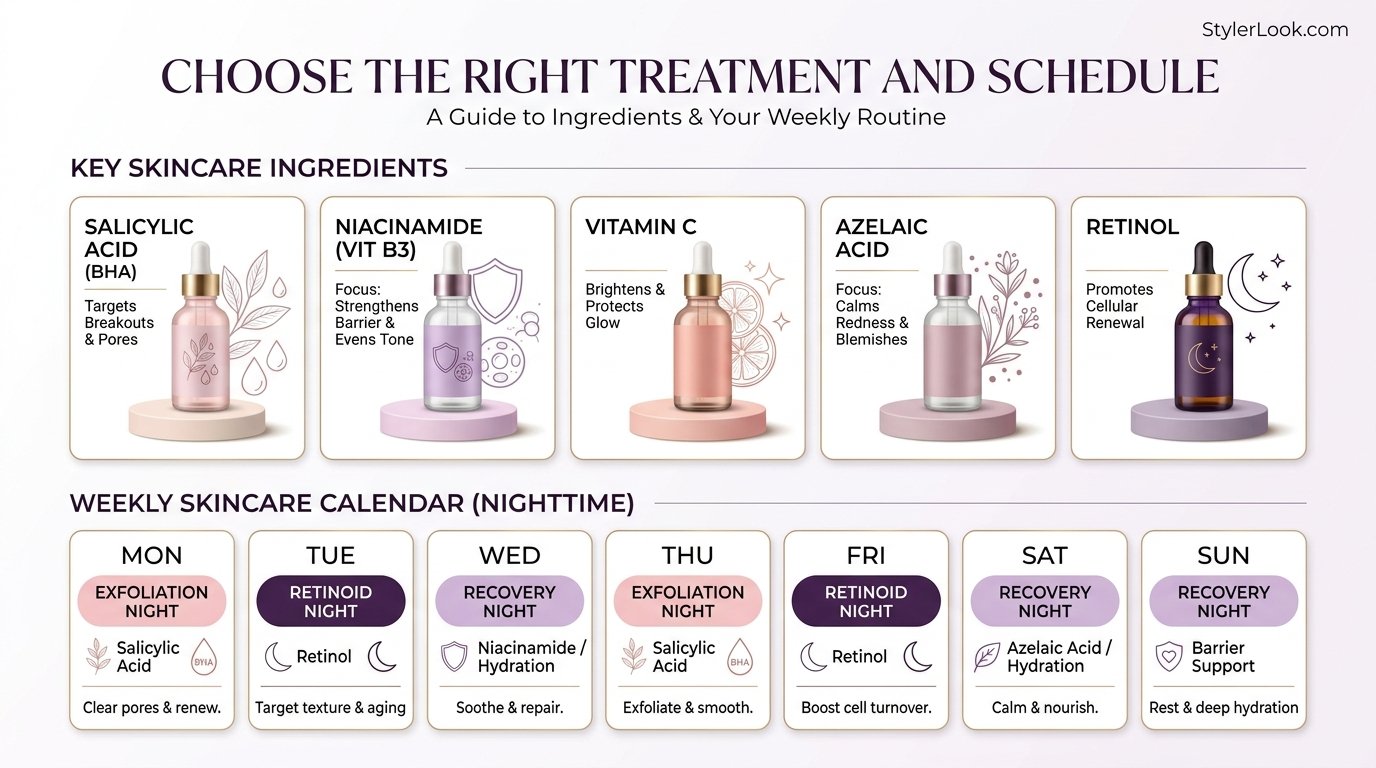
A builder assembles a routine from four slots: cleanse, treat, moisturize, protect. Type chooses textures, one concern chooses the treatment.
Five rules run the whole build. Diagnose your type honestly, fill the slots in order, layer thinnest to thickest, schedule conflicts apart, judge at eight weeks.
Brand quizzes skip most of this. E.l.f. skincare routine quiz explainer shows the standard input set: skin type, concerns, current products, and your birthday.
First, Know Your Skin: The Questions That Diagnose Type
Every builder starts with type, because type decides cleanser texture, moisturizer weight, and how much active your skin tolerates.
The honest diagnosis takes five observations, not a selfie. Answer them across a normal week, not after one unusual day.
The Five Diagnostic Questions
1. The wash test. Thirty minutes after gentle cleansing, does your face feel tight, comfortable, or shiny?
2. The midday check. By noon, is shine everywhere, T-zone only, or nowhere?
3. The pore check. Are pores visible across the cheeks, only on the nose, or barely visible?
4. The reaction history. Do new products often sting, redden, or break you out within days?
5. The flake check. Do you see dry patches or makeup catching on rough spots by afternoon?
Mostly tight, flaky, small pored answers point dry. Shine everywhere with visible pores points oily. Shine only in the T-zone points combination.
Comfortable, quiet answers point normal. Frequent stinging and redness add a sensitive flag on top of any type, and it changes the pacing rules.
Quizzes ask versions of these same questions. Interact sample skincare quiz runs six of them and sorts everyone into the same five type buckets.
Type also moves. Season, climate, age, hormones, and a damaged barrier all shift it, so a build is a snapshot, not a life sentence.
The Four Slots: Cleanse, Treat, Moisturize, Protect
Strip every routine in the research down, and the same four slots remain. Retail builders output them, and editorial guides teach them.
Sixated complete routine guide names the identical four moves: cleanse, treat, moisturize, protect. Master these slots and everything else is refinement.
Slot One: Cleanse
Cleansing removes sunscreen, makeup, sweat, oil, and the day’s pollution so treatments meet skin, not residue.
You cleanse thoroughly at night and gently in the morning. Many dry and sensitive readers do better with a morning water rinse only.
Slot Two: Treat
The treat slot holds the one active aimed at your primary concern. It is the only slot that changes by concern.
Serums live here. So do exfoliating acids and retinoids, each on its own scheduled nights.
Slot Three: Moisturize
Moisturizer supplies the barrier with water and fats and seals the layers beneath it. Every type needs it, oily skin included.
Skip it and skin often answers with more oil and more irritation, the cycle beginners misread as needing stronger products.
Slot Four: Protect
Protection is broad spectrum SPF 30 or higher, every morning, always last. American Academy of Dermatology’s skin care basics anchors this floor for every skin type.
No treatment outperforms daily sunscreen over years. Fading spots, slowing photoaging, protecting retinoid gains: all of it runs through this slot.
Toner, essence, eye cream, and masks are optional refinements. Add them only after the four slots run comfortably for several weeks.
Rule One: Your Type Sets the Textures
Type does not choose your brands. It chooses textures: gel or cream cleanser, lotion or rich moisturizer, fluid or creamy sunscreen.
Get textures right and even average products behave well. Get them wrong and excellent products pill, grease, or sting.
|
Skin type |
Cleanser texture |
Moisturizer texture |
Sunscreen feel |
|---|---|---|---|
|
Oily |
Gel or foaming |
Gel or light lotion |
Fluid, matte leaning |
|
Dry |
Cream or balm |
Rich cream, ceramides |
Creamy, comfortable |
|
Combination |
Gentle gel |
Gel on T-zone, cream on cheeks |
Fluid |
|
Sensitive |
Fragrance free cream |
Barrier cream, few ingredients |
Mineral or gentle fluid |
|
Normal |
Gentle gel or cream |
Lotion or light cream |
Any comfortable finish |
Combination skin is really two builds sharing one face. Zone the textures: lighter where you shine, richer where you flake.
Skincare routine for oily skin shows a full type build worked end to end, including the oil control mistakes that backfire.
Gentle skincare routine for dry sensitive skin is the worked build for the dry and sensitive end, where pacing matters more than product strength.
Rule Two: One Concern Picks the Treatment
Most failed routines chase three concerns at once and irritate all of them. A builder ranks concerns and treats one at a time.
Name your primary concern in one sentence. The sentence picks the active; everything else waits its turn.
|
Primary concern |
First line active |
Placement |
|---|---|---|
|
Breakouts, clogged pores |
Salicylic acid or adapalene |
Night treatment slot |
|
Inflamed spots |
Benzoyl peroxide |
Spot use, away from retinoid layers |
|
Uneven tone, dullness |
Vitamin C or azelaic acid |
Morning or night slot |
|
Texture, photoaging |
A retinoid |
Night only, ramped slowly |
|
Oil balance, mild tone |
Niacinamide |
Either routine, gentle starter |
|
Dehydration |
Humectant layering (hyaluronic acid, glycerin) |
On damp skin, under moisturizer |
Second concerns join only after the first active runs calmly for weeks. Often they join by alternating nights, not by stacking layers.
That ranking discipline is what quizzes cannot do. A quiz sells you the whole shelf today; a builder sequences the shelf across a season.
Rule Three: Order Is Thinnest to Thickest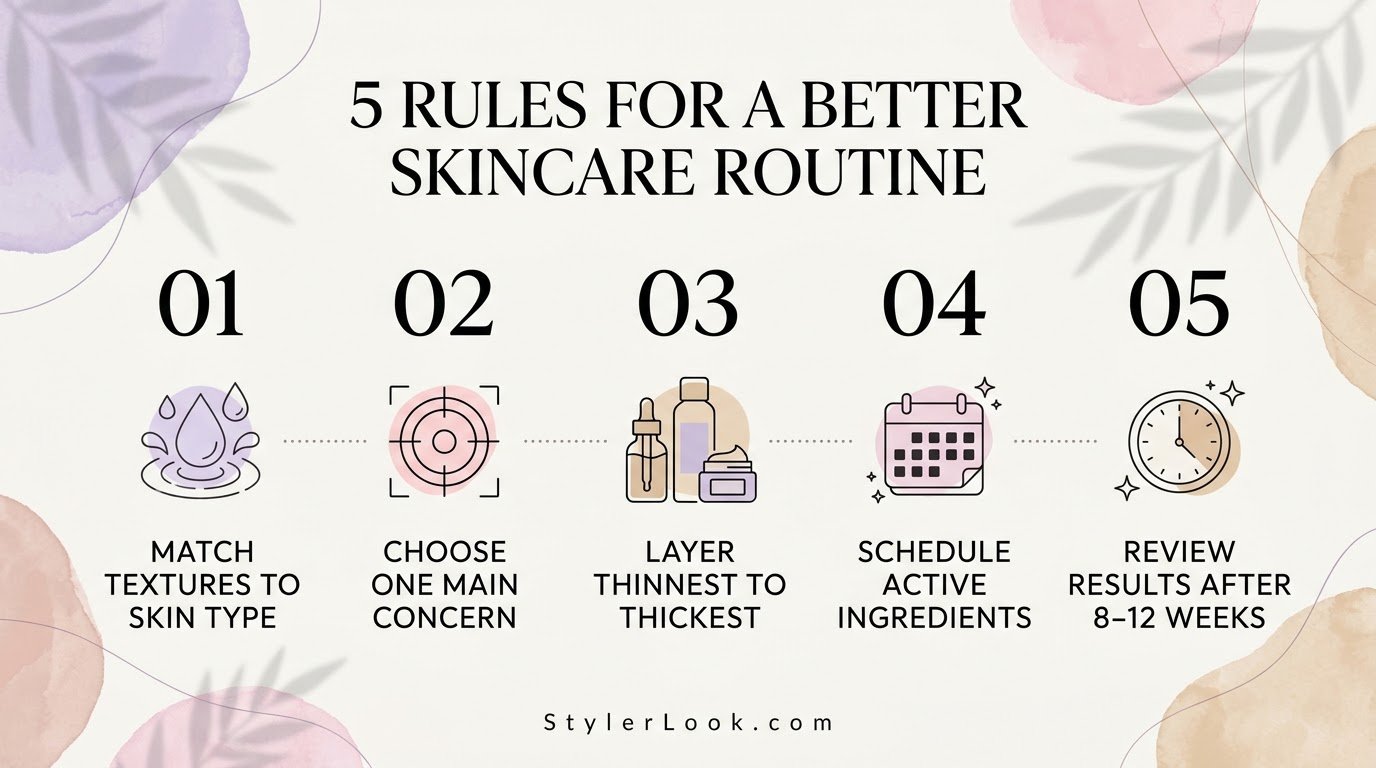
Layer from thinnest to thickest, water based before oil based. Heavy creams form a seal, and a serum under that seal never reaches skin.
Morning order: cleanser or rinse, treatment, moisturizer, sunscreen. Sunscreen is the fixed point, last, with nothing layered over it.
Night order: cleanser, treatment, moisturizer, with an optional occlusive finish on dry nights. Makeup and heavy sunscreen days earn a double cleanse.
Skincare routine order guide teaches the full sequence with its exceptions, and Skincare routine hub holds the broader routine architecture this build sits inside.
Rule Four: Schedule the Conflicts
Most famous ingredient conflicts reduce to one rule: strong actives should not share a night while your skin is learning.
Keep retinoids and exfoliating acids on different nights. Keep benzoyl peroxide away from the retinoid layer, in time or in place.
|
Night pattern |
Mon |
Tue |
Wed |
Thu |
Fri |
Sat |
Sun |
|---|---|---|---|---|---|---|---|
|
Example week |
Retinoid |
Rest |
Exfoliant |
Rest |
Retinoid |
Rest |
Exfoliant or rest |
Skin cycling is just this scheduling with a brand name. Two active nights, then recovery nights of plain moisturizing, suits most beginners.
Vitamin C causes fewer scheduling problems: it sits comfortably in the morning, under sunscreen, while retinoids own the night.
Morning skincare routine and Nighttime skincare routine show the two finished routines this schedule produces, morning protection against night repair.
Rule Five: Add One Product at a Time, Judge at Eight to Twelve Weeks
A build is an experiment, and experiments change one variable. Introduce products one at a time, at least two weeks apart.
Patch test first: inner arm or jawline, several days, before any new product earns your whole face.
Pathway to Progress minimalist routine guide states the judgment window plainly: give a product eight to twelve weeks before deciding, because turnover and pigment change run slowly.
Photograph your skin in the same light every two weeks. Daily mirror checks cannot see slow change and talk people out of working routines.
How to start a skincare routine guide turns this pacing into a beginner calendar, the first month deliberately boring: core slots only, then the treatment.
A Worked Build: Combination Skin Chasing Uneven Tone
Meet the most common builder reader: oily T-zone, normal cheeks, and a primary concern of uneven tone from old breakouts.
Type sets textures: a gentle gel cleanser, gel moisturizer across the T-zone, a light cream on the cheeks, and a fluid sunscreen.
Concern picks the treatment: azelaic acid earns the slot, gentle enough for daily use and aimed squarely at tone and post breakout marks.
Order assembles it: mornings run cleanser, azelaic acid, moisturizer where needed, sunscreen last. Nights run cleanser, treatment, moisturizer.
Scheduling stays simple: no exfoliant for the first month. At week five, one salicylic acid night weekly joins, watching for stinging as the stop signal.
Judgment lands at week ten: tone slightly more even, no new irritation, shine unchanged. The build passes, and a second concern can now apply for the slot.
The Worksheet: Your AM and PM Grid
Here is the builder itself, on paper. Fill one row per slot, using the texture table and the concern table above.
Morning grid: cleanser or water rinse; treatment (vitamin C or niacinamide day); moisturizer if your type needs it; sunscreen, last, every day.
Night grid: cleanser, double if needed; tonight’s scheduled treatment; moisturizer; optional occlusive on dry nights.
Weekly line: write which nights carry the exfoliant, which carry the retinoid, and which are rest nights. Rest nights are part of the build.
Review line: an eight week date, two dated photos, and one sentence: is the primary concern measurably better, same, or worse?
Best skincare routine guide compares finished routine styles if you want to sanity check your grid against complete published builds.
What Brand Quizzes Get Wrong, and When to Use One Anyway
Quizzes fail in four predictable ways. Each one is structural, not a flaw in any single brand.
1. They sell one catalog. Your perfect routine, computed honestly, might span five brands; a quiz’s output spans one shelf.
2. They ask too little. Three to eight questions cannot capture barrier state, prescriptions, or pregnancy, and most never try.
3. They ignore conflicts. The output lists products, not a schedule, so retinoid and acid land in the same cart with no nights assigned.
4. They never follow up. No eight week check, no failure diagnosis, no adjustment: the build is frozen at purchase day.
Use one anyway for discovery: a quiz is a fast texture and format sampler inside a brand you already like.
Then audit its output against the five rules here. Keep what passes, schedule what conflicts, drop what your type rules out.
Budgets: Funding the Slots in Order
Fund slots by evidence, not by marketing. Sunscreen first, then the cleanser and moisturizer you will use daily, then the one treatment.
Drugstore formulas cover all four slots competently. In basic categories, price tracks packaging and fragrance more than performance.
Cut in this order when money is tight: tools, masks, eye cream, toner, essence. The four slots stay funded or the build is not a build.
A builder that outputs a twelve product cart has failed the budget question, whatever its quiz asked. Four well chosen products beat twelve abandoned ones.
Signs Your Build Is Working, and Signs to Rebuild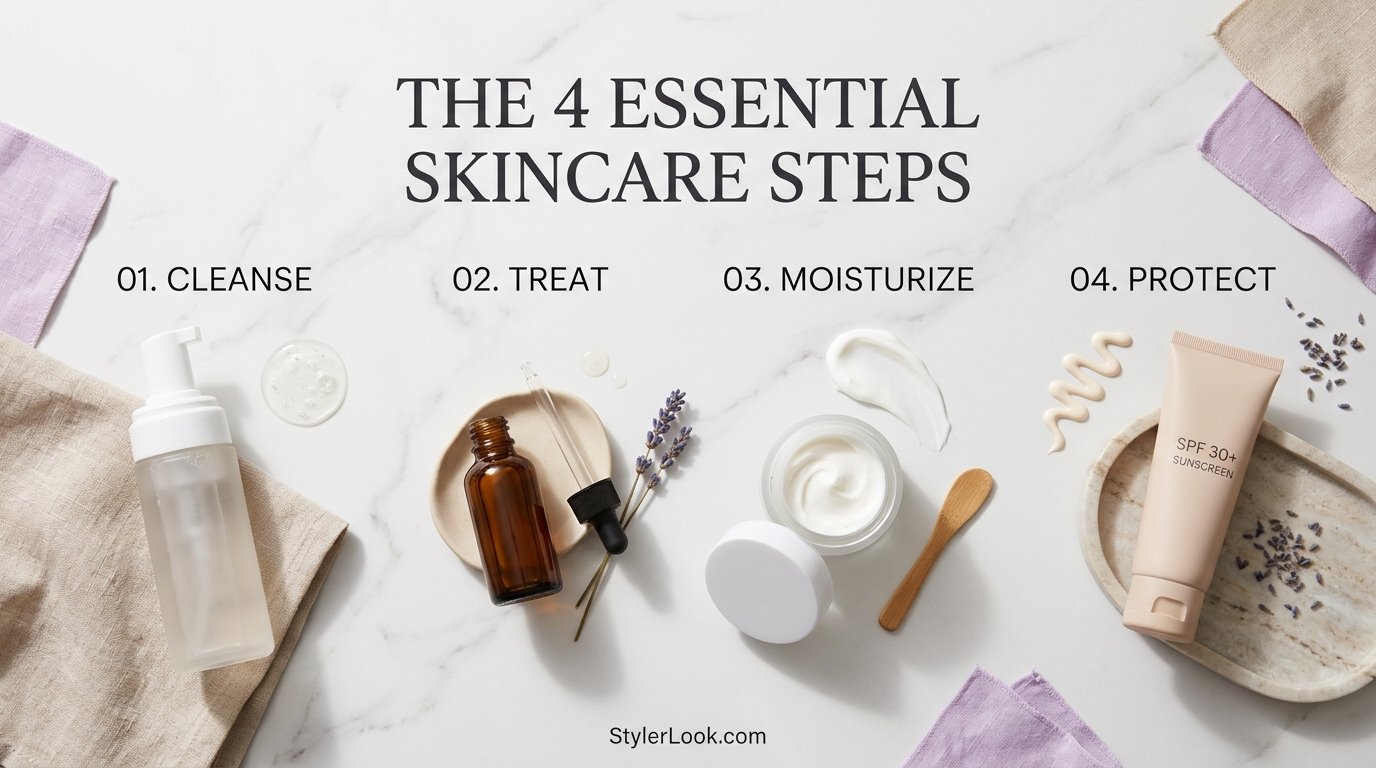
Working signs are quiet: less midday shine or tightness, makeup sitting better, spots fading slowly, fewer new breakouts month over month.
Failure signs are loud: stinging from old favorites, flaking, tightness after cleansing, dark marks darkening, breakouts that began with a product and persist.
The correct response to failure is subtraction. Drop to the core three until skin calms, then rebuild one slot at a time.
One caution for deeper skin tones: irritation triggers post inflammatory pigmentation, so aggressive builds create the marks they promise to fade.
Persistent acne, rosacea patterns, eczema, or sudden changes are a dermatologist’s questions, not a builder’s. Korean skincare routine shows a layered style done gently, for readers whose dry skin wants more steps.
Men’s skincare routine applies the same slots to men’s routines, with shaving counted as an exfoliation event to schedule around.
For the wider site and everything beyond skincare, start at StylerLook.
The Five Building Mistakes This Method Prevents
Mistake one: buying the routine before diagnosing the skin. Type evidence takes a week of observation and costs nothing; carts bought first get diagnosed never.
Mistake two: three actives in week one. Every irritation that follows is untraceable, and the whole build gets abandoned instead of one product.
Mistake three: judging at day ten. Hydration shows in days, tone and texture in months. Early verdicts kill working routines.
Mistake four: copying an influencer’s shelf. Her type, climate, budget, and prescription history are not yours, and her shelf is also an advertisement.
Mistake five: rebuilding with every season change. Adjust textures and frequencies instead; a stable base is what makes results readable.
Frequently Asked Questions
What is a skincare routine builder?
Any system that turns answers about your skin into a routine. Brand builders are quizzes that output products from one catalog
Guide builders are frameworks that output decisions: your skin type sets product textures, one primary concern selects a single treatment active, and the layering order (thinnest to thickest, sunscreen last in the morning) assembles them.
A good builder teaches you to rebuild without it.
Are skincare routine quizzes accurate?
Only within their limits. The quizzes in this research ask three to eight questions and sort you into four or five skin type buckets
None asks about ingredient conflicts, pregnancy, prescription treatments, or a damaged barrier, and a brand quiz can only recommend its own products. Treat a quiz result as a first draft to be checked against the building rules, never as a prescription.
How do I know my skin type?
Use the questions the quizzes themselves use, observed honestly: how your skin feels thirty minutes after gentle cleansing (tight suggests dry, comfortable suggests normal, shiny suggests oily), how it looks by midday (shine in the T-zone only suggests combination)
And how it reacts to new products (frequent stinging or redness suggests sensitivity). Type can shift with season, age, and climate, so retest when your routine stops fitting.
How many products should a skincare routine have?
Three are non negotiable for most people (gentle cleanser, moisturizer matched to type, broad spectrum SPF 30 or higher every morning), plus one treatment for your primary concern.
Everything beyond four or five steps must justify itself against the irritation and inconsistency it adds. The maximalist ten step shelf is a marketing shape, not a dermatological one; the AAD itself warns that stacking multiple active products irritates skin.
What are the core steps every built routine needs?
Cleanse, treat, moisturize, protect: the four slot model the retail builders and the editorial guides converge on.
Cleanse removes the day; treat is the single active aimed at your primary concern; moisturize supplies the barrier with water and fats; protect is morning sunscreen, always last.
Toner, essence, eye cream, and masks are optional refinements, added only after the four slots run comfortably for weeks.
What order should I apply skincare products in?
Thinnest to thickest consistency, water based before oil based, because heavy occlusive layers block lighter products from reaching skin. A working morning order: cleanser, treatment serum, moisturizer, sunscreen.
A working night order: cleanser (double cleanse if makeup or heavy SPF), treatment, moisturizer, optional occlusive. Sunscreen is the fixed point: last in the morning, never layered under anything.
How do I choose a treatment for my concern?
One concern, one active, matched by evidence and tolerance: salicylic acid or adapalene for breakouts and clogged pores, vitamin C in the morning or azelaic acid for uneven tone, a retinoid at night for texture and photoaging
Niacinamide as the gentle all rounder for oil balance and tone, plain humectant layering for dehydration. Choosing two actives for two concerns at once is the classic builder error; sequence them across weeks or alternate nights instead.
Can I use vitamin C and retinol in the same routine?
Yes, in the standard split: vitamin C in the morning (antioxidant support under sunscreen) and the retinoid at night. Same layer stacking is where irritation stories come from.
If your skin is sensitive, alternate nights for the retinoid and keep vitamin C at a modest concentration. The conflict that matters more is retinoid plus strong exfoliating acids on the same night, which most guides, correctly, separate.
What ingredients should not be layered together?
The practical list is short: retinoids with AHA or BHA exfoliants on the same night (irritation stacking), benzoyl peroxide with retinol in the same layer (it can degrade retinol and dry skin
Separate by time of day or night), and multiple strong acids together. Most other famous conflicts are exaggerated; formulation matters more than folklore. When in doubt, alternate nights: skin cycling exists precisely to schedule actives that should not share an evening.
How long does a new routine take to work?
Judge at eight to twelve weeks, the window the careful guides in this research use, because skin cell turnover and pigment change run on that clock. Hydration products feel different in days; acne, texture, and tone actives need the full window.
Photograph your skin in the same light every two weeks, because daily mirror checks cannot see slow change and will talk you out of working routines.
How should I introduce new products?
One at a time, patch tested first (inner arm or jawline, seven to ten days in the protocol one SERP guide uses), with at least two weeks before the next addition.
One at a time is what makes troubleshooting possible: when something stings or breaks you out, the newest product is the suspect, and a routine built three products at once has no suspects, only a mess to abandon.
What is skin cycling?
A scheduling pattern that rotates night treatments across a four night cycle in its popular form: exfoliation night, retinoid night, then two recovery nights of plain moisturizing.
It is a builder’s tool, not a law: useful for people whose skin cannot tolerate nightly actives, unnecessary for tolerant skin, and harmful only when it becomes another rigid system layered over irritation signals. Your skin’s response outranks any named schedule.
Do I need a toner in a built routine?
No. Modern gentle cleansers do not need a toner to rebalance anything, and the slot is optional. Hydrating toners and essences earn their place as a water layer for very dry or dehydrated skin, applied to damp skin before serums.
Astringent, high alcohol toners are the historical artifact to skip. Builders that list toner as mandatory (some templates do) are following tradition, not evidence.
Do I need an eye cream?
Not as a separate slot. A gentle moisturizer serves most eye areas; dedicated eye creams matter mainly for people whose face moisturizer irritates the eye zone, or who want specific textures for makeup wear.
If you use one, it goes before moisturizer in the layering order, applied with a light touch. Budget builders should fund sunscreen and the treatment slot before this one.
How do I build a routine for oily skin?
Keep the four slots, change the textures and the treatment: gel or foaming cleanser, a treatment aimed at your concern (salicylic acid for clogged pores, niacinamide for oil balance and tone)
A gel or lotion moisturizer (oily skin still needs moisturizer, a point the AAD repeats), and a fluid, matte leaning SPF 30 plus.
The builder errors for oily skin are stripping cleansers twice a day and skipping moisturizer, both of which can worsen the oil and irritation cycle.
How do I build a routine for dry skin?
Cream or balm cleansing (a morning cleanse may be water only), humectant layering on damp skin, a cream moisturizer with ceramides and occlusives, and a comfortable SPF you will actually wear daily. Exfoliation drops to the gentle end, often once weekly.
The treatment slot favors consistency over strength: a mild retinoid buffered in moisturizer beats an ambitious one abandoned by week two.
How do I build a routine for combination skin?
Zone treat: the T-zone and the cheeks are two climates sharing one face. Gel moisturizer on the T-zone, cream on the cheeks; exfoliant concentrated where pores clog; cleanser gentle enough for the dry zones and effective enough for the oily ones.
The quiz buckets call this one skin type; a real builder treats it as two overlapping builds with shared slots.
How do I build a routine for sensitive skin?
Subtract before you add: fragrance free, low active count, and new products introduced at the slowest pacing on this page.
The treatment slot starts with the gentlest credible option for the concern (azelaic acid and niacinamide are common first choices), exfoliation is rare and mild, and patch testing is non negotiable.
Persistent redness, flushing, or eczema like patterns are a dermatologist’s territory, not a builder’s; quizzes that route them to products are overstepping.
How do I build a routine on a budget?
Fund the slots in order of evidence: sunscreen first, then a gentle cleanser and a moisturizer you like enough to use daily, then one treatment active. Drugstore formulations cover all four slots competently; price correlates weakly with efficacy in basic categories.
Skip toner, eye cream, masks, and tools until the core four are funded and running. A builder that outputs a twelve product cart has failed the budget question regardless of its quiz quality.
How do I add retinol to an existing routine?
As a replacement in the night treatment slot, not an addition on top of everything: start one to two nights weekly on clean, fully dry skin, pea sized for the face, moisturizer after (or before and after, the sandwich method
If sensitive), and increase frequency over six to eight weeks as tolerated. Pause other strong actives on retinol nights at first. Avoid retinoids entirely in pregnancy, a screening question most quizzes never ask.
What is the sandwich method for retinoids?
Moisturizer, then retinoid, then moisturizer again: buffering the active between two layers to slow its delivery and cut irritation while a beginner’s skin adapts. It trades a little immediacy for a lot of consistency, which is the correct trade in month one.
Graduate to unbuffered application only if the buffered version runs comfortably for several weeks.
Should my morning and night routines be different?
Yes, by design. Morning is protection: optional gentle cleanse or water rinse, antioxidant or hydrating treatment, moisturizer as needed, and sunscreen as the non negotiable finish.
Night is repair: thorough cleansing, the treatment actives that sun or irritation keep out of the morning (retinoids, exfoliants), and a richer moisturizer. Builders that mirror the same list twice have missed the point of having two routines.
How often should I exfoliate in a built routine?
By tolerance, commonly one to three nights weekly for leave on chemical exfoliants, less for sensitive or dry skin, and never on the same night as a retinoid while you are learning your limits.
Daily exfoliation is the most common builder error in the SERP’s own cautionary material: over exfoliation damages the barrier and manufactures the sensitivity people then try to treat with more products.
What are the signs my built routine is failing?
New stinging from products that used to be comfortable, tightness after cleansing, flaking, a crop of small bumps, dark marks darkening rather than fading, or breakouts that began with a product and persist past the adjustment window.
One SERP guide’s rule is the right one: those signals mean the routine is too much, not that it needs more products. Drop to the core three until skin calms, then rebuild one slot at a time.
What is the difference between purging and breaking out?
Purging is a temporary flare in your usual breakout zones when a cell turnover active (retinoids, exfoliating acids) speeds up the exit of clogs already forming; it settles within one cycle, roughly four to six weeks.
Breaking out from a product appears in new places, includes itchy or clustered reactions, or keeps worsening past that window. Purging is a reason to persist carefully; the other pattern is a reason to remove the newest product.
Can a routine builder replace a dermatologist?
No, and the honest tools say so in their own fine print. Builders handle cosmetic concerns and healthy skin maintenance. Persistent acne, rosacea, eczema, changing moles, spreading pigmentation, and anything painful or sudden are medical questions.
A builder’s correct output for those inputs is a referral, which is why the guides in this research that include a when to consult a dermatologist section outrank the ones that route everything to a cart.
How do I build a routine for acne prone skin?
Core three with acne literate choices (non comedogenic moisturizer, sunscreen you will wear daily), and the treatment slot given to one proven acne active at a time: salicylic acid for clogged pores and blackheads
Benzoyl peroxide for inflamed spots (kept away from the retinoid layer), adapalene as the night retinoid with acne evidence. Give it the full eight to twelve weeks.
Moderate, scarring, or cystic acne belongs to a dermatologist, where prescription options outperform any shelf build.
How do I build an anti aging routine?
Sunscreen is the anti aging product with the deepest evidence; the routine builds around it. Morning: vitamin C under SPF. Night: a retinoid ramped slowly, over a moisturizer base with ceramides.
Everything else (peptides, growth factor claims, bakuchiol as a gentler alternative for the retinoid intolerant) is optional refinement. Photoaging is a decades long exposure story, so the builder’s real product is consistency measured in years.
How do I build a routine for dark spots and uneven tone?
Protect first, because ultraviolet light re darkens spots faster than treatments fade them: daily SPF 30 plus, reapplied outdoors, is the treatment’s foundation.
Then one tone active (vitamin C, azelaic acid, or niacinamide are the common first lines), patience at the long end of the judgment window, and zero tolerance for irritation which in deeper skin tones triggers the very post inflammatory pigmentation being treated.
Melasma patterns deserve a dermatologist.
What should a beginner’s first built routine look like?
Week one to four: cleanser, moisturizer, morning sunscreen, nothing else, while you learn your skin’s baseline. Then add the single treatment for your primary concern at starter frequency.
That is a complete build for most beginners, and it is deliberately boring: the beginner pages’ own discipline is that pacing, not product count, is the skill. Expand only when a specific, named gap remains after eight weeks.
How do I adjust my routine for winter or summer?
By texture and frequency, not by replacement. Winter and dry indoor heat push moisturizer richer, exfoliation rarer, and humectant layering up; summer and humidity push textures lighter, cleansing more thorough at night, and sunscreen reapplication stricter.
Your slots and your treatment stay; the build flexes around them. Readers who rebuild from zero each season churn their barrier twice a year for no benefit.
Is a 10 step Korean style routine better than a simple one?
Not by evidence. The layered, hydration forward style popularized by Korean routines suits some dry and dehydrated skin, and its gentle pacing is wise, but steps are not a mechanism: ten products layered badly lose to four layered well.
Build the core, then borrow individual Korean style elements (essence layering, sheet mask occasions) only where they solve a named problem for your skin.
What does non comedogenic mean when choosing products?
A claim that a product is formulated not to clog pores, based on ingredient screening rather than a regulated test with a legal standard.
Treat it as a weak positive signal, not a guarantee: individual skin reacts individually, which is why patch testing and one at a time introduction outrank label claims in every serious builder’s protocol.
How do I read an ingredient list while building?
Ingredients list in descending order of concentration, so the first five or so tell you what the product mostly is; anything at one percent or less may sit at the end in any order.
Find your active and estimate its neighborhood: an advertised hero ingredient listed after fragrance is decoration. Marketing words on the front (natural, clean, medical grade) carry no regulatory definition for cosmetics and should be weighted at zero.
Should I build different routines for face and body?
The slot logic transfers; the products usually should not, because body skin tolerates stronger and cheaper formulations (body acne and keratosis pilaris routinely use the same actives at larger sizes).
Keep face products for the face, and build the body its own simple version: cleanse, treat the named area, moisturize, sunscreen on exposed skin.
How do I maintain a routine once it works?
Change nothing on a schedule. Repurchase what empties, retest your skin type assumptions each season, and introduce experiments one at a time against a stable base so results stay readable.
The maintenance skill is resisting the feed: new launches are not new needs. Rebuild only when skin, climate, life stage, or a new primary concern actually changes.
What questions should a good routine builder ask?
At minimum: skin type behavior across the day, primary concern, sensitivity and reaction history, current products, budget, and the screening questions the SERP’s quizzes skip: pregnancy status for retinoid safety, prescription treatments in use, known allergies
And whether the skin is currently irritated or barrier damaged. A builder that asks fewer than the e.l.f. set (type, concerns, current regimen, age) is guessing with better graphics.
Can I build a routine while pregnant?
With exclusions: retinoids are the standard avoid in pregnancy, and high strength salicylic acid peels are treated cautiously, while gentle cleansing, moisturizing, sunscreen, and commonly azelaic acid form the usual conservative core.
This page is general information, not medical advice: your obstetrician or dermatologist confirms the final list, and any builder that does not ask the question has disqualified itself for this reader.
How do I build a routine for a teenager?
Minimal by default: gentle cleanser, light moisturizer, daily sunscreen, and one acne active if breakouts are the concern. Teen skin rarely needs anti aging actives, strong exfoliation schedules, or multi serum layering, and early overbuilding manufactures sensitivity.
The teen specific guidance in this site’s cluster goes deeper; the builder principle is that a small routine kept daily beats an ambitious one abandoned.
Do men need a different routine builder?
The slots, order, and actives are identical; skin behavior differences are averages, not rules (thicker skin, more sebum, shaving as a recurring exfoliation and irritation event to schedule around).
Build by observed type and concern, exactly as for anyone, with shaving treated as a step whose days may displace exfoliant nights.
What is the best free way to build a routine without an app?
The worksheet method on this page: write your skin type evidence, name one primary concern, fill the four slots (cleanser, treatment, moisturizer, sunscreen) with texture rules for your type, schedule actives across the week
And set an eight week review date with dated photos. It costs nothing, recommends no brand, and leaves you with the skill the apps rent back to you.
Is this medical advice for my skin?
No. This article is general information about building cosmetic skincare routines, drawn from public dermatology guidance such as the AAD’s basics. It does not diagnose or treat any skin condition.
Diagnosis, prescription products, and pregnancy specific decisions belong to your own clinicians, and a good builder always says so.
Conclusion
A skincare routine builder earns its name only when it teaches you to build: four slots, textures set by type, one active chosen by your primary concern, conflicts scheduled apart, and results judged at eight to twelve weeks.
Quizzes will keep offering shortcuts, and shortcuts that end in a single brand’s cart are not builds. Take the worksheet instead: fill your grid, run it calmly, review it honestly, and adjust one slot at a time.
Build your grid this week, fund the slots in order, and let consistency do what product counts cannot. Your skincare routine builder is now you.
