

Halal skincare routine dry skin cheap searches fail at most shelves for one reason. The shopper is running three filters at once, and most advice runs only one.
One filter is certification, whether an auditing body stands behind the halal claim. The second is ingredient source, because labels rarely state it.
The third filter is dry skin itself, which needs gentle cleansing and barrier care. A routine that passes one filter and fails another is not a routine.
This page runs all three together. The method is filters first, products second, with the budget spent in purchase order.
The spine is simple. Certification where possible, source judgment everywhere, barrier first always.
One of the ingredient guides, the Haya Beauty ingredient explainer, warns where the trouble hides. Non halal ingredients sit under scientific names, including carmine, collagen, glycerol, and stearic acid.
Scholarly differences exist on some points below. They are reported as differences, because readers follow different authorities and this page respects that.
Everything here is general information about routines and labels. Persistent, cracked, or painful skin belongs with a clinician, not a shopping list.
The Short Route
Short on time or money? Buy one good moisturizer first, check its sources or its seal, and apply it to damp skin twice daily.
Add a gentle cleanser second, one that never leaves skin tight. Add morning sun protection third, choosing around the alcohol carrier problem.
That trio is the whole starter routine. Everything else in this article explains, verifies, and improves it.
The fuller dry skin framework sits in the dry skin routine guide. This page adds the halal filters and the budget order to that frame.
The Three Filters
Think of every candidate product as passing through three sieves in sequence. The order matters, because the first sieve is the fastest.
The certification sieve asks who audited this product. A recognized seal ends the inquiry for most readers.
The source sieve asks where each questionable ingredient came from. It catches the products the first sieve never examined.
The barrier sieve asks whether the product suits dry skin at all. A compliant product that strips the barrier still fails you.
Cheap enters through sequence, not sacrifice. Run the fast sieve first, and the slow label work shrinks to a few products.
Filter One: Certification, and Who Actually Certifies
There is no single global halal standard for cosmetics. Different countries and bodies run different programs, with different published lists.
In the United States, the recognized name is IFANCA, the Islamic Food and Nutrition Council of America. Malaysia’s JAKIM certifies under its MS 2200 standard.
Indonesia runs certification through BPJPH with MUI. The United Kingdom has HFA and HMC, and Singapore has MUIS.
Certification audits more than a formula on paper. Industry literature describes assurance systems covering sourcing documents, production lines, and cross contamination.
That audit is exactly what a shopper cannot reproduce from a label. It is also why certified lines cost more, a point the budget section answers.
The word halal printed in marketing copy is a claim, not a certification. Brand check investigations routinely find assumed halal brands in no certifier’s registry.
So the working rule is name the certifier or treat it as unverified. If a page cannot name the body, the seal is decoration.
Certifier databases are searchable, and the how to start a skincare routine guide makes the same point for beginners generally. Checking beats assuming, in certification as in routines.
One more wrinkle matters for US readers. A product certified in Malaysia or Indonesia may be sold in the US in a different formulation.
Lists imported from other markets are leads, not verdicts. Verify the exact product, in the exact market, before it joins the routine.
Filter Two: The Source Rule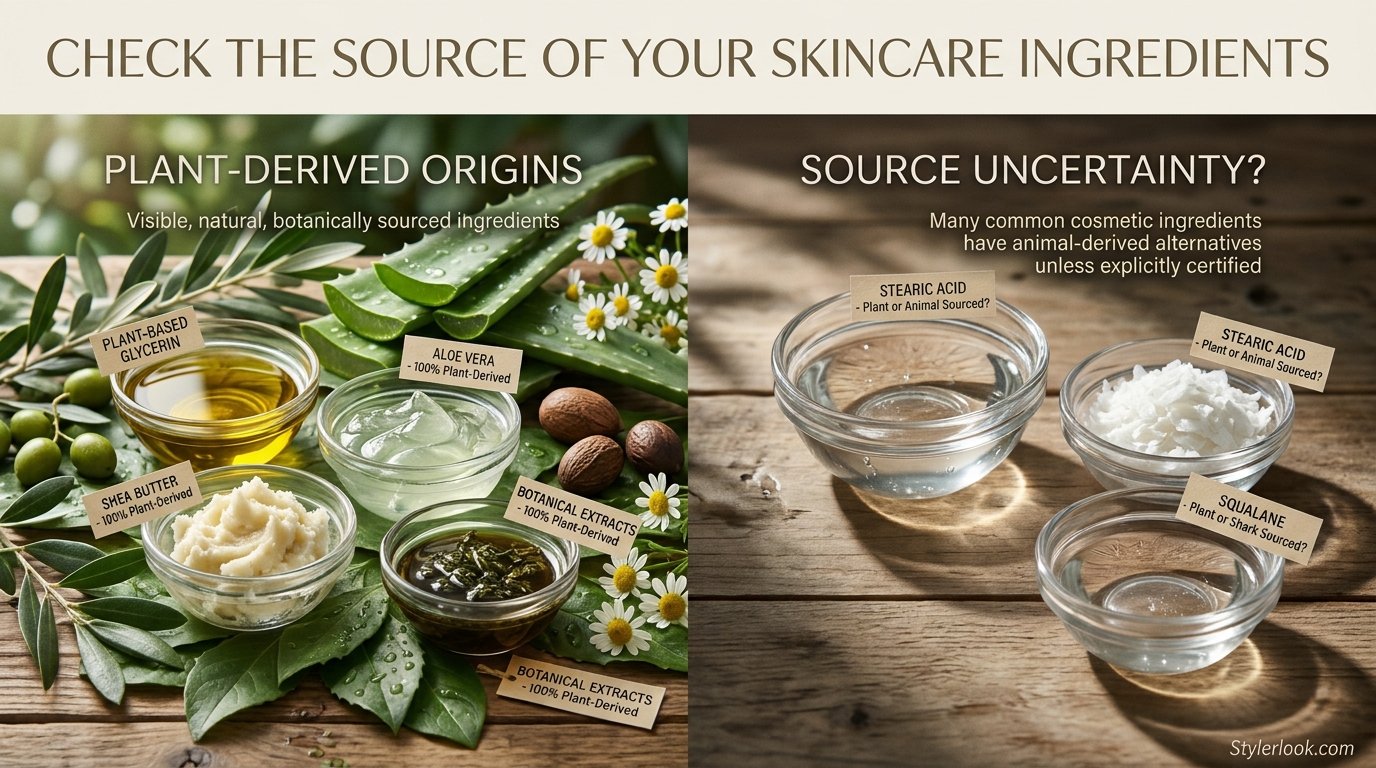
Here is the sentence the whole topic turns on. Judge ingredients by source, not by name.
The same INCI name can come from very different origins. Glycerin may be pressed from plants or rendered from animal fat.
Labels use INCI naming, the standardized Latin and technical vocabulary of cosmetics. It identifies the substance and hides the supply chain.
One rigorous reference, the HalalCodeCheck cosmetics ingredients guide, states the consequence plainly. The source of glycerin is rarely stated on packaging, and confirmation usually means contacting the brand.
The source ambiguous core is short enough to memorize. Glycerin, collagen, stearic acid, keratin, elastin, and squalene all carry the same question.
|
Ingredient |
Possible sources |
How readers resolve it |
|---|---|---|
|
Glycerin |
Plant oils, animal fat, synthetic |
Certified product, vegan mark, or brand confirmation |
|
Collagen |
Porcine, bovine, marine, plant booster |
Source statement or halal certification |
|
Stearic acid |
Plant or animal fat |
Vegan mark or brand confirmation |
|
Squalane |
Olive, sugarcane, shark liver |
Named plant source on the label |
|
Gelatin |
Mostly porcine or bovine |
Certified or vegan alternatives |
|
Keratin |
Wool, horns, synthetic routes |
Brand confirmation |
Collagen deserves one extra line. Porcine collagen is the restricted case, bovine needs halal slaughter status, and marine collagen sidesteps the slaughter question.
None of this makes moisturizers dangerous or exotic. It makes one email to a brand the most powerful tool in this entire article.
The Porcine Family and Carmine
The restricted core is clearer than the ambiguous middle. Certifier lists put pork and every porcine derivative in the strictly restricted class.
That family includes lard, porcine collagen, porcine gelatin, porcine glycerin, and porcine elastin. Placenta extracts and blood derived ingredients sit beside them.
One certifier’s published standard, the Halal Clean Beauty restricted ingredients list, prints the family in full. It is the reference this article uses for the restricted baseline.
Carmine needs its own paragraph. It is the red pigment from cochineal insects, listed as CI 75470, natural red 4, or E120.
Certifier lists restrict carmine, and most scholarly positions treat insect derived colorants as impermissible. A minority disagreement exists and is noted, not settled, here.
For dry skin basics, carmine is mostly a non issue. It lives in lipsticks, blushes, and tinted products, not in plain creams and cleansers.
Budget routines for dry skin therefore dodge carmine by product category. Save the pigment vigilance for color cosmetics and lip products.
Snail mucin and placenta extracts appear in some fashionable serums. Both are animal derived and best avoided in a halal routine unless certification says otherwise.
The Alcohol Three Way Split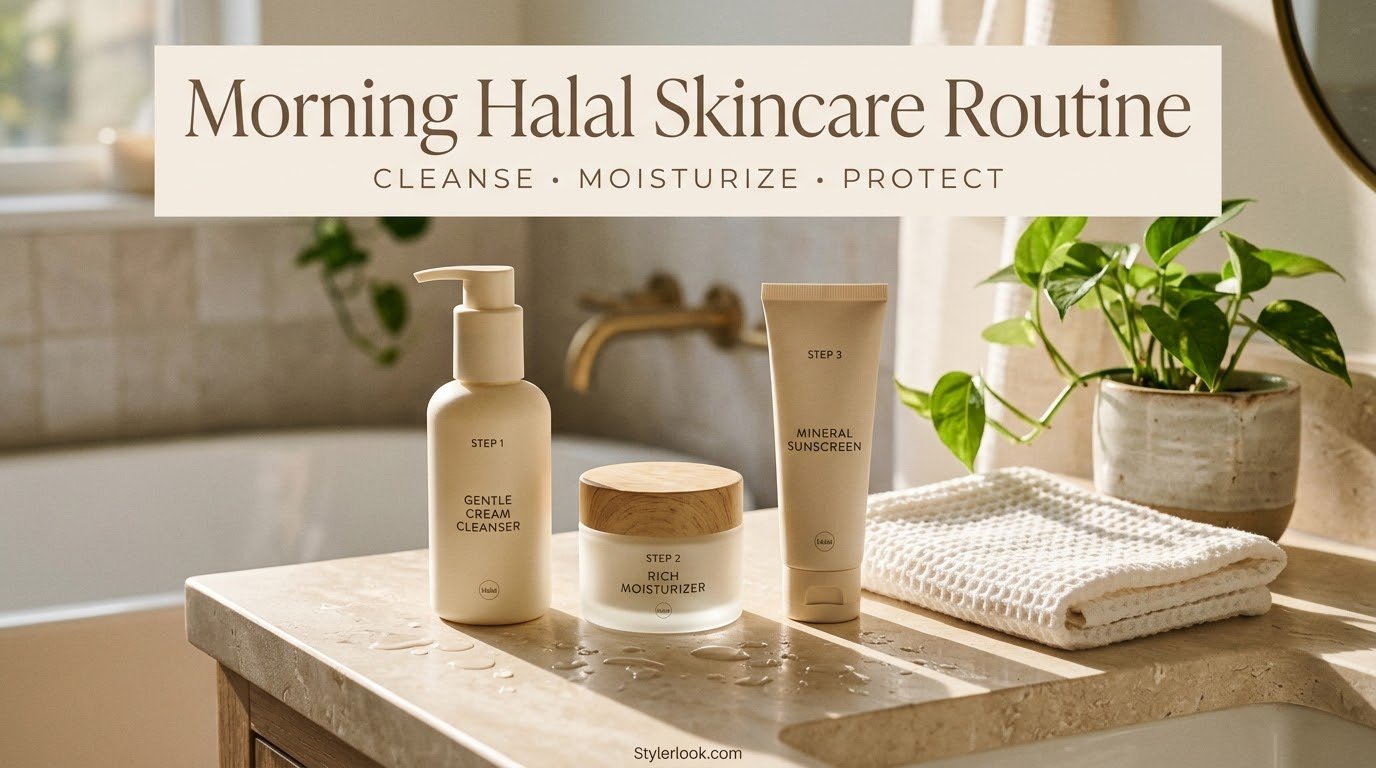
No ingredient causes more confusion here than alcohol. The confusion dissolves when alcohol is split into three different things.
Fermentation ethanol comes first. Alcohol derived from wine or beer fermentation is the restricted class on certifier lists, used as solvent or carrier.
Denatured ethanol is the disputed middle. Some scholarly positions permit it in topical products; others advise avoiding it, and certifiers differ.
This article reports that difference without ruling on it. Readers follow their own school and certifier, and both positions appear in the sources.
Fatty alcohols are not in this argument at all. Cetyl and cetearyl alcohol are solid emollient waxes that soften and stabilize creams.
The certifier list states it in one line. Cetyl alcohol is an emollient, not an intoxicant, and it appears constantly in good dry skin creams.
Avoiding fatty alcohols by mistake impoverishes a dry skin routine. They are part of why rich creams feel rich.
|
Alcohol class |
Where it appears |
Status in the sources |
|---|---|---|
|
Fermentation ethanol |
Toners, perfumes, astringents |
Restricted across certifier lists |
|
Denatured ethanol |
Sunscreens, sprays, gels |
Disputed between positions; readers follow their authority |
|
Fatty alcohols |
Creams, lotions, conditioners |
Permitted; emollient waxes, not intoxicants |
The practical reading rule is simple. Find alcohol on the label, then ask which kind before deciding anything.
In sunscreens, ethanol often carries the formula. The cheap workaround is mineral sunscreen, which suits dry skin and skirts the carrier question.
The Vegan Proxy and Its Gap
Certified vegan products solve half the problem elegantly. A vegan mark removes every animal source question in one glance.
The ingredient guide’s formulation is the sharpest available. Vegan certification eliminates carmine, gelatin, lanolin, collagen, elastin, and animal glycerin.
Then comes the gap, stated in the same source. Vegan status does not cover alcohol and is not a halal audit.
So the proxy reads precisely. Vegan plus an alcohol check approximates certification for a careful reader, without equaling it.
On a budget, the proxy is powerful. Vegan drugstore lines are cheaper than certified boutique lines, and two checks beat ten.
Use the hierarchy consciously. Certified first where affordable, vegan proxy second, label checking third, explicit about which rung each product sits on.
The Berry Blog halal routine guide builds a full routine in this spirit. Its step order is sound, and this page adds the verification and budget layers it leaves out.
Filter Three: Dry Skin Physiology
Dry skin is a barrier problem, not a dirt problem. The outer layer leaks water faster than it should, and care means sealing it.
That single fact writes the routine. Gentle cleansing, moisture in, seal on top, and very few irritating extras.
Harsh foaming cleansers and daily acids widen the leak. They are the most common way cheap routines make dry skin worse.
The three moisturizer functions all matter. Humectants draw water in, emollients smooth, and occlusives seal, and dry skin needs the full set.
Shea butter, ceramides, and plant oils cover emollience well. Petrolatum is the classic occlusive, mineral in origin and widely treated as permissible.
Apply moisturizer to damp skin within minutes of washing. It is the cheapest effectiveness upgrade in skincare, costing nothing.
The gentle version of these principles lives in the gentle dry and sensitive routine. Gentleness is not a compromise here; for dry skin, gentleness is the treatment.
General information ends where symptoms begin. Cracking, bleeding, or spreading irritation needs a clinician’s eyes, as the closing section repeats.
The Routine, Morning
Morning for dry skin is protective, not corrective. Keep it short enough to survive busy days and frequent washing.
Step 1: rinse or cleanse lightly. Many dry faces do best with water only, or a gentle cream cleanser, never a foaming strip.
Step 2: moisturize on damp skin. Pat dry, leave the skin slightly wet, and apply the ceramide or shea rich cream.
Step 3: add drops if the season demands. Two drops of argan, jojoba, or named plant squalane over the cream help in winter.
Step 4: sunscreen, every morning. Choose a moisturizing or mineral formula, applied as the final step before makeup.
Order questions beyond this belong to the skincare routine order guide. The halal specific morning trap is the ethanol carried sunscreen, handled by the mineral route.
For makeup days, the makeup prep routine shows the layering. Moisturized, sealed skin is the primer dry makeup actually needs.
The Routine, Night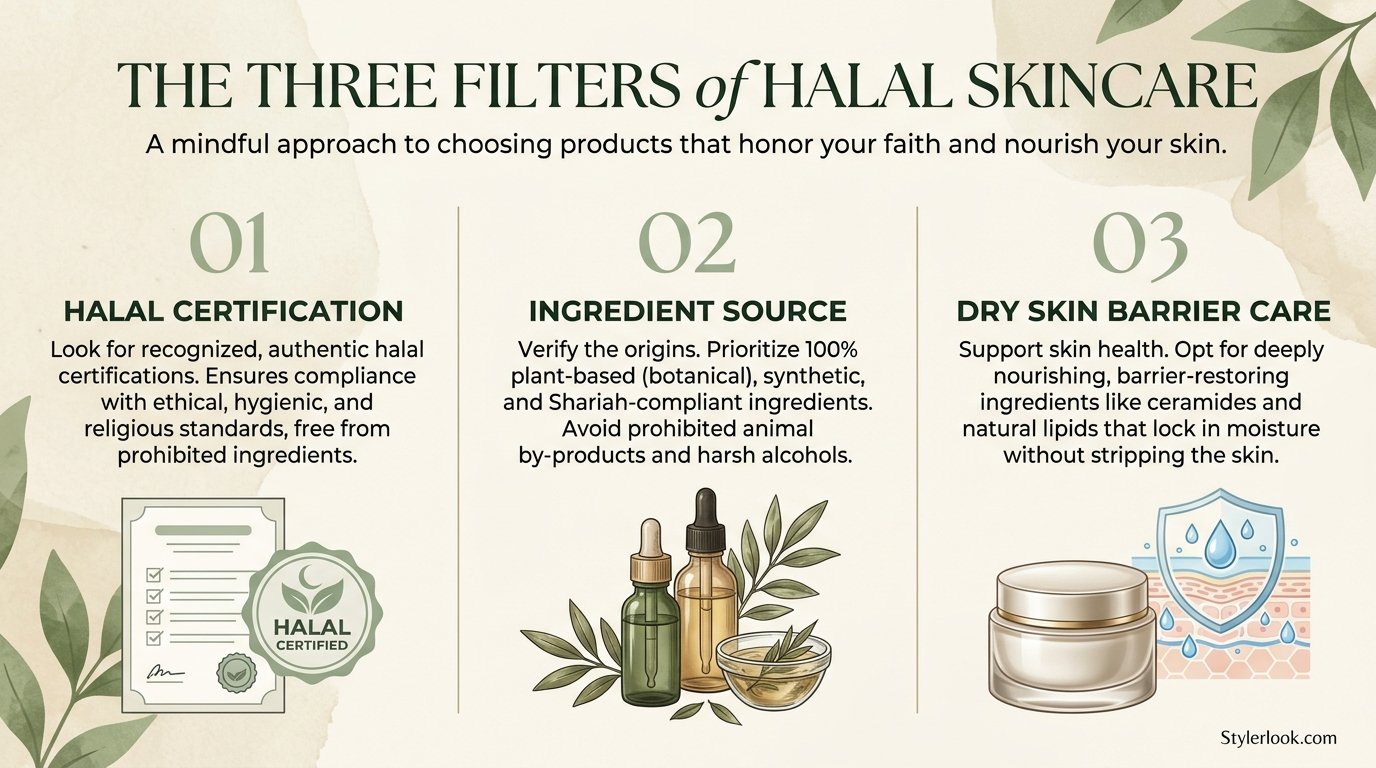
Night is when the barrier gets repaired. The fullest version of the routine lives here, in three unhurried steps.
Step 1: cleanse once, gently. A cream cleanser or cleansing balm removes the day without foam or tightness.
Step 2: hydrate on damp skin. A hydrating toner or essence without ethanol, or a hyaluronic serum, goes under the cream.
Hyaluronic acid itself raises no source question in typical formulas, being produced by fermentation of plant materials in modern supply.
Step 3: cream, then seal. The rich moisturizer goes over everything, and petrolatum or a balm seals the driest patches last.
The seal step is borrowed from slugging practice. A thin layer over cheeks and around the nose prevents overnight water loss.
The rhythm matches the nighttime skincare routine closely. Consistency at night outperforms any expensive single product, at every budget.
The Cheap Method
Certification costs money, so certified lines skew boutique priced. The budget answer is not cheaper standards; it is smarter sequencing.
Dry skin has a hidden budget advantage. It needs fewer products than oily or acne focused routines, three to four instead of eight.
Buy in this order, because the order is the savings. Moisturizer first, since it does the most work per dollar for dry skin.
Cleanser comes second, and gentle cleansers are the cheapest category in skincare. A big simple bottle lasts for months.
Sunscreen comes third, the one place not to underbuy. The mineral route costs a little more and removes a verification headache.
Think in cost per ounce, not shelf price. Large drugstore tubs and pharmacy own brands undercut small boutique jars dramatically per use.
|
Purchase order |
Product |
Halal check |
Budget move |
|---|---|---|---|
|
1 |
Rich moisturizer |
Seal, or vegan plus alcohol check |
Largest tub, cost per ounce |
|
2 |
Gentle cream cleanser |
Label check the short list |
Big pharmacy bottle |
|
3 |
Morning sunscreen |
Mineral route avoids ethanol carriers |
Buy once, use daily, no skimping |
|
4 later |
Hydrating serum or facial oil |
Source check squalane and collagen claims |
Add only after the trio works |
The two list method organizes the shelf. List one is the certified core, the moisturizer and cleanser where certainty matters most.
List two holds label checked additions, the serums and oils verified by the source rule. Both lists together stay cheaper than one boutique set.
Impulse actives wait outside both lists. No acid, brightener, or retinol alternative joins until the trio has run for a month.
Checking Any Product Yourself
The toolkit has three tools, fastest first. The certifier database settles certified claims in a minute.
The ingredient scan applies the source rule to the short ambiguous list. Most labels clear in one reading.
The one question email resolves what labels hide. Ask the brand directly for the sources of its glycerin and collagen.
Scanner apps named in guides, such as Scan Halal and Muslim Pro features, speed the shelf scan. Treat app verdicts as leads under the same discipline.
Keep notes as you go. A personal verified list is the compounding asset; every checked product never needs checking again.
Reformulations are the one decay factor. Recheck favorites yearly, because a changed formula can change a verdict quietly.
Household sharing adds one more check, and the wider library at Stylerlook home covers shared routines generally. Shared products must pass every user’s standard, not the loosest one.
Mistakes That Waste Money
Mistake one: buying the word halal. Marketing copy without a named certifier is the most expensive mistake, paid for in doubt later.
Mistake two: fearing fatty alcohols. Refusing cetyl alcohol removes the best dry skin creams for a confusion the certifier lists already answer.
Mistake three: acids too early. Cheap glow products push daily exfoliation onto dry barriers, and the repair costs more than the acid.
Mistake four: the toner trap. Alcohol heavy toners imported from oily skin routines strip dry skin while adding a compliance problem.
Mistake five: imported lists as verdicts. The same product name in another market can be a different formula entirely.
Mistake six: skipping patch tests. New products, certified or not, get a small test area first, especially on reactive dry skin.
Each mistake shares one shape. A shortcut replaced a check, and the routine paid for it twice.
Wudu, Winter, and Real Life
Frequent washing is real life for many readers. Wudu multiplies water contact, and the moisturizer budget should plan for it honestly.
The answer is frequency, not luxury. A simple, verified cream reapplied after washing beats a rich cream used once.
Keep the verified moisturizer where the washing happens. Placement, not price, decides whether reapplication actually occurs.
Winter tightens every screw at once. Cold air, indoor heating, and hot showers all pull water from the barrier.
The winter upgrade is small and specific. Richer cream, seal more nights, shorter lukewarm showers, and the room humidifier if one exists.
Men’s routines simplify further, and the mens skincare routine guide covers the frame. Beard area dryness responds to the same cream, worked through.
Travel and workdays compress the routine to its core. One verified cream for face and hands carries the day without a bag of products.
Reading a Real Label, Line by Line
Abstract rules become easy on one concrete label. Take a typical rich drugstore cream and walk its ingredient list.
Water and humectants come first, usually including glycerin near the top. That is the first source question, resolved by certification, a vegan mark, or the brand.
Emollients follow, and here cetyl or cetearyl alcohol normally appears. Recognize them as the permitted fatty waxes, not as the alcohol of the dispute.
Occlusives and butters sit in the middle, petrolatum or shea doing the sealing work. Both are comfortable citizens of a halal dry skin routine.
Actives and fragrance close the list. Fragrance is where undisclosed carriers hide, which is why fragrance free basics are the calm default.
The whole read takes under two minutes once the ambiguous list is memorized. Six names carry nearly all the doubt in an ordinary cream.
Compare that with a serum label. Collagen, elastin, and squalane claims concentrate in serums, so serums earn the slowest read of any category.
Lip products invert the pattern. Carmine and lard history live here, so balms get the pigment and fat check that creams skip.
Sunscreens get the alcohol check first. Carrier ethanol is their default architecture, which is why the mineral detour keeps winning mornings.
Product Categories Under the Filters
Cleansers are the easiest category in the whole routine. Simple cream cleansers rarely carry animal actives, and their labels read fast.
Moisturizers carry the glycerin question almost every time. They also repay the effort most, sitting on skin for the longest hours.
Serums are the ambiguity champions. Collagen, elastin, placenta, and squalane claims cluster here, alongside the highest prices per ounce.
Masks are the gelatin risk. Peel off and sheet formats historically use gelatin, so masks get checked or skipped without regret.
Skipping masks costs dry skin nothing. The nightly seal outperforms a weekly mask for barrier purposes at this budget.
Body products overflow cheaply. A verified facial moisturizer usually has a body sibling in the same line, sharing its certification status.
That overflow matters in winter. Hands, shins, and feet consume more product than the face, and big verified formats keep it affordable.
Gift sets deserve suspicion and gratitude together. Sets market the word halal hardest, so their certifier gets named and checked before gifting.
The First Month, Week by Week
Week one belongs to the moisturizer alone. Morning and night, on damp skin, with patch testing on the first days.
Watch for the tightness test. Skin that stays comfortable two hours after washing is reporting a barrier on the mend.
Week two adds the cleanser if the old one strips. Tight, squeaky skin after washing is the signal to switch, not to scrub less.
Week three adds sunscreen to every morning. Expect the mineral learning curve: thinner layers, pressed in, beat one thick smear.
Week four reviews the trio honestly. Comfortable skin on three products means the routine is done, whatever the internet is selling.
Only now may an addition audition. One product, one month, one question: does it fix something the trio left unfixed?
Most readers find the answer is no. That discovery, arriving after a cheap month, is the real budget lesson of the topic.
Keep the routine boring on purpose. Boring routines compound, in skin comfort and in a verified list that grows more valuable yearly.
Certified Brands and the US Shelf
Certified brands exist and some are excellent. Wardah built an industry in Indonesia on certified halal beauty at mass prices.
North American readers meet a thinner shelf. Certified lines like Tuesday in Love and Haya Beauty serve the market at boutique prices.
That price gap is structural, not a scam. Certification, audits, and small distribution cost more per jar than mass manufacturing.
The two list method exists precisely for this shelf. Certified where it counts most, the leave on moisturizer, and label checked discipline elsewhere.
Imported certified products carry one caution. Sellers vary, formulations vary by market, and the seal on the listing photo may belong to another market’s version.
Verify the product in hand against the certifier’s listing. Two minutes of checking protects the entire premise of the purchase.
Over time the balance shifts naturally. As your verified list grows, the certified share of the shelf can grow without the budget breaking.
Sensitive Skin and Patch Discipline
Dry skin and sensitive skin travel together often. The halal filters say nothing about irritation, so a second discipline runs beside them.
Patch test every newcomer. A coin sized area, a few days of watching, then full use if the skin stays quiet.
Introduce one product at a time, always. Two new products plus one reaction equals no information and a wasted month.
Fragrance free is the standing default here. It serves the irritation filter and the fragrance carrier question with the same choice.
Burning is information, not a stage to push through. A product that burns a dry barrier gets retired, certified or not.
Keep a simple log for the first month. Product, date started, skin notes: three lines that rescue guesswork later.
This discipline is why the routine stays general information safely. It manages products and habits, and symptoms route to clinicians as they should.
What Cheap Really Costs
Cheap in this topic is a structure, not a number. The structure has three parts, and each part cuts a different cost.
Part one is count. Three products instead of eight removes five purchases, five verifications, and five chances to irritate dry skin.
Part two is format. Big tubs and pharmacy bottles price each ounce far below small jars, and dry skin uses moisturizer generously.
Part three is sequence. Buying in the order of impact means the budget never strands money in a serum while the moisturizer is wrong.
Compare like with like when judging. A certified boutique jar and a pharmacy tub differ in certification, distribution, and size, not just quality.
The honest comparison is cost per month of comfortable skin. By that measure, the sequenced trio is the cheapest routine most readers will run.
Sales and bundles help at the margin. Buy the verified product on offer, never an unverified substitute because it is discounted.
The routine’s final economy is attention itself.
A settled trio frees the reader from re researching every shelf on every shopping trip. That uncounted cost, the repeated hour of label doubt, disappears once the verified list exists.
The list even appreciates over time. Each yearly recheck is faster than the first pass, because only changes need fresh eyes.
One last habit seals the savings permanently. Photograph your verified shelf once, keep the list on your phone, and shop from the photograph instead of from memory.
Frequently Asked Questions
1. What is a halal skincare routine?
A routine using only halal compliant products. Cleansing, moisturizing, and sun protection built from certified or carefully source checked items, with no porcine ingredients and alcohol handled by the reader’s own scholarly authority.
2. What makes skincare halal?
Permissible ingredients and honest sourcing. No pork or porcine derivatives, no blood derived ingredients, animal ingredients only from acceptable sources, and manufacturing a certifier can audit.
3. How do I build a halal routine for dry skin on a budget?
Buy in order: moisturizer, cleanser, sunscreen. Choose each by certification first, then the source rule, in the largest sensible format.
That trio, used daily, is the complete cheap routine.
4. What are the basic steps of a halal dry skin routine?
Three steps cover it. Gentle cleansing, moisturizer applied to damp skin, and an occlusive seal at night, with sunscreen as the morning finish.
5. Is glycerin halal in skincare?
It depends on the source. Glycerin can be plant, animal, or synthetic derived.
Certified and vegan products settle it; otherwise the brand can confirm its source directly.
6. Is collagen halal in skincare?
It depends on the source. Porcine collagen is restricted, bovine collagen needs halal slaughter status, and marine collagen avoids the slaughter question.
Certification or a stated source resolves it.
7. Is alcohol in skincare haram?
It depends on the type and the position followed. Fermentation ethanol is restricted on certifier lists.
Denatured ethanol in topicals is disputed between scholarly positions, and readers follow their own authority.
8. Are fatty alcohols like cetyl alcohol halal?
Yes, on certifier lists. Cetyl and cetearyl alcohol are solid emollient waxes, not intoxicants.
One certifier’s list calls cetyl alcohol an emollient and halal explicitly.
9. Is carmine halal?
Certifier lists restrict it. Carmine is the insect derived red pigment CI 75470, restricted by certifiers and most scholarly positions, with a minority disagreement noted in the sources.
10. What ingredients should Muslims avoid in skincare?
Start with the porcine family. Lard, porcine collagen, gelatin, glycerin, and elastin, plus placenta extracts and blood derived ingredients.
Then apply the source rule to ambiguous names.
11. Is vegan skincare the same as halal?
No, and the difference matters. Vegan products remove every animal source question but say nothing about alcohol or halal auditing.
Vegan plus an alcohol check approximates certification.
12. How can I check if a product is halal certified?
Name the certifier, then verify it. Look for a recognized body such as IFANCA, JAKIM, or BPJPH, and confirm the exact product in that certifier’s current listing.
13. Which halal certification bodies cover cosmetics?
Several, by region. IFANCA in the US, JAKIM in Malaysia, BPJPH with MUI in Indonesia, MUIS in Singapore, and HFA and HMC in the United Kingdom.
14. Is Wardah halal certified?
Wardah is a certified Indonesian halal brand. Its certification is its founding identity.
US buyers should still verify the exact product and seller, since imports vary.
15. Are drugstore moisturizers halal?
Some pass, many are simply unchecked. Mainstream products are rarely certified.
Apply the source rule to the ambiguous ingredients, or ask the brand, before adding one.
16. My moisturizer is not certified halal, what should I do?
Run the source rule before replacing it. Check for porcine ingredients, then glycerin and collagen sources, using a brand email if needed.
Many products pass on inspection.
17. What is the cheapest way to start a halal routine?
Sequence, not sacrifice. Start with moisturizer alone if needed, add the cleanser when budget allows, then sunscreen.
Three products, bought in order, beat one expensive set.
18. Which product should I buy first for dry skin?
The moisturizer, without contest. For dry skin it does the most work per dollar, twice a day.
Cleanser and sunscreen follow in that order.
19. Do I need a toner in a halal dry skin routine?
No, it is optional. Dry skin often does better without one.
If used, choose a hydrating, ethanol free formula and treat it as a bonus layer.
20. Is hyaluronic acid halal?
Generally yes. Modern hyaluronic acid is produced by fermentation of plant materials and raises no typical source concern.
Certification still gives the simplest certainty.
21. Is snail mucin halal?
Best avoided without certification. Snail mucin is animal derived, and halal treatments differ.
A careful routine skips it unless a certifier covers the product.
22. Is squalane halal?
It depends on the plant on the label. Olive and sugarcane squalane are plant derived; shark squalene is the animal route.
Choose products that name their plant source.
23. Is lanolin halal?
Positions and certifiers differ. Lanolin comes from wool, and many accept it while some checklists flag it.
Readers follow their certifier; the routine works without it either way.
24. Is beeswax halal in skincare?
Widely accepted, debated in some lists. Beeswax appears as debated in a few sources and accepted in most routines.
Certified products settle the question for their users.
25. Is petrolatum halal for slugging dry skin?
Widely treated as permissible. Petrolatum is mineral in origin, and it is the classic seal over moisturizer for very dry patches.
Apply a thin layer at night.
26. Can I use retinol in a halal routine?
Source decides again. Retinol itself is usually synthetic in modern formulas, but carriers and blends vary.
Many readers choose plant positioned alternatives or certified products instead.
27. What halal friendly alternatives to retinol exist?
Bakuchiol is the named one. Guides list it as the plant positioned retinol alternative.
Niacinamide and vitamin C are also common halal friendly actives in checked products.
28. How does wudu affect a dry skin routine?
It raises the moisturizer budget. Frequent washing removes moisture, so reapplying a simple verified cream after washing matters more than owning an expensive one.
29. How many products does a dry skin routine need?
Three to four. Cleanser, moisturizer, and sunscreen, plus an optional hydrating layer.
Dry skin punishes long routines with irritation and rewards short ones with consistency.
30. Why is halal certified skincare expensive?
Certification and small batches cost money. Audits, documentation, and niche distribution price certified lines above mass drugstore products, which is why the budget method sequences purchases.
31. Can I mix certified and non certified products?
Yes, with clear eyes. Many readers run a certified core with label checked additions.
Keep track of which rung each product sits on, and recheck over time.
32. What should a morning halal routine for dry skin include?
Rinse gently, moisturize damp, protect. Water or a cream cleanser, the rich cream on damp skin, then sunscreen, with mineral formulas sidestepping ethanol carriers.
33. What should a night halal routine for dry skin include?
Cleanse, hydrate, seal. A gentle cleanse, a hydrating layer on damp skin, the rich cream, and a thin occlusive seal over the driest patches.
34. How do I do a halal routine in winter?
Upgrade richness, not count. Richer cream, sealing more nights, shorter lukewarm showers, and reapplying after washing.
The trio stays; the textures get heavier.
35. Are fragrances a problem in halal skincare?
Fragrance can carry alcohol and irritate dry skin. Undisclosed fragrance is restricted without certification on one certifier’s list.
Fragrance free basics are the calm budget default.
36. Can men follow this halal dry skin routine?
Yes, the filters are unisex. Men follow the same certification, source, and barrier rules.
Beard area dryness responds to the same cream worked through the beard.
37. Is halal skincare better for sensitive skin?
Often, but not by magic. Halal routines tend to avoid harsh alcohols and heavy fragrance, which suits sensitive skin.
Patch testing still decides, product by product.
38. What if my skin keeps cracking despite a routine?
Leave the routine and book the clinician. Cracking, bleeding, oozing, or spreading irritation is medical territory.
This article covers general routine information, not treatment.
39. How do I read an INCI ingredient list for halal issues?
Hunt the short ambiguous list. Glycerin, collagen, stearic acid, keratin, elastin, squalane.
Note their names, ignore the rest initially, and resolve sources by certification or brand contact.
40. Do halal certifications expire or change?
Yes, both can change. Certifications renew, lapse, and reformulations happen quietly.
Recheck favorites yearly rather than trusting an old blog list.
41. Are halal skincare products cruelty free?
Often overlapping, not identical. Many certifiers also audit animal testing, but cruelty free is a separate claim with separate marks.
Check each claim on its own evidence.
42. What is a good halal lip balm for dry lips?
Look for certified or source clear balms. Beeswax based balms are common in halal lines; petrolatum based options also work.
Avoid anything listing lard among its ingredients.
Conclusion
A working halal skincare routine dry skin cheap plan is not a longer shopping list. It is a shorter one, bought in the right order.
Run the filters in sequence. Certification where a certifier can be named, the source rule everywhere else, and barrier first judgment on every product.
Spend in order as well. Moisturizer, cleanser, sunscreen, at cost per ounce, and let a month of consistency judge before anything joins them.
Keep the verified list growing. Every product you check once, by database, label, or one honest email, never needs checking again.
Begin this week with the single first purchase. One verified moisturizer, used on damp skin morning and night, starts the routine today.
