

Some haircuts look best standing still. Waterfall layers look best in motion.
Picture long hair that cascades from the face downward, each layer spilling softly over the next. The ends flick and curve like water moving over stone, and the whole shape swings when you turn your head.
That flowing look is why waterfall layers keep coming back. The cut feels retro and modern at once, and it adds body without cutting away your length.
But the cut is also easy to get wrong. The angle, the starting point, and your hair type all decide whether it looks dreamy or limp.
Table of Contents
What Are Waterfall Layers?

Waterfall layers are a cascading layered cut where shorter pieces start near the face and gradually lengthen toward the back. The layers sit over each other, so they flow downward like a waterfall.
The result is movement, volume, and softly flared ends.
Quick answer: Waterfall layers are graduated layers cut at an angle so hair cascades from the face downward. They add bounce and movement to long hair while keeping most of the length.
Where the Layers Start
The shortest layer often begins around the nose, mouth, or chin, depending on face shape. From there, the layers lengthen as they move back.
The back usually stays long, which keeps the cut looking full.
Why It Is Called a Waterfall
Each layer falls over the next in a gentle cascade. The angled cutting makes the ends flare out into wave-like shapes.
The effect is most visible when the hair moves or dries naturally.
A Quick Bit of History
The look is tied to 1970s style and was once nicknamed the “Farrah Fawcett” cut. It returned as a trend with a softer, more modern feel.
Today’s version is looser and less sprayed than the original.
Waterfall Layers vs. Other Layered Cuts
Layered cuts share a family resemblance, so names get mixed up. Knowing the differences helps you ask for exactly what you want.
| Cut | Key Feature | Look |
|---|---|---|
| Waterfall layers | Graduated, angled layers that cascade from the face | Flowing, bouncy, retro |
| Traditional layers | Layers cut straight across at set lengths | Neat, simple movement |
| Face-framing layers | Shorter pieces around the face only | Soft frame, rest unchanged |
| Butterfly cut | Short top layers over longer layers underneath | Big volume, wing-like shape |
| C cut | Layers sit lower and read heavier | Weighted, curved ends |
| Shag | Choppy layers throughout | Messy, edgy |
| Feathered layers | Tapered, wispy layers with flicked ends | Airy, soft |
Waterfall vs. Traditional Layers
Traditional layers are cut straight across. Waterfall layers are graduated and cut at an angle under 90 degrees.
That angle makes the ends flare out and creates the cascade.
Waterfall vs. Face-Framing Layers
Face-framing layers only shape the front. Waterfall layers flow from the face through the mid-lengths.
The two can be combined for a fuller effect.
Waterfall vs. the C Cut
A C cut sits lower and looks heavier. Waterfall layers can start near the nose or mouth and feel lighter.
The lightness also suits warmer weather because it removes bulk.
Waterfall vs. the Butterfly Cut
A butterfly cut stacks short layers on top of longer ones for big volume. Waterfall layers cascade more gradually.
Both add movement, but the butterfly cut is usually bolder.
Why Waterfall Layers Are So Popular
Long hair can feel heavy and plain. Waterfall layers fix both problems without a big chop.
They also adapt to many styling moods.
They Keep Your Length
Few people want to lose long hair. The back stays long, so you keep the full look.
You change the shape, not the length.
They Add Movement and Body
Graduated layers lift the hair and let the ends swing. Even straight hair looks fuller.
The cascade shows most when you move.
They Remove Bulk Without Looking Thin
Waterfall layers lighten heavy hair while keeping shape. Thin hair can look fuller thanks to the lifted layers.
Placement matters more than quantity.
They Air-Dry Beautifully
When cut well, waterfall layers dry into a soft, beachy shape. That makes them popular with low-effort routines.
Leave the hair alone while it dries for best results.
Types of Waterfall Layers
Waterfall layers come in several versions. Your stylist can adjust the length, starting point, and texture.
Here are the most popular looks.
Classic Long Waterfall Layers
Layers begin near the chin or nose and lengthen to the back. The ends flare softly.
This is the easiest version to wear every day.
Waterfall Layers With Waterfall Bangs
Waterfall bangs are light, see-through, and longer than traditional bangs. They sit around the cheekbones and blend into the layers.
They work best with a middle part and can be styled inward for volume.
Waterfall Layers With Curtain Bangs
Curtain bangs sweep to each side and blend into the cascade. They are a forward-facing alternative to waterfall bangs.
They grow out gracefully.
Medium-Length Waterfall Layers
Medium hair can carry the cut with shorter, lighter layers. The effect is less dramatic but still bouncy.
Explore more shapes with these medium length layered haircuts.
Short Waterfall Layers
Short versions use smaller cascades around the face. They fit bobs and shaggy cuts.
For more short options, see these short layered hairstyles.
Wavy and Curly Waterfall Layers
Waves and curls help the layers show their shape. The layers are chosen to suit the curl pattern.
Face-framing bangs follow the curve of the cheekbones.
Subtle Waterfall Layers
Only a few layers are added, mostly at the front. The length stays almost the same.
This is a good first step for people new to layers.
Waterfall Layers by Face Shape
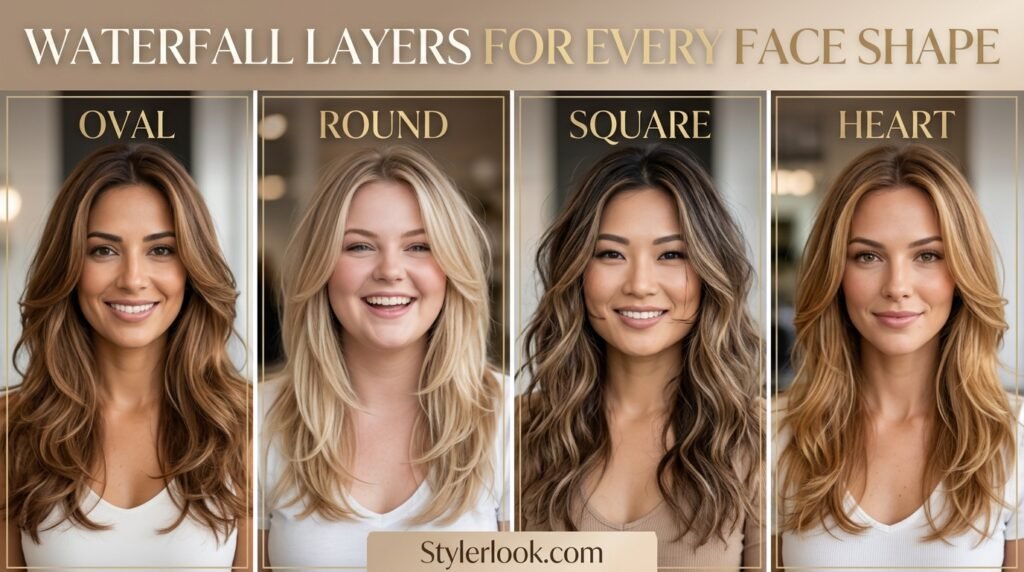
Face shape guides where the shortest layer begins. Treat this as a guide, not a rulebook.
A good stylist adjusts the cut to your features.
| Face Shape | Suggested Approach |
|---|---|
| Oval | Most versions work; try bolder bangs if you like |
| Round | Layers and waterfall bangs to soften the face; avoid ending layers at the widest point |
| Square | Softer curtain bangs and wispy layers to soften the jaw |
| Heart | Waterfall bangs and layers that add volume near the chin |
| Rectangular or oblong | Waterfall bangs and side volume to add width |
| Diamond | Soft layers near the cheekbones and a gentle fringe |
Oval Faces
Oval faces suit nearly every style. Choose based on your hair type and routine.
Try bolder bangs if you want a fresh look.
Round Faces
Round faces can look softer with waterfall layers and light bangs. Start the shortest layer below the cheeks.
Avoid layers that end right at the widest point.
Square Faces
Square faces have a strong jaw. Softer curtain bangs and wispy layers soften angles.
Layers that curve near the jaw feel gentler.
Heart-Shaped Faces
Heart-shaped faces have a wider forehead and narrower chin. Waterfall bangs suit them especially well.
Layers that add volume near the chin help balance proportions.
Rectangular and Oblong Faces
Longer faces benefit from width. Waterfall bangs and side volume break up the length.
Curtain-style bangs also add width.
Diamond Faces
Diamond faces have prominent cheekbones. Soft layers around the cheekbones add balance.
A gentle fringe softens the forehead.
Waterfall Layers by Hair Type
Hair texture and density change how the cascade looks. The same cut can look very different on two people.
Match the technique to your hair.
Waterfall Layers for Fine Hair
Fine hair can look wispy with too many layers. Keep layers subtle and start them below the chin so the hair doesn’t look thinner.
Very fine, very straight hair may look sparse, so ask for a careful plan.
Waterfall Layers for Thick Hair
Thick hair gains movement and loses bulk. The graduated layers add bounce without heaviness.
Ask your stylist to remove weight carefully, so the cut doesn’t turn into a triangle. See this guide to layered haircuts for thick hair for more ideas.
Waterfall Layers for Straight Hair
Straight hair shows the shape clearly, so blending matters. It often needs a round brush or flat iron to match the salon look.
Add a little texture spray to help the layers separate.
Waterfall Layers for Wavy Hair
Wavy hair is a natural match. The waves give the cascade its flowing shape.
A light cream and an air-dry often do the job.
Waterfall Layers for Curly Hair
Curly hair adds shape and visual interest to the layers. But curly hair cut while straight can shrink a lot when it dries.
Ask your stylist about cutting in the natural pattern and leaving extra length.
Waterfall Layers for Coily Hair
Coily hair has a lot of shrinkage, so layers look shorter when dry. Cutting in the natural state helps predict the final shape.
Choose a stylist experienced with your texture.
Waterfall Layers for Thin, Fragile Ends
Long hair that has become thin at the ends can benefit from layers placed there. This helps retain length while refreshing the shape.
Healthy ends make the cascade look softer.
How Stylists Cut Waterfall Layers
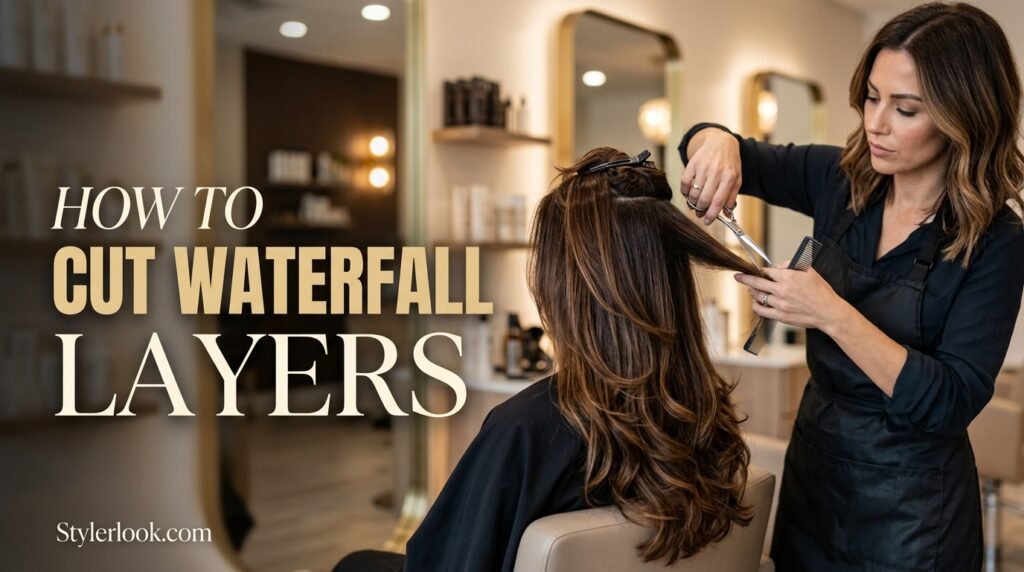
You do not need to know every technique. A basic idea builds trust in the process.
Methods vary by stylist and hair type.
Starting at the Front
Many stylists start with the shortest point at the front. They bring hair forward and cut it at a steep angle.
This graduation becomes a guide for the rest of the layers.
Cutting at an Angle
Waterfall layers are cut at an angle under 90 degrees. That angle makes the ends flare and flow.
It is the key detail that separates the cut from traditional layers.
Keeping the Back Long
The back usually stays long so the cut keeps its fullness. Avoiding overly short layers in the back helps it look good when air-dried.
Short back layers can make the cascade look uneven.
Point Cutting
Point cutting snips into the ends at an angle. It blends the layers into each other for a seamless finish.
It is common for soft, wispy edges.
Dry Cutting for Curls
Some stylists cut curly hair dry or in its natural pattern. This shows how the layers will actually fall.
It reduces surprises from shrinkage.
How to Ask Your Stylist for Waterfall Layers
Clear communication prevents disappointment. Prepare before your appointment.
Vague requests lead to surprise results.
Use the Name
“Waterfall layers” is a recognized term, so say it clearly. Add details such as bangs or face framing.
Describe how soft or textured you want the layers.
Bring Reference Photos
Choose photos of people with a similar face shape, hair type, and style. Include one example of what you do not want.
Photos show details that words miss.
Ask Where the Shortest Layer Starts
This detail changes how the cut flatters your face. Ask where it will start, such as the nose, mouth, or chin.
A good stylist explains their plan.
Talk About Your Routine
Tell your stylist how you normally style your hair. A cut that needs a round brush every day won’t suit a wash-and-go routine.
Honest answers lead to a wearable cut.
Discuss Hair Density
Fine hair needs subtle layers. Thick hair can handle more.
Ask your stylist how many layers suit your density.
Confirm Their Experience
Ask whether the stylist has done this cut before. Look at their portfolio.
Experience with your texture matters even more.
Questions to Ask Before You Cut
- Where will the shortest layer start?
- How long will the back stay?
- How will this look on my face shape?
- How will this work with my hair thickness and texture?
- How do I style it each morning?
- How often will I need a trim?
Waterfall Bangs and Fringe

Bangs can complete the look. Waterfall bangs are lighter than traditional bangs and blend into the cascade.
Choose a style that suits your forehead and routine.
What Are Waterfall Bangs?
Waterfall bangs are light, see-through bangs that fall across the forehead. They often graze the brows or sweep toward the cheekbones.
They blend into the hair around the face for a soft, seamless frame.
Who Suits Waterfall Bangs?
They work for many face shapes, and heart-shaped and rectangular faces especially. They can be low maintenance on many textures.
Very fine or very straight hair may look sparse with too many layers.
Waterfall Bangs for Curly Hair
Curly hair needs extra care. A common tip is to cut bangs about twice as long as you want them to allow for shrinkage.
Ask your stylist to cut them dry.
Waterfall Bangs vs. Curtain Bangs
Waterfall bangs are longer and more see-through. Curtain bangs part in the middle and sweep to each side.
Both blend easily into layers.
Giving New Bangs Time to Settle
New bangs may take a few days to settle into place. Don’t judge them straight after the cut.
Practice styling them for a few mornings first.
Waterfall Layers and Hair Color
Color adds dimension to layers. The right placement makes the cascade stand out.
Plan color and cut together.
Balayage and Highlights
Soft, blended highlights add depth to the layers. Lighter pieces around the face brighten the complexion.
Bring photos to show your stylist.
Brunette and Warm Tones
Warm browns and chestnuts show shine and dimension. A gloss treatment keeps them rich.
Dark hair benefits from regular conditioning.
Copper, Vivid, and Very Dark Shades
These shades fade quickly. They may need frequent salon visits or touch-ups.
Use color-safe products to protect the tone.
Natural Hair
Layers still show on a single shade. A glossy finish helps them catch the light.
Healthy hair needs less color to look great.
How to Style Waterfall Layers
The cut sets the shape, but styling shows it off. A few simple techniques make a big difference.
Style to match your texture and mood.
Air-Dry for a Natural Finish
Apply volumizing shampoo and conditioner, then a lightweight leave-in. Leave the hair alone while it dries so it isn’t disturbed.
The cascade settles into a beachy shape.
The Round-Brush Blowout
Apply heat protectant and mousse. Dry with a round brush, lifting the roots and rolling the ends away from the face.
A bouncy, fluffed-out finish shows off the layers.
Root Clipping for Height
Clip sections up off the scalp before diffusing. This adds crown height.
It works especially well on wavy and curly hair.
Curling the Ends
Use a large barrel curling iron to curl the front pieces away from the face. Brush out the curls so they don’t look tight.
Velcro rollers are a quicker option.
Light Bends With a Flat Iron
A flat iron can add soft bends to the ends. It also curves the ends inward for a sleeker look.
Keep movements gentle to avoid flat layers.
Styling Waterfall Bangs
Part the hair in the middle and style the bangs inward for volume. Use a round brush or a large brush with mousse.
Move the dryer side to side so partings don’t show.
Finish With Light Hold
Use a flexible hairspray that holds without stiffness. A light mist is usually enough.
Avoid heavy products that weigh the layers down.
Step-by-Step: A Simple Waterfall Layers Routine
Follow this routine for a polished finish. Adjust it to your hair type.
- Wash with a volumizing shampoo and conditioner.
- Gently squeeze out water and apply a leave-in product.
- Add heat protectant and a little mousse at the roots.
- Blow-dry with a round brush, lifting at the roots.
- Roll the ends away from the face as you dry each section.
- Curl or bend the front pieces if you want more flow.
- Let hair cool, then finish with a flexible hairspray.
Best Products for Waterfall Layers
Products should add lift without weight. Choose by hair type and styling goal.
Use less than you think you need.
| Goal | Product Type |
|---|---|
| Light body | Volumizing shampoo and conditioner |
| Moisture and frizz control | Leave-in product |
| Heat protection | Heat protectant spray |
| Root lift | Thickening mousse |
| Beachy texture | Texture or sea salt spray |
| Piecey definition | Texturizing paste |
| Shine and sealed ends | Light hair oil, such as argan |
| Hold | Flexible hairspray |
| Curl definition | Curl cream, gel, or soufflé |
Fine Hair Products
Use lightweight mousse and volumizing products. Avoid heavy oils and thick creams.
Apply mainly at the roots.
Thick Hair Products
Use smoothing creams and a little oil on the ends. Avoid piling product at the front.
A leave-in conditioner controls frizz.
Curly and Wavy Hair Products
Scrunch in products one at a time instead of raking your fingers through. Use a wide-tooth comb to detangle first.
Keep hands off while the hair dries.
Tools for Styling Waterfall Layers

A few tools cover most looks. Choose ones with adjustable heat.
You do not need a full collection.
- Round brush: Adds lift and shape.
- Hair dryer with a volumizing brush: Speeds up styling and adds body.
- Large-barrel curling iron: Creates soft, flowing bends.
- Velcro rollers: Add volume and flick with little effort.
- Styling clips: Hold sections up for root lift.
- Flat iron: Adds light bends to the ends.
- Wide-tooth comb: Detangles without disturbing curls.
How Often Should You Trim Waterfall Layers?
Layers keep their shape with regular trims. Trimmed ends make the cascade look intentional.
Your stylist can tailor the schedule to your hair.
A General Guide
Many stylists suggest a trim every six to eight weeks. This keeps the shape and prevents split ends.
Bangs usually need trims sooner.
Signs You Need a Trim
The cascade looks flat or heavy. Ends look frayed or split.
The front no longer falls in a flattering shape.
Between Appointments
Use a leave-in conditioner weekly. Detangle gently with a wide-tooth comb or paddle brush.
Apply heat protectant before every hot tool.
Waterfall Layers and Hair Health
Layers expose the ends, so ends need care. Healthy hair holds the shape better.
Protect your hair to keep the cascade soft.
Keep Ends Moisturized
Use a hair oil and a deep conditioner. Seal the ends after washing.
Dry ends make layers look frayed.
Limit Heat Damage
Use heat protectant and moderate temperatures. Let hair air-dry when you can.
Heat is the main risk in daily styling.
Detangle Gently
Use a wide-tooth comb or paddle brush. Start at the ends and work upward.
Rough brushing causes breakage.
Protect at Night
A silk pillowcase or loose braid reduces friction. It also protects the layers.
Gentle habits add up over time.
Is Waterfall Layers Haircut High Maintenance?
It depends on your texture and the version you choose. Many people find it easy because the cut air-dries well.
Straight, fine hair needs more styling.
Low-Effort Options
Wavy and curly hair often needs only a leave-in and an air-dry. Subtle layers need less upkeep.
Choose a longer, softer version for easier care.
Higher-Effort Options
Straight hair that needs bend and lift takes more time. Waterfall bangs also need regular trims and styling.
Plan your routine around your schedule.
Can You Cut Waterfall Layers at Home?
Some people try to cut their own layers. It can work for a tiny trim, but this cut depends on precise angles.
Mistakes are hard to undo.
Why a Professional Is Safer
Stylists understand angles, tension, and how hair falls. The cut relies on a specific graduated shape.
Uneven layers show quickly on long hair.
If You Still Want to Try
Use sharp hair-cutting scissors, not household ones. Cut small amounts on clean, dry hair.
Check often and stop early.
Safer Alternatives
Ask your stylist for a quick shape-up between full cuts. Many salons offer inexpensive trims.
Bring photos and notes to your appointment.
Pros and Cons of Waterfall Layers
Every haircut has trade-offs. Weighing them helps you decide.
| Pros | Cons |
|---|---|
| Keeps most of your length | Needs regular trims |
| Adds movement and body | Very fine, straight hair can look sparse |
| Removes bulk from thick hair | Needs a stylist who knows the technique |
| Air-dries beautifully | Straight hair needs more styling |
| Works with bangs and color | Curly hair can shrink more than expected |
| Light for warmer weather | Overdone layers can look wispy |
Common Waterfall Layers Mistakes
Most disappointments are preventable. Watch for these errors.
- Asking for “layers” without naming the style.
- Cutting the back too short.
- Choosing too many layers for fine, straight hair.
- Ignoring curl shrinkage.
- Starting the shortest layer at the widest part of the face.
- Skipping heat protectant.
- Using heavy products that flatten the cascade.
- Touching the hair while it air-dries.
- Waiting too long between trims.
- Expecting a photo to look identical on your hair.
How to Choose the Right Waterfall Layers
Use this guide to narrow down your options. Start with your main goal.
| If You Want | Consider |
|---|---|
| A subtle change | A few soft layers starting below the chin |
| More volume | Waterfall layers with a round-brush blowout |
| A retro vibe | Center part, waterfall bangs, and flicked ends |
| Low maintenance | Soft layers on wavy hair with air-drying |
| Less bulk | Graduated layers through mid-lengths |
| A softer jaw | Curtain bangs and wispy layers |
| Curl definition | Layers cut in the natural curl pattern |
| Face-framing | Waterfall bangs blending into the cascade |
Waterfall Layers for Different Occasions
The cut adapts to many settings. A few tweaks change the mood.
Plan your style around the day.
Everyday and Work
A smooth blowout with soft ends looks polished. Keep products light and styling quick.
Tuck one side behind your ear.
Evenings and Events
Add loose waves and brush them out for glamour. Finish with flexible hold.
Pin one side back with a clip.
Weekends
Air-dry and let the cascade settle into a beachy shape. Add a headband or clip.
Soft waves look effortless.
Warm Weather
The lightness of the cut suits warm months because it removes bulk. Wear it down or in a half-up style.
A half-up pouf with waterfall bangs also looks great.
Growing Out Waterfall Layers
Growing out layers takes patience. The front grows more visibly than the back.
Plan the transition to avoid awkward stages.
Ask for Blending Trims
Request light trims that keep the layers soft. This prevents harsh steps as hair grows.
Tell your stylist your goal length.
Style Creatively
Use clips, headbands, and half-up styles to manage short pieces. Curl or sweep them to the side.
Texture spray makes the phase look intentional.
Keep Hair Strong
Healthy hair grows with fewer breaks. Use conditioner and protect from heat.
Strong ends make growing out easier.
Waterfall Layers Trends
Trends change, but the core idea stays the same. Here are popular directions.
Choose what suits your hair, not only what is popular.
- Soft, rumpled cascades: Loose, lived-in movement.
- Waterfall bangs: Light, see-through fringe.
- Retro 70s blowouts: Flicked ends and center parts.
- Layers with balayage: Color that shows off the cascade.
- Air-dried finishes: Low-effort, natural texture.
For more cut ideas, read this guide to layered hairstyles for long hair and these modern mullet haircut ideas.
Choosing the Right Stylist
Your stylist matters as much as the cut. Choose someone experienced with your texture.
Take your time.
Check Portfolios
Look through photos of past work. Search for clients with similar hair to yours.
Social media pages show a stylist’s range.
Book a Consultation
Many salons offer short consultations. Use it to talk through your goals.
Notice how well they listen.
Read Reviews
Look for comments about communication and consistency. Pay attention to clients with similar hair types.
Honest reviews are a helpful guide.
Speak Up
Be open to advice but voice any concerns. A good stylist welcomes questions.
You should leave feeling heard.
Real-World Examples of Waterfall Layers
These are illustrative scenarios, not case studies of named people. They show how the principles apply.
Your own results depend on your hair and stylist.
The Heavy, One-Length Cut
Someone with thick, long hair feels weighed down. Their stylist adds waterfall layers that start below the chin.
The hair keeps its length and gains bounce.
The Fine Hair Experiment
A person with fine, straight hair gets many short layers and finds the ends look wispy. A trim and softer, longer layers fix the shape.
They learn that fewer layers can look fuller.
The Curly Hair Surprise
Someone with curly hair gets bangs cut while the hair is stretched straight. The bangs shrink far shorter than expected. Next time, they ask for a dry cut with extra length.
The new fringe falls where they wanted.
The Air-Dry Convert
A person with natural waves adds waterfall layers and waterfall bangs. They apply a leave-in and let the hair dry untouched.
Their routine gets shorter and the cascade looks effortless.
Waterfall Layers Checklist
Use this list before booking. Check each item.
- I know my face shape and hair type.
- I know my hair thickness and texture.
- I have two or three reference photos.
- I know where I want the shortest layer to start.
- I know how much length I’m willing to lose.
- I can describe my daily styling routine.
- I’ve decided on waterfall bangs or no bangs.
- I’ve chosen a stylist experienced with this cut.
- I have heat protectant and basic tools at home.
Authoritative Resources for Hair Care
Reliable sources help you care for your hair safely. Check them for updates.
- American Academy of Dermatology Association for hair and scalp care advice.
- U.S. Food and Drug Administration: Cosmetics for guidance on hair product safety.
- Professional Beauty Association for industry resources.
- National-Interstate Council of State Boards of Cosmetology for information on licensed professionals.
For more hair ideas, explore these old money haircut ideas and these short mod cut ideas.
Also Read:
- Short Layered Hairstyles: The Complete Guide to Cuts, Styling and Face Shape Matches (2026)
- Medium Length Layered Haircuts: 25 Styles, Face Shape Matches and Styling Tips for 2026
- Layered Hairstyles for Long Hair: The Complete Guide to Cuts, Styling and Face Shape Matches 2026
- Layered Haircuts for Thick Hair: 30 Styles, Cutting Techniques and Styling Tips for 2026
- 20 Old Money Haircuts for Men That Signal Wealth
- Stunning Short Mod Cuts You’ll Absolutely Love
- Ice Cream Haircut: Before & After That’ll Blow Your Mind
- Burst Fade Buzz Cut: 33 Must-Try Styles for Men in 2026
- 27 Best Burst Fade Haircut Ideas for Men (2026) + Complete Barber Guide
- Modern Mullet men Haircut Ideas That Are Trending
- Drop Fade Haircut Ideas: Modern Styles for Men of All Ages
- 15 Popular Low Taper Fade Blowout Haircut 2026
- Low Taper Fade with Beard: 17 Best Styles for Men 2026
- 22 Trendy Low Taper Fade Short Haircut for Men 2026
- 20 Trendy Low Taper Fade With Long Hair Styles 2026
- 27 Stylish Low Taper Fade Wavy Hair 2026
- 27 Stylish Low Taper Fade Curly Haircuts for Men 2026
- Low Taper Fade Afro: 20 Best Afro Haircuts for Black Men
- 22 Trendy Low Taper Fade Quiff Haircuts for Men 2026
- 15 Best Low Taper Fade for Kids 2026
- Low Taper Fade Blonde Hair: 15 Cool Styles for Men 2026
- 25 Low Taper Fade Buzz Cut Styles for Men 2026
Frequently Asked Questions (FAQs)
What are waterfall layers?
They are graduated layers cut at an angle so hair cascades from the face downward. The ends flare softly, adding movement and body.
How are waterfall layers different from regular layers?
Regular layers are cut straight across. Waterfall layers are graduated and cut at an angle under 90 degrees, which creates the cascade.
Where do waterfall layers start?
The shortest layer often begins around the nose, mouth, or chin, depending on face shape. The layers then lengthen toward the back.
Do waterfall layers need long hair?
They work best on long hair. Medium and shorter versions exist, but the cascade is less dramatic.
Do waterfall layers suit fine hair?
Yes, with subtle layers that start below the chin. Too many layers can make very fine hair look wispy or sparse.
Do waterfall layers suit thick hair?
Yes. The graduated layers remove bulk and add bounce without making the hair look heavy.
Do waterfall layers work on curly hair?
Yes. They add shape and visual interest to curls. Ask about cutting in the natural pattern to account for shrinkage.
Do waterfall layers work on straight hair?
Yes, but straight hair often needs a round brush or flat iron to show the shape. Texture spray helps.
Which face shapes suit waterfall layers?
The cut can work on most shapes when the shortest layer is placed well. Heart-shaped and rectangular faces suit waterfall bangs especially.
What are waterfall bangs?
They are light, see-through bangs that sweep across the forehead toward the cheekbones. They blend into the layers around the face.
What is the difference between waterfall layers and the C cut?
A C cut sits lower and looks heavier. Waterfall layers can start higher and feel lighter.
What is the difference between waterfall and butterfly layers?
A butterfly cut stacks short top layers over longer ones for big volume. Waterfall layers cascade more gradually.
How do I ask my stylist for waterfall layers?
Use the name, bring reference photos, and ask where the shortest layer will start. Describe your routine and hair density.
How do I style waterfall layers?
Air-dry with a leave-in, or blow-dry with a round brush. Curl the front pieces away from the face for more flow.
Can I air-dry waterfall layers?
Yes. Apply a leave-in and leave the hair alone while it dries so the cascade settles naturally.
How often should I trim waterfall layers?
Many stylists suggest every six to eight weeks. Bangs usually need trims sooner.
Are waterfall layers high maintenance?
Many people find them easy, especially on wavy hair that air-dries well. Straight, fine hair needs more styling.
Do waterfall layers damage hair?
The cut itself does not. Heat styling is the main risk, so use protectant and moderate heat.
What products work best for waterfall layers?
Volumizing shampoo and conditioner, a leave-in, mousse, texture spray, and flexible hairspray cover most needs.
Can I cut waterfall layers myself?
You can trim a little, but the cut depends on precise angles. A professional cut is safer for a real change.
Why did my layers come out too short in front?
Curly hair shrinks when it dries, especially if cut while stretched straight. Ask for a dry cut with extra length.
Do waterfall layers work with color?
Yes. Balayage, warm tones, and soft highlights show off the cascade. Vivid and very dark shades fade quickly.
How do I grow out waterfall layers?
Ask for light blending trims and use clips or half-up styles for short pieces. Keep your hair healthy to speed growth.
Is the waterfall cut still in style?
Yes. It returned in softer, more modern versions and remains popular for its flowing, low-effort look.
What should I do first before getting waterfall layers?
Know your face shape and hair type, collect reference photos, and book a consultation with a stylist experienced with the cut.
Conclusion
Waterfall layers give long hair what a one-length cut cannot: a soft cascade that moves, lifts, and flows. You keep your length, lose the weight, and gain a shape that looks beautiful even when it air-dries.
The best results come from matching the cut to your face shape, hair thickness, and texture. Fine hair needs subtle layers, thick hair loves the weight removal, and curly hair needs a careful plan for shrinkage.
Bring clear photos, tell your stylist where you want the shortest layer to start, and leave the hair alone while it dries. Then trim every six to eight weeks to keep the cascade fresh.
Book a consultation, show what you love, and let waterfall layers bring flow and movement to your long hair.
