
People with fine hair dream of your density. Meanwhile, you know the other side of the story: the triangle shape that appears at the ends, the hour-long blow-dry, the ponytail holder that leaves a dent in your wrist.
Thick hair is a gift that behaves like a burden when it is cut wrong. Weight collects at the bottom, volume balloons at the sides, and nothing seems to move the way it does in photos.
This is where layered haircuts for thick hair change everything. The right layers remove bulk without stealing length, shape the silhouette and give heavy strands somewhere to go.
The surprising part is that thick hair does not need more layers. It needs smarter ones.
Table of Contents
What Are the Best Layered Haircuts for Thick Hair?
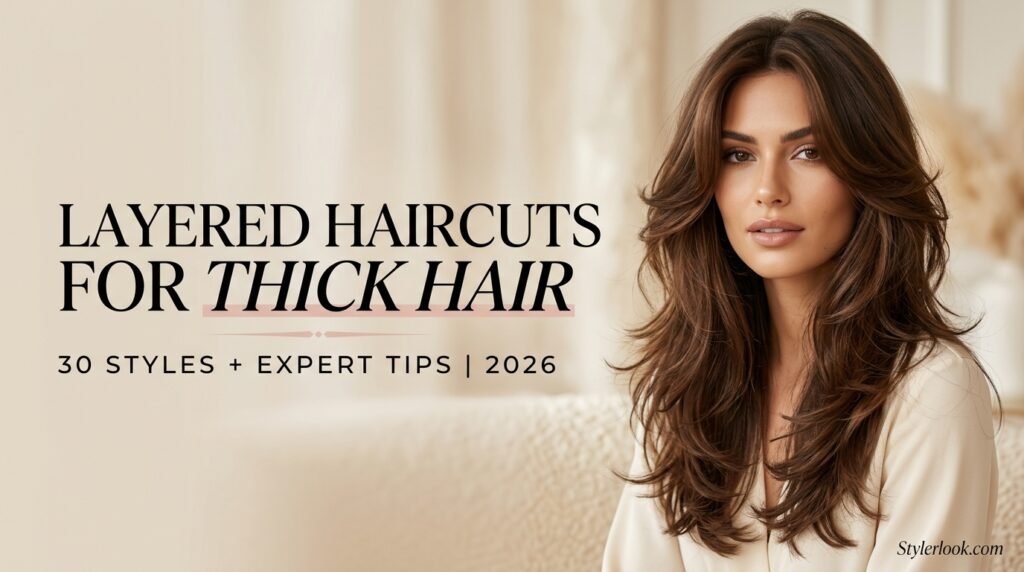
The best layered haircuts for thick hair use long, blended layers, shaggy cuts, wolf cuts, layered lobs and butterfly layers. These styles remove weight from the mid-lengths and ends while keeping the outline full.
Choose long layers if you want to keep length, a shag or wolf cut for texture and movement and a layered lob for an easy, polished shape.
Key Takeaways
- Layers remove weight and shape thick hair without making it look thin.
- Strategic layering works better than aggressive thinning.
- Long layers starting near the shoulders give length with movement.
- Texture and cutting technique matter as much as the cut itself.
- Over-thinning can cause frizz, stringy ends and extra puffiness.
- Trims every eight to twelve weeks keep the shape balanced.
Why Layers Work So Well for Thick Hair
Thick hair carries a lot of weight. When every strand is the same length, that weight pulls the hair down and pushes it outward, which creates the heavy, triangular silhouette many people dislike.
Layers solve this by breaking up the weight. Shorter pieces sit higher and add lift, while longer pieces fall below and keep the length.
What Layers Do for Thick Hair
| Benefit | How It Helps |
|---|---|
| Removes bulk | Takes weight out of the mid-lengths and ends |
| Adds shape | Creates a defined silhouette instead of a heavy block |
| Reduces puffiness | Helps hair sit closer, especially around the face |
| Speeds up drying | Less density means faster blow-dries |
| Adds movement | Lets hair swing and bounce |
| Improves styling | Makes curls, waves and straight styles easier to control |
Why Layers Do Not Mean Thinner Hair
A good layered cut keeps the outline dense and takes weight from inside the shape. The hair still looks full from the outside, but it feels lighter and moves more freely.
What Counts as Thick Hair?
Thick hair can mean two different things. One is density, which is how many strands grow per square inch of scalp. The other is strand width, which is how coarse each individual hair feels.
Many people have both. Others have dense but fine strands or fewer but coarse strands.
How to Tell if Your Hair Is Thick
- A ponytail feels wide and heavy when you hold it.
- Your scalp is hard to see when hair is parted.
- Blow-drying takes a long time.
- Your hair puffs out at the sides when cut at one length.
- Hair ties often feel tight or leave dents.
Density vs Strand Thickness
| Type | What It Means | Layering Approach |
|---|---|---|
| High density, fine strands | Lots of hair, each strand thin | Remove weight carefully, avoid over-thinning |
| High density, coarse strands | Lots of hair, strong strands | Layers plus internal weight removal |
| Low density, coarse strands | Fewer, wide strands | Keep the perimeter blunt, add light layers |
How Stylists Layer Thick Hair: Techniques Explained
Knowing a few terms helps you talk to your stylist. Each technique removes weight in a different way.
Point Cutting
The stylist snips into the ends with the tips of the scissors. It softens blunt lines and removes bulk without a visible step.
The more parallel the scissors are to the hair, the softer the texture.
Slide Cutting
The scissors glide along the hair shaft from top to bottom. This removes weight from the inside and creates a soft, feathered finish.
Channel Cutting
The stylist cuts small channels into sections to remove density. It is useful for very heavy, high-density hair that needs significant relief.
Thinning and Texturizing Shears
Thinning shears have a comb-like blade that removes only some hair with each cut. Stylists say they work best on thick hair, though balance is key.
One stylist advises using only the first few teeth on coarse hair, since coarse strands cut very easily. Over-thinning can create unwanted volume and frizz.
Invisible or Ghost Layers
These are short layers hidden under the top layer. They remove weight and add movement without changing the outer outline.
Many stylists consider them the safest way to lighten thick hair while keeping a full look.
Dry Cutting
Many stylists prefer to cut or refine thick hair dry. It lets them see growth patterns and weight distribution as the hair naturally falls.
Technique Quick Reference
| Technique | What It Does | Best For |
|---|---|---|
| Point cutting | Softens ends | Blunt or heavy edges |
| Slide cutting | Removes inner weight | Straight and wavy thick hair |
| Channel cutting | Removes heavy density | Very dense hair |
| Thinning shears | Removes bulk in small amounts | Coarse, straight hair, used lightly |
| Ghost layers | Adds lift without visible steps | Thick hair that needs a full outline |
| Dry cutting | Customizes weight removal | All thick textures |
Layers by Length: Choosing How Short or Long to Go
Length changes how layers behave. Each length has its own strengths for thick hair.
| Length | Best Layered Styles | Best For |
|---|---|---|
| Short | Layered bob, textured pixie, shaggy crop | Low styling time |
| Medium | Layered lob, shag, wolf cut, butterfly cut | Balance of length and manageability |
| Long | Long layers, U-cut layers, V-cut layers | Keeping length with movement |
Short Layered Haircuts for Thick Hair
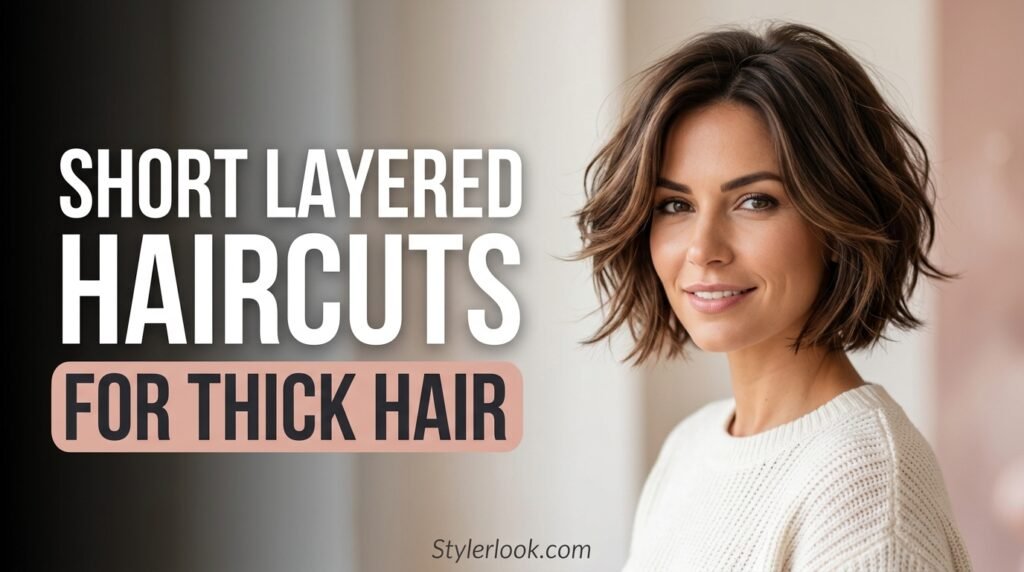
Short cuts remove the most weight and dry fastest. They also show shape clearly, so precise layering matters.
Thick hair can puff out at the sides when cut short without layers. Layering around the crown and temples keeps the shape neat.
For a closer look at cuts at this length, read the complete guide to short layered hairstyles.
Layered Bob
A layered bob has graduated layers and a clean outline. The layers take weight from inside the shape so the bob does not look like a heavy block.
It suits straight and slightly wavy thick hair, and it needs only a quick blow-dry.
Stacked Bob
The back is cut short and angled upward. It removes bulk at the nape and adds height at the crown.
Textured Pixie
A longer top with choppy layers and tapered sides keeps thick hair light. A little paste adds definition.
Shaggy Crop
Short, broken-up layers around the crown create a messy, rock-and-roll finish. It works well on wavy and coarse hair.
Modern Mod-Inspired Cut
Structured short layers give thick hair a sharp, deliberate shape. See these short mod cuts for ideas.
Short Wolf Cut
A short wolf cut layers the crown heavily and leaves wispy ends. It suits thick and wavy hair especially well.
Medium Layered Haircuts for Thick Hair
Medium length is the sweet spot for many people with thick hair. It keeps enough length for styling and drops enough weight to feel manageable.
The shortest layers usually sit near the cheekbone or chin, and the longer layers fall beneath them.
Layered Lob
A lob cut to the collarbone with soft layers is easy to style and looks polished. Layers keep the ends from flaring out.
Shoulder-Length Shag
Feathered, choppy layers remove bulk and add volume at the crown. It is a favorite for thick, wavy hair.
Wolf Cut
The wolf cut blends shag layers with a mullet-style back. It gives thick hair a lot of shape and removes heavy weight at the neck.
Butterfly Cut
Short, face-framing layers sit on top of longer layers beneath. The cut adds movement while keeping length, and it flatters thick hair.
Jellyfish Cut
A shorter, rounded top layer sits above longer, wispy lower layers. Learn more in this jellyfish haircut guide.
Medium Layers with Curtain Bangs
Curtain bangs blend into face-framing layers and soften the forehead. They suit thick hair because they spread weight across the front.
Long Layered Haircuts for Thick Hair
Thick long hair can feel like a curtain you carry around. Layers are a must at this length.
One stylist notes that layers should be built throughout the hair, not only at the face, so they give fullness and remove weight evenly. Layers starting just above the shoulders are a good rule of thumb.
Long Layers
Soft, blended layers throughout the length keep the silhouette full while removing weight. This is the safest and most popular option.
U-Shaped Layers
The ends curve into a gentle U shape. It looks soft and full from behind.
V-Shaped Layers
The ends point toward the center of the back. It looks more dramatic and removes more weight from the sides.
Long Shag
Long, feathered layers with texture give thick hair a lived-in look. It works well with curtain bangs.
Long Butterfly Layers
Short face-framing layers on top of long layers add movement without sacrificing length.
Blunt Perimeter with Internal Layers
A blunt bottom edge keeps thick ends looking healthy. Layers inside the hair remove weight without visible steps.
EOF wc -w layered-haircuts-for-thick-hair.md### Layered Haircuts for Thick Hair by Texture
Texture decides how layers fall. A cut that works on straight hair may not suit curls.
Thick Straight Hair
Straight hair shows every line, so layers need to be precise. A blunt base line with layers inside gives a sleek, full result.
One stylist recommends a super blunt baseline with internal layers for thick, straight hair. Soft layers or slide cutting prevent a helmet shape.
Best cuts: layered lob, long layers, blunt cut with ghost layers.
Thick Wavy Hair
Wavy hair has natural movement, so layers make waves more visible. Without layers, thick waves often form a triangle.
A shag or shoulder-length layered cut shows waves beautifully. See low taper fade wavy hair for a short, tapered option.
Best cuts: shag, wolf cut, textured lob.
Thick Curly Hair
Curly hair needs careful layering. Too many short layers can create a triangle, while too few leave the bottom heavy.
Many stylists cut curls dry so they can see how each curl springs up. Thinning shears are usually avoided on curls because they can cause frizz and uneven texture.
Best cuts: rounded layers, curly shag, curly butterfly cut.
For men and boys with curls, browse low taper fade curly hair and curly taper fade mullet.
Thick Coily and Natural Hair
Coily hair has beautiful density and volume. Rounded, tapered layers keep the shape balanced and the crown full.
Moisture matters just as much as the cut. A leave-in conditioner and a light oil seal help layers stay defined.
Best cuts: rounded layered cut, tapered layers, twist-out friendly layers.
Thick Coarse Hair
Coarse strands cut easily, so over-thinning can quickly cause trouble. Stylists often use only a few teeth of thinning shears, or none at all.
Best cuts: long layers, shag with soft ends, blunt cut with internal layers.
Thick Asian Hair
Asian hair is often straight, strong and dense. Without layers it looks heavy and flat at once.
Light layers remove weight and add movement. Texture at the ends keeps the cut soft. For tapered ideas, see low taper fade Asian hair.
Layered Haircuts for Thick Hair by Face Shape
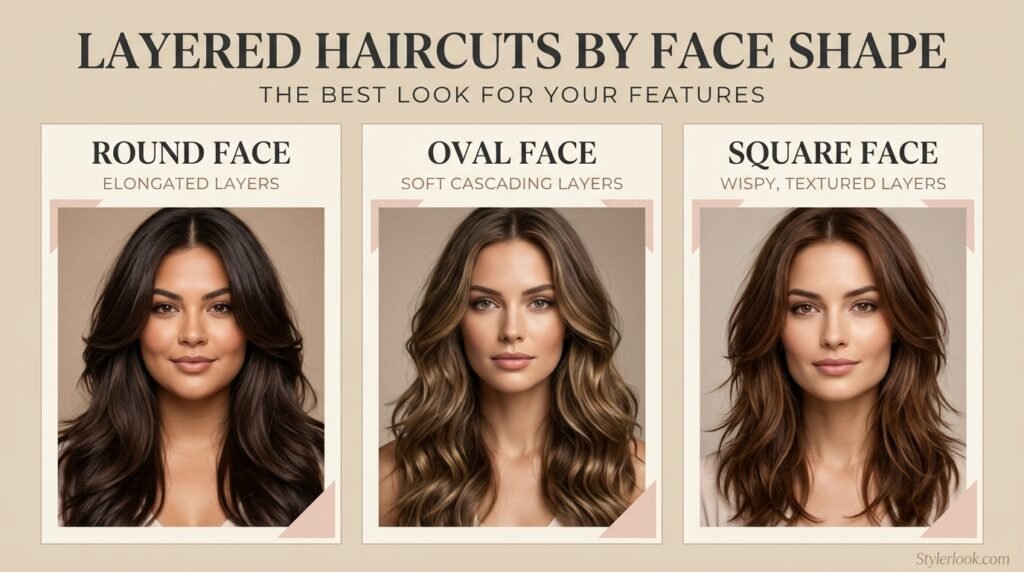
Layers can flatter your features when they are placed with face shape in mind.
| Face Shape | Best Layered Cut | What to Ask For |
|---|---|---|
| Oval | Almost any layered cut | Soft layers throughout |
| Round | Long layers, layered lob | Length at the front, volume at the crown |
| Square | Textured shag, soft layers | Wispy layers around the jaw |
| Heart | Chin-length layers, side-swept fringe | Layers that add width near the jaw |
| Long | Layered lob with fringe | Side volume, layers at the cheekbones |
| Diamond | Shag, butterfly cut | Layers that soften the cheekbones |
Round Face
Thick hair can add width at the sides of a round face. Long layers with length at the front help elongate the shape.
Square Face
Soft, wispy layers around the jaw soften strong angles. A textured shag with curtain bangs is a flattering match.
Heart-Shaped Face
Layers near the jaw balance a wider forehead. A chin-length layered cut with a side fringe works well.
Long Face
Add width with side volume and a fringe. A layered lob ending near the chin or collarbone shortens the look of the face.
Layered Haircuts for Thick Hair with Bangs
Bangs can look heavy on thick hair if they are cut as one solid block. Choose a fringe that blends into your layers.
Curtain Bangs
Curtain bangs part in the middle and sweep to the sides. They spread weight across the forehead and blend into face-framing layers.
Wispy Bangs
Thin, airy bangs lighten the front of thick hair. They are easier to style on hot, humid days.
Side-Swept Bangs
Long fringe falls diagonally and softens the forehead. It works well with a deep side part.
Shaggy Bangs
Broken-up, textured bangs match shag layers. They suit wavy and coarse hair.
Cowlicks and Thick Bangs
A strong cowlick at the hairline can push thick bangs out of place. Talk to your stylist about cutting the fringe slightly longer so it lies flat.
Layered Haircuts for Thick Hair for Men
Men with thick hair face the same issues: puffiness at the sides, bulk at the back and a top that will not lie flat. Layers and tapers solve most of them.
Men’s layered cuts usually pair a neat outline with a textured, layered top.
Layered Crop
A short crop with layers on top and a taper at the sides removes bulk. It is low maintenance and works well with matte clay.
For clean, textured ideas, see low taper fade with textured crop and low taper fade French crop hair.
Textured Fringe
Layers on a longer fringe keep thick hair from looking heavy. Explore low taper fade textured fringe and low taper fade fringe haircuts.
Quiff
Thick hair holds a quiff well. Layers lift the front and keep the shape from collapsing. See low taper fade quiff.
Layered Flow
Long layers with a taper create a relaxed, swept-back shape. Browse low taper fade with long hair for ideas.
Mullet
Layers keep a thick mullet from turning into a heavy block. See modern mullet men haircut ideas, modern mullet fade styles and low taper fade mullet.
Fluffy and Messy Styles
Thick hair is perfect for volume. See low taper fade fluffy hair, messy low taper fade and the ice cream haircut.
Polished Styles
For a refined look, see old money haircuts and low taper fade middle part.
Men’s Styling Tips
- Blow-dry the roots in the direction you want the hair to lie.
- Use a matte clay or paste for hold without shine.
- Trim every four to six weeks if you keep a taper.
- Keep the neckline neat to make layers look intentional.
Layered Haircuts for Thick Hair for Women Over 50
Hair can change with age, but many women keep dense, strong hair. Layers keep it light and flattering.
Soft layers work better than sharp, choppy ones for a refined effect. A layered lob or shoulder-length cut with side-swept bangs is a reliable choice.
Silver and ash tones look beautiful with layers because each step catches the light. Keep ends healthy to avoid a frizzy outline.
Layered Haircuts for Thick Hair for Kids and Teens
Thick hair on kids can be hard to detangle and slow to dry. Simple layers make mornings easier.
Soft layers on a shoulder-length cut suit girls, and tapered cuts suit boys. See low taper fade for kids and modern mullet kids hairstyles for ideas.
Why Over-Thinning Hurts Thick Hair
Thinning shears can be helpful, but they are easy to overuse. Removing too much density leaves stringy ends that frizz in humidity.
Over-thinning can also create unwanted volume at the mid-lengths, because shorter pieces stand up and puff out. That is the opposite of what you want.
Signs of Over-Thinning
- Ends look see-through or ragged.
- Short pieces poke out of the style.
- Frizz appears even after styling.
- Hair feels lighter but looks wider.
Safer Options
Ask for ghost layers, point cutting or slide cutting instead of heavy thinning. Choose a stylist who explains where weight will be removed.
Hair Color Ideas for Layered Thick Hair
Color adds dimension and shows off layers. Thick hair holds color well, but it needs care to stay shiny.
| Color Idea | Effect | Best With |
|---|---|---|
| Balayage | Soft, grown-out dimension | Long layers, shag |
| Face-framing highlights | Brightens the face | Butterfly cut, curtain bangs |
| Chestnut and chocolate | Shine and warmth | Layered lob |
| Bronde | Blend of brown and blonde | Wavy layers |
| Silver and ash | Cool, modern finish | Textured layers |
| Deep black and blue-black | High-gloss finish | Blunt cut with internal layers |
Color Care Tips
Use color-safe shampoo and cool water. A gloss treatment every few weeks keeps tone fresh.
30 Layered Haircut Ideas for Thick Hair
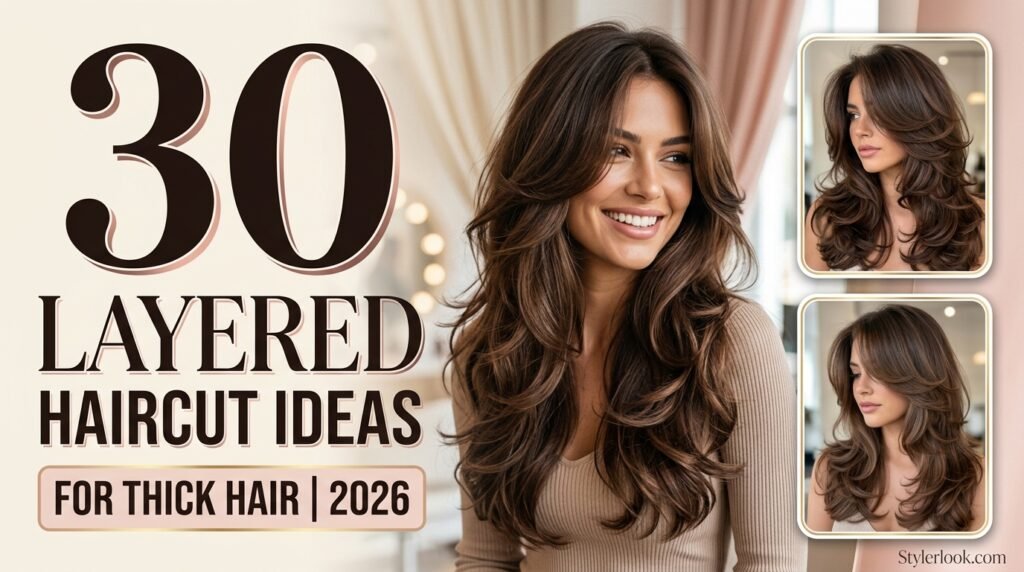
Use these as starting points and adapt them to your texture and lifestyle.
Short Styles
- Layered bob: graduated layers with a clean outline.
- Stacked bob: short, angled nape with a lifted crown.
- Textured pixie: choppy top with tapered sides.
- Shaggy crop: broken-up layers around the crown.
- Mod-inspired cut: structured short layers with a sharp finish.
- Short wolf cut: voluminous crown and wispy ends.
Medium Styles
- Layered lob: collarbone length with soft internal layers.
- Shoulder-length shag: feathered, choppy layers.
- Wolf cut: shag layers with a mullet-style back.
- Butterfly cut: short face-framing layers over longer ones.
- Jellyfish cut: rounded top with wispy lower layers.
- Medium layers with curtain bangs: soft fringe blended into the layers.
- Textured lob: point-cut ends and loose layers.
- Blunt cut with ghost layers: clean edge, hidden lift.
Long Styles
- Long layers: soft steps throughout the length.
- U-cut layers: curved ends for a soft finish.
- V-cut layers: pointed ends for a dramatic shape.
- Long shag: feathered layers with curtain bangs.
- Long butterfly layers: face-framing layers over length.
- Blunt perimeter with internal layers: thick, healthy ends with less bulk.
Men’s Styles
- Layered crop: textured top with a taper.
- Textured fringe: layered top with a neat fade.
- Quiff with layers: lifted front and tapered sides.
- Layered flow: swept-back length with a taper.
- Modern mullet: layered top with length at the back.
- Fluffy layered cut: airy volume with a low taper.
Curly and Textured Styles
- Curly shag: rounded layers that follow the curl.
- Curly butterfly cut: face-framing curls with length underneath.
- Curly taper mullet: layered curls with a neat taper.
- Rounded coily cut: tapered layers with a full crown.
How to Choose the Right Layered Haircut for Thick Hair
Choosing gets simpler when you consider four things.
1. Density and Strand Width
Dense but fine hair needs careful weight removal. Coarse hair often needs internal layers and soft ends.
2. Texture
Straight hair needs precise blending. Wavy and curly hair needs layers that follow the pattern.
3. Face Shape and Features
Use the face shape table above to place the shortest layers where they flatter you.
4. Time You Will Spend Styling
A layered lob and long layers are quick. A wolf cut or butterfly cut needs a little more effort.
Decision Table
| If You Want | Choose |
|---|---|
| Low maintenance | Long layers or layered lob |
| Maximum movement | Shag or wolf cut |
| Keep length | Long layers with internal layers |
| A sleek finish | Blunt cut with ghost layers |
| Short and easy | Layered bob or textured pixie |
| Curl definition | Curly shag or rounded layers |
How to Talk to Your Stylist About Thick Hair
A short conversation prevents most bad haircuts. Use these points at your consultation.
Describe Your Biggest Problem
Say whether the issue is bulk, puffiness, triangle shape or hard-to-style hair. Specific complaints lead to better cuts.
Ask About Technique
Ask how the stylist plans to remove weight. Point cutting, slide cutting and ghost layers are safer choices than heavy thinning.
Ask for Dry Cutting or a Dry Finish
Many stylists check weight on dry hair. It shows how your hair truly falls.
Bring Photos
Bring photos of hair with a similar texture and density. A photo of fine hair may not translate.
Discuss Maintenance
Tell your stylist how often you can visit and how much time you can spend styling.
How to Style Layered Thick Hair at Home
Good styling keeps thick layers neat and controlled. Follow this routine for most textures.
- Wash with a hydrating shampoo. Thick hair can be dry, so use conditioner on mid-lengths and ends.
- Towel-dry gently. Squeeze out water instead of rubbing.
- Apply a lightweight product. Use cream, mousse or serum depending on your texture.
- Rough-dry first. Remove most of the water with the dryer on medium heat and a nozzle attached.
- Dry in sections. Use clips to separate the hair and dry each section from root to end.
- Shape the layers. Use a round brush, flat iron or curling wand to define the layers.
- Finish lightly. Apply a flexible-hold spray and a small amount of serum on the ends.
Styling by Texture
| Texture | Quick Routine |
|---|---|
| Straight | Blow-dry in sections, finish with smoothing serum |
| Wavy | Sea-salt spray, scrunch, diffuse or air-dry |
| Curly | Curl cream, diffuse, avoid touching while drying |
| Coily | Leave-in, gel or cream, twist-out or wash-and-go |
| Coarse | Heat protectant, smoothing oil, section drying |
Drying Time Tips
A high-quality dryer with a concentrator nozzle cuts drying time. Dry the roots first and the ends last.
Best Products and Tools for Layered Thick Hair
Thick hair needs products that control without weighing it down.
| Product or Tool | What It Does | Best For |
|---|---|---|
| Hydrating shampoo and conditioner | Adds moisture | Dry, coarse hair |
| Lightweight leave-in | Smooths frizz | All thick textures |
| Smoothing serum | Controls frizz and adds shine | Straight and coarse hair |
| Curl cream | Defines curls | Curly and coily hair |
| Texturizing spray or powder | Shows off layers | Shag and wolf cuts |
| Root lifter or volumizing spray | Adds lift at the crown | Hair that falls flat at the roots |
| Heat protectant | Shields from heat | Anyone using hot tools |
| Round brush | Smooths and shapes | Lobs and long layers |
| Ionic dryer | Speeds drying and reduces frizz | Thick, dense hair |
| Wide-tooth comb | Detangles gently | Curly and wavy hair |
Stylists recommend texturizing spray or powder to accentuate layers, a volumizing spray to give heavy hair some buoyancy and a light setting spray for control.
How to Control Frizz in Layered Thick Hair
Thick hair tends to be more prone to frizz, especially when it is curly. Good habits make a big difference.
- Condition every wash and use a weekly mask.
- Avoid rough towel-drying.
- Use a heat protectant before blow-drying or flat ironing.
- Sleep on a silk or satin pillowcase.
- Seal ends with a lightweight oil or serum.
- Trim regularly so splits do not travel.
How Often Should You Trim Layered Thick Hair?
Thick hair holds shape well, but layers still need maintenance. Most stylists suggest a trim every eight to twelve weeks for long and medium layers.
Short cuts and tapered styles need visits every four to six weeks. If the outline starts to widen or the layers lose shape, it is time for a shape-up.
Common Mistakes with Layered Haircuts for Thick Hair
A few errors can make thick hair harder to handle. Avoiding them saves money and frustration.
Over-Thinning
Too much thinning leaves stringy, frizzy ends. Ask your stylist to use it lightly or avoid it.
Too Many Short Layers
Short layers can stand up and make thick hair puff out. Keep layers connected and balanced.
Ignoring Texture
A cut that suits straight hair may fail on waves or curls. Always plan around your pattern.
Skipping Heat Protection
Thick hair takes longer to dry, so it often gets more heat. Use protectant and a lower setting where possible.
Using Heavy Products
Thick hair does not need heavy creams on the roots. Use lightweight products and focus on mid-lengths and ends.
Choosing a Cut from a Photo of Fine Hair
Fine hair behaves very differently from thick hair. Choose references with similar density.
Waiting Too Long Between Trims
Overgrown layers lose shape and weight returns to the bottom. Book your next visit before you leave.
Pros and Cons of Layered Haircuts for Thick Hair
Every cut has trade-offs. Here is an honest look.
| Pros | Cons |
|---|---|
| Removes bulk and weight | Needs regular trims |
| Adds shape and movement | Over-thinning can cause frizz |
| Speeds up drying | Some styles need daily product |
| Reduces triangle shape | Mistakes show during grow-out |
| Works on most textures | Short layers can puff out |
| Keeps length for updos | Requires a skilled stylist |
Hair Care Tips to Keep Thick Layers Healthy
Healthy ends help layers look crisp. Thick hair can be dry, so moisture matters.
Use a hydrating shampoo and conditioner, and avoid washing every day if your scalp allows it. Rinse with cooler water to help smooth the cuticle.
Detangle gently from the ends upward with a wide-tooth comb. A weekly mask adds moisture and softness.
Loose braids or a silk scrunchie at night protect layers from friction and keep waves and curls in shape.
Final Checklist Before You Book Your Cut
Run through this list before your appointment.
- Know your density and strand width.
- Know your hair texture.
- Decide how much length you will keep.
- Save two or three reference photos with similar hair.
- Decide whether you want bangs.
- Ask your stylist about technique.
- Plan your trim schedule.
Also Read
- Short Layered Hairstyles: The Complete Guide to Cuts, Styling and Face Shape Matches (2026)
- Jellyfish Haircut Complete Guide: Styles and Variations
- Stunning Short Mod Cuts You’ll Absolutely Love
- Ice Cream Haircut: Before & After That’ll Blow Your Mind
- Modern Mullet Men Haircut Ideas That Are Trending
- Modern Mullet Fade Styles That Scream Confidence
- 21 Best Low Taper Fade Mullet Haircuts for Men 2026
- Curly Taper Fade Mullet: 15+ Trendy Styles and Care Tips
- 27 Stylish Low Taper Fade Curly Haircuts for Men 2026
- 27 Stylish Low Taper Fade Wavy Hair 2026
- 16 Best Low Taper Fade Fluffy Hair 2026
- 27 Low Taper Fade With Trending Textured Crop 2026
- Low Taper Fade Textured Fringe: Complete Style Guide
- 22 Trendy Low Taper Fade Fringe Haircuts for Men
- 24 Trendy Messy Low Taper Fade Haircuts 2026
- 22 Trendy Low Taper Fade Quiff Haircuts for Men 2026
- 20 Trendy Low Taper Fade With Long Hair Styles 2026
- Low Taper Fade French Crop Hair: Modern Stylish Haircut 2026
- 22 Low Taper Fade Asian Hair Styles for Modern 2026
- 15 Best Low Taper Fade for Kids 2026
- Modern Mullet Kids Hairstyles: Trendy, Fun and Easy to Maintain
- 20 Old Money Haircuts for Men That Signal Wealth
- Low Taper Fade Middle Part 2026 Guide to Effortless Style
Frequently Asked Questions (FAQs)
What are the best layered haircuts for thick hair?
Long layers, layered lobs, shags, wolf cuts and butterfly cuts work best. They remove weight while keeping the outline full.
Do layers help thick hair?
Yes. Layers break up weight, reduce bulk and add movement. They also help thick hair dry faster and sit closer to the head.
How many layers should thick hair have?
Enough to remove weight without making the hair look thin. Many stylists prefer fewer, well-placed layers over many short ones.
Can thick hair look thin with layers?
It can if layers are overdone or if thinning shears take out too much. A stylist who keeps the perimeter dense avoids this.
Should I use thinning shears on thick hair?
They can help when used lightly, especially on straight or wavy hair. Over-thinning causes frizz and stringy ends, and they are usually avoided on curls.
What are ghost layers?
Ghost layers are short, hidden layers cut beneath the top layer. They remove weight and add movement without visible steps.
What is the best layered cut for thick curly hair?
A rounded curly shag or curly butterfly cut works well. A curl-aware stylist who cuts dry gives the best results.
What is the best layered cut for thick straight hair?
A layered lob or long layers with a blunt base line gives a sleek, full result. Soft internal layers prevent a heavy look.
What is the best layered cut for thick wavy hair?
A shag, wolf cut or textured lob shows off waves and removes bulk. These cuts also prevent a triangle shape.
What is the best short layered cut for thick hair?
A layered bob, textured pixie or shaggy crop works well. Layers around the crown keep the sides from puffing out.
What is the best long layered cut for thick hair?
Long layers with layers starting near the shoulders give length with movement. U-cut and V-cut layers are popular options.
Is a wolf cut good for thick hair?
Yes. The shag layers and mullet-style back remove significant weight and add shape.
Is a butterfly cut good for thick hair?
Yes, when the layers are balanced. Short face-framing layers over longer ones add movement without losing length.
Do layered cuts take longer to style?
Not usually. Layers remove weight, so drying is faster, and shape does much of the work.
How often should I trim layered thick hair?
Every eight to twelve weeks for long and medium cuts, and every four to six weeks for short or tapered cuts.
Can men get layered haircuts for thick hair?
Yes. Layered crops, textured fringes, quiffs and mullets all work. A taper keeps the sides neat.
How do I stop thick layered hair from frizzing?
Use a hydrating conditioner, a lightweight serum and a heat protectant. Avoid over-thinning and trim regularly.
Are bangs good with thick layered hair?
Yes, if they blend into the layers. Curtain bangs and wispy bangs work especially well on thick hair.
What products are best for thick layered hair?
Lightweight leave-in conditioner, smoothing serum and texturizing spray work well. Use heavy creams only on the ends.
How do I ask my stylist for layers on thick hair?
Describe your problem, bring photos of similar texture and ask about weight removal technique. Mention your styling time and trim schedule.
Do layers make thick hair easier to blow-dry?
Yes. Less weight means faster drying, and sectioning makes it even quicker.
Can I get layers if I have a cowlick?
Yes. A skilled stylist works with the growth pattern, and slightly longer layers near the cowlick help it lie flat.
Are layered cuts good for women over 50 with thick hair?
Yes. Soft layers keep the hair light and flattering, and a layered lob is a reliable choice.
What hair color works best with layered thick hair?
Balayage, face-framing highlights and rich brunette tones show off layers. Color adds depth to each step.
Conclusion
Layered haircuts for thick hair turn a heavy, hard-to-style mane into a shape that moves. The right layers remove weight, add movement and keep the silhouette full.
The secret is strategy rather than quantity. Choose layers that suit your texture and face shape, ask your stylist about technique and avoid over-thinning.
Whether you pick long layers, a layered lob, a shag, a wolf cut or a tapered crop, you are choosing a cut that makes daily life easier. Bring clear photos, build a simple routine and enjoy hair that finally works with you.
