

Curly hair has a mind of its own. It lifts where you wanted it flat, drops where you wanted volume, and shrinks the moment it dries.
Then one good cut changes everything. The shape balances out, the curls bounce, and the hair finally looks the way you pictured it.
That cut is usually curly layers. Done well, they remove weight, lift the crown, and give each curl room to move. Done badly, they leave you with a heavy triangle or a flat top.
Table of Contents
What Are Curly Layers?
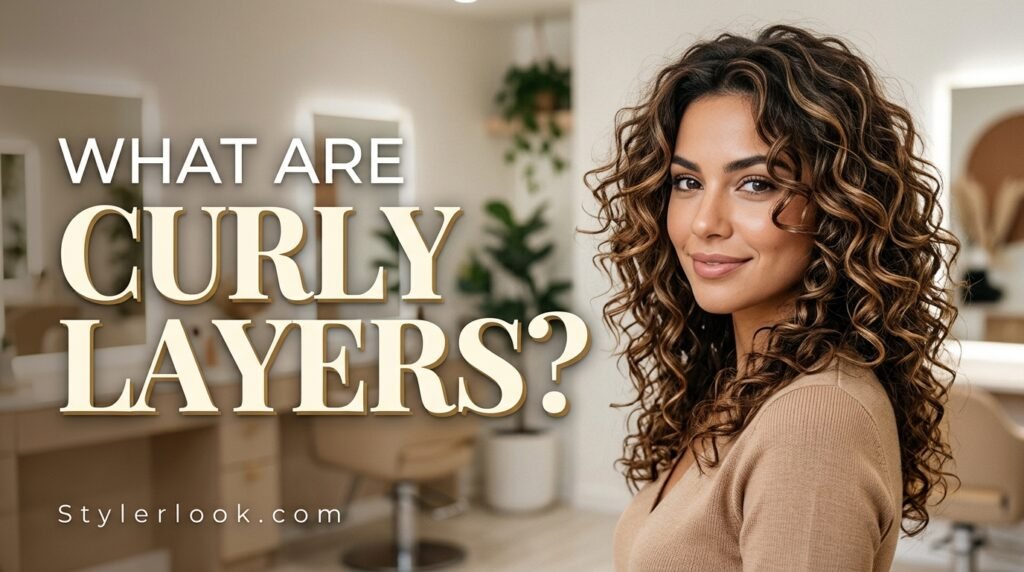
Curly layers are layers cut into curly hair so the length varies from top to ends. They remove weight, balance the shape, and let curls bounce instead of hanging in a heavy mass.
The goal is a rounded, even silhouette with healthy volume.
Quick answer: Curly layers are varied-length cuts designed for curly hair. They reduce bulk, prevent a triangle shape, and add bounce, volume, and definition to curls.
Why Curly Hair Needs a Different Approach
Curly hair behaves differently from straight hair. It shrinks as it dries, and each curl pattern holds its shape differently.
A technique that works on straight hair can leave curls uneven or too short.
Layers Work Like Sculpting
One stylist compares cutting curly hair to shaping a cloud, not drawing crisp lines. The idea is to work with the hair’s natural tendencies instead of forcing a shape it resists.
That is why the best curly cuts feel soft and rounded.
What Layers Can and Cannot Do
Layers remove weight and add bounce. They do not remove shrinkage, but they can make hair look longer.
Poor layering can create a triangle shape or leave hair just as heavy.
Why Curly Layers Are So Popular
Curly hair often grows out in a pyramid: flat on top, full at the bottom. Layers fix the proportions.
They also make styling easier.
They Prevent the Triangle Shape
A triangle shape has a flat crown and a heavy, wide bottom. Short layers in the last few inches remove weight from the ends so the crown can lift.
Internal layers add lift without changing the outline.
They Add Bounce and Movement
Without layers, heavy curls can pull straight down. Layers let curls spring up and move.
Each curl gets room to form its own shape.
They Define Curl Patterns
Lighter ends help curls clump and define. The pattern looks clearer and less frizzy.
Shape and definition work together.
They Can Make Hair Look Longer
Removing weight lets curls lift and spring. The hair often looks longer because the curls are not dragged down.
Shrinkage stays the same, but the overall impression changes.
Understanding Curl Patterns
Curl pattern changes how layers should be cut. Knowing yours helps you explain what you want.
Stylists often group curls into waves, curls, and coils.
| Pattern | Description | Layering Approach |
|---|---|---|
| Type 2 (wavy) | S-shaped waves, loose to defined | Layers can enhance or minimize wave |
| Type 3 (curly) | Defined spirals and ringlets | Rounded layers to build bounce |
| Type 4 (coily) | Tight coils and zigzags, high shrinkage | Cut in natural state, shape carefully |
| Mixed patterns | Different curl types on one head | Layers adapted section by section |
Wavy Hair and Layers
Wavy hair can look more or less wavy depending on layer length. Shorter layers enhance waves by removing weight.
Longer layers keep weight and relax the wave.
Curly Hair and Layers
Curly hair benefits from rounded layers that create a soft cascade. Layers highlight the curl and balance volume.
Cutting with scissors on medium or long hair helps keep the layers even.
Coily Hair and Layers
Coily hair has a lot of shrinkage and a tight pattern. Stylists often use scissors or clippers and cut the hair in its natural state.
Layers should be shaped carefully to keep volume even.
Mixed Curl Patterns
Many heads have more than one pattern. The cut should respect each area.
A stylist with experience in mixed patterns is invaluable. They can adjust layer length across sections.
Types of Curly Layers
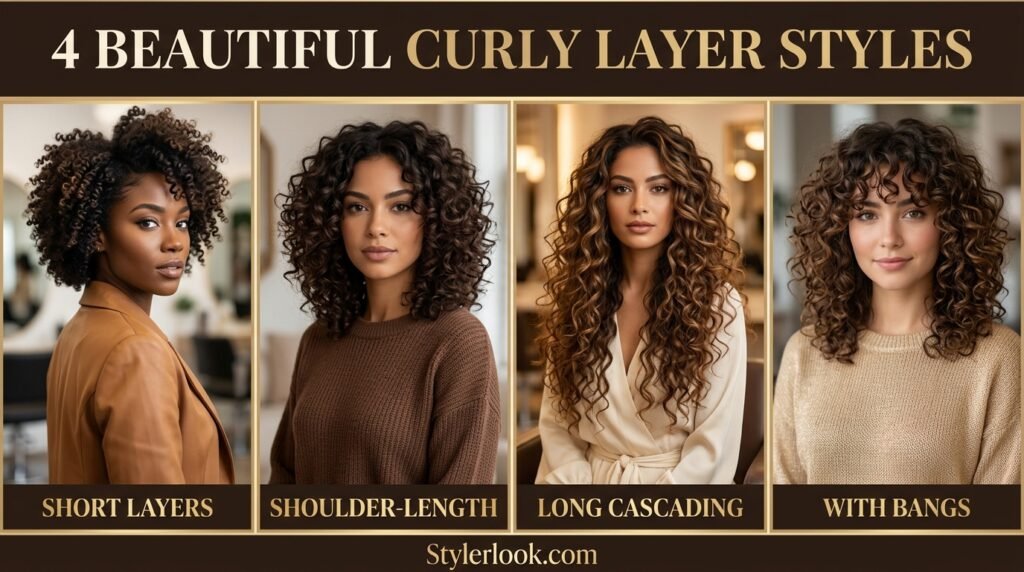
Curly layers come in many shapes. The right one depends on your pattern, density, and lifestyle.
Here are the most popular versions.
Long Curly Layers
Long layers soften the shape without removing much length. They keep curls bouncy and balanced.
For ideas on longer lengths, see these layered hairstyles for long hair.
Medium-Length Curly Layers
Shoulder-length curls have enough length to show layers clearly. They are versatile and easy to style.
Browse more shapes in these medium length layered haircuts.
Layered Curly Bob
A curly bob with layers removes bulk and adds volume at the crown. It suits many curl patterns.
A center-part version looks chic and polished.
Layered Curly Lob
A long bob with layers sits near the shoulders. It has bounce and is long enough to tie up.
Wavy and curly textures both suit it.
Rounded Cascade Layers
Layers fall in a rounded cascade that follows the curl pattern. The look is balanced and full.
It suits medium to long curls.
Crown Layers
Shorter layers near the crown add lift where curly hair often falls flat. They help prevent a flat top.
They work well with a diffuser.
Tapered Curls
Hair is longer on top and shorter at the sides and nape. This tapered shape suits coily and 4C hair, especially fine hair that needs volume.
It looks sculpted and bold.
High-Volume Layers
These layers maximize lift and curl size. They suit type 3 and type 4 hair.
They need good moisture and shaping products.
Shaggy Curly Layers
Shags use layers to add texture and movement. The top has more volume, with longer pieces underneath.
Shaggy cuts usually need trims every six to eight weeks.
Curly Layers With Bangs
Curly bangs frame the face and change the whole look. Cut them longer than you think, since curls shrink.
Ask for a dry cut for accuracy.
Layered Curly Pixie
Short sides and back with more length on top create a bold, low-maintenance cut. Layers add shape and texture.
It suits people who want minimal styling.
Face-Framing Curly Layers
Layers around the face soften features and add movement. They blend into the rest of the cut.
They are easy to add to almost any length.
Curly Layers by Face Shape
Face shape guides where layers start and how long they run. Treat these as guidelines, not rules.
A good stylist adjusts the cut to your features.
| Face Shape | Suggested Approach |
|---|---|
| Oval | Most styles work; layers show off balanced proportions |
| Heart | Layers that add volume near the chin and soft bangs |
| Round | Layers that add height and length; avoid width at the cheeks |
| Square | Soft, rounded layers around the jaw |
| Long or oblong | Layers that add width at the sides |
| Diamond | Layers that add volume at the forehead and jaw |
Oval Faces
Oval faces suit nearly every curly cut. Choose based on your curl pattern and routine.
Layers can show off balanced proportions.
Heart-Shaped Faces
Heart-shaped faces have a wider forehead and narrower chin. Layers that add volume near the chin balance them.
Soft bangs can also help.
Round Faces
Round faces can benefit from layers that add height and length. Avoid layers that add width at the cheeks.
Face-framing curls that fall past the jaw help elongate.
Square Faces
Square faces have a strong jaw. Soft, rounded layers around the jaw gentle the angles.
Curl volume around the face adds softness.
Long and Oblong Faces
Long faces benefit from width. Layers that add volume at the sides help balance length.
Curly bangs can also shorten the look.
Diamond Faces
Diamond faces have prominent cheekbones. Layers that add volume at the forehead and jaw add balance.
Soft curls near the cheeks frame them nicely.
Curly Layers by Hair Density and Thickness
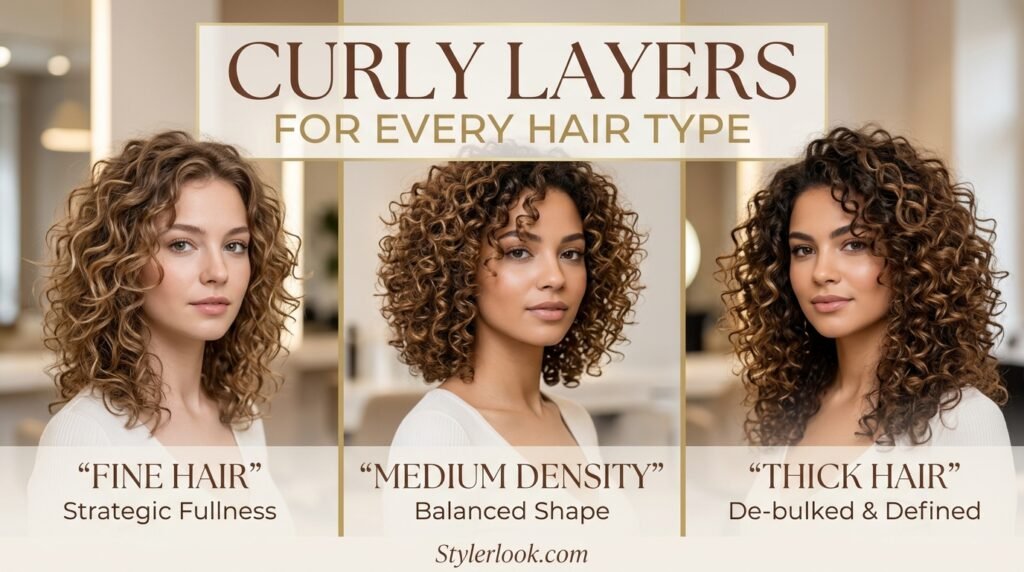
Density changes how many layers curls can handle. The right balance prevents both bulk and thinness.
Ask your stylist how dense your hair is.
Curly Layers for Fine Curls
Fine curls can look thin if over-layered. Keep layers soft and avoid too many short pieces.
Tapered or high-volume layers can add lift without losing fullness.
Curly Layers for Medium-Density Curls
Medium density is very versatile. Most layered shapes work.
Choose based on pattern and lifestyle.
Curly Layers for Thick Curls
Thick curls benefit most from weight removal. Layers prevent the heavy triangle shape.
See this guide to layered haircuts for thick hair for more ideas.
Curly Layers for Color-Treated or Dry Curls
Dry or damaged curls can look uneven when layered. Moisture and trims come first.
Healthy ends make layers look smooth.
Dry Cut vs. Wet Cut for Curly Layers
Many stylists cut curly hair wet, dry, or both. Each method has strengths.
Ask which your stylist prefers and why.
| Method | Benefits | Considerations |
|---|---|---|
| Wet cut | Precise, balanced foundation; good for stretched or straightened hair | Curls change shape as they dry |
| Dry cut | Shows how hair naturally falls; helps remove weight from dense areas | Take off weight carefully |
| Combination | Wet for the foundation, dry for shaping | Takes more time |
Wet Cutting
Wet cutting gives a more precise, balanced foundation. It suits clients who alternate between curly and straight hair.
A stylist can build a more technical shape.
Dry Cutting
Dry cutting shows how curls naturally fall. It is often better for clients who mostly wear their hair curly.
It helps remove weight from dense areas while preserving shape.
Combining Both
Some stylists cut wet for the foundation and refine dry. This blends precision with realism.
It is a popular approach for complex shapes.
How Your Routine Decides
If you often blow-dry or straighten, a wet cut may work. If you mostly air-dry or diffuse, a dry cut better matches your life.
Tell your stylist how you really wear your hair.
Understanding Shrinkage
Shrinkage is how much curls contract as they dry. It is the biggest reason curly cuts go wrong.
Most curly clients already know how much their curls shrink.
How to Estimate Shrinkage
Dampen a section and compare its stretched length with the dry hair beside it. The difference shows how much it will contract.
Your stylist can do this before cutting.
Cut Less Than You Think
Curls can shrink significantly. A common stylist tip is to cut about half of what seems necessary.
You can always cut more later.
Bangs and Shrinkage
Curly bangs shrink the most. Ask for extra length and a dry cut.
Some stylists cut them twice as long as you want them to end.
Layers and Length
Layers don’t reduce shrinkage. But they let curls lift, which can make hair look longer.
That is why layered curls often look fuller and longer.
How Stylists Cut Curly Layers
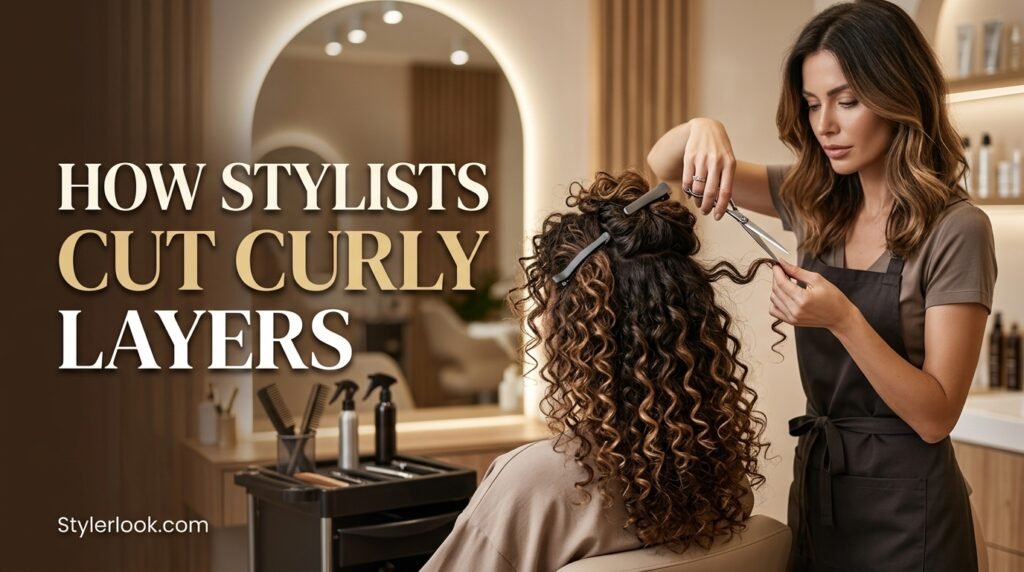
You don’t need to know every technique. A basic idea builds trust in the process.
Methods vary by stylist and curl pattern.
The Consultation
A good stylist starts by asking about your routine. They ask how often you wash, which products you use, and how you style.
This helps them choose the right method.
Setting the Shape
The stylist often sets the outline first, since the cut sets the silhouette for the whole style. They shape the hair like a cloud, not a crisp line.
They adjust for how the curls fall.
Adding Internal Layers
Internal layers remove weight from inside the hair without changing the outline. They add lift and bounce.
They are helpful for thick curls.
Short Layers at the Ends
Adding short layers within the last three to four inches removes weight from the ends. This helps the crown lift.
It is a common fix for the triangle shape.
Scissors and Clippers
Stylists use scissors, and sometimes clippers or carving-comb techniques on short styles. Tight coils can be cut in their natural state with either tool.
The tool depends on the pattern and length.
Avoiding Too Much Tension
Pulling curls too tight makes clean lines hard. Stylists use light tension and cut in small sections.
This keeps the shape even once the curls spring back.
How to Ask Your Stylist for Curly Layers
Clear communication prevents disappointment. Prepare before your appointment.
Vague requests can lead to the wrong shape.
Choose a Curl Specialist
Look for a stylist experienced with curly hair. Check portfolios for curls similar to yours.
Experience with your pattern matters most.
Bring Reference Photos
Choose photos of people with a similar curl pattern and density. Include one example of what you do not want.
Photos show details words miss.
Describe Your Routine
Tell your stylist how you wash, dry, and style. Mention whether you diffuse, air-dry, or straighten.
Honest answers lead to a wearable cut.
Discuss Shrinkage
Mention how much your curls shrink. Ask them to account for it when cutting.
Agree on a conservative first cut.
Say What You Want From the Layers
Do you want more volume, less bulk, or a rounder shape? Say so clearly.
Ask how the layers will connect to the outline.
Questions to Ask Before You Cut
- Will you cut wet, dry, or both?
- How will you handle shrinkage?
- Where will the shortest layers fall?
- How will this prevent a triangle shape?
- How do I style it each day?
- How often will I need a trim?
How to Style Curly Layers
Curly layers need the right styling to show their shape. A few techniques make a big difference.
Style gently and keep hands off while curls dry.
Start With Clean, Moisturized Curls
Wash with a gentle shampoo and condition well. Detangle with a wide-tooth comb while conditioner is in.
Clear buildup before it flattens your curls.
Apply Products to Damp Hair
Scrunch in products one at a time instead of raking your fingers through. Start with a leave-in, then add a curl cream or gel.
Smooth products through and let curls clump.
Diffuse for Volume
Use a diffuser with gentle heat. Tilt your head and move the hair with your fingers so the curls expand.
Direct the hair upward at the roots for lift.
Clip the Roots
Clip sections near the roots while drying. This lifts the crown and prevents a flat top.
You can also lift the hair with your fingers while leaning forward.
Air-Dry for Definition
Let curls dry untouched to avoid frizz. Plop or use a microfiber towel if you want extra definition.
Avoid touching until fully dry.
Fluff and Shape
Once dry, gently fluff the roots with your fingers. Shake the hair into place.
Trim stray ends carefully if needed.
Step-by-Step: A Simple Curly Layers Routine
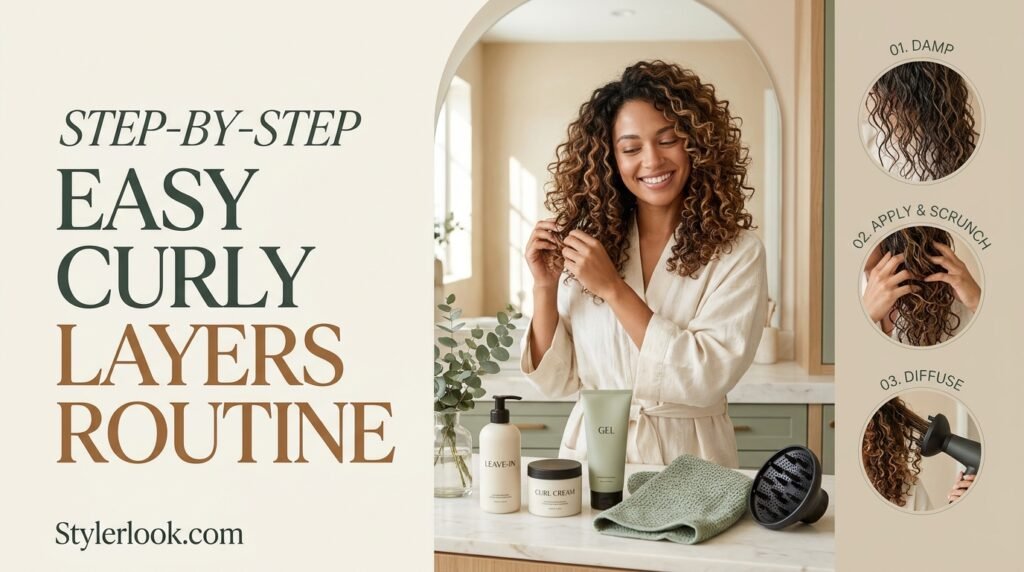
Follow this routine for defined, bouncy curls. Adjust it to your pattern and density.
- Wash with a gentle, sulfate-free shampoo and condition well.
- Detangle with a wide-tooth comb while the conditioner is in.
- Gently squeeze out extra water, without rubbing.
- Apply leave-in conditioner to damp curls.
- Add curl cream or gel and scrunch upward.
- Diffuse with clips at the roots or air-dry untouched.
- Fluff the roots and shake the hair into place once dry.
Best Products for Curly Layers
Products should add moisture, definition, and hold. Choose by curl pattern and density.
Use less than you think you need, and apply to damp hair.
| Goal | Product Type |
|---|---|
| Moisture | Leave-in conditioner or cream |
| Definition | Curl cream or gel |
| Hold in humidity | Strong-hold gel that doesn’t add moisture |
| Heat protection | Heat protectant spray |
| Refresh | Leave-in mixed with water |
| Deep hydration | Weekly deep conditioner or mask |
| Buildup removal | Gentle clarifying shampoo |
| Shine | Light oil on the ends |
Products for Fine Curls
Use lightweight creams and mousse. Avoid heavy oils and butters.
Apply mainly at the mid-lengths and ends.
Products for Thick Curls
Use richer creams and gels to control frizz. A deep conditioner each week helps.
Seal the ends with a light oil.
Products for Coily Hair
Use moisturizing creams, jellies, and leave-ins. Layer products for hydration and shape.
Seal the ends to protect from dryness.
Tools for Styling Curly Layers
A few tools cover most looks. Choose gentle ones for curls.
You do not need a full collection.
- Wide-tooth comb: Detangles without breaking curls.
- Diffuser: Dries curls without disturbing the pattern.
- Clips: Lift the roots for crown volume.
- Microfiber towel or cotton T-shirt: Reduces frizz while drying.
- Small barrel curling iron: Refreshes a few random sections.
- Satin scrunchie: Protects curls overnight.
- Satin bonnet or pillowcase: Reduces friction and frizz.
Refreshing Curly Layers on Day Two
Curls often flatten overnight. A quick refresh brings them back.
You can often skip a full wash.
Mist and Scrunch
Mix leave-in conditioner with water in a spray bottle. Mist the curls and scrunch.
Add a little gel if needed.
Shake Out the Roots
Flip your head over and fluff the roots with your fingers. This brings back volume.
Use clips if the crown is flat.
Curl a Few Sections
Use a small barrel iron on a few random sections. This adds bounce without redoing the whole head.
Always use heat protectant.
Sleeping With Curly Layers
Nighttime habits protect curl shape. Good habits save time in the morning.
Reduce friction and preserve volume.
Pineapple Your Hair
Gather curls into a loose top knot with a satin scrunchie. This protects the pattern and the crown.
Avoid tight bands that crush the curls.
Use a Satin Bonnet or Pillowcase
Satin or silk reduces friction and frizz. It also helps curls hold moisture.
It is one of the simplest curl-care upgrades.
How Often Should You Trim Curly Layers?
Layers blur as they grow. Regular trims keep the shape balanced.
Your stylist can tailor the schedule.
A General Guide
Many stylists suggest trims every eight to twelve weeks for curly layers. Shaggy or shorter shapes may need trims every six to eight weeks.
Your curl pattern and growth rate matter too.
Signs You Need a Trim
Layers blur and the shape grows heavy. The crown flattens or the ends look uneven.
Curls tangle more or look dry at the ends.
Between Appointments
Use a leave-in conditioner and deep condition weekly. Protect ends with a light oil.
Keep tools and towels gentle on curls.
Curly Layers and Hair Health
Curly hair tends to be drier, so moisture matters. Healthy curls hold layers better.
A few habits keep curls strong.
Moisturize Regularly
Use a deep conditioner or mask weekly. Seal the ends with a light oil.
Dry curls look frizzy and lose shape.
Clear Buildup
Product buildup weighs curls down. Use a gentle clarifying shampoo from time to time.
Rinse thoroughly.
Limit Heat Damage
Use heat protectant and low heat when using hot tools. Let curls air-dry when you can.
Heat can loosen curl patterns.
Be Gentle When Detangling
Detangle with a wide-tooth comb while the hair is conditioned. Start at the ends and work up.
Avoid raking through dry curls.
Curly Layers and Hair Color
Color adds dimension to curly layers. It also affects hair health.
Plan color and cut together.
Balayage and Highlights
Soft highlights show off curl shape and add depth. Lighter pieces around the face brighten the complexion.
Ask your colorist about protecting curl health.
Layered Ombré
A soft gradient or colored ends add dimension to layers. The curls catch the color beautifully.
Use sulfate-free shampoo to protect color.
Natural Hair
Layers still show on a single shade. A glossy finish helps curls catch the light.
Healthy hair needs less color to look striking.
Protecting Color-Treated Curls
Color-treated curls need extra moisture. Use color-safe products and deep condition weekly.
Schedule trims to keep ends healthy.
Can You Cut Curly Layers at Home?
Some people try to layer their own curls. It is risky, because curly cutting needs specialized skill.
Mistakes are hard to undo.
Why a Professional Is Safer
Curls spring up, shrink, and change shape as they dry. A stylist who knows curls can predict this.
Uneven layers show clearly in curly hair.
If You Still Want to Try
Use sharp hair-cutting scissors, not household ones. Cut tiny amounts, ideally dry, one curl at a time.
Stop early and check often.
Safer Alternatives
Ask a curl specialist for a quick shape-up between full cuts. Many salons offer inexpensive trims.
Bring photos and notes to your appointment.
Pros and Cons of Curly Layers
Every haircut has trade-offs. Weighing them helps you decide.
| Pros | Cons |
|---|---|
| Prevents the triangle shape | Needs a stylist experienced with curls |
| Adds bounce and volume | Shrinkage can surprise you |
| Defines curl patterns | Needs regular trims |
| Reduces bulk in thick hair | Fine hair can look thin if over-layered |
| Makes hair look longer | Needs moisture and gentle care |
| Easier styling | DIY layering is risky |
Common Curly Layers Mistakes
Most disappointments are preventable. Watch for these errors.
- Cutting too much length because of shrinkage.
- Choosing a stylist who doesn’t specialize in curls.
- Ignoring your curl pattern and density.
- Pulling curls with too much tension while cutting.
- Over-layering fine curls.
- Skipping moisture and deep conditioning.
- Raking fingers through curls while they dry.
- Letting product buildup pile up.
- Waiting too long between trims.
- Expecting a photo to look identical on your hair.
How to Choose the Right Curly Layers
Use this guide to narrow down your options. Start with your main goal.
| If You Want | Consider |
|---|---|
| To fix a triangle shape | Short layers at the ends plus internal layers |
| More crown volume | Crown layers with root clips and diffusing |
| A bold, low-maintenance cut | Layered curly pixie or tapered curls |
| Long length with bounce | Long curly layers with face framing |
| A chic, polished shape | Layered curly bob with a center part |
| Texture and movement | Shaggy curly layers |
| Less bulk | Internal layers on thick curls |
| Face-framing | Curly bangs or face-framing layers |
Curly Layers for Different Occasions
Curly layers adapt to many settings. A few tweaks change the mood.
Plan your style around the day.
Everyday and Work
Define your curls and fluff the roots. Keep products light for a polished finish.
Tuck one side behind your ear.
Evenings and Events
Refresh with leave-in and a little gel. Add a statement clip or half-up style.
Curls look glamorous with a glossy finish.
Weekends
Air-dry and let curls do their thing. A headband adds a casual finish.
Natural volume looks effortless.
Active Days
Pull curls into a loose top knot or ponytail. Use a satin scrunchie to avoid crushing the pattern.
Let the face-framing pieces fall.
Growing Out Curly Layers
Growing out layers takes patience. Curls grow in different directions.
Plan the transition to avoid awkward stages.
Ask for Blending Trims
Request light trims that keep the shape balanced. This prevents heaviness as hair grows.
Tell your stylist your goal length.
Style Creatively
Use clips, headbands, and half-up styles to manage in-between lengths. Pineapple at night to protect curls.
Texture and moisture make the phase look intentional.
Keep Hair Strong
Healthy hair grows with fewer breaks. Deep condition weekly and protect from heat.
Strong ends make growing out easier.
Curly Layers Trends
Trends change, but the core idea stays the same. Here are popular directions.
Choose what suits your hair, not just what is popular.
- Rounded cascades: Soft, balanced layers that follow the curl.
- Curly bobs and lobs: Chic, easy shapes with bounce.
- Shaggy curly cuts: Textured and relaxed.
- Curly bangs: Soft fringe that frames the face.
- Tapered curls: Sculpted, bold, and low-maintenance.
- Lived-in color: Balayage that shows off curl shape.
If you’re exploring curly styles beyond layers, see these curly low taper fade haircuts and these afro haircut ideas.
Choosing the Right Stylist
Your stylist matters as much as the cut. Choose someone experienced with curls.
Take your time.
Check Portfolios
Look through photos of past work. Search for clients with a curl pattern similar to yours.
Social media pages show a stylist’s range.
Book a Consultation
Many salons offer short consultations. Use it to talk through your goals and routine.
Notice how well they listen.
Read Reviews
Look for comments from clients with curls. Pay attention to remarks about shape and communication.
Honest reviews are a helpful guide.
Speak Up
Be open to advice but voice any concerns. A good stylist welcomes questions.
You should leave feeling heard.
Real-World Examples of Curly Layers
These are illustrative scenarios, not case studies of named people. They show how the principles apply.
Your own results depend on your hair and stylist.
The Triangle Shape
Someone with long curly hair has a flat crown and heavy bottom. Their stylist adds short layers in the last few inches and internal layers.
The crown lifts and the shape balances out.
The Shrinkage Surprise
A person gets curly bangs cut while their hair is stretched. The bangs shrink far shorter than expected. Next time they ask for a dry cut with extra length.
The new fringe falls exactly where they wanted.
The Fine Curl Experiment
Someone with fine curls asks for lots of short layers and finds the ends look thin. A softer cut with fewer layers restores fullness.
They learn that less can look fuller.
The Mixed Pattern Fix
A person with a mix of waves and curls gets a uniform cut and finds parts look uneven. A stylist experienced with mixed patterns adjusts the layers by section.
The overall shape looks even and natural.
Curly Layers Checklist
Use this list before booking. Check each item.
- I know my curl pattern and density.
- I know how much my curls shrink.
- I’ve chosen a stylist experienced with curls.
- I have two or three reference photos.
- I can describe my daily routine.
- I know whether I prefer a wet or dry cut.
- I know how much length I’m willing to lose.
- I’ve decided on bangs or no bangs.
- I have a moisturizing routine ready at home.
Authoritative Resources for Hair Care
Reliable sources help you care for your hair safely. Check them for updates.
- American Academy of Dermatology Association for hair and scalp care advice.
- U.S. Food and Drug Administration: Cosmetics for guidance on hair product safety.
- Professional Beauty Association for industry resources.
- National-Interstate Council of State Boards of Cosmetology for information on licensed professionals.
For more hair ideas, explore these short layered hairstyles and these modern mullet ideas.
Also Read:
- Short Layered Hairstyles: The Complete Guide to Cuts, Styling and Face Shape Matches (2026)
- Medium Length Layered Haircuts: 25 Styles, Face Shape Matches and Styling Tips for 2026
- Layered Hairstyles for Long Hair: The Complete Guide to Cuts, Styling and Face Shape Matches 2026
- Layered Haircuts for Thick Hair: 30 Styles, Cutting Techniques and Styling Tips for 2026
- 27 Stylish Low Taper Fade Curly Haircuts for Men 2026
- Low Taper Fade Afro: 20 Best Afro Haircuts for Black Men
- 27 Stylish Low Taper Fade Wavy Hair 2026
- Modern Mullet men Haircut Ideas That Are Trending
- 20 Old Money Haircuts for Men That Signal Wealth
- Stunning Short Mod Cuts You’ll Absolutely Love
- Ice Cream Haircut: Before & After That’ll Blow Your Mind
- Burst Fade Buzz Cut: 33 Must-Try Styles for Men in 2026
- 27 Best Burst Fade Haircut Ideas for Men (2026) + Complete Barber Guide
- Drop Fade Haircut Ideas: Modern Styles for Men of All Ages
- 15 Popular Low Taper Fade Blowout Haircut 2026
- Low Taper Fade with Beard: 17 Best Styles for Men 2026
- 22 Trendy Low Taper Fade Short Haircut for Men 2026
- 20 Trendy Low Taper Fade With Long Hair Styles 2026
- 22 Trendy Low Taper Fade Quiff Haircuts for Men 2026
- 15 Best Low Taper Fade for Kids 2026
- Low Taper Fade Blonde Hair: 15 Cool Styles for Men 2026
- 25 Low Taper Fade Buzz Cut Styles for Men 2026
Frequently Asked Questions (FAQs)
What are curly layers?
They are varied-length layers cut into curly hair to remove weight, prevent a triangle shape, and add bounce and definition.
Are layers good for curly hair?
Yes, when cut by someone who understands curls. Good layers reduce bulk and add bounce, while poor layering can create a triangle shape.
What is the triangle shape in curly hair?
It is a flat crown with a wide, heavy bottom. Short layers in the last few inches and internal layers help balance it.
Do layers reduce shrinkage?
No. Layers don’t reduce shrinkage, but they let curls lift, which can make hair look longer.
Should curly hair be cut wet or dry?
Both can work. Wet cutting is precise, while dry cutting shows how curls naturally fall. Many stylists combine both.
How much should I cut off curly hair?
Cut conservatively. A common stylist tip is to cut about half of what seems necessary, since curls shrink as they dry.
Do curly layers suit fine hair?
Yes, with soft, fewer layers. Over-layering can make fine curls look thin.
Do curly layers suit thick hair?
Yes. Layers and internal layers remove bulk and help prevent the heavy triangle shape.
Do curly layers work on coily 4C hair?
Yes. Tapered curls and high-volume layers suit coily hair. The hair is often cut in its natural state with scissors or clippers.
Do curly layers work on wavy hair?
Yes. Shorter layers enhance waves, and longer layers keep weight to relax them.
What curly layers suit a round face?
Layers that add height and length work well. Avoid layers that add width at the cheeks.
Should I get bangs with curly layers?
Bangs are optional. Curly bangs frame the face, but they shrink a lot, so cut them longer and dry.
How do I ask my stylist for curly layers?
Choose a curl specialist, bring photos, describe your routine, and discuss shrinkage and wet vs. dry cutting.
How do I style curly layers?
Apply leave-in and curl cream or gel to damp hair, scrunch, then diffuse with clips at the roots or air-dry untouched.
How do I add volume to the crown?
Clip sections at the roots while diffusing and direct hair upward. Crown layers also help.
How do I refresh curly layers on day two?
Mist with leave-in mixed with water, scrunch, and fluff the roots. Curl a few sections if needed.
How often should I trim curly layers?
Many stylists suggest every eight to twelve weeks, or every six to eight for shaggy shapes.
How do I protect curls at night?
Gather curls in a loose top knot with a satin scrunchie and use a satin bonnet or pillowcase.
What products work best for curly layers?
Leave-in conditioner, curl cream or gel, heat protectant, and a weekly deep conditioner cover most needs.
How do I reduce frizz?
Moisturize, avoid over-drying, and don’t touch curls while they dry. Use a strong-hold gel in humidity.
Can I cut curly layers myself?
It is risky, because curly cutting takes specialized skill. A curl specialist is safer.
Does heat damage curly layers?
Frequent heat can loosen curl patterns and dry the hair. Use heat protectant and low heat.
Can curly layers work with color?
Yes. Balayage, highlights, and ombré add dimension. Color-treated curls need extra moisture.
How do I grow out curly layers?
Ask for light blending trims and use clips or half-up styles. Deep condition weekly to keep hair strong.
What should I do first before getting curly layers?
Know your curl pattern and density, collect reference photos, and book a consultation with a stylist experienced with curls.
Conclusion
Curly layers give curls what a one-length cut cannot: balance, bounce, and a shape that works with your natural pattern. They prevent the triangle, lift the crown, and make styling easier.
The best results come from choosing a stylist who understands curls, planning for shrinkage, and matching the layers to your pattern and density. Fine curls need softer layers, thick curls love weight removal, and coils benefit from a careful, natural-state cut.
Bring clear photos, describe your real routine, and learn to diffuse, clip, and refresh your curls. Then trim every couple of months to keep the shape balanced.
Book a consultation with a curl specialist, show what you love, and let curly layers bring out the best in your natural texture.
