
Nighttime skincare routine order is the sequence that decides whether your evening products reinforce eachother or quietly block each other. Get it right and every layer lands where it can work.
The consensus order has seven slots. Removal first when the day needs removing, then cleanser, optional toner or essence, one treatment, eye cream, moisturizer, and an optional oil or occlusive finish.
Five of those slots are genuinely disputed. Competitor pages print one confident order each, but dermatologist sources disagree on double cleansing, eye cream, retinol placement, face oil and spot treatment.
The wait times are the least settled part. Figures run from no wait at all to thirty minutes for the same step, so every wait below is printed as a labelled strand with its source.
The Nighttime Order in 60 Seconds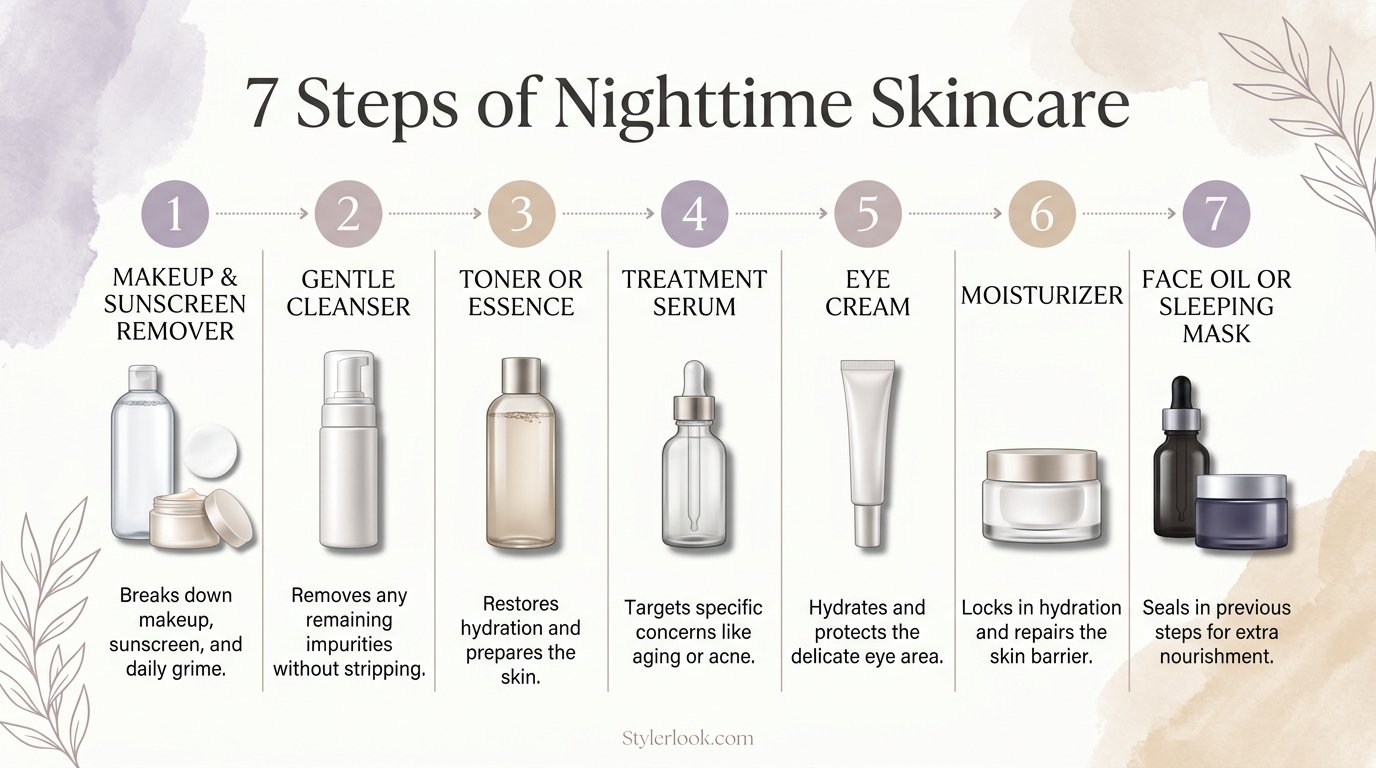
Short answer: cleanse, treat, moisturize, in that order. Everything else in the nighttime order is an optional slot fitted around those three load-bearing steps, which are also the floor the dermatology sources themselves publish.
The full version runs to seven slots. Makeup and sunscreen removal where needed, cleanser, toner or essence, a treatment, eye cream, moisturizer, and a face oil, sleeping mask or occlusive layer for those who use one.
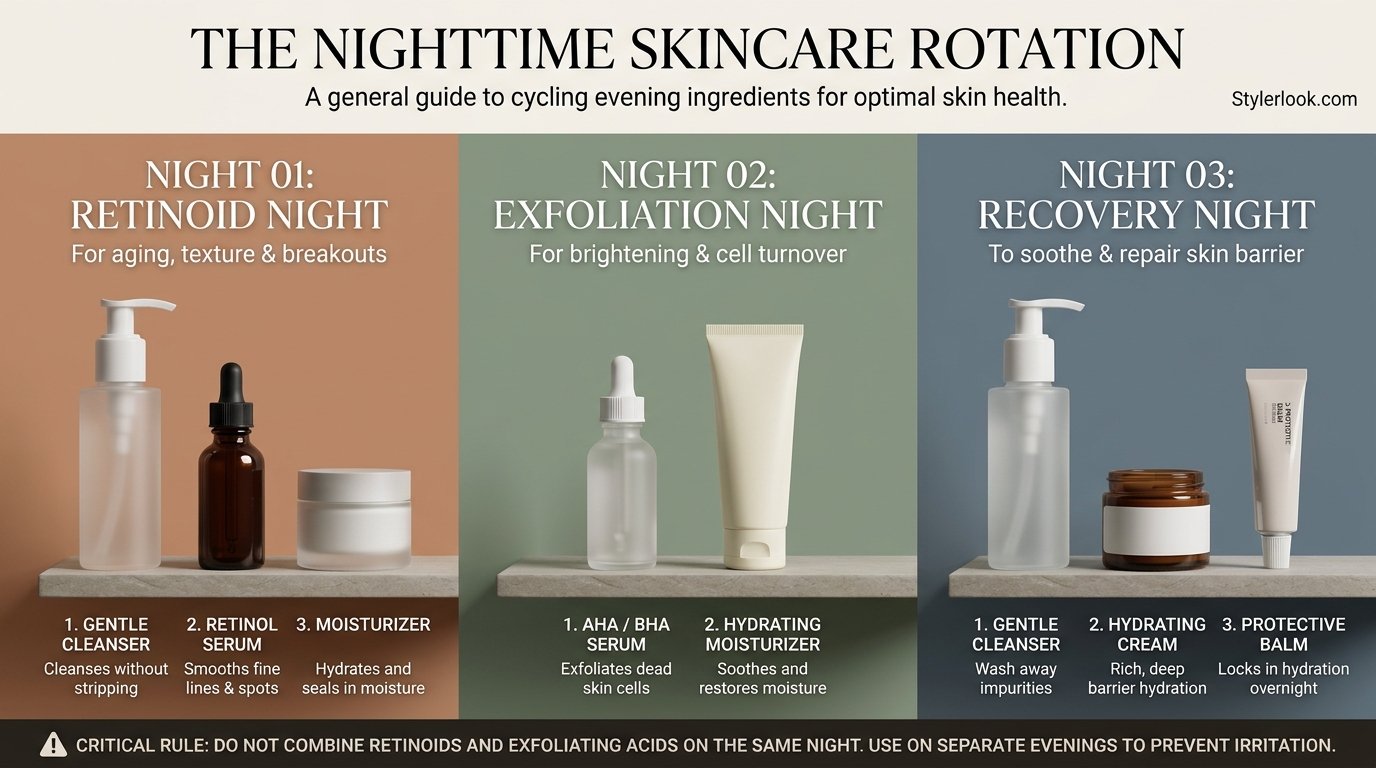
Only the treatment slot rotates. One night it holds a retinoid, another night an exfoliating acid, and on recovery nights it holds nothing at all. The slots around it stay fixed, which is what makes the order learnable.
Why the Night Order Is Not the Morning Order
Morning order ends at an anchor: sunscreen. Sunscreen must sit last over everything, which fixes the final slot and pushes treatments into thinner layers beneath it. Night removes that anchor, and the whole sequence reshuffles around the gap.
Treatments move up after dark. Retinoids are evening products in the clinical guidance because sunlight can deactivate them and raise irritation, a point the Cleveland Clinic guide to the correct order for skin care products states directly.
The treatment slot therefore sits early, right after cleansing, not buried under creams.
The skin itself behaves differently in the evening. A 1998 Journal of Investigative Dermatology study documented that transepidermal water loss and skin permeability run higher in the evening than in the morning. That rhythm, not a repair window, is the documented kernel under richer night moisturizers.
This page is the nighttime companion to our skincare routine order guide. That guide covers the shared order logic across both routines, while the morning-specific sequencing lives in our morning skincare routine for anti aging. Here, only the evening sequence and its disputes get the full treatment.
The Master Order Table
One table, with the disputes left visible. The master order below marks each slot as required, conditional or optional, and flags the five slots where credible sources publicly disagree instead of pretending the argument is settled.
|
Step |
Product class |
Status |
Dispute flag |
|---|---|---|---|
|
1 |
Makeup and sunscreen removal |
Conditional, only when worn |
Disputed: the double cleanse |
|
2 |
Cleanser |
Required |
None |
|
3 |
Toner or essence |
Optional |
Minor: often skipped on retinoid nights |
|
4 |
Treatment: retinoid or exfoliating acid, never both |
Required on active nights |
Disputed: retinol placement |
|
5 |
Eye cream |
Optional |
Disputed: placement and necessity |
|
6 |
Moisturizer |
Required |
None |
|
7 |
Face oil, sleeping mask or occlusive |
Optional |
Disputed: oil placement |
|
Floating |
Spot treatment |
As needed |
Disputed: three positions exist |
Required means the routine breaks without it. Cleanser and moisturizer appear in every credible version of the night order, from the shortest dermatologist floor to the longest blog routine. The treatment slot is required only on the nights an active is scheduled.
The Seven Slots, Step by Step
Slot 1: Makeup and Sunscreen Removal
This slot exists only when the day left something behind. Makeup and water-resistant sunscreen need an oil cleanser, balm or micellar first pass, because many ordinary cleansers do not lift them fully on their own. Bare skin skips straight to slot two.
Slot 2: Cleanser
The cleanser is the one step nobody disputes. Use a gentle, non-abrasive cleanser with lukewarm water and fingertips, at about a nickel-sized amount. Harsh scrubbing here raises the irritation price of every active applied afterward.
Slot 3: Toner or Essence
This is the hydrating slot, and it is optional. A toner or essence adds water-based hydration before treatment, and layered essence routines in our Korean skincare routine show how far the slot can stretch. On retinoid nights many routines drop it entirely.
Slot 4: The Treatment
One active per night holds this slot. A retinoid or an exfoliating acid, never both on the same night, is the rule every source in the research supports. Prescribed medication takes this same slot, applied right after cleansing unless its label directs otherwise.
Slot 5: Eye Cream
Eye cream sits here by texture, not by anatomy. Eye formulas are usually thinner than face moisturizer, so the thinnest-to-thickest rule parks them before it. The placement exceptions, including the balm flip and the skip-it position, get their own section below.
Slot 6: Moisturizer
Moisturizer is the seal the whole order points at. It locks in the treatment and the water-based layers beneath it and limits transepidermal water loss overnight. Dry skin routines, compared in our skincare routine for dry skin, simply run this slot richer rather than reordering it.
Slot 7: Face Oil, Sleeping Mask or Occlusive
The finish is optional and always last in the majority order. A face oil, sleeping mask or a thin occlusive layer sits over moisturizer to slow water loss through the night. Whether oil belongs here or one slot earlier is a live dispute, argued below.
The Authority Floor: Three Steps That Carry the Routine
The official orders are much shorter than the blog orders. The four steps in the American Academy of Dermatology guidance on product order run wash the face, apply medication or treatment right after cleansing, then moisturizer and/or sunscreen, then makeup if desired.
Toner, serum and eye cream never appear in it.
Cleveland Clinic trims the evening to three. The evening version in the Cleveland Clinic guide to the correct order for skin care products runs cleanser first, a retinoid or other retinoid product in the evening slot instead of a serum, and moisturizer last.
Its author usually recommends moisturizer over eye cream and treats most extra slots as optional.
A named dermatologist lands in the same place. The same skeleton shapes the nighttime routine published by dermatologist Heather Rogers, built on three goals, cleanse, treat and moisturize, with an occlusive balm allowed as an optional final layer on barrier-focused nights. Three independent authority sources, one shared skeleton.
The short floor is a complete routine, not a starter compromise. The seven-slot version adds comfort, hydration and targeting around that skeleton, and our basic skincare routine shows the floor assembled as a full routine. Extra slots must earn their place; the floor never has to.
The Five Disputed Slots at a Glance
Five slots carry flags because credible sources take different sides. The table states each position fairly and gives the verdict the full sections defend. Where a product label disagrees with every column, the label wins, a rule no source in the research disputes.
|
Slot |
Positions held |
Verdict |
|---|---|---|
|
Double cleanse |
Every night as routine, versus only after makeup or water-resistant sunscreen, versus harmful as a habit |
Removal is a conditional first cleanse, not a nightly ritual |
|
Eye cream |
Before moisturizer, versus after moisturizer, versus skip it entirely |
Texture decides: default before, thick balms flip, retinol eye products may buffer after |
|
Retinol |
Directly before moisturizer, versus buffered under moisturizer, versus sandwiched between moisturizer layers |
Before moisturizer on dry skin; buffering trades potency for tolerance |
|
Face oil |
Dead last, versus just before moisturizer |
No universal rule; the product directions decide, majority last |
|
Spot treatment |
Step two after cleansing, versus after serums before moisturizer, versus last |
Treatment-slot logic governs; the product label outranks every position |
Dispute One: Double Cleansing
The blog camp treats two cleanses as the default. An oil or balm pass dissolves makeup and sunscreen, then a water-based cleanser washes the skin itself. On days with makeup or water-resistant sunscreen, that sequence is genuinely useful and widely supported.
The loudest dissent comes from the most-cited authority. The Cleveland Clinic dermatologist behind the Cleveland Clinic guide to the correct order for skin care products states that double cleansing causes more harm than good and that cleansing once each time is enough.
Almost no ranking page repeats that sentence, although many cite the same page for other rules.
The verdict splits the claim, not the difference. A removal pass is a tool with a trigger condition: something on the skin that a single gentle cleanse leaves behind. Run nightly on bare skin, it only strips. Run when needed, it is simply slot one doing its job.
Dispute Two: Eye Cream and the Texture Rule
The majority position is before moisturizer. Most guides place eye cream after serums and before face moisturizer, reasoning from the thinnest-to-thickest rule: a light eye gel sealed under a heavier cream still reaches the skin, while the reverse order can block it.
Texture flips the answer, and that is the real rule. If the eye product is a thick balm and the face moisturizer is a light lotion, the moisturizer goes first and the balm seals on top.
The rule was never about eyes; it is about which of the two actual products is heavier.
Retinol eye products earn a second exception. For sensitive skin, a retinoid eye cream may sit after moisturizer, or sandwiched between two moisturizer layers, so the cream buffers contact. One major brand even instructs applying its eye product after moisturizer as the last step, against the majority rule.
The skip-it position deserves its sentence. Cleveland Clinic usually recommends a suitable moisturizer over a separate eye cream, to avoid further irritation around the eye. A reader whose moisturizer is fragrance free and tolerated near the eyes may already own everything this slot sells.
Dispute Three: Retinol, Buffering and the Sandwich Method
The standard position is retinol before moisturizer, on completely dry skin. Damp skin increases penetration and irritation, so the direct method waits until the face is fully dry after cleansing, applies a pea-sized amount, then seals with moisturizer. Cleveland Clinic and most order guides hold this line.
Buffering moves moisturizer underneath the retinoid. A layer of moisturizer goes on first and is left to settle, with one widely repeated strand putting that settle at 5 to 10 minutes, before the retinoid is applied over it.
The trade is explicit: somewhat slower absorption in exchange for less flaking and stinging.
The sandwich method adds the layer back on top. Moisturizer, then retinoid, then moisturizer again, which surrounds the active with buffer on both sides. It suits beginners and sensitive skin, and its known cost is heaviness: oily and breakout-prone routines often find the double seal too much.
Frequency belongs inside this dispute, not beside it. Starting patterns in the sources run from once a week for sensitive skin, through every other night as the standard ramp, up to two to four retinoid nights a week in rotation guides.
The full frequency table sits with the night-type section below.
One authority outranks every technique here. Prescription retinoid labels carry their own timing and dryness conditions, and where a label speaks, buffering folklore does not. The label story, including the fact that labels disagree with each other, is told in the wait-time section next.
Dispute Four: Face Oil
The majority order puts face oil dead last. Oil is occlusive, so anything layered over it is partly blocked, which is why most guides park it after moisturizer or use it in place of the final seal on dry nights.
Shangyii, Insider Beauty and Veloura all close the routine with it.
The authority outlier moves it one slot earlier. In it, the Cleveland Clinic guide to the correct order for skin care products advises applying a face oil right before moisturizer.
Its author does not recommend face oils at all unless the skin is dry, warning that their occlusiveness can feed breakouts.
The dissent is printed in almost no competing guide.
The honest verdict is that no universal oil rule exists. One rare page, the AllWomenStalk nighttime order guide written from dermatologist guidance, prints both positions and concludes that the directions on the product in hand decide.
Some oils are formulated as pre-moisturizer treatments and some as seals, and the bottle knows which.
Dispute Five: Spot Treatment
Cleveland Clinic gives spot treatment the earliest slot of all. In the Cleveland Clinic guide to the correct order for skin care products, salicylic acid or benzoyl peroxide spot treatments are step two, applied as needed right after cleansing and before everything else.
The logic is direct contact: a treatment under layers is a diluted treatment.
The blog consensus parks it much later. Most order guides place spot treatment after hydrating serums and before moisturizer, arguing that moisturizer applied first would dilute it and that a short settle of about a minute protects the layers beneath.
One derm-branded outlier places it after night cream instead.
The verdict follows the same hierarchy as retinol. A prescribed product follows its label. An over-the-counter spot treatment follows its own directions, and where directions are silent, the treatment slot right after cleansing is the position with the strongest authority behind it.
Breakout routines feel this dispute most. The step-by-step systems in our skincare routine for acne and its companion our skincare routine for acne prone skin both build around a treatment slot, and product-first guidance continues in our best skincare routine for acne guide.
Wherever the slot sits, one targeted treatment per night is the ceiling the sources share.
Wait Times: Strands, Not Rules
No honest single number exists for waiting between layers. The figures below contradict each other by an order of magnitude for the same transition, so they are printed as strands with sources attached. Anyone quoting one wait as the rule is quoting a preference.
|
Transition |
Figure |
Source |
|---|---|---|
|
Ordinary layers |
No wait needed; let a layer absorb, do not run a timer |
AllWomenStalk; Rael states the same in text |
|
Layer to layer, general |
30 to 60 seconds, until no longer wet or tacky |
Veloura Beauty; several layering guides |
|
After strong actives |
About 60 seconds |
Veloura Beauty FAQ |
|
Retinol to moisturizer |
1 to 2 minutes |
SkinGuardApp wait table strand |
|
Retinol to moisturizer |
3 to 5 minutes to settle |
lovedetour layering pages |
|
Retinol to moisturizer, sensitive skin |
10 to 20 minutes |
Lilach Bullock strand |
|
Washing to tretinoin |
Wait 20 to 30 minutes; skin completely dry |
FDA tretinoin label on DailyMed, official |
|
Washing to tretinoin, other labels |
Pat dry only, no timed wait |
Retin-A Micro, Atralin and Ziana labels |
Exactly one figure in the table carries an official source. In the official tretinoin cream label on DailyMed, the instruction runs washing first, then a wait of 20 to 30 minutes for the skin to dry completely before applying tretinoin, a condition aimed at irritation control.
It also doses the drug at about half an inch or less squeezed onto a fingertip.
Even the labels disagree with each other. That disagreement is documented in the Skinli comparison of tretinoin labels: the classic tretinoin cream, Retin-A and Renova leaflets carry the timed wait, while Retin-A Micro, Atralin and Ziana say only to pat the skin dry.
The official record is itself two strands, not one rule.
The no-wait end of the table is also sourced. At that end, the AllWomenStalk nighttime order guide written from dermatologist guidance states that a layer usually needs only to absorb, not to sit under a timer.
For its part, the Veloura Beauty routine order guide ties its 30 to 60 second pause to pilling prevention rather than absorption science.
Function, not chemistry, explains most short waits.
What the strands actually agree on is narrow. Skin must be fully dry before a retinoid, however long that takes a given face.
Beyond that single condition, waiting is a comfort and pilling tool, and the routine finished 20 to 30 minutes before sleep is a pillow-transfer strand, not a studied rule.
The Order by Night Type
One static order is the wrong unit; the week is the right one. Rotating the treatment slot across three night types keeps the sequence identical while the active changes. The three complete orders below are the same seven slots with different tenants.
|
Slot |
Retinoid night |
Exfoliation night |
Recovery night |
|---|---|---|---|
|
Removal |
Only if makeup or sunscreen worn |
Only if makeup or sunscreen worn |
Only if makeup or sunscreen worn |
|
Cleanser |
Gentle cleanser |
Gentle cleanser |
Gentle cleanser |
|
Toner or essence |
Optional, often skipped |
Optional hydrating layer |
Hydrating layer welcome |
|
Treatment |
Retinoid, on fully dry skin |
AHA or BHA exfoliant |
None |
|
Eye cream |
By texture rule |
By texture rule |
By texture rule |
|
Moisturizer |
Seal over the retinoid |
Seal over the acid |
Richest layer of the week |
|
Oil or occlusive |
Optional |
Optional |
The classic slugging night |
Skin cycling is this rotation with a brand name. Dermatologist Whitney Bowe’s framework repeats four nights: exfoliation, retinoid, recovery, recovery.
One caveat travels with the rotation, and the Dermatology Times review of skin cycling states it plainly: no published literature has tested that specific four-night sequence as a unit, however sensible its parts are.
Frequencies stay strands even inside the rotation. The rotation implies one retinoid night in four, while other sources run retinoids two to four nights a week or every other night after a ramp.
Sensitive starts go as low as once a week. All of them outrank any single schedule printed without a source.
|
Active |
Starting frequency in sources |
Ceiling in sources |
Source |
|---|---|---|---|
|
Retinoid, standard start |
Every other night |
Nightly as tolerated |
AAD guidance as relayed by AllWomenStalk |
|
Retinoid, rotation guides |
2 to 4 nights a week |
4 nights a week |
Insider Beauty rotation |
|
Retinoid, sensitive start |
Once a week |
Build slowly |
Veloura Beauty sensitive skin section |
|
Exfoliating acid |
1 to 2 nights a week |
3 nights a week maximum |
Range across Skin Stacker, Michele Green and Insider Beauty |
|
Retinoid inside skin cycling |
1 night in 4 |
Fixed by the framework |
Bowe framework via Dermatology Times |
The rotation numbers above are why the Insider Beauty nighttime routine steps guide matters. Its schedule, retinoid two to four nights and acid one to three, is the most concrete a ranking guide offers, and it is still one guide’s strand.
A routine is calibrated by tolerance over weeks, not adopted whole from any table.
Beginner Three Steps, Full Seven Steps, and Skipping Logic
Beginners start at the floor and stop there. Cleanser, one treatment introduced slowly or none at first, and moisturizer: the three-step version in our simple skincare routine is the authority floor wearing casual clothes.
Add one slot every few weeks, and only when the current version is boringly tolerated.
The full seven steps are a ceiling, not a target. Each optional slot must justify itself: removal when there is something to remove, essence when hydration is the gap, eye cream when the eye area needs its own formula, oil when water loss is the problem.
Slots without a job are decoration.
Skipping follows a fixed order of sacrifice. On a tired night, drop the optional finish first, then eye cream, then toner, and run cleanser, treatment if scheduled, and moisturizer. The routines in our skincare routine for combination skin keep that same skeleton while changing product weights by zone.
Two steps are load-bearing and never skipped. Cleansing and moisturizing appear in every credible order in the research, and a retinoid night without moisturizer is the classic beginner injury. Readers who want the sequence assembled for their own shelf can lay it out in our skincare routine builder.
Mistakes to Avoid in the Night Order
Most night-order damage is sequencing, not products. Each mistake below is a placement or pacing error that the sources flag repeatedly, and each one is fixable without buying anything new.
- Stacking a retinoid and an exfoliating acid on the same night. The separation rule is the closest thing this topic has to unanimity, and ignoring it is the fastest route to a stripped barrier.
- Applying retinol to damp skin. Water on the skin raises penetration and irritation, which is why every direct-method source insists on fully dry skin before the retinoid slot.
- Double cleansing bare skin out of habit. A removal pass with nothing to remove only strips, and the tight, stinging result is often misread as a product allergy.
- Burying the treatment under moisturizer and oil. Layers over an active dilute and block it; a treatment that seems to do nothing is often a treatment that never arrived.
- Changing three products in the same week. When irritation starts, an untestable routine gives no way to name the cause, and the whole shelf gets blamed for one slot.
- Doing the routine in bed. Finishing 20 to 30 minutes before sleep is a practical strand with plain logic: products belong on the face for the night, not transferred to the pillow in the first hour.
Frequently Asked Questions
1. What is the correct nighttime skincare routine order?
Cleanse, treat, moisturize is the spine. The full order runs removal when needed, cleanser, optional toner or essence, one treatment, eye cream, moisturizer, and an optional oil or occlusive finish.
Five slots are disputed, and the verdicts sit in the sections above.
2. How many steps should a nighttime routine have?
Three steps are the floor, seven the ceiling. Cleanser, treatment and moisturizer form the complete authority version, and removal, toner, eye cream and an occlusive finish are optional slots added only when each has a job.
3. What order do the AAD dermatologists give?
Four steps, and treatment comes second. The academy order is wash the face, apply medication or treatment right after cleansing, then moisturizer and/or sunscreen, then makeup if desired.
Toner, serum and eye cream do not appear in it.
4. What order does Cleveland Clinic give?
Cleanser, retinoid, moisturizer at night. The clinic order uses a serum in the morning slot and a retinoid instead of a serum in the evening, with moisturizer last in both.
Sunscreen closes only the morning version.
5. Do I need to double cleanse at night?
Only when there is something to remove. Makeup or water-resistant sunscreen justifies a removal pass before the cleanser.
On bare skin, one gentle cleanse is enough, and the Cleveland Clinic position is that habitual double cleansing causes more harm than good.
6. Where does toner go in a nighttime routine?
After cleansing, before treatment. Toner or essence is the optional hydrating slot between the cleanser and the active.
Many routines skip it on retinoid nights, and skipping it costs the order nothing structural.
7. Does exfoliation come before or after cleansing?
After cleansing, in the treatment slot. An exfoliating acid is the night’s active, so it sits where a retinoid would sit, on clean skin before moisturizer.
It never shares a night with a retinoid in any source in the research.
8. Should retinol go before or after moisturizer?
Before moisturizer, on completely dry skin. That is the standard direct method.
Buffering or sandwiching with moisturizer trades some potency for tolerance, and a prescription label overrides every version of the answer.
9. What is buffering a retinoid?
Moisturizer first, retinoid second. A layer of moisturizer is applied and left to settle before the retinoid goes over it, softening contact and reducing flaking and stinging.
One repeated strand gives that settle 5 to 10 minutes.
10. What is the sandwich method for retinol?
Moisturizer, retinoid, moisturizer. The active is layered between two moisturizer coats, which slows absorption and suits beginners and sensitive skin.
The cost is heaviness, which oily and breakout-prone routines often find too much.
11. Where does eye cream go at night?
Before moisturizer, by the texture rule. Eye formulas are usually thinner than face moisturizer, so they sit in the slot after serums.
A thick balm eye cream flips the order, and retinol eye products may sit after moisturizer as a buffer.
12. Do I actually need an eye cream?
Often, no. Cleveland Clinic usually recommends a suitable moisturizer over a separate eye cream, partly to avoid irritation around the eye.
A dedicated product earns its slot when the eye area needs a different formula from the face.
13. Does face oil go before or after moisturizer?
Most sources say last, and one authority disagrees. The majority park oil after moisturizer because it is occlusive, while Cleveland Clinic advises just before moisturizer and only for dry skin.
The directions on the product in hand settle it.
14. Where does spot treatment go in the order?
Authority puts it second, blogs put it later. Cleveland Clinic makes salicylic acid or benzoyl peroxide spot treatment step two, right after cleansing, while blog consensus places it after serums and before moisturizer.
A product label outranks both.
15. Does serum always go before moisturizer?
Yes, in every order in the research. Serums are water-based and thin, moisturizer is the seal, and the thinnest-to-thickest rule puts the seal last.
The live disputes concern treatments, eye cream and oil, never the serum and moisturizer pair.
16. How long should I wait between skincare layers at night?
There is no single sourced figure. Strands run from no wait at all, through 30 to 60 seconds for ordinary layers, to 10 to 20 minutes before moisturizer over retinol for sensitive skin.
Each figure belongs to its source, not to a rule.
17. How long should I wait before applying tretinoin?
The label figure is 20 to 30 minutes. The official tretinoin cream label instructs washing first, then waiting until the skin is completely dry before applying.
Other retinoid labels say only to pat dry, so the label you own governs.
18. What does the FDA label say about tretinoin timing?
Wash, wait, then apply. The label carried on DailyMed directs once-daily bedtime use, washing first, and a wait of 20 to 30 minutes for complete dryness to limit irritation.
It also doses about half an inch or less onto a fingertip.
19. How long before bed should I finish my routine?
A practical strand says 20 to 30 minutes. The reasoning is pillow transfer, not chemistry: products finished earlier stay on the face instead of the pillowcase.
No study in the research measures an ideal interval, so treat it as logistics.
20. What is skin cycling?
A four-night rotation of the treatment slot. Night one exfoliates, night two applies a retinoid, and nights three and four are recovery with hydration and barrier support only.
Dermatologist Whitney Bowe coined and popularized the framework.
21. Is skin cycling proven?
The specific sequence is untested. Dermatology Times states that no published literature has tested the four-night cycle as a unit.
Its parts rest on established principles, gradual retinoid titration and an exfoliation ceiling, but the rotation itself is a heuristic.
22. What happens on recovery nights?
The treatment slot stays empty. Recovery nights run cleanser, optional hydration, eye cream by the texture rule and a rich moisturizer, with oil or slugging as the classic finish.
No retinoid, no acid, nothing exfoliating.
23. Can I use retinol and an exfoliating acid on the same night?
No source in the research allows it. The separation rule is near-unanimous: one active per night, with retinoid nights and acid nights on different days.
Stacking them is the fastest documented route to irritation and a stripped barrier.
24. What order does a prescribed acne medication take?
The label outranks every chart. A prescribed medication normally takes the treatment slot, right after cleansing and before moisturizer, unless its own label directs otherwise.
Where a generic order and a label disagree, the label and the prescribing clinician win.
25. What is the nighttime order for oily skin?
The same order, with lighter weights. Oily routines keep all seven slots available but run gel textures, treat the oil finish as rarely needed, and often find the retinol sandwich too heavy.
Order stays fixed, and product weight is the variable.
26. What is the nighttime order for dry skin?
The same order, with the seal run richer. Dry routines keep the sequence and upgrade the moisturizer slot, welcome the hydrating essence, and use oil or an occlusive finish most nights.
The evening water-loss rhythm is the documented reason the richer seal helps.
27. What is the nighttime order for sensitive skin?
The floor, plus buffering. Sensitive routines start at cleanser, a slowly introduced treatment and moisturizer, use buffering or the sandwich method for retinoids, and begin actives at the lowest frequency strands.
New products arrive one at a time, weeks apart.
28. What is a good beginner nighttime routine order?
Cleanser, treatment, moisturizer. Begin at the three-step floor, introduce the treatment slowly or not at all in the first weeks, and add one optional slot at a time.
A routine that stays boring and tolerated is the correct beginner outcome.
29. Does skincare order actually matter?
Yes, at the points where physics applies. Treatments need direct contact with clean skin, seals work only over what they seal, and oil blocks what follows it.
Between two similar hydrating layers, order matters far less, which is why the floor is short.
30. What is the thinnest to thickest rule?
Layer by texture, thinnest first. Watery products go on before creamy ones so nothing thin is trapped under something occlusive.
The rule explains most slots, and its exceptions are functional: sunscreen last in the morning, oil placement by product design.
31. What happens if I apply moisturizer before serum?
The serum is partly blocked. Moisturizer is formulated to seal, so a water-based serum layered over it penetrates less evenly and can pill.
It is a wasted-product problem more than a safety problem, and the fix is simply reversing the pair.
32. Where does a sleeping mask go?
Last, in the finish slot. A sleeping mask is an occlusive-style final layer, so it replaces face oil at step seven, over moisturizer.
It belongs to any night type and is a classic recovery-night finish.
33. Where does slugging fit in the order?
At the very end, over everything. A thin occlusive layer seals the finished routine and is the heaviest form of the optional seventh slot.
Sources place it on barrier-focused and recovery nights.
34. Should I skip toner on retinoid nights?
Many routines do, and the order survives. Toner is an optional hydrating slot, and dropping it on retinoid nights simplifies the stack around a strong active, while keeping a gentle hydrating toner is also defensible.
The slot is preference, not structure.
35. Should retinol be used every night?
Not at the start, whatever the goal. Sources begin at once a week for sensitive skin or every other night as the standard ramp, building only as tolerated.
Nightly use is an endpoint some skin reaches, not a starting instruction.
36. How much retinol should I use?
A pea-sized amount for the whole face. Cleveland Clinic, Dermatology Times and Doctor Rogers all state the same measure, and the tretinoin label doses in similarly small terms.
More product raises irritation without raising benefit.
37. Can I use retinoids during pregnancy?
No, the sources are uniform. Guidance across the research set says retinoids are not used during pregnancy, and the academy position matches.
Anyone pregnant, trying to conceive or breastfeeding should ask their clinician about alternatives instead of adapting an order chart.
38. Why does the AAD order only have three steps?
Because it is written for medication, not collections. The academy order covers washing, treatment delivery and moisturizing, the steps with clinical consequences.
Toners, serums and eye creams are cosmetic slots that common practice fits between cleansing and moisturizer by texture.
39. What is different between morning and night order?
The anchor and the tenant change. Morning order ends with sunscreen, which fixes the last slot, and uses a serum in the treatment position.
Night drops sunscreen, moves retinoids into the treatment slot, and allows a heavier final seal.
40. Why do my products pill at night?
Layers are going on too wet or fighting textures. Pilling strands point to short pauses, with 30 to 60 seconds between layers as the repeated figure, and to silicone-heavy products rolled by the next layer.
Fewer layers and a brief settle usually end it.
41. When should I see a dermatologist about my routine?
When the problem outlasts the routine change. Persistent acne, eczema or rosacea, irritation that does not settle after stopping a product, pregnancy questions about retinoids, and any prescribed treatment all belong with a clinician.
General order guidance ends exactly there.
42. Should the nighttime order extend to the neck and chest?
Yes, with gentler pacing. The same sequence applies below the jaw, and the neck tolerates actives more slowly, so retinoids there start at lower frequency.
Cleanser and moisturizer extend fully, and treatments extend cautiously.
Conclusion
Nighttime skincare routine order is a floor plus a rotation. Three steps carry every version, cleanser, treatment and moisturizer, and the treatment slot rotates between retinoid nights, exfoliation nights and recovery nights while everything around it stays put.
The disputed slots all resolve the same way. Texture decides eye cream, dryness decides retinol placement, the trigger decides double cleansing, and the product label outranks every chart, including the verdicts printed on this page.
Wait times stay strands to the end. The only official figure belongs to one drug label, 20 to 30 minutes on completely dry skin, and even that label family disagrees with itself. Comfort and pilling, not chemistry, govern the rest.
Build the routine your tolerance can repeat. Start at the floor, add one slot at a time, and let weeks of calm skin promote each active. More guidance for every skin type sits at the StylerLook home page, where the routine library continues.
