
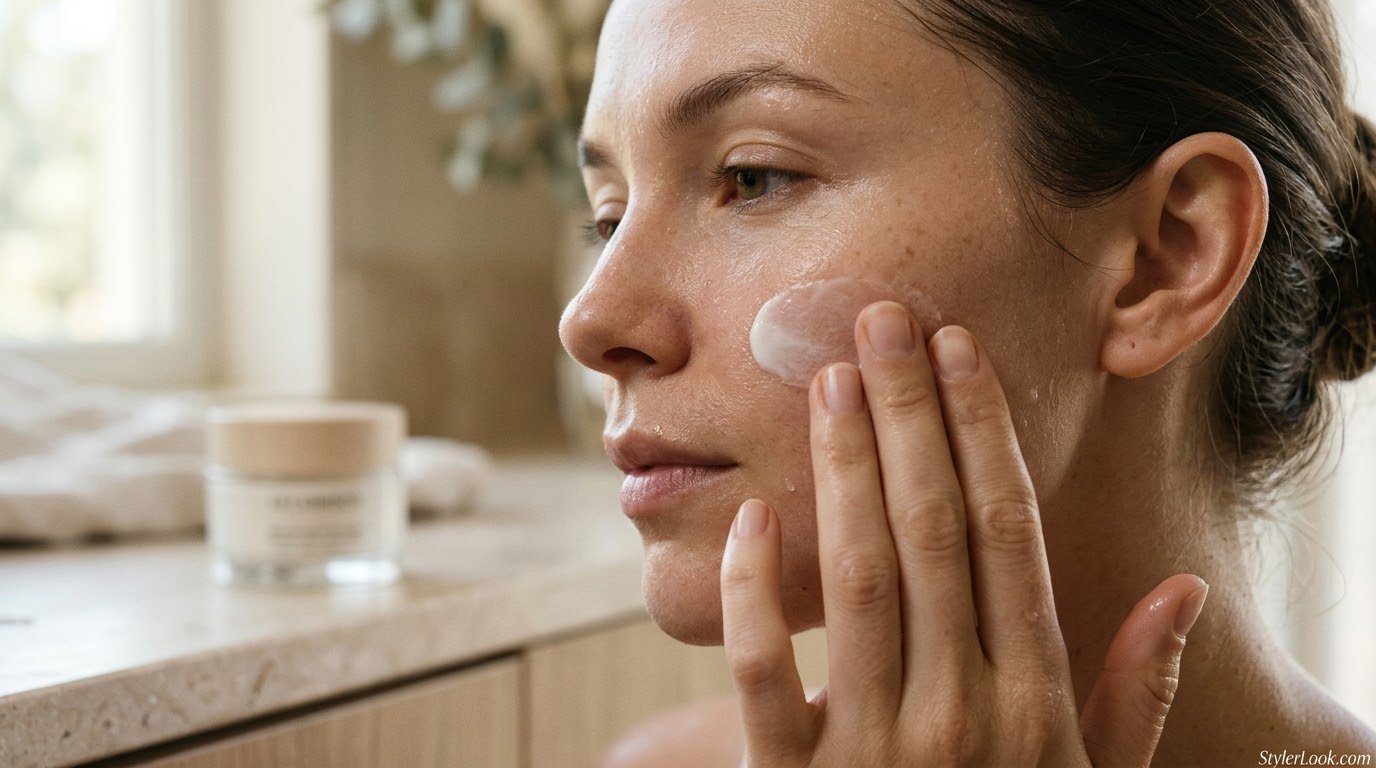
simple skincare routine advice collapses, in every serious source, to three steps: cleanse gently, moisturize, and protect with sunscreen.
The steps are not the hard part. The technique inside each step is where routines quietly fail.
The wider shelf lives at the StylerLook home page, and the basic skincare routine covers the starter mechanics in full.
This page owns a different job: why three is enough, how well each step must be done, and what to do when three stops working.
Every number below arrives labeled with its source. Where the field disagrees, the disagreement prints openly instead of being averaged away.
The Three Steps and the Two Exceptions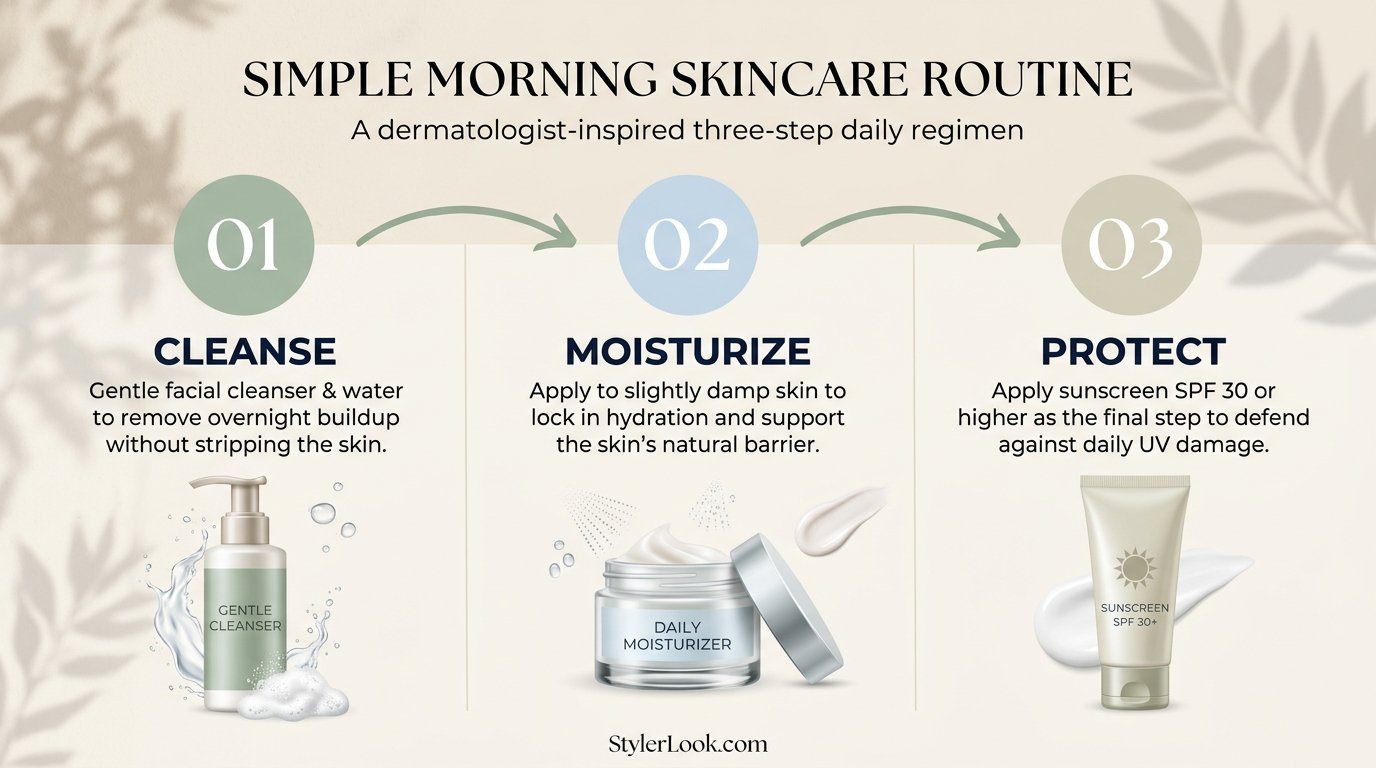
Three steps are complete because skin asks for three jobs. Remove the day, hold the water, and block the ultraviolet light.
The morning runs all three. The night runs two, because sunscreen has no night shift.
One analysis of product counts, the SkinStacker product count analysis, puts the optimum at 3 to 5 products, with irritation risk rising past 7 to 8.
Two exceptions keep the count honest. Makeup and heavy sunscreen nights may need a remover before the cleanser, and dry skin may rinse with water only in the morning.
Neither exception adds a daily step. They are situations, not shelf items, and treating them as products is how three becomes nine.
The Budget Math of Three Products
Three products carry the whole routine’s cost. One cleanser, one moisturizer, one sunscreen, replaced at the pace skin actually empties them.
The clinic position in the Cleveland Clinic everyday routine guide removes the upgrade pressure: effectiveness lives in ingredients and consistency, not in the price tier.
The expensive routine is the abandoned one. Ten products bought in January and dropped by March cost more per use than three finished jars.
Spend the savings on the sunscreen upgrade. If one product earns a premium, it is the one whose texture decides daily compliance.
The Count Evidence, Printed as a Position
The fewest products position is not folk wisdom. It comes from dermatology facing, daily, the people using the most products.
The SkinStacker analysis notes that the most reactive, sensitized patients dermatologists see are often the heaviest users. That observation belongs to subtraction, not sales.
The same analysis names the non negotiables plainly: a gentle cleanser, a moisturizer, and broad spectrum SPF 30 or higher, every morning.
Everything past those three is a targeted extra. Extras are legitimate, but each one must arrive with a named job.
Why Routines Grow: The Addition Without a Job
Routines grow by accumulation, never by design. A dull week adds a serum, a stressful month adds an acid, and nothing ever gets removed.
Each addition also adds a variable. When skin reacts, the suspect list is suddenly eight bottles long.
Simplicity is therefore a diagnostic tool. Three products mean a reaction has three suspects, and the answer arrives in days.
The chemist behind the Forari USA minimalist explainer makes the matching point: a shorter routine is easier to keep, and keeping it is the variable that matters.
Step 1 Done Right: Cleanse
Cleansing removes what the day deposited, nothing more. Dirt, oil, sunscreen, makeup, and city air leave; the skin barrier stays.
The technique card is short. Lukewarm water, fingertips only, 30 to 60 seconds of gentle contact in one guide’s strand, then pat dry.
The technique layer in the FacialRate basic routine guide is explicit: no scrubbing, no hot water, and no cleanser chosen for how tight it leaves skin.
Tight after washing is a warning, not a result. It means the wash took barrier lipids along with the dirt.
Choosing the Cleanser: Gentle Is a Specification
Gentle means the face feels calm afterward. Gel, cream, and low foam families all qualify when they rinse clean without squeaking.
The beginner guidance in the LG Beauty beginner guide specifies a gentle, nonmedicated cleanser, echoing the clinic sourcing it quotes. Medicated washes are treatments, and treatments wait for the addition rule.
Twice a day is the default, morning and night, and again after heavy sweating. More washing than that buys irritation, not cleanliness.
Skip the bar soap for the face. Its job is hands and body, and facial skin pays for the substitution in dryness and tightness.
The Morning Question: Wash or Rinse
Dry skin may rinse with water alone in the morning. Nothing but overnight oil sits on the face, and a full wash can cost more than it cleans.
Oily and acne prone skin usually keeps the morning wash. Overnight sebum is real, and the day’s sunscreen sits better on a clean base.
Sensitive skin decides by response, not by rule. Alternate for two weeks and let the stinging diary settle it.
The night cleanse is never optional. Sunscreen and the day must come off, or every later step works through a film.
Worked Example: A Week of Cleansing Done Right
Monday through Friday, the wash takes ninety seconds. Lukewarm water, a coin of cleanser, fingertips in slow circles, and a pat dry.
The weekend exposes the two failure modes. Saturday’s hot shower wash leaves the face tight until noon, and Sunday’s scrub brush experiment earns a week of stinging.
The lesson is mechanical, not moral. Temperature and friction are the variables, and both sit inside the same cheap cleanser that behaved all week.
Write your own version on the mirror card. Water lukewarm, hands only, one minute, pat. Four instructions replace a shelf of corrective products.
Step 2 Done Right: Moisturize
Moisturizer holds the water the skin already has. It is plumbing, not magic, and it runs after every cleanse, morning and night.
The timing detail matters most: apply it to skin that is still slightly damp. It spreads easier and traps the surface water instead of chasing it.
The damp rule appears in the FacialRate basic routine guide as its central correction, because most people wait until the face is fully dry and lose the benefit.
Texture is the only personal variable. Gel for oily skin, lotion for normal, cream for dry, one product chosen well, not three layered hopefully.
One Moisturizer, Not Three
One well formulated moisturizer does three jobs. Hydrate, support the barrier, and calm, which is why the count guides argue for singularity.
Layering two or three moisturizers usually signals a wrong texture, not a needy face. A dry face needs a richer single cream, not a committee.
The exception is honest: a thin lotion plus an occlusive on the driest nights is a deliberate technique, used knowingly, not a habit.
Read the label by ingredient family, not by front of pack claims. Ceramides, glycerin, and humectants first tell you what the jar actually does.
The Thirty Second Label Read
Turn the jar around and read the first five ingredients. Water, a humectant like glycerin, and an emollient near the top describe a working moisturizer.
Fragrance high on the list is information. On a leave on product it buys scent at the price of reaction risk, and sensitive skin should price it accordingly.
The front of pack is advertising; the back is the product. Glow, youth, and miracle are not ingredient families, and no regulator requires them to mean anything.
One jar, read once, lasts months. The label read is a one time skill that quietly upgrades every future purchase at this step.
Oily Skin Moisturizes Too
Skipping moisturizer is oily skin’s favorite mistake. The barrier still loses water, and the face answers a stripped surface with more visible shine by afternoon.
The fix is texture, not abstinence. A light gel or gel cream, labeled oil free and non comedogenic, gives water without weight.
Acne prone readers follow the same rule with label discipline. The treatment slot discipline of the best skincare routine for acne applies when breakouts enter the picture.
Step 3 Done Right: Protect
Sunscreen is the step with no substitute and no days off. Broad spectrum, SPF 30 or higher, every morning, last in the routine.
Its evidence dwarfs the other two steps. The clinic framing in the LG Beauty beginner guide ties the AAD’s sunscreen guidance to premature aging and skin cancer risk alike.
SPF 30 blocks about 97 percent of UVB in the standard explainer strand. Higher numbers add little, and none of them license a thinner layer.
Water resistant formulas matter when you will sweat or swim. The label term is regulated; the comfort term is not.
Finding a Sunscreen You Will Actually Wear
The best sunscreen is the one applied generously every morning. Texture preference is therefore a real specification, not vanity.
Mineral formulas sit on the surface and suit many sensitive faces, at the price of a possible white cast. Chemical formulas wear lighter and vanish faster.
Tinted options split the difference for many skin tones. The category matters less than the morning verdict: comfortable enough to use at full dose.
Decant a small tube for the bag. The reapplication rule only works when the product is physically present at hour two.
The Amount Problem: The Step Everyone Underdoes
Sunscreen is tested at 2 milligrams per square centimeter. That test dose is the quiet fact under every SPF number printed on a bottle.
Real application falls short, in strands that disagree. One guide reports most people apply a quarter to a half of the tested amount.
The same guide cites a Japanese survey finding about two thirds. Two strands, one conclusion: people under apply, so wear generously.
The two finger length for face and neck is the practical translation. When in doubt, the second coat over the first beats a higher number worn thin.
Reapply about every two hours outdoors in the common guidance, with one strand printing two to three. Swimming, sweating, and toweling reset the clock regardless.
Sunscreen Over Makeup: The Working Compromises
Reapplication over makeup is the rule’s hardest hour. The honest options are a second careful layer patted on, a sunscreen mist, or a powder with SPF as a top up.
Each compromise under delivers versus a fresh full coat. The guides know it, and the answer is ranking honesty, not pretending the powder equals the cream.
Plan the day around the strong version. Apply the full dose before makeup, and treat midday products as maintenance, not replacement.
Hats and shade are not old fashioned. They are the only reapplication method with no technique at all, and dermatology has recommended them all along.
Moisturizer With SPF: The Honest Verdict
A moisturizer with SPF is sunscreen applied at moisturizer amounts. The chemistry is fine; the dose fails, because nobody creams their face at test thickness.
As a cloudy day compromise it beats nothing. As the daily system it leaves the most important step underpowered by design.
Buy the two products separately. The moisturizer can be generous at night, and the sunscreen can be generous in the morning, each at its own dose.
The Morning Grid and the Night Grid
Morning is protection; night is removal and rest. The grids differ by one step and one purpose, which is why this routine survives busy lives.
|
Time |
Steps |
Job |
|---|---|---|
|
Morning |
Cleanse or rinse, moisturize, sunscreen |
Protect the day |
|
Night |
(Remover if needed), cleanse, moisturize |
Remove the day, hold water |
The whole routine takes about five minutes in the clinic strand’s framing: less time than the coffee beside it. Time was never the real obstacle.
Write the routine down in three lines. A written routine gets followed; a remembered routine gets renegotiated nightly.
The Clinic Variant, Printed as a Variant
One authority version runs four steps in the morning. The guide at the Cleveland Clinic everyday routine guide opens with cleanser, then an antioxidant cream or serum, then sunscreen.
Its night adds a vitamin A based final step: retinol, adapalene, tretinoin, or bakuchiol named as the family. That is a clinic’s prescription flavored version.
Print it as a variant, not a correction. The three step base stays the default, and the clinic’s extra steps are exactly the addition rule’s two slots, arrived early.
The same guide states the budget truth plainly: the products that help are not always the most expensive, a position this page adopts as its own.
The Judgment Timeline: When Three Steps Prove Themselves
Skin renews itself over roughly a month. Any fair judgment waits for at least one full cycle, and most guides ask for more.
One evidence explainer prints the line directly: give a routine eight weeks before judging anything. That is the working judgment date here.
Active ingredients run longer horizons. The clinic relay on vitamin C puts visible results at about three months of consistent use.
|
Horizon |
What it judges |
Source strand |
|---|---|---|
|
About 1 month |
One full skin renewal cycle |
Explainer consensus strand |
|
About 8 weeks |
The routine as a whole |
Evidence explainer strand |
|
About 3 months |
A single active, fairly |
Clinic relay strand |
Impatience is the routine killer. Products judged at day nine get replaced at day ten, and skin lives in permanent week one forever.
What Progress Actually Looks Like, Week by Week
Weeks one and two feel like nothing, and that is the first result. No stinging, no new tightness, and a face that stops announcing itself by midday.
Weeks three and four show texture quietly. Makeup sits smoother, the afternoon shine pattern stabilizes, and the morning mirror gets less interesting, which is the point.
Weeks five to eight are where the verdict forms. The routine is either invisible infrastructure by now, or one step has earned a complaint with six weeks of evidence behind it.
Photograph monthly, same light, same angle. Memory edits skin ruthlessly in both directions, and a plain photo is the only witness that does not flatter.
Consistency math beats intensity math. A simple routine done daily outperforms a grand routine done twice a week, in every guide that does the comparison.
The Reset: When Your Skin Needs Fewer Products, Not More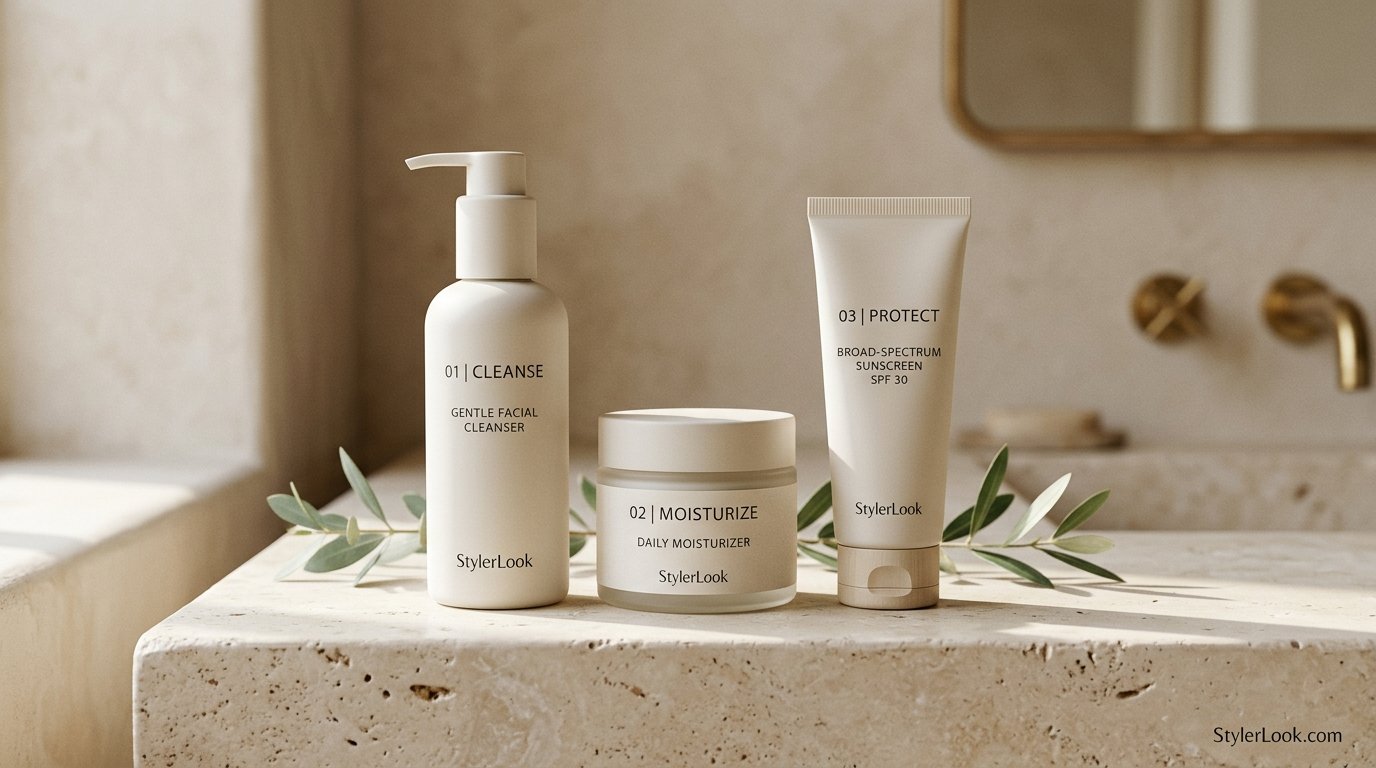
The reset is this page’s second product. Stinging, new breakouts, flaking, and a face that reacts to everything are its admission signs.
Cut back to the core three and hold. The count analysis prints the window: four to six weeks at cleanser, ceramide friendly moisturizer, and SPF.
Nothing returns during the window. Not the favorite serum, not the one gentle exception, because exceptions are how the shelf grew.
When the window ends calm, additions return one at a time, each with a two week watch. The first sting names its suspect immediately.
What to Cut First, and What Never Gets Cut
Cut treatments before basics. Acids, retinoids, scrubs, and fragranced extras leave in the first pass; the cleanser gets gentler, not gone.
Sunscreen never gets cut. It is the one step whose absence does cumulative harm, and the reset protects it even on irritated weeks with a gentler formula.
Fragrance leaves early in every reset account. It carries no skin job and a real share of reactions, the easiest subtraction in skincare.
Keep a one line daily note: products used, morning feel, evening feel. Six weeks of notes turns the next flare from mystery into record.
The Reset Shopping List: Three Products, Chosen Once
The reset buys nothing new at first. Use the gentlest versions already in the house: the mildest cleanser, the plainest moisturizer, any tolerable sunscreen.
Replace only what stings. A burning cleanser goes, a calm one stays, and the reset budget stays near zero by design.
Note the expiry dates while you sort. Ancient products join the cut pile for age alone, because a reset is also a shelf audit.
Three products remain on the counter. Everything else waits in a box, out of sight, because willpower is a worse organizer than distance.
Editing by Skin Type Without Adding Steps
Skin type edits textures, never the count. Three steps flex across every skin type in this table, and the step list does not move.
|
Skin type |
Cleanser edit |
Moisturizer edit |
Sunscreen note |
|---|---|---|---|
|
Oily |
Gentle foaming gel |
Gel or gel cream, oil free |
Fluid or gel finish |
|
Dry |
Cream or milk cleanser |
Rich cream, damp applied |
Cream formulas sit best |
|
Combination |
Gentle gel |
Lotion, richer on cheeks if needed |
Any comfortable finish |
|
Sensitive |
Fragrance free, minimal |
Barrier cream, few ingredients |
Mineral filters often tolerated |
|
Acne prone |
Gentle gel, non comedogenic |
Gel cream, non comedogenic |
Lightweight, non comedogenic |
Combination skin runs one routine, not two. A single gentle set, with moisturizer weighted to the dry zones, beats a split shelf.
Sensitive skin subtracts first. Fragrance free everything, the patch test before any face use, and stinging treated as data.
Men run the identical three, with shaving placed after the cleanse and before moisturizing. Teens run the same three with adult supervision on any active.
Older, drier skin keeps the count and enriches the seal. The routine’s shape survives every age; only the textures gray gracefully.
Seasons Change Textures, Not Steps
Winter asks for a richer seal and a gentler wash. Indoor heating dries the air, and the same three steps answer with cream where lotion stood.
Summer asks for lighter finishes. A gel moisturizer and a fluid sunscreen keep the morning bearable in humidity, count unchanged.
Travel compresses containers, never logic. The three travel at any size, and the weekly extras stay home without penalty.
Climate moves argue for texture swaps only. A routine that reorders itself every season is not adapting; it is starting over quarterly.
The One Addition Rule
Add nothing until one thing is owed. A stable base, a named concern, and eight calm weeks are the three entry requirements.
The legal slots are two. An antioxidant in the morning, vitamin C the usual candidate, or a retinoid at night, never both new at once.
The slot system extends the order logic of the skincare routine order guide: every addition lands in its one place, or it does not land at all.
Judge the addition alone for weeks. A second addition during the trial voids the experiment and restarts the clock.
The Patch Test, Done Properly
New products meet the forearm before the face. A small amount on the inner forearm, twice a day, is the protocol the technique guides carry.
The window runs four to five days in the association guidance relayed there. A reaction on the arm is a cheap lesson; the same lesson on the face costs a month.
Patch testing cannot catch everything. Slow irritation and clogging declare over weeks, which is why the patch test opens the trial instead of replacing it.
One product per trial, always. Testing two newcomers together rebuilds the suspect problem the whole routine exists to prevent.
Additions That Stay Optional Forever
Toner, essence, and sheet masks are pleasures, not duties. In the ten step world mapped by our Korean skincare routine they have real jobs; in a simple life they are gifts to self, kept or skipped freely.
Eye cream is the most optional product sold. A gentle moisturizer serves the area for most people, and the honest guides say so.
Exfoliation is the one weekly guest worth scheduling later: gentle, infrequent, and only once the base is boring. Boring is the base’s graduation certificate.
When additions multiply beyond one concern, the tool that assembles routines properly is the skincare routine builder, which sequences them instead of stacking them.
When Simple Is Not Enough
Some skin is a medical matter wearing a routine’s clothes. Scarring acne, spreading rashes, changing moles, and sores that do not heal belong to dermatologists.
Persistent pigmentation, rosacea patterns, and eczema likewise outrank any product. The guides agree: route the problem, do not purchase at it.
A simple routine still serves during treatment. It becomes the gentle base a clinician’s plan can build on, which is a role, not a failure.
Teaching the Routine: Three Lines on a Card
The routine survives households because it fits on a card. Wash gently, moisturize damp, sunscreen in the morning: three lines, teachable in one conversation.
A teen learns it in a week when the card lives on the mirror. A partner adopts it because nothing in it is gendered or fussy.
Guests and gifts follow the card too. A starter set given with the three lines lands as instruction, while the same box alone lands as homework.
Simplicity compounds socially. One routine, shared vocabulary, shared products in a pinch: the base becomes the household default, not one person’s hobby.
Frequently Asked Questions
1. What is a simple skincare routine?
A simple skincare routine is three steps: cleanse gently, moisturize, and protect. Broad spectrum SPF 30 or higher closes the morning, and the night drops the sunscreen and keeps the other two.
2. How many steps should a skincare routine have?
Three steps are the dermatology consensus core. A count analysis puts the optimum at 3 to 5 products total, with irritation risk rising past 7 to 8, so three is the floor, not a compromise.
3. What are the three basic skincare steps?
The three steps are a gentle cleanser, a moisturizer, and a broad spectrum sunscreen. The cleanser removes the day, the moisturizer holds water, and the sunscreen blocks ultraviolet damage every morning.
4. What order do I apply a simple skincare routine in?
Cleanse first, moisturize second, sunscreen last in the morning. At night the order is cleanse, then moisturize.
Nothing in the simple routine goes under the cleanser or over the sunscreen.
5. Do I need to wash my face in the morning?
Most skin benefits from a gentle morning wash, but dry skin may skip it. Oily and acne prone skin usually keeps the wash, because overnight sebum gives the day a greasy head start.
6. Can I just rinse with water in the morning?
Yes, dry skin can rinse with water alone in the morning. Nothing but overnight oil sits on the face, and skipping the cleanser protects a dry barrier.
The night cleanse stays non negotiable.
7. How long should I cleanse my face?
About 30 to 60 seconds of gentle contact is one guide’s strand. Fingertips, lukewarm water, no scrubbing.
The point is full coverage without friction, not a stopwatch performance.
8. What water temperature is best for washing my face?
Lukewarm water is the standard. Hot water strips barrier lipids and leaves skin tight and reactive, while cold water does not close pores, whatever the shelf talk claims.
9. Is bar soap okay for washing my face?
No, bar soap is built for hands and body, not faces. Facial skin pays for it in dryness and tightness.
A gentle facial cleanser costs little more and treats the barrier properly.
10. Why does my face feel tight after cleansing?
Tightness after washing is a warning, not proof of cleanliness. It means the cleanser took barrier lipids with the dirt.
Switch to a gentler formula and moisturize while skin is still damp.
11. Should I moisturize while my skin is still damp?
Yes, moisturize while skin is still slightly damp. The cream spreads easier and traps surface water instead of chasing it, which is the single easiest technique upgrade in the whole routine.
12. Does oily skin need moisturizer?
Yes, oily skin loses water like every other skin type. Skipping moisturizer leaves a stripped surface that often looks shinier by afternoon.
A light gel or gel cream gives water without weight.
13. What is the difference between a gel, lotion, and cream moisturizer?
Gel is the lightest, lotion sits in the middle, and cream is the richest. Oily skin usually takes gel, normal skin lotion, and dry skin cream, one product chosen by texture.
14. How much sunscreen should I apply to my face?
Sunscreen is tested at 2 milligrams per square centimeter. The practical translation is about a two finger length for face and neck.
Most people under apply, so a generous hand matters more than a higher number.
15. Can a moisturizer with SPF replace sunscreen?
Only as a compromise, not as the daily system. A moisturizer with SPF is sunscreen worn at moisturizer amounts, and the dose fails.
Separate products let each one be applied at its proper thickness.
16. How often should I reapply sunscreen?
About every two hours outdoors in the common guidance. One strand prints two to three hours.
Swimming, sweating, and toweling reset the clock immediately, whatever the schedule says.
17. Is SPF 30 enough for daily use?
Yes, SPF 30 is the dermatology floor for daily use. It blocks about 97 percent of UVB in the standard strand.
Higher numbers add little and never license a thinner layer.
18. Do I need sunscreen on cloudy days or indoors?
Cloudy days still deliver ultraviolet light, and the guides keep the step daily. Indoors away from windows is the one low exposure case, and even then the habit costs thirty seconds to keep.
19. What does a simple night routine look like?
The night routine is two steps: cleanse, then moisturize. Add a remover first only on makeup or heavy sunscreen nights.
There is no sunscreen step, and no treatment is required.
20. Do I need to double cleanse in a simple routine?
Only on makeup or heavy sunscreen nights. A remover or oil based first step lifts what a gentle cleanser struggles with.
On bare skin nights, one gentle cleanse does the whole job.
21. Do I need a toner in a simple skincare routine?
No, toner is optional in a simple routine. Modern gentle cleansers do not need a corrective second step.
A hydrating toner is a pleasure addition, not a missing duty.
22. Do I need a serum in a simple skincare routine?
No, a serum is an addition, not a foundation. It enters later, one concern at a time, through the addition rule: an antioxidant in the morning slot or a retinoid in the night slot.
23. Is eye cream necessary?
No, eye cream is the most optional product in skincare. A gentle moisturizer serves the eye area for most people.
Keep eye cream only where that area runs notably dry.
24. Can I exfoliate in a simple routine?
Yes, later and weekly, never at the start. A gentle exfoliant joins once the three step base is stable and boring, used infrequently.
Daily exfoliation is how simple routines stop being gentle.
25. How long does a simple routine take to work?
Judge the routine at about eight weeks. Skin renews over roughly a month, so one cycle is the minimum, and a fair verdict on the whole system takes two.
26. How long should I test a new product before judging it?
Give a new product weeks, not days, and change one thing at a time. A product judged at day nine was never tested.
Two weeks catches reactions, and the full judgment window catches results.
27. What is the one product I should add first?
Add the product that matches your one named concern. Most people start with a morning antioxidant such as vitamin C, or a night retinoid, never both new in the same month.
28. Where does vitamin C fit in a simple routine?
Vitamin C sits in the morning, after cleansing and before moisturizer and sunscreen. It is the antioxidant slot, and clinic relay puts its visible results at about three months of consistent use.
29. Where does retinol fit in a simple routine?
Retinol sits at night, after cleansing and before or under moisturizer. Retinoids are the night slot because of sun sensitivity, and they start a few nights a week rather than nightly.
30. Can I use vitamin C and retinol in the same routine?
Yes, separated by the clock, which is exactly how the slots work. Vitamin C owns the morning and the retinoid owns the night.
Stacking both new at once is what the addition rule forbids.
31. What is a skincare reset and how long does it take?
A reset means cutting back to cleanser, moisturizer, and sunscreen, and holding. The count analysis prints a four to six week window.
Nothing returns early, then additions re enter one at a time.
32. How do I know if I am using too many products?
The signs are stinging, new breakouts, flaking, and a shelf past seven products. When every product has a rival suspect and your skin reacts to water, the routine itself is the problem.
33. Why is my skin getting worse on more products?
More products mean more variables and more ingredient conflicts. Dermatologists note the most reactive patients are often the heaviest users.
The barrier gets sanded by good intentions, one active at a time.
34. Can a simple routine help with acne?
A simple routine supports acne prone skin but does not treat significant acne. Gentle cleansing, non comedogenic moisturizer, and daily sunscreen form the base, and persistent or scarring acne belongs with a dermatologist.
35. What is a simple skincare routine for sensitive skin?
Fragrance free everything, the fewest ingredients, and patch testing before face use. Sensitive skin runs the same three steps with gentler textures, and treats stinging as a stop signal, not a working sign.
36. What is a simple skincare routine for men?
Men run the identical three steps. Cleanse, moisturize, and sunscreen in the morning, with shaving placed after the cleanse.
The routine takes about five minutes, and no separate men’s system is required.
37. What is a simple skincare routine for teens?
Teens run the same three steps with gentle, non comedogenic products. No actives without a reason and adult awareness, and persistent breakouts go to a dermatologist rather than to a stronger shelf.
38. How do I patch test a new skincare product?
Test a small amount on the inner forearm, twice a day, for four to five days. That protocol comes from association guidance relayed by a technique guide.
No reaction there earns a cautious face trial.
39. What does it mean if a product stings?
Stinging means the product and your barrier are in conflict. Occasional brief tingling from an active is one thing; stinging from a cleanser or moisturizer means stop, simplify, and let the reset do its work.
40. Is an expensive moisturizer better than a cheap one?
No, price is not a quality signal in skincare. A named Cleveland Clinic dermatologist makes the point directly: the products that help are not always the most expensive ones on the shelf.
41. Can a simple routine work on a tight budget?
Yes, three drugstore friendly categories are the whole spend. A gentle cleanser, a moisturizer, and a sunscreen, bought once and replaced slowly.
The expensive routine is the one abandoned by week two.
42. When should I see a dermatologist instead of adding products?
See a dermatologist for scarring acne, spreading rashes, changing moles, or sores that do not heal. Persistent pigmentation, rosacea patterns, and eczema also outrank products.
Route the problem instead of purchasing at it.
Conclusion
Three steps are not a starter version of a real routine. They are the routine, done at full quality: a gentle cleanse with the right temperature and touch, a moisturizer landed on damp skin, and sunscreen worn at an honest thickness every single morning.
Keep the simple skincare routine written in three lines, judge it at eight weeks, and let the reset be your answer when a shelf starts arguing with your face.
Add only when one concern is genuinely owed a product, one slot at a time, and let the StylerLook home page hold the wider shelf for the day a second concern earns its plac
