
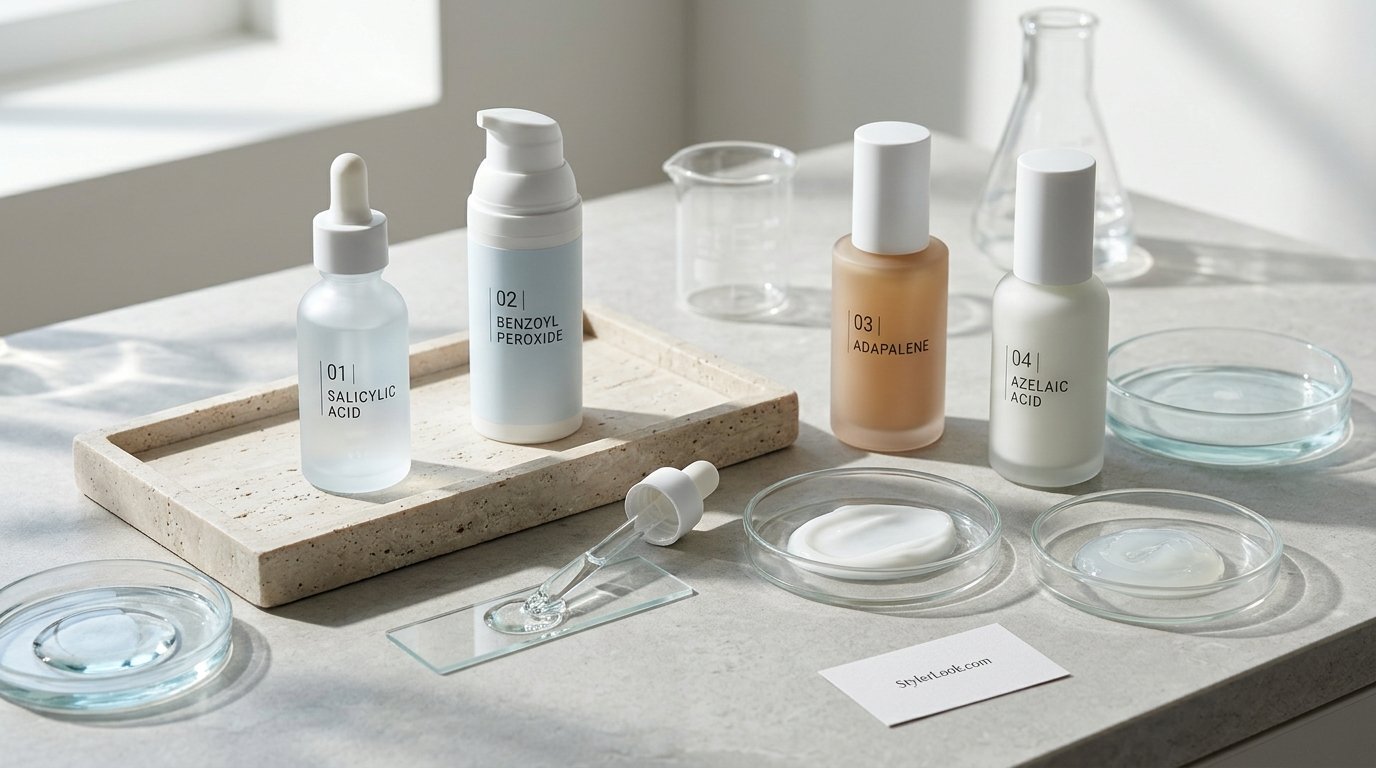
Skincare routine for acne works best when it is built like a system instead of a shopping list: four steps, one treatment active, chosen for the kind of breakouts you actually get, and judged over weeks rather than days.
Most failed acne routines fail for the same two reasons. The active does not match the acne type, or five actives start at once, irritate everything, and get abandoned before any of them had time to work.
Everything here is general information, drawn from dermatology guidance and the guideline itself, not personal treatment advice. Acne is a medical condition; deep, painful, scarring, or persistent acne belongs with a dermatologist, and this article will keep pointing there.
Start With Your Acne Type
Before any product, sort the breakouts. The screened guide in the research puts its type table at the front door, and it is the right design, because the correct first active follows from the type:
|
What You See |
Type |
First Line Direction in the Guides |
|---|---|---|
|
Blackheads, whiteheads, small skin colored bumps |
Comedonal, clogged pore |
Adapalene at night, or salicylic acid |
|
Red, sore, or pus filled spots |
Inflammatory |
Benzoyl peroxide, wash or 2.5 to 5 percent leave on |
|
A mix of both |
Mixed |
Benzoyl peroxide in the morning, adapalene at night, added one at a time |
|
Deep, painful lumps, or breakouts that scar |
Nodular or cystic |
A dermatologist; prescription treatment works best |
The full matching table, with its escalation row intact, is laid out in the GlowKitDrop acne prone routine guide, whose screened format this page follows in spirit.
Most home routines are mixed once you look honestly: some clogged pores on the forehead, some inflamed spots on the chin. That is why the morning and night split exists, and why the sequencing rule below matters more than any single product.
When in doubt between two rows, start with the row that describes most of your breakouts, and let the first judging window tell you whether the sort was right.
The Four Steps: Cleanse, Treat, Moisturize, Protect
Dermatology guidance converges on four steps, totally, across the independent guides in this research: cleanse, treat, moisturize, protect.
In the DetoxOz acne prone skin care guide, the framework is stated directly, with the honest caveat that it is a general planning framework, not an individualized prescription.
Cleanse gently, up to twice daily and after sweating, with fingertips and a non abrasive cleanser, the AAD pattern the guides repeat. Rough washcloths, brushes, and scrubbing are not a step; they are an injury with good marketing.
Treat is the one active slot, matched to type above. Everything this article says about ingredients exists to fill this single slot well, first in the morning or at night depending on the active.
Moisturize with a lightweight non comedogenic formula, even on oily skin. This step is a treatment partner, not a cosmetic extra, for reasons the tolerability section covers.
Protect every morning with broad spectrum SPF 30 or higher. Acne treatments raise sun sensitivity, and post acne marks darken with exposure; this step defends both the skin and the results.
What the Guideline Actually Recommends
This topic has something most skincare topics lack: a current, named guideline. The 2024 American Academy of Dermatology guideline for acne management (Reynolds and colleagues, in the Academy’s journal) grades the topical options, and the grades organize everything:
|
Ingredient |
AAD 2024 Grade (as reported) |
Practical Notes From the Guides |
|---|---|---|
|
Benzoyl peroxide |
Strong recommendation |
Targets bacteria and inflammation; can dry, irritate, and bleach fabric |
|
Topical retinoids (adapalene and others) |
Strong recommendation |
Address clogged pores; can dry and raise sun sensitivity |
|
Salicylic acid |
Conditional recommendation |
Exfoliates inside the pore; common in cleansers and leave ons |
|
Azelaic acid |
Conditional recommendation |
An option that also speaks to post acne pigmentation |
Grades are not rankings of worth; they are strength of evidence and consensus. A conditional ingredient matched to your type will outperform a strong ingredient matched to someone else’s.
Strong does not mean start strong, either. The guides consistently begin the strong pair at their gentlest effective settings, which is where the next sections spend their time.
Benzoyl Peroxide: The Inflammatory Specialist
Benzoyl peroxide is the inflammatory acne specialist: it targets the bacteria and inflammation behind red, sore, pus filled spots, and it comes in two delivery styles, a wash used in the shower or at the sink, and a leave on gel or cream.
The most useful number in this topic belongs to it. Two independent guides state that 2.5 percent works about as well as 5 or 10 percent for inflamed acne, with less irritation.
Held as their strand, it still teaches the right instinct: start at the low setting of the strong tool.
The wash format deserves its reputation among the sensitive: contact time at the sink, then rinsed away, trades a little exposure for a lot of tolerability, and it is how many routines keep benzoyl peroxide in the system for years.
Logistics, honestly: it bleaches towels, pillowcases, and collars. Use white linens on benzoyl peroxide nights, or dedicate a set you do not mind fading, and let leave ons dry before fabric touches them.
Adapalene and the Retinoids: The Pore Specialists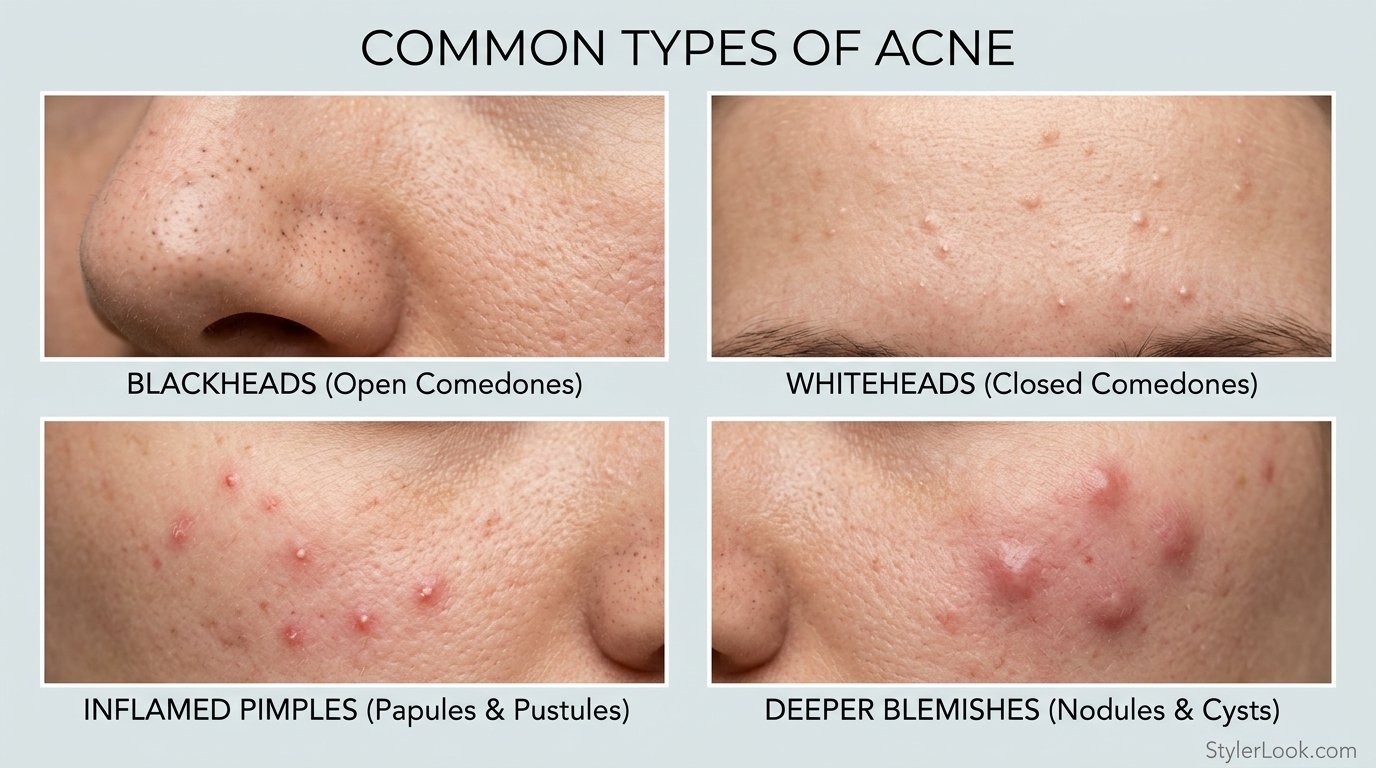
Topical retinoids are the pore specialists: they address the clogged pores that become comedones and, given time, help prevent new ones, which is why they anchor the comedonal and mixed rows of the type table.
Adapalene 0.1 percent is the over the counter member in the United States, available for adults and children 12 years and older per the guideline summaries, and the most studied topical retinoid for acne in the guides’ phrasing.
Use follows a pattern everywhere it appears: at night, on dry skin, a pea sized amount for the whole face. More is not faster; more is a rash with a receipt. Moisturizer goes after it, or before it for sensitive skin.
The safety note travels with it, printed in the guides wherever the ramp is described: topical retinoids are not for use in pregnancy. Anyone pregnant, planning, or unsure should take the whole retinoid question to their clinician instead.
The Conditional Pair: Salicylic Acid and Azelaic Acid
Salicylic acid works inside the pore, loosening the dead skin that plugs it, which makes it the natural match for blackheads and whiteheads. It lives comfortably in cleansers (the research’s strands run 0.5 to 2 percent) and in leave on formulas.
Azelaic acid holds the conditional grade with a second job: the guides place it among recommended acne options and reach for it again when post acne pigmentation is part of the picture, which makes it the bridge ingredient between the breakout system and the marks system below.
Conditional does not mean weak tea. It means the evidence and consensus support them in the right situations, and for comedonal skin and marks prone skin those situations are common.
What the conditional pair should not do is stack casually on top of the strong pair from day one. That is a sequencing failure, and it has its own section.
The Morning Routine: Protect and Prevent
Morning is the light shift: remove the night, optionally treat, moisturize, and above all protect.
Morning order:
- Cleanse gently, or with a benzoyl peroxide wash on inflammatory routines.
- Treat (optional) with the morning active where the plan calls for one, azelaic acid or benzoyl peroxide in the mixed split.
- Moisturize light and non comedogenic.
- Protect with broad spectrum SPF 30+, the full intended amount.
The general layering logic, thin to thick with sunscreen last, is the same discipline detailed in our skincare routine order guide, which this page leans on rather than repeats.
Tinted sunscreens earn a specific mention for marks prone readers: one guide suggests tinted formulas with iron oxides when dark marks are a concern, a small upgrade with a real rationale.
The Evening Routine: Treat and Repair
Evening is where the main treatment lives, because retinoids are night workers and because the day needs removing first.
Evening order:
- Cleanse thoroughly and gently, sunscreen and makeup fully off, no scrubbing.
- Treat with the night’s active on dry skin, adapalene for the retinoid routines.
- Moisturize after it, or before it when skin is sensitive and buffering.
Two or three treatment nights a week is a legitimate starting schedule, not a compromise. The guides’ beginner ramps all begin there and build only as tolerance allows, a pattern the next section formalizes.
Starting Adapalene: The Ramp and the Pea Sized Rule
Starting a retinoid, step by step:
- Week one and two: two nights a week, pea sized amount, on fully dry skin, moisturizer after.
- Week three and four: three nights if the first fortnight was calm, no stinging that lingers, no flaking that spreads.
- Thereafter: add a night at a time toward nightly or every other night, stopping at the frequency your skin treats as boring.
Dry skin application is not folklore: applying to damp skin increases penetration and irritation for many people, which is why the guides specify dry skin in their instructions.
Expect the adjustment period to include some dryness and possibly a rough few weeks of breakouts as pores clear out. The purge question gets its own decision guide below, because it decides whether people quit exactly when they should not.
One Active at a Time: The Sequencing Rule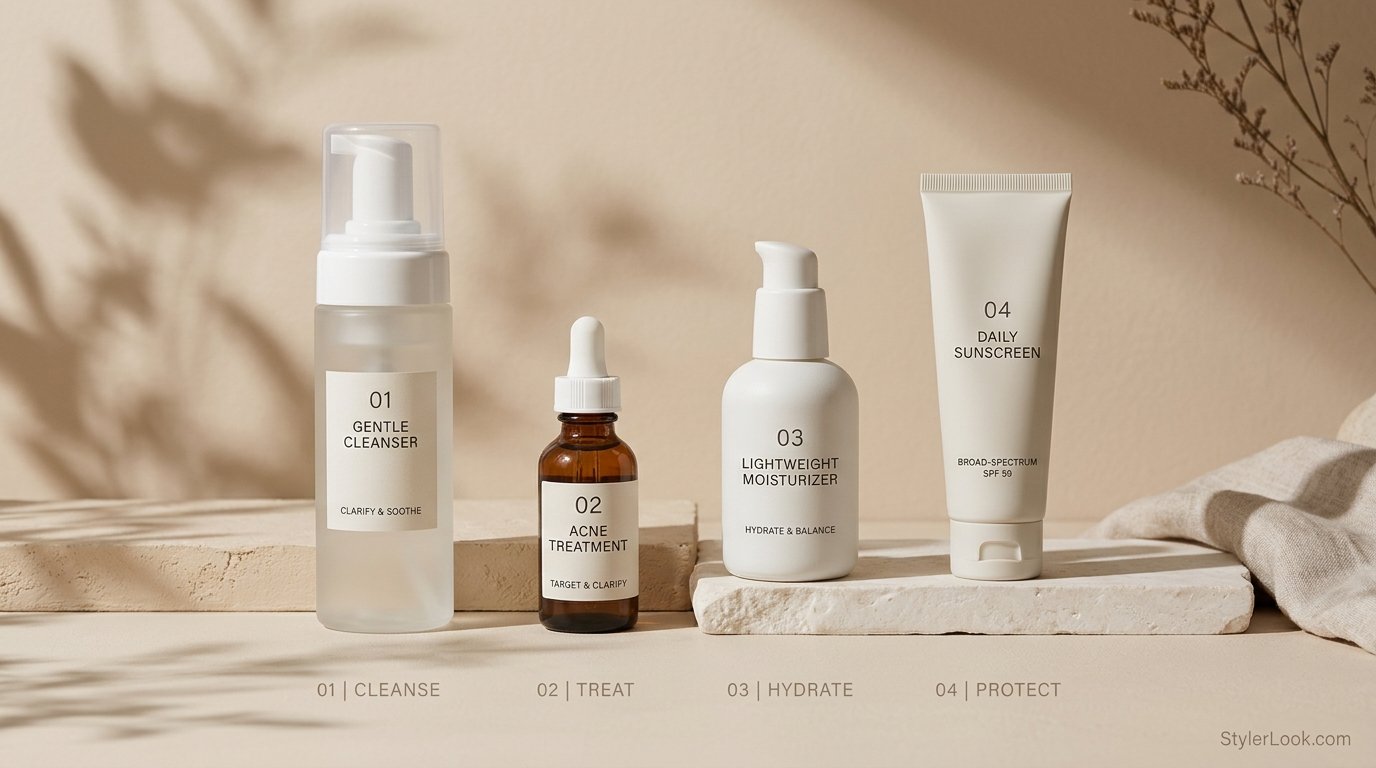
If one rule protects this entire system, it is this: introduce one new active at a time. The guideline faithful guide gives the reasoning in one breath: starting several at once makes irritation likely, and if the skin reacts, you cannot tell which product caused it.
The branching guide in the research makes the same point by listing the temptation: you do not need salicylic acid, glycolic acid, adapalene, benzoyl peroxide, and azelaic acid simultaneously, however logical each one sounds in its own tab.
Sequence by priority instead: the type matched active first, given its judging window, then the second active for mixed acne added in the opposite half of the day, then any supporting extras. Each addition is a small experiment with one variable.
This is also why the minimal base matters. The whole discipline of launching from a calm, known base is the subject of our simple skincare routine, and acne routines are its strictest application.
Tolerability: Dryness, Buffering, and the Purge Question
Dryness, tightness, and light flaking are the expected tax of the strong actives, and the routine’s answer is structural, not heroic: moisturizer used faithfully, frequencies adjusted down without shame, and buffering where needed.
Buffering means applying moisturizer before the retinoid on sensitive skin, a technique named in more than one guide. Like the sandwich in other routines, it trades a degree of intensity for a routine that survives contact with real skin.
The purge question deserves a careful frame. Breakouts can temporarily worsen as a retinoid speeds up the cycle of clogged pores surfacing; that pattern settles within the judging window.
Burning, spreading redness, swelling, or rash is a different signal entirely: that is a reaction, and the answer is to stop the new product and let the skin settle.
When the line between the two is unclear, the conservative move wins: pause, return to the gentle base, and let a clinician sort persistent or worrying reactions. General information can describe patterns; it cannot examine your face.
Moisturizer Is a Treatment Partner
The oily skin objection dissolves under one guideline note, repeated by the branching guide: the AAD observes that moisturizer can help people tolerate drying acne treatments, including benzoyl peroxide, salicylic acid, and topical retinoids.
That reframes the step completely. Moisturizer is not competing with the treatment; it is what allows the treatment to be used consistently enough to work. Skipping it to feel less greasy is how routines become too harsh to keep.
Choose by texture and label: lightweight gel or fluid formulas, non comedogenic, fragrance free where possible, with barrier friendly ingredients like ceramides and glycerin named in the builders’ checklists.
Sunscreen, Marks, and Photosensitivity
Two facts put sunscreen inside an acne routine rather than beside it. Several acne treatments increase photosensitivity, and post inflammatory dark marks darken with sun exposure, undoing months of fading in a few unprotected weeks.
The marks focused guide in the research, the Glow Theory acne routine and dark spot guide, builds its whole second half on that connection: breakouts controlled, sunscreen daily, and fading ingredients doing slow work on the marks that remain.
Judge your sunscreen like a treatment product: broad spectrum, SPF 30 or higher, in a texture you will actually wear daily over moisturizer. The best acne sunscreen is the one that survives your mornings.
Dark Marks After Acne: The Fading System
Dark marks are not scars and not active acne; they are pigment left where inflammation was, and they follow their own timeline. One guide’s strand puts usual fading at 6 to 12 months once breakouts stop, which is why the first step of fading is stopping new breakouts.
The system is three verbs: stop (the type matched routine prevents new marks), shield (daily sunscreen, tinted with iron oxides if marks are the priority), and fade (azelaic acid or the retinoid already in the system doing gradual work).
What the system is not: aggressive exfoliation layered on top of treatments in the hope of speed. On marks prone, reactive skin, that path commonly trades pigment for irritation, and irritation makes pigment.
True scars, the pitted or raised kind, are a different category with a different address: they do not respond meaningfully to shelf products, and they are one of the clearest reasons on the escalation list below.
How Long to Judge: Weeks, Not Days
The judging windows in the research do not agree, and this article prints them as the range they are.
One screened guide says judge consistency at 4 to 6 weeks, another says give a routine 6 to 12 weeks, and a third sets judgment at 8 to 12 weeks.
The shared rule underneath the disagreement is unanimous: acne takes time to clear, changing treatments too often irritates skin and can itself cause breakouts, and weeks, not days is the unit of judgment.
Use the window actively: dated notes or photos every two weeks, the same light, and a simple count of new spots per week. The trend across the window decides; any single week is weather, not climate.
Sensitive Skin and Teen Starters
Sensitive skin runs the same system with the volume down: wash off benzoyl peroxide instead of leave on, buffered adapalene on fewer nights, the conditional pair favored early, and fragrance an early suspect when things misbehave.
Teen skin starts from the guideline’s own threshold: adapalene’s over the counter status begins at 12 years and older in the US summaries, and for younger teens the gentle base plus one matched active, with a parent aware of the plan, is the sane shape of a routine.
For both groups the escalation bar sits lower, not higher: acne that is deep, scarring, or affecting how a young person feels about themselves deserves professional help early, a point the screened guide makes explicitly.
After Clearing: The Maintenance Routine
Clearing is a phase change, not a finish line. The maintenance routine keeps the four steps and keeps a retinoid in the system at whatever frequency holds the result, because comedones reform quietly when prevention stops.
Moisturizer and sunscreen stay daily and unchanged; they were never acne specific, they are skin specific. The treatment slot simplifies rather than disappears.
Relapses are information, not failure: a returning pattern gets sorted against the type table again, because types drift with age, season, and hormones, and the routine re matches rather than merely intensifying.
Keep the diary running through maintenance, at a slower rhythm. A monthly photo and a line about any new pattern is enough to catch a drift early, while it is still a small adjustment instead of a new problem.
The Product Led Companion
This page is the system version of the topic: type first, grades second, products last. Its sibling on this site takes the complementary angle, the product led tour of the same ground.
Read our best skincare routine for acne alongside this system when you want the category by category product discussion, and use this page’s tables to audit whatever that tour suggests.
Both pages share the ceiling rule, and it bears repeating in both voices: the shelf has a limit, and past it the most effective product is an appointment.
When Acne Leaves the Shelf: Seeing a Dermatologist
The escalation triggers, gathered from across the guides, are clear enough to list: deep or painful lumps; acne that leaves scars or dark spots; acne not improving after a fair over the counter trial inside the judging windows; and acne that is affecting how you feel.
Bring the routine with you when you go: products, strengths, how long each ran, and the dated photos. A documented trial turns a first visit from guesswork into a second step, and clinicians consistently ask for exactly that history.
Prescription territory is real treatment, with options the shelf does not carry, and reaching it is the system working as designed. A routine that knows its ceiling is a feature of good care, not an admission of defeat.
Start the whole cluster from the guides gathered on our StylerLook home page, where the acne system, its product led companion, and the foundation routines sit together.
A Week on the Acne System
An established week is mostly repetition, with the treatment nights spaced like fence posts:
|
Day Part |
Daily Base |
Treatment Nights (2 to 4 per week at first) |
Notes |
|---|---|---|---|
|
Morning |
Gentle cleanse, moisturizer, SPF 30+ |
Same; benzoyl peroxide wash on inflammatory plans |
Morning active only where the plan assigns one |
|
Evening |
Gentle cleanse, moisturizer |
Cleanse, the night active on dry skin, moisturizer |
Buffer under the active on sensitive skin |
|
Weekly |
Dated photo and spot count |
Review stinging, flaking, new marks |
One change at a time, recorded |
The grid’s real message is how empty most of it is. Four steps repeat; the active appears on schedule; the rest of the week the skin is simply being kept calm, clean, and protected.
Restraint is visible in what is absent: no daily exfoliant, no rotating cast of serums, no emergency spot product layered over everything on a bad morning. Bad mornings get the base and patience, not reinforcements.
Common Routine Mistakes
Starting everything on Monday. The five active shelf, launched together, produces irritation by Friday and no usable information ever. It is the most common failure in the research and the easiest to avoid.
Judging at day ten. Acne’s unit of change is the week, and the guides’ windows start at four of them. A routine judged inside a fortnight has been reviewed, not tried.
Scrubbing at inflamed skin. Friction feels productive and is the opposite: it injures the barrier every other step is trying to keep intact. Fingertips and patience are the entire technique.
Dropping moisturizer when oily. The treatment then becomes intolerable, the routine shortens, and the acne outlasts both. Gel texture solves the feel; skipping solves nothing.
Treating marks like breakouts. Pigment needs protection and time; breakout actives piled onto marks add irritation, and irritation deepens pigment. The marks system runs at its own pace beside the breakout system.
Frequently Asked Questions
1. What is a good skincare routine for acne?
Four steps with one matched active. Cleanse gently, treat with the active your acne type calls for, moisturize with a non comedogenic formula, and protect with SPF 30+ every morning, judged over weeks of consistent use.
2. What are the four steps of an acne routine?
Cleanse, treat, moisturize, protect. That is the framework the dermatology guidance converges on in this research, with the guideline faithful guide adding that it is a general planning framework, not an individualized prescription.
3. Which acne active is best for blackheads and whiteheads?
A retinoid or salicylic acid. Comedonal acne is clogged pores: blackheads and whiteheads.
The type tables point to adapalene at night, or salicylic acid, which works inside the pore, as the first line directions.
4. Which acne active is best for red, inflamed pimples?
Benzoyl peroxide. Inflammatory spots are red, sore, or pus filled, and benzoyl peroxide targets their bacteria and inflammation.
The guides offer it as a wash or a 2.5 to 5 percent leave on.
5. What if I have both blackheads and inflamed pimples?
Split the day. The mixed pattern in the type tables is benzoyl peroxide in the morning and adapalene at night, introduced one at a time so any reaction has an identifiable culprit.
6. What do the 2024 AAD acne guidelines recommend?
Benzoyl peroxide and topical retinoids get strong recommendations. Salicylic acid and azelaic acid get conditional ones.
That grading, from the 2024 AAD guideline as reported across the guides, organizes the whole routine.
7. How do I start adapalene?
Slowly, on dry skin, at night. A pea sized amount for the whole face, two or three nights a week at first, moisturizer after, building frequency only as tolerance allows, per the guides’ convergent ramp.
8. How much adapalene should I use?
A pea sized amount for the whole face. That dose appears in the guides’ instructions repeatedly.
More product is not faster treatment; it is the standard route to dryness, peeling, and quitting.
9. Can I use benzoyl peroxide and adapalene together?
Yes, split across the day in the standard pattern. Benzoyl peroxide in the morning and adapalene at night is the mixed acne schedule in the type tables, started one at a time rather than both on day one.
10. Is 2.5 percent benzoyl peroxide strong enough?
On two guides’ strands, yes. They state 2.5 percent works about as well as 5 or 10 percent for inflamed acne, with less irritation, which is why the routine starts the strong tool at its lowest setting.
11. Why does benzoyl peroxide bleach towels?
It is a known property of the ingredient. The guideline summary lists fabric bleaching among benzoyl peroxide’s practical notes.
White or dedicated towels and pillowcases are the standard household fix.
12. How long does an acne routine take to work?
Weeks, and the sources give a range. One screened guide judges at 4 to 6 weeks, others at 6 to 12 or 8 to 12 weeks.
The shared rule is unanimous: judge in weeks, not days.
13. What is purging, and how is it different from a reaction?
Purging is breakouts surfacing faster; a reaction is damage. Temporary worsening in the usual places can accompany retinoid adjustment.
Burning, spreading redness, swelling, or rash means stop the new product and let skin settle.
14. Should I moisturize if my skin is oily and acne prone?
**Yes.
The guideline itself supports it.** The AAD notes moisturizer helps people tolerate drying acne treatments.
On oily skin the answer is a lightweight gel texture, not skipping the step that keeps treatment usable.
15. Does moisturizer cause breakouts?
**The right formula, rarely.
The fear, commonly.** Non comedogenic, lightweight moisturizers are built for acne prone skin, and dryness from skipped moisturizer makes treatments harsher and routines shorter.
Persistent worsening deserves a product change, not a category ban.
16. Why is sunscreen in an acne routine?
For two documented reasons. Several acne treatments increase sun sensitivity, and post acne dark marks darken with sun exposure.
The guides treat morning SPF 30+ as part of the treatment, not an optional extra.
17. How often should I wash my face with acne?
Up to twice daily, and after sweating. That is the AAD pattern the guides repeat, with a gentle non abrasive cleanser applied with fingertips.
More washing than that commonly trades oil for irritation.
18. Can I scrub acne away with a washcloth or brush?
**No.
Scrubbing is an injury, not a step.** The guidance specifies gentle cleansing with fingertips and warns implicitly through every source: rough washcloths, brushes, and gritty scrubs aggravate inflamed skin and damage the barrier treatments depend on.
19. What order do acne products go in?
Thin to thick, treatment in its slot, sunscreen last. Morning runs cleanser, optional treatment, moisturizer, SPF.
Evening runs cleanser, the night active on dry skin, then moisturizer, or moisturizer before the active when buffering.
20. Can I use salicylic acid and benzoyl peroxide together?
Carefully, and usually sequenced, not stacked. Both are graded options, but the one active rule applies: introduce one, judge it, then consider the second.
Simultaneous launches are how routines become uninterpretable and irritating.
21. What is azelaic acid good for in acne?
It holds a conditional guideline grade with two jobs. Azelaic acid is listed among recommended acne options in the guidance, and the guides reach for it again for post acne pigmentation, making it the bridge to the marks system.
22. Should I use acne products in the morning or at night?
Retinoids at night, by design. The morning slot carries protection and optional lighter actives; the retinoid works at night on dry skin, partly because of sun sensitivity.
Benzoyl peroxide can sit in either half depending on format.
23. What should I do when one active stops working?
Treat it as data, not defeat. First check the judging window and consistency, then the type match.
A plateau after a fair trial is one of the escalation considerations; a dermatologist visit with your routine history is the productive next step.
24. How do I fade dark marks left by acne?
Stop, shield, then fade. Prevent new marks with the type matched routine, protect daily with sunscreen (tinted iron oxide formulas are one guide’s suggestion), and let azelaic acid or the system retinoid do gradual fading work.
25. How long do acne dark marks take to fade?
One guide puts usual fading at 6 to 12 months. That strand assumes breakouts have stopped and sunscreen is daily.
Marks are pigment, not scars; pitted or raised scarring is a dermatologist category, not a routine timeline.
26. Is adapalene available without a prescription?
In the United States, yes, at 0.1 percent. The guideline summaries describe adapalene 0.1 percent as available over the counter for adults and children 12 years and older, with availability and labeling varying by country.
27. Can teenagers use this acne routine?
The base, yes; actives with the age notes attached. Adapalene’s over the counter status starts at 12 plus in the US summaries.
Deep, scarring, or emotionally heavy teen acne deserves a dermatologist early rather than a long shelf trial.
28. Can I use retinoids for acne during pregnancy?
The guides print a clear warning: do not use topical retinoids during pregnancy. Anyone pregnant, planning, or unsure should take acne treatment questions to their clinician, who can outline the options that apply to them.
29. What acne needs a dermatologist instead of products?
Deep, painful, scarring, or persistent acne. The escalation lists across the guides converge: nodular or cystic lumps, acne leaving scars or marks, no improvement after a fair OTC trial, or acne affecting how you feel.
30. Should I stop my routine before seeing a dermatologist?
Bring the history instead. The guides’ practical advice is to arrive with products, strengths, durations, and dated photos.
Whether to pause anything before the visit is a question for that clinician’s office, not a general rule.
31. Can makeup be worn over acne treatments?
Yes, with layering sense. Sunscreen and treatments go on in routine order and makeup after, and the evening cleanse must remove the day fully and gently.
Heavy occlusive layering over inflamed skin is the combination to avoid.
32. Does diet cause acne?
This research does not settle it, and says so. Diet and acne claims exceed what these routine guides establish.
Anyone suspecting a personal pattern should track it and discuss it with a clinician rather than overhauling their diet on headlines.
33. What about back and body acne routines?
The four steps adapt, with delivery changes. Body skin tolerates wash formats well, which is why benzoyl peroxide washes are a common body choice in the guides’ logic.
Clothing friction and coverage change the details; the grades do not.
34. Why did my acne get worse when I started treatment?
Often, temporarily, and it has a name. Retinoid adjustment can surface clogged pores faster for a few weeks, the pattern called purging.
Worsening that burns, spreads, or persists beyond the judging window is a stop and reassess signal.
35. Can I use vitamin C or niacinamide with acne actives?
They are the supporting cast in this research. Niacinamide appears in moisturizer checklists and morning serum options, vitamin C in morning antioxidant slots.
Neither replaces a graded active; both are added one at a time like everything else.
36. How do I know if a product is non-comedogenic?
Treat the label as a claim to test, not a guarantee. The term is not a regulated promise.
The practical method in the guides is formula texture, ingredient awareness, and watching your own skin’s response across a judging window.
37. Should I change products if my routine stings?
Stinging is information to act on. Brief mild tingling with a new active is common; stinging that lingers, burns, or escalates means reduce frequency, buffer, or stop.
The ladder is frequency first, then buffering, then a gentler active.
38. What is the maintenance routine after acne clears?
Keep the base and a preventive. Maintenance keeps cleanse, moisturize, and protect daily, and usually keeps a retinoid at the frequency that holds results, because clogged pores reform when prevention stops entirely.
39. Can adults get acne, and is the routine different?
Yes, adult acne is common in these guides’ framing. The grades and four steps are the same; life context differs, marks and sensitivity often matter more, and persistent adult acne has a lower escalation bar, not a higher one.
40. Do I need a toner for acne?
Not as a required step. No guide in this research lists toner among the four steps.
An alcohol free, gentle toner is an optional extra some enjoy; an astringent, stripping one works against the tolerability the system is built on.
41. How many products does an acne routine need?
Four steps, and usually four to five products. Cleanser, one treatment active, moisturizer, sunscreen, with a second active only for mixed acne after sequencing.
Every additional product must solve a specific problem to earn its place.
42. When should I expect to see a dermatologist’s help instead?
When the triggers appear, not after a fixed date. Deep or painful lumps, scarring or marks forming, no improvement inside the judging windows, or acne affecting your mood are the guides’ convergent list for booking the visit.
Conclusion
Skincare routine for acne holds together as four steps, one active, and the patience to judge it properly.
Sort before you shop. The type table decides the first active: benzoyl peroxide for inflamed spots, a retinoid for clogged pores, the split schedule for mixed skin, and a dermatologist for anything deep or scarring.
Trust the grades, start them gently. The 2024 AAD guideline strongly recommends the benzoyl peroxide and retinoid pair and conditionally recommends salicylic and azelaic acids, and every credible routine starts even the strong tools at their kindest settings.
Sequence, then wait. One new active at a time, weeks as the unit of judgment, moisturizer as the partner that makes treatments tolerable, and sunscreen guarding both skin and fading marks.
Respect the ceiling. Deep, painful, scarring, or persistent acne is not a shelf problem, and escalating to a dermatologist with your routine history in hand is the system completing, not failing.
Keep the base forever. Long after breakouts quiet down, the gentle cleanse, moisturize, and protect steps gathered on our StylerLook home page remain the routine everything else was built on.

1 thought on “Skincare Routine for Acne: Four Steps, One Active, Matched to Type”