

Best skincare routine for dry skin in India starts with an admission most guides skip: dry skin here is partly an address.
The same face flakes in a Delhi January and behaves in coastal humidity, because generic routines ignore the local physics: hard water film, metro pollution, and nine hours of office air conditioning.
What follows is one routine with dials. The skeleton never changes; the moisturizer weight, the sealing strength, and the seasonal extras adjust to your city, your water, and your month.
First, Dry or Dehydrated: The Distinction That Decides Everything
Dry skin is a type. It under produces oil all year, so the barrier runs short of lipids in every season and on every body part.
India manufactures dehydrated skin seasonally: winter air, AC offices, and long flights dehydrate people whose skin type is not dry at all. Most winter readers here are both at once.
The Three Jobs Every Product Must Do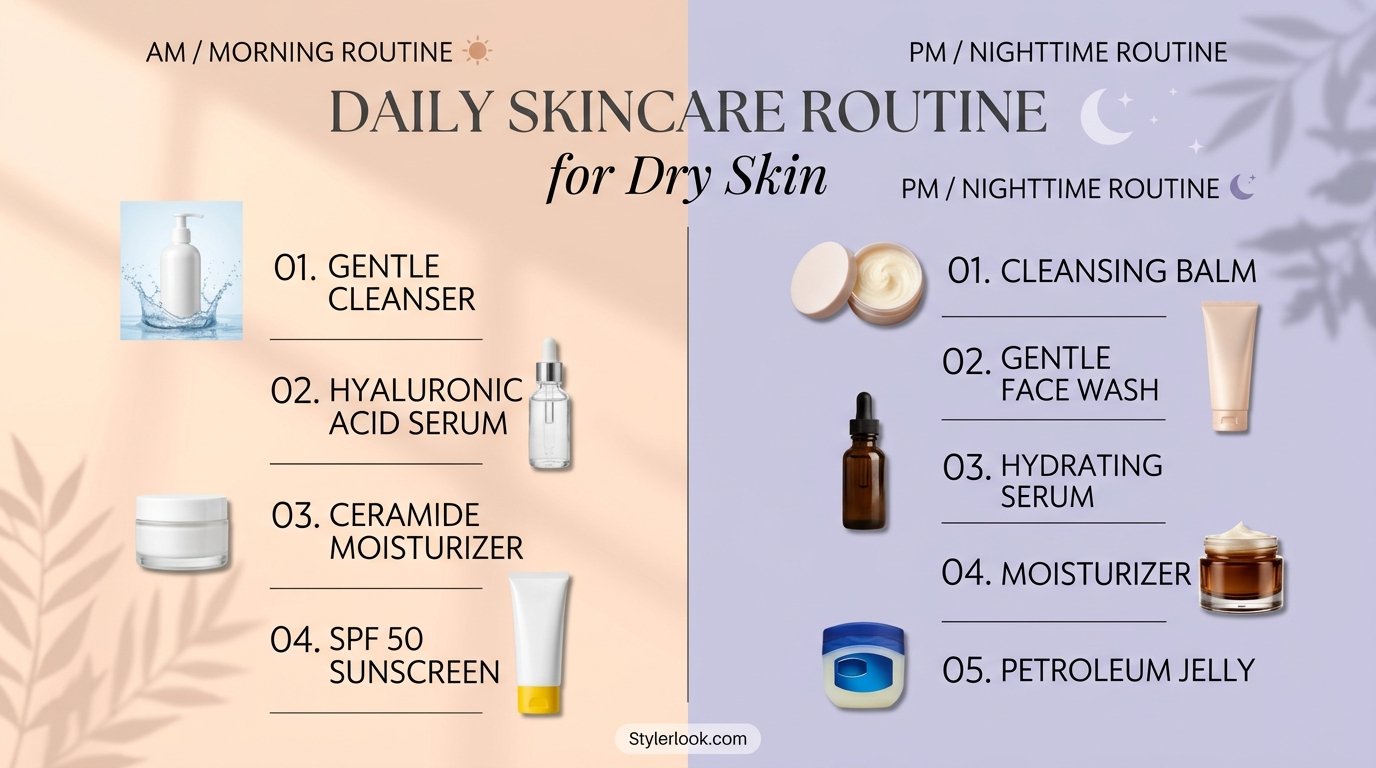
|
Job |
What it does |
Ingredients that do it |
|
Attract water |
Pulls moisture into the surface layers |
Hyaluronic acid, glycerin, honey |
|
Supply lipids |
Rebuilds the barrier mortar between cells |
Ceramides, shea butter, kokum butter, squalane |
|
Seal |
Slows water escaping back out |
Petrolatum, dimethicone, rich creams |
Dermatologists describe the barrier as bricks and mortar: skin cells are the bricks, and lipids are the mortar holding water in. Ceramides alone make up roughly half of those lipids.
The 3 Minute Rule: The Step That Costs Nothing
Moisturize within about three minutes of bathing, on skin left slightly damp. The Sir Ganga Ram Hospital dermatology guide to winter skin mistakes calls this timing the single most important winter cure.
The mechanics are simple. Pat dry, never rub dry, and apply cream while water still sits on the skin, so the product seals that water in instead of resting on a dry surface.
Timing beats shopping. Most readers who fix only this sequence discover their existing moisturizer was adequate all along, which is why this routine is built around the clock before the products.
The Morning Routine, Step by Step
Mornings in India are a defense shift: AC, commute pollution, and strong sun all draw on the same barrier before lunch. Build slightly richer than comfort alone demands.
The skincare routine order guide sequences any routine this way, and the morning skincare routine shows the general template.
- Rinse or cleanse gently. If skin is calm and last night’s seal is intact, lukewarm water alone can be enough; otherwise use the gentle cleanser.
- Hydrate on damp skin. A hyaluronic acid or glycerin serum, or a hydrating essence, applied while skin is still slightly wet from washing.
- Seal with ceramide cream. Choose the weight your city and season dictate, from emulsion in humidity to rich cream in a northern winter.
- Sunscreen, every morning. The convention in Indian dermatologist led routines is SPF 50 PA++++; the floor in the American Academy of Dermatology tips for relieving dry skin is SPF 30 broad spectrum.
The Night Routine, Step by Step
Night is the repair shift, and in an AC bedroom the air keeps drawing moisture while you sleep. Seal slightly beyond what the evening seems to need.
- First cleanse when needed. A balm or oil cleanse removes sunscreen and the day’s pollution film without scrubbing, on makeup or heavy sunscreen days.
- Gentle cleanser. Low residue, fragrance free, and never the squeaky clean finish that signals stripped lipids.
- Hydrating layer on damp skin. The same humectant step as morning, because damp application matters more than product novelty.
- Ceramide cream. The standard seal for most of the Indian year.
- Occlusive layer, season permitting. A thin film of petrolatum over the driest zones in dry winter conditions, or a sleeping mask where humidity rules.
The nighttime skincare routine lays out the general night structure this adapts. For readers whose skin is also reactive, gentle skincare routine for dry sensitive skin owns the sensitive variant of this same skeleton, without duplicating the India dials.
Front One: Climate Zones, One Country, Three Skins
Delhi in January runs cold, dry, and polluted: skin loses water to the air all day. The full winter build applies: rich cream, occlusive nights, and lukewarm bathing discipline.
The monsoon is its own season, not a break. Humidity helps hydration while friction zones and folds grow fungal problems that get mistaken for dry patches, so cleansing stays gentle but thorough.
|
Zone and season |
Moisturizer weight |
Seal |
Watch out for |
|
Delhi winter |
Rich cream |
Occlusive nights |
Hot showers, indoor heating |
|
Coastal summer |
Emulsion or lotion |
Cream only |
Over sealing, trapped sweat |
|
Monsoon |
Lotion, lighter cream |
Minimal |
Fungal patches mistaken for dryness |
|
AC office, any city |
Cream |
Standard |
Midday dryness, desk top up needed |
Front Two: Hard Water and Pollution
Hard water is a named barrier stressor across the Indian sources behind this routine. Its mineral load leaves a residue film, fights cleansers into needing more product and more rinsing, and ends in more stripping.
The routine responses are plain: shorter lukewarm washing, low residue gentle cleansers, and the 3 minute rule applied with extra discipline in hard water homes. Scrubbing harder is the one wrong answer.
Front Three: Air Conditioning, the Nine Hour Draw
An office AC is a dehumidifier that runs all day, and Indian office guidance names the fix plainly: a midday top up, not a richer morning.
Keep a small tube of your regular cream and a lip balm in the desk drawer. One reapplication over the driest zones at midday outperforms any heroic layer applied at 8 in the morning.
Ingredients by Job: Reading an Indian Label
Shop by job, not by fame. Hyaluronic acid and glycerin attract water; apply them to damp skin and seal immediately, especially in dry zones where air offers no water to pull.
Ceramides, cholesterol, and fatty acids rebuild mortar, and complete formulas carry them together. Shea and kokum butters are the traditional Indian emollients that do this job legitimately.
Petrolatum and dimethicone seal hardest, which is why petrolatum remains the cheapest effective product in any Indian pharmacy. Urea around 5 percent, found in pharmacy brand routines such as the Derma Co step by step routine for dry skin, softens very dry, rough zones like heels and shins.
Brand Tiers and a Realistic Budget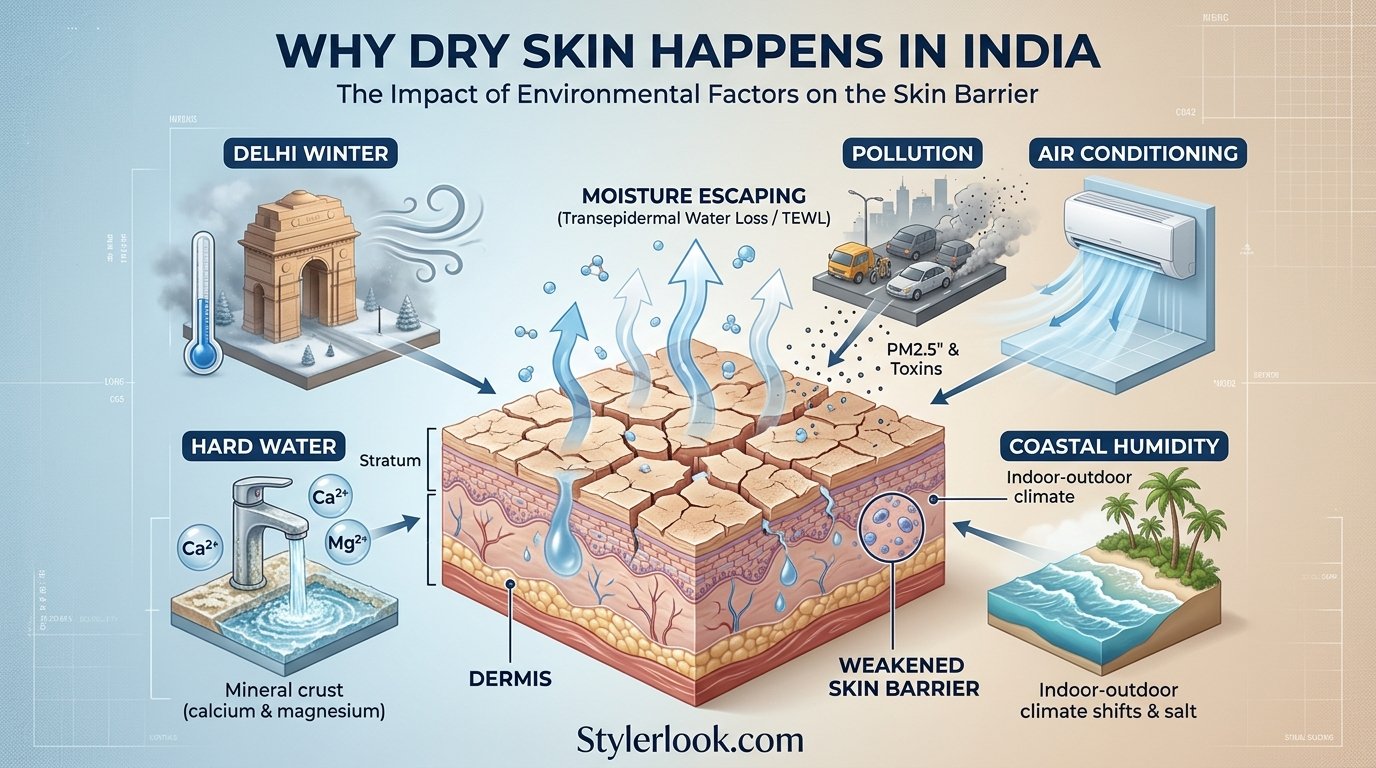
Dermatologists recommend ingredient profiles; brands are delivery vehicles. The Indian market sorts into tiers, and a sound routine can be assembled from any of them. The complete skincare routine hub at StylerLook organizes the wider routine family these tiers feed into.
|
Tier |
Who lives here |
What to expect |
|
Dermatologist led Indian brands |
The Derma Co, Minimalist style labels |
Transparent percentages, pharmacy pricing |
|
Global pharmacy brands |
CeraVe, La Roche Posay class |
Ceramide systems, wide availability |
|
K beauty Indian arms |
Rice ceramide lines |
Emulsion layering, humidity friendly |
|
Ayurvedic positioned brands |
Kokum, goat milk, honey labels |
Traditional emollients, claims need grading |
Prices here are dated snapshots, not promises. The Derma Co’s gentle cleanser listed at Rs 299 for 125 ml on its own site in November 2026, and a four step pharmacy routine commonly assembles around Rs 800 to 1,500 a month in replacement costs.
Ayurveda and Home Remedies, Appraised Fairly
Kitchen staples get honest grades. Malai and ghee soften body skin on contact but supply lipids unevenly, carry no humectant, and suit faces poorly. Coconut oil moisturizes bodies well and is comedogenic for many faces.
Tradition often found the ingredients; formulation decides the dose and the company they keep.
Exfoliation and Actives on Dry Skin
Retinol can coexist with dry skin when buffered: low strength, two nights a week, the moisturizer sandwich, and the rest of the routine kept acid free during the ramp. Peak winter may still argue for lower frequency.
Anyone building from zero should read the guide to starting a skincare routine first, then add one product per fortnight with a patch test. The Korean skincare routine explains the essence step this routine borrows, for readers curious about layering’s origin.
Body, Hands, Heels, and Lips
Face principles scale to the body; economics change. Body skin tolerates richer, cheaper formulas, and the after bath 3 minute application matters more there than anywhere.
Urea creams handle rough zones: heels, elbows, shins. Hands follow the hospital protocol of cream after every wash and, in hard winters, cream plus petrolatum under cotton gloves overnight.
For Men: Same Skeleton, Two Additions
The routine is unisex; the pharmacy shelf already knows it. Men add shaving, which is controlled exfoliation plus friction, done after a lukewarm soak with cushioning, fragrance free media.
The mens skincare routine covers the wider male routine. Everything else here, from hard water discipline to the desk drawer tube, transfers without translation.
The Steroid Trap and Other Mistakes
One warning outranks every tip here. Steroid combination creams, sold casually across India, thin skin, mask fungal infections, and convert small problems into chronic ones. Never self treat a patch with one.
Hot showers undo the routine at the source; over exfoliation strips what sealing builds; salon bleach and aggressive facials land hardest on dry, sensitive skin, especially in the week before an event they were meant to perfect.
When Dry Skin Needs a Dermatologist
See a dermatologist when dryness persists or worsens despite a correct routine, when cracking or fissures appear, when itching disturbs sleep, or when patches suggest eczema, psoriasis, or dermatitis.
A hospital blog reporting on a landmark Indian study puts sensitive or very sensitive skin at 32.3 percent of the population, printed here as reported. Sensitivity at that scale is the mainstream case, and it deserves pacing, not shame.
Frequently Asked Questions
What is the best skincare routine for dry skin in India?
Per the dermatology guidance in this SERP and the AAD dry skin framework: a gentle non stripping cleanser, a hydrating layer (hyaluronic acid or glycerin) applied to damp skin,
A ceramide rich cream to seal, and sunscreen in the morning (SPF 50 PA++++ is the Indian market convention; SPF 30 plus is the AAD floor). At night: cleanse, hydrate, seal, with an occlusive layer in dry winter conditions.
The India specific work is the dials: hard water, pollution, air conditioning, and a climate that swings from Delhi’s dry winter to coastal humidity.
General information only; persistent dryness with cracking, itching, or patches needs a dermatologist, because eczema and other conditions hide inside the words dry skin.
Why is dry skin worse in India in winter?
North Indian winters combine cold, dry air and wind with indoor heating and the season’s great pleasure,
Long hot showers, which the Sir Ganga Ram Hospital dermatology guide names the number one winter mistake because hot water strips the lipid barrier.
Add low humidity pulling moisture out of skin (transepidermal water loss rises) and heavier pollution in northern cities, and the barrier faces the two front assault that hospital guide describes.
The routine answer is seasonal: richer cream, damp skin application, lukewarm shorter showers, and sunscreen kept on despite the weaker looking sun.
What is the 3 minute rule for dry skin?
Moisturize within about three minutes of bathing, on skin left slightly damp. The hospital dermatology guidance in this SERP calls it the single most important winter cure: pat dry, do not rub dry,
And apply the thick cream while water is still on the skin, so the moisturizer seals that water in instead of sitting on a dry surface.
It costs nothing and outperforms most product upgrades, which is why this report builds the whole routine around hydrate on damp, then seal.
What ingredients should dry skin in India look for?
Three jobs, per the guidance across this SERP. Humectants that pull water in: hyaluronic acid, glycerin.
Barrier lipids that rebuild the mortar: ceramides (about half of the skin barrier’s lipids, per the formulation sources), cholesterol and fatty acids in complete formulas, shea and kokum butters.
Occlusives and keratolytics for the hard cases: petrolatum and dimethicone to seal, urea (a 5 percent urea cream appears in the Indian pharmacy brand routines) to soften very dry, rough areas. Niacinamide and panthenol support.
The label reading skill is matching ingredient to job, not collecting famous names.
Ceramide or hyaluronic acid: which matters more?
They do different jobs and the routine needs both, in order.
Hyaluronic acid is a humectant: it attracts and holds water in the skin’s surface layers, and works best applied to damp skin in India’s dry zones (in very dry air with no water source,
Technique matters more: damp application, then seal immediately). Ceramides are structure: they refill the lipid mortar between skin cells that keeps that water from escaping.
The Face Shop India guides in this SERP make the same pairing argument: HA pulls water in, ceramides lock it there. Serum first, cream over it.
Which sunscreen suits dry skin in India?
A moisturizing, cream textured broad spectrum sunscreen. The Indian market convention in this SERP is SPF 50 with PA++++ (the Derma Co routine specifies it), while the AAD floor is SPF 30 plus broad spectrum;
This report presents both honestly: Indian dermatologist led brands standardize on SPF 50 PA++++ for India’s UV intensity, and dry skin should choose the cream or lotion formats over drying gels and alcohol heavy fluids.
White cast is a real adherence issue on Indian skin tones; tinted options exist and adherence beats specifications. Reapply outdoors; winter sun still carries UVA, the hospital guide’s myth number two.
How does hard water affect dry skin, and what can I do?
Hard water is a named barrier stressor across the Indian sources in this SERP: its mineral load can leave residue on skin, interfere with cleansers (more product needed, more rinsing,
More stripping), and worsen dryness and irritation, particularly for sensitive and eczema prone skin.
Routine level responses: shorter lukewarm washing, gentle low residue cleansers, moisturizing immediately after (the 3 minute rule matters more in hard water homes), and not compensating with harsher scrubbing.
Shower filters are widely marketed in India; this report notes them as a household choice without endorsing effect claims the sources do not establish.
My skin is dry in Delhi winter but fine in Mumbai. Why?
Because dry skin is partly an address. Delhi’s winter air is cold and dry, so the skin loses water to the air and needs the full winter build: rich cream, occlusive nights, humidifier logic.
Mumbai’s humidity does part of the humectant’s job for free, and the same rich cream can feel heavy; an emulsion or lotion often suffices, and the monsoon adds its own fungal and friction cautions.
The routine that travels is a skeleton with dials: cleanser constant, moisturizer weight and sealing adjusted to the city’s air. This climate zone thinking is almost entirely missing from the SERP and is a core asset of the planned article.
What is a realistic budget routine in India?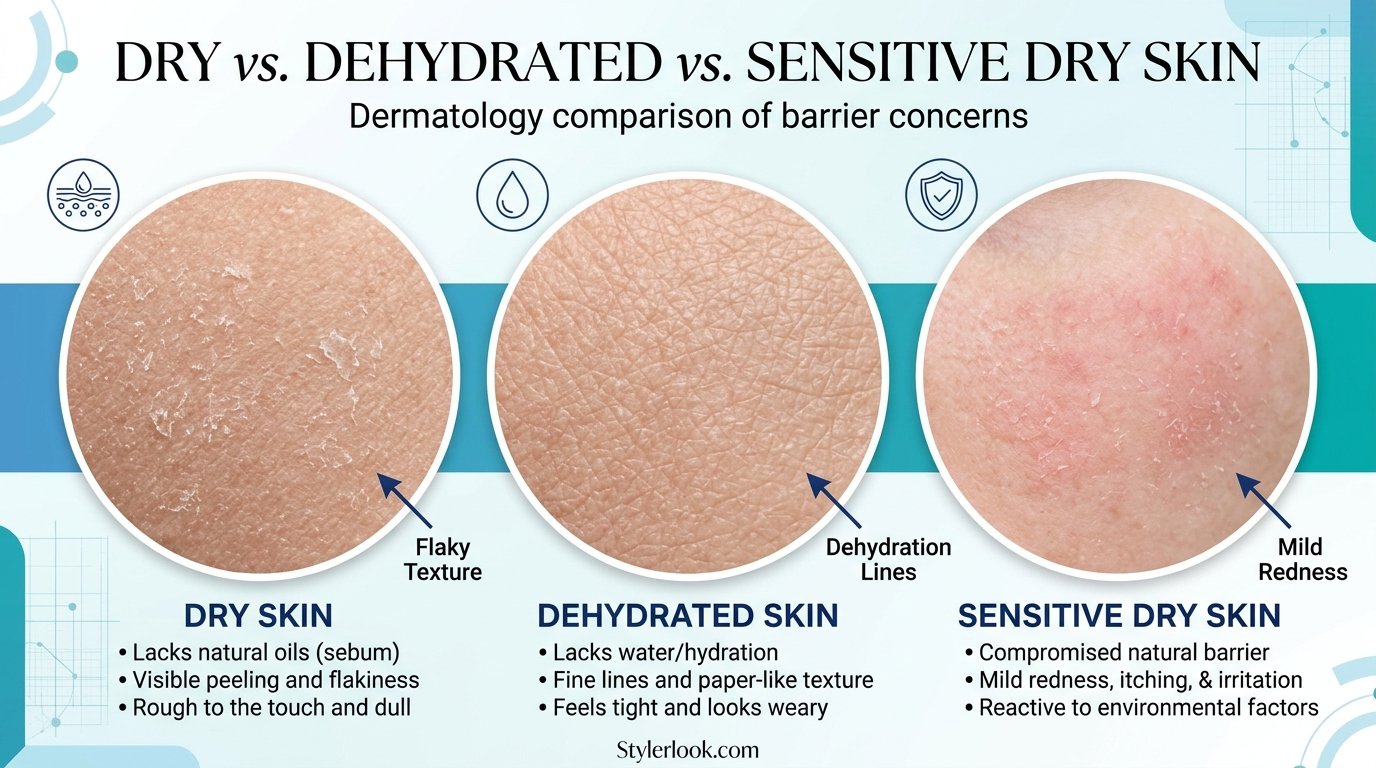
The structure is cheap; only some formulas are not.
Indian pharmacy and dermatologist led brands price the core steps low: The Derma Co’s gentle cleanser is listed at Rs 299 for 125 ml on the brand’s own site (a dated snapshot, November 2026),
And a full four step routine from Indian pharmacy brands commonly assembles in the Rs 800 to 1,500 per month replacement range, printed here as a market observation, not a promise.
Petrolatum, the most effective occlusive in the guidance, is among the cheapest products in any Indian pharmacy. Spend order: cleanser and moisturizer first, sunscreen second, serums last.
Which Indian brands do dermatologists actually use for dry skin?
The SERP’s dermatologist led and pharmacy tier includes The Derma Co (dermatologist designed, transparent percentages, dry skin routine with a 5 percent urea cream),
Global pharmacy brands sold widely in India (CeraVe with ceramides and MVE technology, La Roche Posay Lipikar),
K beauty’s Indian arms (The Face Shop’s rice ceramide line), and Ayurvedic positioned brands (VedicDerm and similar) whose claims this report treats as marketing until evidenced.
The honest answer is that dermatologists recommend ingredient profiles, and brands are delivery vehicles; the article will organize by job and tier, not by logo worship.
Can Ayurvedic products fix dry skin?
Ayurvedic positioned brands are a major SERP presence for this keyword (goat milk washes, kokum butter creams,
Honey and silk protein cleansers), and some of their ingredients overlap with dermatology’s own list: kokum and shea butters are legitimate emollients, honey is a humectant.
What this report will not do is credit traditional use as clinical evidence, or print glow and healing claims as facts.
The appraisal rule: judge the formula by the same three jobs (attract water, supply lipids, seal), whatever tradition it comes from, and keep fragrance and allergen caution identical for natural and synthetic products.
What about home remedies like malai, ghee, and coconut oil?
They are the cultural first line for dry skin in India and deserve a fair hearing.
Malai (cream) and ghee are emollient fats that soften skin on contact, and coconut oil is a widely used moisturizer and hair oil with some supportive evidence as an emollient.
The limits are consistency, purity, and completeness: kitchen fats supply lipids unevenly, carry no humectant, and can irritate or clog some skins (coconut oil is comedogenic for many faces).
Verdict of this report: acceptable occlusive improvisation for body skin in a pinch, not a facial routine, and never a substitute for barrier formulas on eczema prone skin.
Is slugging with Vaseline suitable in India?
Conditionally. A thin petrolatum layer over moisturizer at night is the strongest seal in the guidance (the hospital guide even prescribes hand slugging under cotton gloves), and for Delhi winter faces it can be transformative.
In humid coastal and monsoon conditions the same seal can feel intolerable and trap sweat and heat, so frequency and thinness become the dials, and acne prone zones should skip it.
Slugging is a climate dependent tool in India, which the US centric slugging content never mentions.
How often should dry skin exfoliate?
Once or twice weekly at most, gently, per the clinic guidance in this SERP, with lactic acid or PHAs preferred for dry skin because they exfoliate while being kinder and partly humectant, and with physical scrubs discouraged.
Exfoliation’s job in a dry routine is removing the flaky layer that blocks moisturizer absorption, not chasing smoothness.
In winter peaks and on irritated skin the correct frequency can be zero for a few weeks; a barrier in trouble gets rest before it gets acids.
Can dry skin use retinol?
Yes, carefully, and the Indian brands in this SERP sell exactly that bridge (a 0.3 percent retinol night cream positioned for dry skin with hydration support).
The technique matters more than the molecule: start low and slow (two nights weekly), buffer with the moisturizer sandwich,
Keep the rest of the routine acid free while ramping, and expect a drier first month that the sealing layers must absorb. In peak winter, even established users often drop frequency.
Retinoid cautions apply: avoid in pregnancy, and irritated or eczema flaring skin pauses until calm.
Does drinking more water fix dry skin?
No, and the Indian sources are refreshingly aligned with global guidance here: dry skin is a barrier and lipid problem at the surface, not a whole body hydration gauge in otherwise healthy people.
Drinking water is good general health practice; it does not route meaningfully to the stratum corneum. What routes there is what you apply to damp skin and how you keep the room and the shower from stripping it.
Anyone with excessive thirst and dry skin together should mention both to a doctor, since systemic causes exist, which is a medical conversation, not a skincare tip.
What is the difference between dry and dehydrated skin?
Dry skin is a type: it under produces sebum, so it lacks oil year round and everywhere.
Dehydrated skin is a state: it lacks water, can strike oily skin too, and shows as tightness, fine surface lines, and products suddenly stinging.
India’s climate manufactures dehydrated skin seasonally (AC offices, winter air, travel) in people whose type is not dry at all.
The distinction decides the fix: dry needs lipids and seal; dehydrated needs humectants and gentleness; most Indian readers in winter need both, sequenced hydrate then seal.
Why does my moisturizer work in the morning and fail by evening in AC?
Air conditioning is a dehumidifier running all day, and the Face Shop India guidance names the practical fix used across Indian offices: keep a midday top up at the desk,
A small cream or hydrating mist, rather than rebuilding the whole routine. Morning technique also matters: moisturizer applied to dry skin in a hurry seals in very little. Applied to damp skin under sunscreen, the same product lasts hours longer.
If evenings still feel parched, the night’s occlusive layer, not a stronger morning cream, is usually the missing piece.
When should dry skin see a dermatologist in India?
The referral triggers from the clinic sources: dryness that persists or worsens despite a correct routine; severe flaking, cracking, or fissures;
Itching that disturbs sleep; patches that look like eczema, psoriasis, or dermatitis; and any dry area that is spreading, oozing, or not responding in a few weeks.
India specific addition from public health dermatology: avoid self treating patches with over the counter steroid combination creams, a widely documented misuse pattern that masks fungal infections and thins skin; a proper diagnosis is cheaper than the complications.
Can men follow this routine?
Identically, with two additions. Shaving is controlled exfoliation plus friction, so dry skinned men shave after a lukewarm soak, use cushioning fragrance free shave media, and moisturize immediately after;
And the beard zone traps dryness and flaking (seborrheic patterns live there), which may need its own attention.
The Indian brand routines in this SERP explicitly design for men and women alike, and the market reality is that the pharmacy shelf is unisex even when the marketing is not.
What changes during the monsoon for dry skin?
Humidity rises, so humectants work easily and heavy creams feel suffocating: switch the seal down a weight (cream to emulsion or lotion),
Keep cleansing gentle but thorough against sweat and pollution film, and watch friction zones and folds, where monsoon fungal problems thrive and are routinely mistaken for dry patches. Do not stop sunscreen for cloud cover; UVA passes through monsoon cloud.
The monsoon mistake is abandoning the routine because skin feels less dry, then meeting October with a depleted barrier.
Is toner or essence necessary for dry skin?
Optional, and the Indian market borrows the essence step from K beauty routines (the Face Shop’s emulsion layering).
A hydrating toner or essence is a water layer that makes the damp skin principle easier to execute away from the sink, useful in AC offices and winter.
It is a delivery convenience, not a category of magic; glycerin and HA serums do the same job. Alcohol based toners and astringents are the dry skin enemy and appear in no credible routine in this SERP.
How do I build a dry skin routine for very sensitive skin?
Subtract before adding. The landmark Indian data point in this SERP, reported by a Delhi hospital: 32.3 percent of the population reports sensitive or very sensitive skin, so this is the mainstream case, not an edge case.
The build: fragrance free everything, the shortest ingredient lists, cleanser and cream from the pharmacy tier, one new product per fortnight with a patch test, and actives (retinol, acids, vitamin C) postponed until the base runs calmly for a month.
Sensitivity is a pacing specification, not a separate shelf.
What makeup works on dry skin in India?
Prep is the product: moisturizer fully absorbed, then a moisturizing or tinted sunscreen as the base layer, cream and liquid formats over powders, and setting with restraint (powder only where shine actually appears).
Salons’ heavy pre event routines (bleach, strong facials) are a documented irritant risk on dry and sensitive skin in the Indian context and belong in the week before an event never, with gentle prep instead in the fortnight before.
Removal at night returns to the balm or oil first cleanse so the day leaves without scrubbing.
Do I need different products for face and body?
The principles are one; the economics differ.
Body skin covers more area and tolerates richer, cheaper formulas: urea creams for rough zones (heels, elbows, shins), petrolatum seals, and the after bath 3 minute application over the whole body, which the hospital guidance emphasizes.
Faces get the finer textures and the sunscreen discipline. India’s winter body signs, ashy shins and itchy backs, are barrier dispatches from skin that is usually washed hotter and moisturized less than the face.
What is the morning routine for dry skin in India, step by step?
One: cleanse gently or rinse if skin is calm and the night seal is intact. Two: a hydrating layer (HA or glycerin serum, or an essence) on skin still slightly damp from washing.
Three: ceramide cream matched to the season’s weight. Four: sunscreen, SPF 50 PA++++ by the Indian market convention, in a moisturizing format.
The morning’s economy matters in India because the day will tax it: AC, commute pollution, and sun all draw on the same barrier, so the morning is built slightly richer than comfort alone demands.
What is the night routine for dry skin in India, step by step?
One: remove sunscreen and the day’s pollution film, with a balm or oil first cleanse if makeup or heavy sunscreen was worn. Two: the gentle cleanser. Three: the hydrating layer on damp skin.
Four: the ceramide cream, and in dry winter conditions five: the occlusive seal, petrolatum thinly over the driest zones, or a sleeping mask in emulsion friendly climates.
Night is when India’s dry skin does its repair shift, and the AC bedroom is the argument for sealing slightly beyond what the evening seems to need.
Cream, lotion, emulsion, or ointment: which should I choose?
By water content and climate, not by preference. Ointments seal hardest and suit winter nights, heels, and hands. Creams are the default face and body seal for most of the Indian year.
Lotions spread easily over large body areas in warm months. Emulsions are the humid climate and combination skin compromise, lighter than cream while still carrying lipids, which is why K beauty’s Indian lines build on them.
The seasonal switch is the skill: many Indian readers need two weights in the wardrobe, summer and winter, rather than one hero product.
How do I stop my skin from looking ashy in winter?
Ashiness is visible surface dryness, flaky stratum corneum scattering light, and it shows most on deeper skin tones and on legs.
The fix is the routine at body scale: lukewarm shorter bathing, moisturizer within three minutes over the whole body (not just the face),
A urea containing cream for shins and rough zones a few times weekly, and gentle exfoliation so the seal lands on skin, not on a flake layer.
Ashiness that comes with itching, thickened patches, or spread is past cosmetic territory and joins the referral list.
Is a humidifier worth it in Delhi?
For winter bedrooms, it is one of the few device purchases the barrier logic supports: raising indoor humidity reduces overnight water loss from skin, working while you sleep.
The hospital guidance’s framework (dry air pulls moisture out) makes the humidifier a source fix rather than another product.
Practical notes: clean it scrupulously, because a dirty humidifier aerosolizes what grows in it, and place it for the sleeping hours rather than running it all day. In coastal and monsoon conditions it has nothing to add.
What should I keep at my office desk for dry skin?
Two items, per the Indian office pattern in this SERP: a small tube of your regular cream for the midday top up (hands and face), and lip balm.
The AC draw is steady, and a single midday reapplication over the driest zones outperforms a richer morning layer applied at 8 a.m.
Mist sprays feel refreshing and can help a top up spread, but a mist alone, evaporating unsealed, can leave skin drier than before; mist then cream is the correct pairing if mists are used at all.
Can dry skin use vitamin C?
Yes, with format care. Vitamin C addresses the dullness that rides along with Indian dry skin and pollution exposure, and the combos in this SERP pair it with niacinamide for tone.
Dry and sensitive skin usually tolerates gentler derivatives and lower strengths better than strong L ascorbic acid, introduced after the base routine runs calmly, in the morning under sunscreen.
Stinging that persists is information to change format or pause, not a toll to pay for glow.
Why do my hands and heels crack every winter?
Hands are washed most, gloved least, and moisturized last; heels bear weight on skin with no oil glands of its own.
The hospital guidance’s hand protocol is the model: lukewarm washing, thick ceramide hand cream immediately after every wash, and the night treatment of cream plus petrolatum under cotton gloves.
Heels answer to urea creams and the same night sealing under socks. Cracks that bleed, or heel fissures in people with diabetes, move to medical care promptly; that footnote saves feet.
What is the role of diet in dry skin in India?
Supportive, not decisive. Adequate dietary fats and overall nutrition support skin among everything else, and traditional Indian diets rich in fats are not the villain of this story.
No food, however, substitutes for a broken barrier’s topical repair, and supplement led fixes inherit the caution from the AAD’s supplement warnings.
Readers whose dryness arrives with fatigue, weight change, or hair changes should route the whole picture to a doctor, since thyroid and metabolic causes are common and treatable.
Should I use a shower filter for hard water?
It is a reasonable household experiment, not an established treatment.
Filters marketed in India claim to reduce hardness and chlorine at the shower head; this report found no clinical source in the SERP establishing skin outcomes from them, so they are graded as optional hardware.
The routine responses with established logic come first: shorter lukewarm washing, gentle cleansers, immediate moisturizing. If a filter delights you and the routine is already right, keep it; if the routine is wrong, no filter will rescue it.
How should students on a budget handle dry skin in hostels?
Hostels concentrate every stressor: shared hard water, rushed bathing, no storage, tiny budgets. The minimum viable kit is three items: a gentle cleanser, one good cream used face and body, and sunscreen, with petrolatum as the winter multiplier.
Bucket bathing with lukewarm water is genuinely compatible with barrier care. The expensive mistakes at this budget are fairness products, salon facials, and five half used serums; the three item kit, finished and repurchased, beats all of them.
What skincare should outdoor workers in India prioritize?
Sun and seal. Outdoor work across Indian summers and winters combines UV, dust, pollution film, and wind.
Priorities: a robust moisturizing sunscreen reapplied through the day, a thorough but gentle evening cleanse to remove the day’s film, and a rich night seal. Head coverings and shade are skin equipment, not accessories.
Dryness with cracking on exposed zones, or any changing spot, deserves the dermatologist rather than a stronger cream.
Can threading, waxing, and salon facials harm dry skin?
They are controlled injuries, and dry or sensitive skin heals them slower.
Schedule threading and waxing away from active dry flares, moisturize and soothe afterward, and skip salon bleach and aggressive facials on dry skin entirely in the days around important events, a caution the Indian clinic sources support.
A patch of redness the week of a wedding is the classic outcome of a facial the day before it. Gentle prep for a fortnight outperforms heroic prep for an afternoon.
Is sunscreen needed indoors in India?
The nuanced answer this report prints: UVA passes through window glass, so long hours beside bright windows argue for sunscreen, while deep interior rooms away from windows are a lower exposure case.
Indian dermatologist led routines default to daily SPF regardless, partly for habit protection. Dry skin indoors has a bigger enemy anyway, the AC, and the desk drawer cream.
Let exposure, not anxiety, set the indoor rule, and never let the indoor debate excuse skipping sunscreen outdoors.
Why does my skin get drier as I age, and what changes?
Barrier lipids and natural moisturizing factors decline with age, so skin holds less water and repairs slower; the Face Shop and clinic sources both build senior adjustments on this.
The routine changes are weight and gentleness: richer creams year round, fewer and milder actives, meticulous after bath sealing, and attention to itch, which in older skin can signal more than dryness.
In Indian households this is often a parent’s skin being managed by an adult child, and the three item, fragrance free, pharmacy tier kit is the kindest format.
What is the single most common dry skin mistake in India?
By the hospital guide’s ranking and this report’s agreement: the long hot shower in winter, followed by toweling dry and moisturizing late or not at all, a sequence that strips the barrier and then abandons it.
Its correction is equally singular: lukewarm and shorter, pat, and seal within three minutes.
Most readers who fix only this sequence discover their existing moisturizer was adequate all along, which is why the routine in this report is built around timing before products.
How long before a dry skin routine shows results?
Comfort changes within days when the sealing is right (tightness after washing should end almost immediately with a gentler cleanser and damp application).
Flaking and texture need two to four weeks of consistent barrier care, and chronic winter patterns are managed seasonally rather than cured.
Judge products at three to four weeks of correct use, changing one variable at a time; judge the routine at the season turn. Dryness that ignores a correct month of care is a referral trigger, not a shopping trigger.
Conclusion
The best skincare routine for dry skin in India is a skeleton with dials: hydrate on damp skin, seal within three minutes, and adjust the seal to your city’s air, your home’s water, and your office’s AC.
Judge every product, traditional or dermatologist led, by the three jobs and nothing else.
Give the routine three to four weeks of correct use before judging it, change one variable at a time, and let persistent, cracking, or spreading dryness end the experiment and start a dermatologist visit instead.
Calm, sealed, comfortable skin is the whole goal, and in India it is mostly a matter of timing and dials.
General information only, not medical advice. Prices are dated snapshots from November 2026 and will change.
