

Best skincare routine for aging skin starts with an admission most product pages skip: the skin itself has changed jobs. A routine that behaved beautifully at 35 can start stinging, flaking, and disappointing at 55, and the products are usually not the problem.
What changed is the brief. Skin commonly becomes thinner, drier, and more reactive with age, loses moisture faster, and repairs more slowly, so the routine has to be rebuilt around a different set of priorities.
Everything here is general information, the shared ground across dermatologist guided sources, not personal advice. Bodies differ, medications and conditions change the picture, and anything worrying on your own skin belongs to a clinician, not a routine.
How Aging Skin Changes the Job
The evidence led guide in the research describes the post 50 shift in one sentence: skin often becomes thinner, drier, and more reactive through aging, cumulative sun exposure, and, for many women, hormonal changes, so routines built for younger or oilier skin often cause irritation rather than results.
Underneath sits structure. A dermatologist informed guide puts collagen decline at roughly 1 percent per year from the mid 20s, reaching some 30 to 35 percent lower by the 60s. Treat those as that guide’s figures, an orientation, not a measurement of your face.
Water handling changes too: aging skin loses moisture faster, a rise in transepidermal water loss in the technical phrase, which is why the same moisturizer that felt rich at 40 can feel like nothing at 60.
The practical conclusion matters more than the biology: the priority hierarchy inverts. In the SkinStacker mature skin routine guide, the shift is stated flatly: the focus moves from controlling oil and acne toward hydration, structural support, and repair of sun damage.
The Four Pillars and the Three Non-Negotiables
The framework guide in the research organizes mature care into four pillars: gentle cleansing that preserves the barrier, hydration replenishment, targeted repair with collagen supporting actives, and daily broad spectrum sun protection.
Inside that frame sits a shorter list, and it is the one to memorize: the WhatsInSkincare mature skin routine guide, citing named board certified dermatologists, gives mature skin three non-negotiables: a gentle cleanser, a ceramide rich moisturizer, and broad spectrum SPF 30 or higher.
Everything else in this article is negotiable, sequenced, or optional. Those three are the floor the rest of the routine stands on, and a routine missing one of them is not a shorter routine; it is an unfinished one.
The Priority Order
The same routine guide prints an explicit priority order for mature skin, and it is the most useful table in this topic:
|
Priority |
Step |
Why It Ranks There |
|---|---|---|
|
1 |
Sunscreen, SPF 30+, every morning |
The best supported protection against further damage |
|
2 |
Rich ceramide moisturizer |
Counters the dryness and water loss of aging skin |
|
3 |
Gentle retinoid, or bakuchiol |
The strongest evidence active, started tolerably |
|
4 |
Vitamin C serum, mornings |
Antioxidant support with trial evidence behind it |
|
5 |
Gentle exfoliation, weekly |
Renewal at the pace older skin accepts |
Read the order as a budget and as a tolerance plan. If money or patience runs out at step two, the routine still stands; the order guarantees the most proven steps are never the ones skipped.
Note where the famous active sits: third, not first. Retinoids earn their fame, but on aging skin they only work inside a routine whose first two steps keep the barrier calm enough to receive them.
The Morning Routine: Defend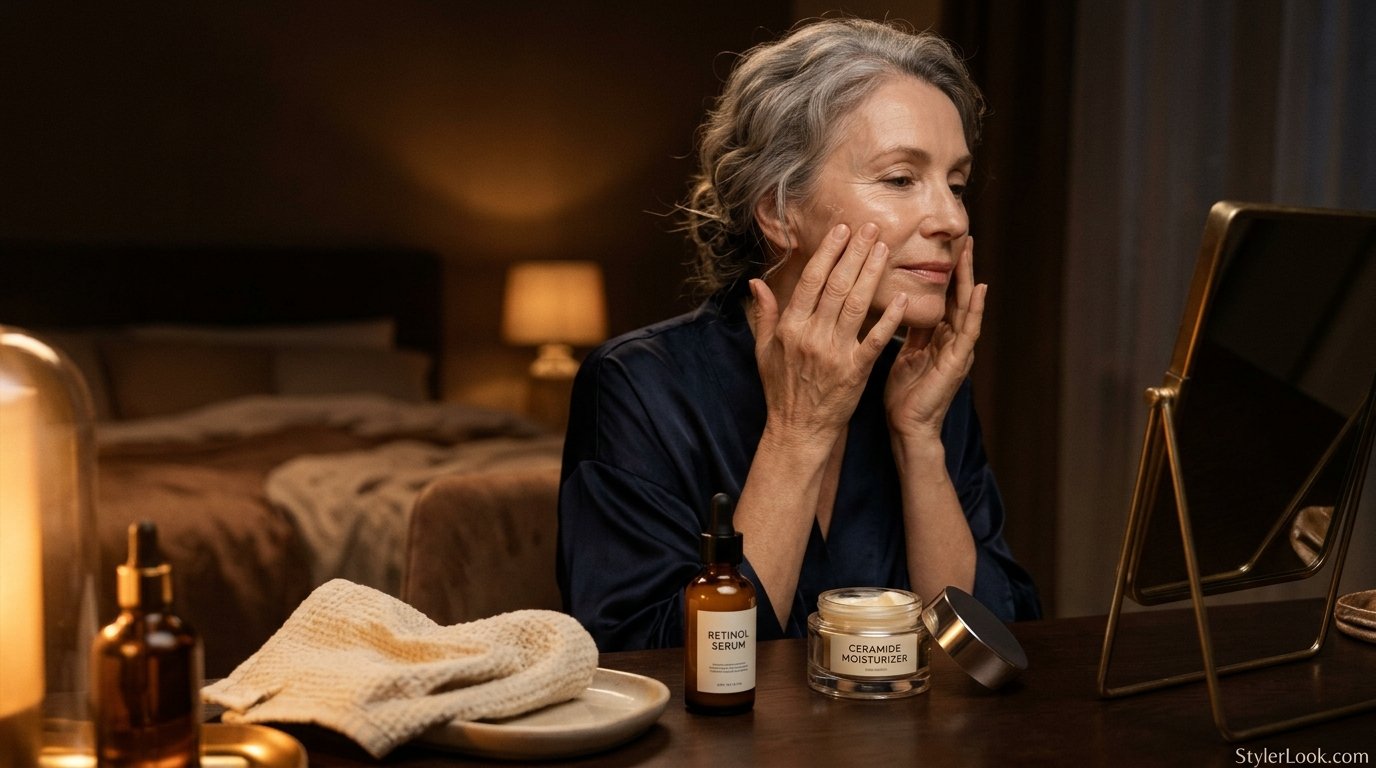
Morning is defense: the day’s UV, pollution, and dry indoor air are the incoming problems, and the routine’s job is to leave the house armored and comfortable.
Cleanse gently or not at all with product: many mature routines rinse with water in the morning and save the cream or milk cleanser for the evening, when sunscreen and the day need removing.
The cleanser that leaves skin squeaky is stripping a barrier that can no longer afford it.
The step by step morning, with product textures and sunscreen practice in full, is the whole subject of our morning skincare routine for anti aging, linked here so this page can spend its length on the full day system instead.
Layer the middle steps thin to thick, the order logic detailed in our skincare routine order guide: antioxidant serum on clean skin, moisturizer over it, and sunscreen always last, in the amount the label intends, not a pea sized gesture.
Vitamin C and the Antioxidant Case
Topical vitamin C holds the morning’s active slot on evidence, stated carefully by the evidence guide: research support for antioxidant protection against UV and pollution related damage, and some evidence for supporting collagen production.
Hold the claim at exactly that strength. Vitamin C is a supporting player with real research, not a wrinkle eraser, and its best documented job is helping the sunscreen shift by neutralizing some of what gets through.
It suits the morning because that is when the exposure happens. Readers who find it tingly on reactive skin can use it on alternate mornings; the evidence rewards consistency at tolerance over daily use endured through irritation.
The Evening Routine: Repair
Evening is repair: no UV to fight, hours of contact time, and skin in its overnight maintenance window. This is where the treatment actives live, one at a time.
Cleanse properly now. If sunscreen or makeup was worn, the builder guide’s advice is a double cleanse: an oil based first pass to dissolve the day, then the gentle water based cleanser, thorough without harshness.
Then the active slot, then moisturizer, and on some nights an optional occlusive layer as the final step, a richer seal over everything, used a few nights a week rather than nightly per the routine guide’s protocol.
Retinoids: The Strongest Evidence, the Most Care
Every credible source in this research lands in the same place: retinoids, from over the counter retinol to prescription tretinoin, carry the strongest evidence base for improving fine lines and supporting collagen, with the American Academy of Dermatology’s position cited behind them.
The same sources land together on the warning: retinoids are also the ingredient most likely to cause dryness, redness, and peeling, a real problem for skin whose barrier is already thinner and drier than it was.
Both facts are the reason the next section exists. Retinoid success on aging skin is rarely about finding the strongest product; it is about arriving at regular use without the irritation that makes people quit in week three.
Prescription strength decisions belong with a clinician who can see your skin and history. This article’s scope is the over the counter ramp that the guides describe, and its limits.
The Start Low Protocol
The routine guide’s protocol is concrete: start retinol at 0.25 to 0.5 percent, use it two to three nights per week, and build toward every other night over two to three months, always paired with a rich moisturizer and next day sunscreen.
A second builder in the research starts newcomers lower still, which is worth printing openly: the guides do not agree on one entry number. What they agree on completely is the shape of the ramp: low, infrequent, patient, and increased only when the current level is boring.
Judge the ramp by skin response, not by calendar. A level is earned when two weeks at it produce no stinging, no flaking, no new redness; until then, the schedule waits.
Expect the work to be slow. One framework guide puts visible retinol results in a 4 to 12 week window of consistent use, another strand entirely, and the honest summary across sources is months, not days.
The Sandwich Method and the Tolerability Ladder
When the ramp still stings, the research’s standard rescue is the sandwich method: moisturizer first, retinoid over it, or the retinoid between two moisturizer layers, buffering contact while the skin adapts.
The evidence guide is admirably honest about the trade: applying after moisturizer can reduce irritation while retaining some benefit, and it trades off some effectiveness for tolerability. On aging skin that trade is usually correct, because a tolerated routine outperforms a strong one abandoned in a drawer.
Build the full ladder and climb it in order before quitting an active: fewer nights first, then the sandwich, then a lower strength, then a different active. Most routines that “failed” simply stopped at the first rung.
Persistent burning, cracking, or rash is not a rung on any ladder. That is the routine telling you to stop and, if it does not settle quickly, to ask a clinician rather than the internet.
The Supporting Actives: Niacinamide, Bakuchiol, Peptides
Niacinamide is the supporting act with the friendliest file: the evidence guide describes it as supported by randomized trials for improving fine lines, pigmentation, redness, and barrier function over several weeks, and generally very well tolerated, which on reactive aging skin is half the battle.
Bakuchiol is the designated alternative when retinoids will not settle: it appears in the priority list itself as the sensitive skin option, with a most cited head to head trial against retinol behind it.
The honest label is promising and gentler, with a smaller evidence base than the retinoids it substitutes for.
Peptides sit one tier lower in certainty: real supporting research, in the evidence guide’s caution, from trials that are mostly small and short. Enjoy them inside a good moisturizer; do not build the routine’s hopes on them.
The tiering is the point. Aging skin tolerates fewer experiments than young skin, so each slot should be filled by the best evidenced ingredient the skin accepts, in that order of tests.
Exfoliation: Weekly and Gentle
Exfoliation keeps its place, at the bottom of the priority order and at a mature pace: the consensus across the guides is gentle and weekly, not the daily acid regimens marketed to younger skin.
The job is modest and real: lift the dull surface layer so moisturizers spread evenly and skin looks less flat. The risk is equally real: over exfoliated aging skin is how barriers end up worse than the dullness the acids were treating.
Skip exfoliation entirely on retinoid rough weeks. Two renewal systems at once is a young skin’s game, and the ladder rule applies: when in doubt, subtract.
Decade Shifts: 40s, 50s, 60s and Beyond
|
Decade |
What Rises |
What Softens |
Watch For |
|---|---|---|---|
|
40s |
Retinoid and antioxidant build |
Harsh cleansers, daily acids |
First intolerance of old favorites |
|
50s |
Hydration, barrier lipids, richness |
Exfoliation frequency, strong actives nightly |
Dryness, reactivity, hormonal shifts |
|
60s+ |
Richness, occlusives, gentleness everywhere |
Almost all aggression |
Screening, slow healing, new spots |
The routine guide’s own summary carries the same drift: retinol and antioxidants become more important in the 40s, while hydration and gentle exfoliation take priority in the 50s and beyond.
Menopause deserves its sentence: for many women the hormonal shift is when dryness and reactivity step up noticeably, and the correct response is the decade table’s, more barrier, less battle, not a shopping spree.
After 60 the routine’s center of gravity is comfort and protection: the richest textures skin enjoys, actives at whatever frequency stays boring, and the health habits in the next section carrying more weight than any serum.
Sensitive Aging Skin: The Gentle Path
Sensitive aging skin is not a niche; it is close to the default after 50. Its routine is the same spine with the aggression removed: the three non-negotiables, niacinamide as the lead active, and bakuchiol where a retinoid would go.
Introduce one new product at a time, with a patch test on a small area and a two week watch before the next addition. On reactive skin, simultaneous launches make culprits impossible to identify.
Fragrance is the variable to interrogate first when a gentle routine still misbehaves, followed by the exfoliation habit. Subtraction solves more sensitive skin mysteries than addition ever will.
The Minimal Routine: Three Steps Done Daily
Strip the system to its floor and it still works: gentle cleanser, ceramide moisturizer, morning sunscreen, with the moisturizer repeated at night. That is the whole routine, and it beats every elaborate routine that collapses after a fortnight.
The cluster’s own foundation version of this discipline is our simple skincare routine, which pairs naturally with this page: simple first, then the aging specific upgrades layered on top in priority order.
Add back exactly one element at a time, in the priority order’s sequence, only when the current version is boringly consistent. Boredom is the metric; a routine you no longer think about is a routine that is working.
Dryness, the Constant Companion
For many readers the daily battle is not lines but dryness: tightness after washing, flaking at the edges, makeup settling into texture. The routine answer is structural, richer textures and fewer stripping steps, not more actives.
The dedicated treatment of that fight, textures, layering, and seasonal shifts, lives in our skincare routine for dry skin, and most aging skin readers should treat it as the companion volume to this page.
One habit from that research transfers directly: apply moisturizer to slightly damp skin, which traps more water than the same cream on a bone dry face, a free upgrade at every age.
Sunscreen Is Health, Not Only Cosmetic
Daily broad spectrum sunscreen is the best supported step in every source, full stop. The evidence guide adds the framing the beauty pages underuse: skin cancer risk increases with age and cumulative exposure, making sun protection a health issue, not just a cosmetic one.
That framing changes adherence more than any wrinkle statistic. A step done to protect health gets done on cloudy days and busy mornings; the full daily practice, amounts and reapplication, is detailed in the DetoxOz anti-aging routine evidence guide alongside its evidence review.
SPF 30 is the floor the guides agree on; some builders in the research set their essential tier at SPF 50. Held as strands, the shared rule is simpler than the numbers fight: the sunscreen worn daily at the right amount is the effective one.
Screening After 50 and the Red Flags
The routine guide includes a piece of advice no serum can substitute: see a dermatologist annually for skin screening, because risk rises significantly after 50. Book it like the dentist; it is maintenance, not alarm.
Between visits, know the red flags that should not wait for the annual slot: a spot that is new, changing, growing, bleeding, or not healing, or anything that looks different from everything around it.
Those go to a clinician promptly, and this article will not pretend a routine has anything to say about them. Early professional eyes are the entire treatment at that stage.
What the Evidence Does Not Support
The skepticism section is a feature, not a mood. The evidence guide warns plainly that claims about one miracle ingredient, or products marketed as dermatologist approved with no actual dermatologist behind them, overstate what skincare alone can do.
Skincare cannot reverse deep wrinkles, lift sagging, or replace procedures and medicine; its honest wins are slower visible damage, better hydration and texture, and gradual softening of fine lines over months.
Percentages deserve special suspicion. Trial figures describe specific products, doses, and groups under study conditions; one framework guide’s cited tretinoin number is exactly that, its cited number, and this article deliberately does not print it as an expectation for anyone’s face.
When a claim sounds like a promise, it is marketing. When it sounds like a probability with conditions, it is probably evidence, and that is the filter to carry into every purchase.
A Week on the System
A tolerated week, once the ramp is established, looks unremarkable, which is the goal:
|
Day Part |
Most Days |
Retinoid Nights (2 to 3 per week) |
Exfoliation Night (1 per week) |
|---|---|---|---|
|
Morning |
Gentle cleanse or rinse, vitamin C, moisturizer, SPF |
Same |
Same |
|
Evening |
Cleanse, moisturizer |
Cleanse, retinoid (sandwiched if needed), moisturizer |
Cleanse, gentle exfoliant, moisturizer |
|
Optional |
Occlusive layer on driest nights |
Buffer layers as tolerated |
No retinoid the same night |
The pattern matters more than the grid: actives rotate, basics repeat. Cleanser, moisturizer, and sunscreen appear every single day; the treatment steps take turns in the spaces between.
Beginners run a simpler week: basics daily, retinoid on two fixed nights, exfoliation paused until the retinoid is boring. The calendar grows only when the skin’s diary says it may.
Neck, Hands, and the Forgotten Skin
Faces get routines; necks and hands get evidence. Both age visibly, both are exposed like the face, and both are usually treated with whatever is left on the palms.
Extend the morning sunscreen to the neck, chest, and backs of hands as a habit, and let the evening moisturizer make the same trip. These areas need the protection steps more than they need their own product shelf.
They also react faster than faces. Introduce actives to the neck later and weaker than the face, if at all, and let persistent changes on the hands follow the same clinician rule as anywhere else.
Judge Slowly: The Review Rhythm
Give every version of the routine a fair trial. The results window the guides describe runs to weeks and months, so a product judged at day ten has not been judged at all.
Keep a simple diary: product changes, the nights actives ran, and any stinging, flaking, or new redness, dated. Patterns invisible week to week become obvious across a page, and the ladder decisions stop being guesses.
A dated photograph once a month, same light and angle, belongs in the same diary, because memory edits skin generously and pictures do not.
Review the whole system on a season’s rhythm, not a week’s: richness up as heating season dries the air, sunscreen discipline audited as days lengthen, and the annual screening booked on the same calendar as other maintenance.
Change one variable per review period. A routine edited in five places at once teaches nothing, and on reactive skin it risks a reaction with five suspects and no culprit.
Buying in Priority Order
When the budget arrives in pieces, spend it in the priority order’s sequence: sunscreen first, because it protects everything else you will ever buy, then the ceramide moisturizer the routine leans on twice a day.
The cleanser comes third, and it is the step where overspending buys the least: a gentle formula’s job is to leave the barrier alone, and modest versions do it well. Save the deliberate money for the active you will actually tolerate, where formulation quality affects comfort.
Buy one upgrade at a time and let it earn its slot across a full review period before the next purchase. A shelf assembled slowly in evidence order outperforms a haul assembled in an evening, at a fraction of the cost.
The whole cluster of routine guides, from the minimal version to the dry skin companion, is gathered on our StylerLook home page, so the buying order and the reading order can grow together.
Travel, Illness, and Broken Weeks
Routines break: travel, illness, busy seasons, grief. The system’s design anticipates it, because its floor is three steps. On the hardest weeks, cleanser, moisturizer, sunscreen is not a failure state; it is the routine doing its minimum job.
Actives resume where they left off, not where the calendar says they should be. After a long break, a retinoid restarts a rung lower for a week or two, because tolerance fades like fitness does.
New medications, treatments, or a skin condition diagnosis change the brief entirely. At that point the routine’s next step is a conversation with the treating clinician about what the skin can use, and general guides, including this one, step aside.
Frequently Asked Questions
1. What is the best skincare routine for aging skin?
An ordered system, not a product pile. Gentle cleanser, ceramide moisturizer, and daily SPF 30+ as the floor; then a tolerated retinoid at night, vitamin C in the morning, and weekly gentle exfoliation, added in that priority order.
2. What are the three non-negotiable steps for aging skin?
A gentle cleanser, a ceramide rich moisturizer, and broad spectrum SPF 30+. That trio is the non-negotiable set named by the routine guide citing board certified dermatologists.
Everything else is sequenced around them.
3. In what order should aging skin products be applied?
Thin to thick, sunscreen last in the morning. Cleanser, then serums, then moisturizer, then SPF.
At night the active sits between cleansing and moisturizer, or sandwiched inside moisturizer layers while skin adapts.
4. Is sunscreen really the most important anti-aging step?
On the evidence in this research, yes. Every credible source ranks daily broad spectrum sunscreen as the best supported step, and the evidence guide frames it as health protection, since skin cancer risk rises with age.
5. When should I start an anti-aging routine?
Guideline consensus points to the mid 20s for prevention habits. Sunscreen and gentleness pay earliest.
Treatment actives are usually a later addition, introduced slowly and only as the skin’s needs and tolerance suggest.
6. Is it too late to start a skincare routine at 60?
**No.
The sources are explicit that it is never too late.** The routine’s job simply shifts with age: more barrier support, richer moisture, tolerated actives, and screening habits joining the cosmetic goals.
7. How do I start retinol on mature skin?
Low, infrequent, and patient. The routine guide’s protocol: start at a low percentage, two to three nights a week, build toward every other night over two to three months, always with rich moisturizer and next day sunscreen.
8. What retinol strength should a beginner over 50 use?
The guides disagree, so learn the ramp instead. One routine guide starts at 0.25 to 0.5 percent; a builder starts newcomers lower.
Judge by response: a level is earned when two weeks bring no stinging or flaking.
9. What is the sandwich method for retinol?
Moisturizer buffers the retinoid. Apply moisturizer first and the retinoid over it, or the retinoid between two moisturizer layers.
The evidence guide notes it can reduce irritation while retaining some benefit, trading some effectiveness for tolerability.
10. What if retinol still irritates my skin?
Climb the ladder before quitting. Fewer nights, then the sandwich, then a lower strength, then a gentler active like bakuchiol.
Persistent burning, cracking, or rash means stop, and ask a clinician if it does not settle.
11. Is bakuchiol a real alternative to retinol?
It is the designated alternative in the research. Bakuchiol appears in the priority order itself as the sensitive skin option, with a widely cited head to head trial behind it, and a smaller evidence base than retinoids overall.
12. What does niacinamide do for aging skin?
It is the best tolerated supporting active here. The evidence guide describes randomized trial support for improvements in fine lines, pigmentation, redness, and barrier function over several weeks of use, with generally very good tolerability.
13. Do I need both vitamin C and niacinamide?
Not necessarily. Both earn places, vitamin C as the morning antioxidant and niacinamide as the tolerant all rounder, but the priority order fills slots by evidence and tolerance.
Many routines do well with one well chosen serum.
14. Should vitamin C be used in the morning or at night?
Morning, on this research’s consensus. Vitamin C’s documented job is antioxidant defense against the day’s UV and pollution exposure, and the guides place it in the AM routine ahead of moisturizer and sunscreen.
15. How often should aging skin exfoliate?
Weekly and gentle is the consensus ceiling. Exfoliation ranks last in the priority order for aging skin.
Daily acid regimens are a younger skin pattern, and exfoliation pauses entirely during retinoid rough weeks.
16. What cleanser is best for aging skin?
A gentle cream, milk, or oil based cleanser. The builder guides favor formulas that remove sunscreen and the day without disrupting the barrier.
Skin left squeaky is skin stripped, which aging barriers cannot afford.
17. Why does my old routine suddenly irritate my skin?
Because the skin changed, not the product. After 50 skin is commonly thinner, drier, and more reactive, and water loss rises.
A routine built for younger, oilier skin then causes irritation rather than results, per the evidence guide.
18. How rich should a moisturizer for aging skin be?
Richer than felt necessary at 40. The builders call the mature moisturizer non optional and significantly richer, lipid heavy and ceramide based, because it directly answers the increased dryness and water loss of aging skin.
19. What is the difference between retinol and tretinoin?
Same family, different strength and oversight. Retinol is the over the counter member; tretinoin is the prescription member with the deepest trial record.
Prescription choices belong in a clinician conversation, not a shopping decision.
20. Can I use retinol and vitamin C together?
Yes, at different times of day. The standard arrangement in the research is vitamin C in the morning routine and the retinoid at night, which sidesteps layering friction and matches each to its job.
21. How long does an anti-aging routine take to show results?
Months, judged patiently. One framework guide puts visible retinol results in a 4 to 12 week window of consistent use, held as its strand.
The shared summary across sources is gradual change over months, not days.
22. Do peptides work for aging skin?
Promising, with an honest asterisk. The evidence guide notes real supporting research from trials that are mostly small and short.
Peptides are a reasonable extra inside a moisturizer, not the foundation of a routine.
23. What is the best routine for aging sensitive skin?
The same spine, gentler crew. Non-negotiables first, niacinamide as a lead active, bakuchiol instead of a retinoid, one new product at a time with patch tests, and fragrance as the first variable to interrogate.
24. How does menopause change skincare needs?
For many women, noticeably. The routine guide ties part of the post 50 shift to hormonal changes: dryness and reactivity step up.
The research’s answer is more barrier support and richness, less aggression, not more products.
25. What changes in a routine after 60?
Richness and protection take the lead. The guides describe hydration and gentle handling taking priority in the 50s and beyond, with actives kept at tolerated frequencies and screening habits carrying more weight after 60.
26. Should men follow the same aging skin routine?
The spine is the same. Cleanser, moisturizer, sunscreen, a tolerated evening active.
Starting habits and product marketing differ by audience; the biology of aging skin and the evidence order do not.
27. What is the minimum routine for aging skin on a budget?
The three non-negotiables, kept daily. Gentle cleanser, ceramide moisturizer, sunscreen.
The minimal version in this research drops every optional active before it drops a proven basic, and adds back one element at a time.
28. Is SPF 30 enough, or do I need SPF 50?
The guides print both numbers as strands. SPF 30 is the agreed floor; some builders set their essential tier at 50.
The shared rule matters more: the sunscreen actually worn daily, in the intended amount, is the effective one.
29. Do I need sunscreen on cloudy days and indoors?
The evidence framing says yes for daytime protection. UV exposure is cumulative and not limited to beach weather, which is why the guides treat morning sunscreen as a daily default rather than a sunny day extra.
30. What skincare claims should I be skeptical of?
Miracle ingredient stories, and borrowed authority. The evidence guide calls out single ingredient fix claims and products marketed as dermatologist approved with no dermatologist behind them.
Percentages from single trials are claims, not promises.
31. Can skincare reverse wrinkles?
No, and honest sources say so. Skincare’s documented wins are slower visible damage, better hydration and texture, and gradual softening of fine lines.
Reversal of deep wrinkles or lifting is beyond what topicals claim credibly.
32. How does collagen loss affect the routine?
It raises the value of the support steps. With collagen declining across adulthood, one guide’s figures suggest roughly a third lower by the 60s, the routine leans harder on protection, moisturization, and the collagen supporting actives skin tolerates.
33. Should I double cleanse at night?
When sunscreen or makeup was worn, it helps. The builder guidance is an oil based first cleanse to dissolve the day, then the gentle cleanser, achieving thorough removal without one harsh product.
On bare skin days, once is enough.
34. What is an occlusive layer and does aging skin need one?
A sealing final layer for some nights. The routine guide lists an optional nighttime occlusive over moisturizer, used two to three nights a week rather than nightly, to cut water loss on the driest nights.
35. Can I use retinol around my eyes?
Carefully, and often not with the face routine’s strength. The eye area is thinner and more reactive.
Sources favor products made for the area and clinician advice for persistent concerns, rather than extending strong actives by default.
36. What should I do about dark spots on aging skin?
With patience and the pigment aware steps. Sunscreen discipline first, since spots deepen with exposure, then the tolerated actives.
The evidence supports gradual improvement; new, changing, or irregular spots are a clinician visit, not a routine question.
37. When should a skin spot be checked by a doctor?
Promptly, not at the next annual visit. The red flags in the research are spots that are new, changing, growing, bleeding, or not healing, or any spot that looks different from the rest.
Those go to a clinician first.
38. How often should I see a dermatologist after 50?
Annually, on the routine guide’s advice. It recommends a yearly dermatologist skin screening after 50 because risk rises significantly with age.
Treat it as scheduled maintenance, like dental checks.
39. Is a 10-step routine better for aging skin?
Not on this evidence. The winning routines here are short and ordered, three non-negotiables plus a few tolerated actives.
Length is not a virtue in the research; consistency at tolerance is what the results track.
40. What ingredients should aging skin avoid?
Aggression is the main category. Harsh stripping cleansers, daily strong acids, and several new actives launched at once are the recurring problems.
Fragrance is the variable to check when a gentle routine still causes reactions.
41. How do I patch test a new active?
Small area, two weeks, one product. Apply the new product to a limited patch, watch for stinging, redness, or flaking across about two weeks, and only then give it a full slot.
One launch at a time keeps culprits identifiable.
42. Can diet or supplements replace a skincare routine?
**No.
They answer different questions.** Nothing in this research supports supplements replacing sunscreen, moisturizer, and tolerated actives, and supplement claims deserve the same skepticism as miracle creams.
Food and health questions belong with your clinician.
Conclusion
Best skincare routine for aging skin is a system of priorities, not a pile of products.
Hold the floor first. A gentle cleanser, a ceramide rich moisturizer, and daily broad spectrum sunscreen are the non-negotiables every credible source agrees on, in that order of importance.
Let tolerability steer. Retinoids carry the strongest evidence and the most irritation, so the ramp, the sandwich method, and the ladder decide real world results more than any percentage on a label.
Keep the decades in view. The 40s build actives, the 50s rebuild the barrier, the 60s and beyond trade aggression for richness, comfort, and protection.
Treat sunscreen and screening as health. Sun protection slows the damage that ages skin fastest, and a yearly professional check after 50 catches what no routine can. Changing or bleeding spots always skip the routine and go straight to a clinician.
Add slowly, judge slowly. One change at a time, weeks to evaluate, and the full routine map gathered on our StylerLook home page when you are ready to layer the next upgrade.
