

Best skincare routine for acne searches usually end at a product shelf, and the shelf is where the money leaks. Ten cleansers get ranked, three serums get stars, and nobody tells you which single treatment your breakouts actually need.
The honest answer is structural, not commercial. Every credible routine shares four steps: cleanse, treat, moisturize, protect. The routines differ in exactly one place, the treat step, and that step is a matching problem.
One active, matched to your pattern. Blackheads and whiteheads point one way, red inflamed pimples point another, recurring breakouts point to a third. Pick that one active and the routine is built.
Then the clock decides. Judge the routine at twelve weeks, not twelve days. Every spot you see this week began as an invisible plug weeks ago, and prevention works on that clock.
StylerLook publishes general information, not medical advice. Deep, painful, or scarring acne belongs to a dermatologist, and this page says so wherever the line appears.
The Four Steps Every Best Routine Shares
Step 1: cleanse, gently. Wash up to twice daily and after sweating, with a gentle non abrasive cleanser and your fingertips. Rough cloths and scrubs inflame the skin you are trying to calm.
Step 2: treat, once. This is the step that does the work, and it holds exactly one active at the start. Everything else in the routine exists to make this step tolerable.
Step 3: moisturize, always. Moisturizer is not optional for oily skin. Guideline summaries note it improves tolerance of drying treatments like benzoyl peroxide, salicylic acid, and retinoids.
Step 4: protect, every morning. Broad spectrum SPF 30 or higher, daily, because several acne actives raise sun sensitivity and because dark marks darken in sunlight.
The frame survives every variant. Teen, hormonal, dry, sensitive, budget: the four steps never change. Only the treat step and the textures flex, which is what makes the routine learnable.
Order matters for a simple reason. Thinnest and most active products land on clean skin first; moisturizer seals; sunscreen sits last in the morning because nothing may dilute it.
Our skincare routine order is the house reference for sequence questions, and acne obeys the same order with one swap: the active takes the treatment slot, ahead of moisturizer.
|
Step |
Morning job |
Night job |
|---|---|---|
|
Cleanse |
Remove overnight oil, gently |
Remove sunscreen, makeup, and the day |
|
Treat |
Optional light active for some patterns |
The main active lives here |
|
Moisturize |
Lightweight, non comedogenic |
Same, or slightly richer if tight |
|
Protect |
Broad spectrum SPF 30 or higher |
Nothing; the night repairs |
Why four steps beat ten. Adherence research relayed in routine guides makes the practical point: complicated regimens get abandoned, and an abandoned routine has an efficacy of zero.
What the frame deliberately excludes. Toners, essences, masks, and serums are decorations on this frame, not load bearing walls. Add one later only to solve a named problem.
The Drivers Underneath: Why the Frame Is Shaped This Way
Acne runs on four drivers. Excess sebum, sticky skin cells clogging the pore, the bacterium Cutibacterium acnes, and inflammation. Every useful product addresses at least one driver.
No single product covers all four. That is why the frame pairs a cleansing base with one chosen active, rather than asking a miracle gel to do everything.
The treat step is chosen against the drivers. A pore clog problem wants a comedolytic; a bacteria and inflammation problem wants an antibacterial anti inflammatory. Matching starts from the driver, not the brand.
Match the Active to Your Breakouts: The Only Choice That Matters
Pattern one: blackheads and whiteheads. Mostly comedonal acne: bumps, blackheads, closed comedones, texture. The pore is plugged, so the active must unplug it.
First choices for pattern one. Salicylic acid, the oil soluble BHA that works inside the pore, or a topical retinoid, which normalizes how the follicle sheds. Start one of them, not both.
Pattern two: red, inflamed pimples. Papules and pustules, sore and visible. The bacteria and inflammation drivers lead, so benzoyl peroxide leads the routine.
First choice for pattern two. Benzoyl peroxide at 2.5 percent to start, a strength with a famous finding behind it, covered in its own chapter below.
Pattern three: recurring breakouts across an area. The same zones refill month after month. That pattern wants prevention, and prevention is the retinoid’s home ground, with adapalene 0.1 percent the reference choice.
Pattern four: jawline and chin, cyclical. Adult hormonal pattern acne. The frame and an active still apply, but this pattern has a ceiling, and the escalation chapter names it honestly.
The Detoxoz acne prone skin care guide prints the guideline grades behind this matching. In its table of the AAD 2024 guideline, benzoyl peroxide and topical retinoids carry strong recommendations.
The same table grades the other two. Salicylic acid and azelaic acid carry conditional recommendations, useful and legitimate, one tier below the anchors. Grades, not influencers, set this order.
|
Your dominant pattern |
First active |
Starting point |
Its main job |
|---|---|---|---|
|
Blackheads, whiteheads, texture |
Salicylic acid or a retinoid |
BHA 0.5 to 2 percent, or adapalene 0.1 percent |
Unplug the pore |
|
Red, inflamed pimples and pustules |
Benzoyl peroxide |
2.5 percent, wash or leave on |
Kill bacteria, calm inflammation |
|
Recurring breakouts, same zones |
Adapalene (retinoid) |
0.1 percent, ramped at night |
Prevent new plugs forming |
|
Marks and redness left behind |
Azelaic acid |
10 to 20 percent, as the support active |
Fade marks, ease redness |
One active is a starting rule, not a life sentence. A second active earns its place after the first is tolerated, usually by taking the other shift, morning against night.
What matching refuses to do. It refuses the three active starter stack: acid, peroxide, and retinoid from day one, which the mistakes chapter shows is the field’s most common failure.
The Morning Routine: Protect and Prevent
Step 1: cleanse, or rinse. Oily skin usually wants the gentle cleanser; dry or sensitive skin may do better with a lukewarm water rinse and save the cleanser for night.
Step 2: the optional light treatment. Some patterns place a gentle active here: a salicylic acid product or azelaic acid, while the heavy treatment waits for night. Optional means optional.
Step 3: moisturize, lightweight. A gel or lotion texture, non comedogenic, fragrance free. In summer humidity this layer can be thin; in winter it thickens, and the variant chapter covers both.
Step 4: sunscreen, the non negotiable. Broad spectrum SPF 30 or higher, enough of it, every morning. The Skn Biome dermatologist backed AM PM guide makes the same point with dermatology backing: protection is a treatment step, not a beauty step.
Makeup goes over the sunscreen. Give the SPF a few minutes to set, then apply makeup as usual. Reapplication over makeup is a real problem with spray and powder answers, sized honestly in the FAQs.
The morning is not where retinoids live. Adapalene and its cousins are night products, for stability and for sun sensitivity. A morning retinoid is a routine error, not a shortcut.
Sweat changes the schedule, not the frame. After a workout, cleanse promptly and reapply sunscreen if the day continues. The frame bends around exercise without breaking.
The Night Routine: Treat and Repair
Step 1: remove the day fully. Sunscreen and makeup must come off; a gentle cleanser usually suffices, with micellar water first for heavy makeup. Residue under an active wastes the active.
Step 2: wait for dry skin. Apply the night active to fully dry skin. Damp skin absorbs faster and irritates more, a small detail with outsized consequences for retinoid users.
Step 3: a pea sized amount. For a retinoid, one pea sized amount covers the whole face. More product buys more irritation and zero extra clearing; the tube lasting months is a feature.
Step 4: moisturize over it. The base moisturizer buffers the active and defends the barrier overnight. Dry skin types may also layer moisturizer under the active, the sandwich method in the next chapter.
The AcnePath morning and night routine lays out the same morning and night skeleton with named drugstore staples, which is useful corroboration: independent guides converge on this frame because the guideline does.
Night is also audit time. A ten second mirror check, new irritation or new calm, tells you whether tomorrow’s active dose stays, drops, or rests. The routine is a feedback loop, not a script.
What the night must never hold. Never stack the retinoid with a strong acid the same night while you are still ramping. Alternation is the grown up tool, and it gets its own chapter.
Starting a Retinoid Without Wrecking Your Barrier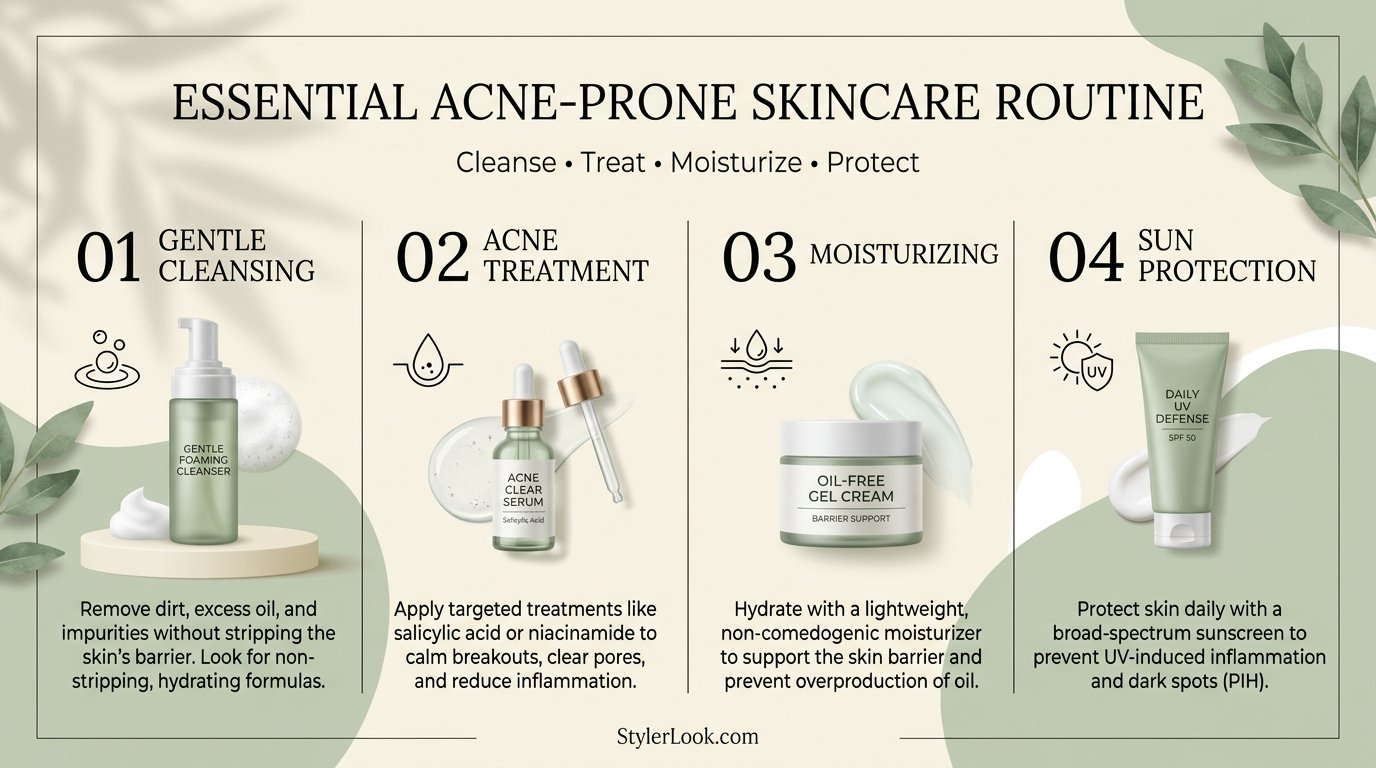
Retinization is a scheduled cost. Dryness, flaking, and sensitivity in the first weeks of a retinoid are the known adjustment, described across the clinical sources. Managed, they fade; fought, they end routines.
The ramp is the management. The clinic guides print the same ladder: two nights a week for two weeks, then alternate nights, then nightly as tolerated. Your skin sets the pace, not the calendar.
The Ramp: Two Nights a Week to Nightly
Step 1: weeks 1 and 2, twice weekly. Apply adapalene on two non consecutive nights. Moisturizer goes on generously on the off nights; the barrier is being trained, not punished.
Step 2: weeks 3 and 4, alternate nights. If flaking is mild and settling, move to every second night. If it is not settling, hold at twice weekly without shame; holding is the protocol working.
Step 3: week 5 onward, nightly as tolerated. Nightly is a ceiling, not a deadline. Plenty of skin clears on alternate nights forever, and that is a result, not a compromise.
Step 4: buffer when needed. The sandwich method, moisturizer, then retinoid, then moisturizer, trades a little speed for a lot of tolerance. Sensitive and dry skin types should start sandwiched.
Step 5: protect the borders. Keep the retinoid away from the eye corners, lip edges, and nostril creases, where skin is thin and irritation concentrates. A plain balm on those borders first is the field’s quiet trick.
The pregnancy line is absolute. Topical retinoids are avoided during pregnancy across the sources, stated in the guideline summaries without hedging. Pregnancy changes the routine, and the variant chapter routes it.
Adapalene’s label facts matter. In the US it is available over the counter at 0.1 percent for ages 12 and up, per the guideline summaries. Tretinoin remains prescription, a distinction the comparison table keeps clean.
Benzoyl Peroxide and Salicylic Acid: The Other First Choices
Benzoyl peroxide kills the bacterium. It attacks Cutibacterium acnes and calms inflammation, and it carries a rare superpower: bacteria do not develop resistance to it, which is why guidelines pair antibiotics with it.
The 2.5 percent finding inverts the shelf. A clinic source relays the classic study result: 2.5 percent performed like higher strengths with significantly less irritation. The 10 percent tube is not the upgrade it advertises.
That clinic source is Australian, flagged as such. The finding travels because it is a study result, not a market claim, but prices and product names in that guide do not transfer to US shelves.
Wash or leave on is a real choice. A benzoyl peroxide wash gives short contact: apply, wait briefly, rinse. It suits sensitive skin and large areas, and it still bleaches fabric on contact.
The bleaching is not a side note. Benzoyl peroxide bleaches towels, pillowcases, and collars. White linens for the treatment season are the standard practical advice, repeated because it keeps being learned the hard way.
Salicylic acid works inside the pore. As an oil soluble BHA, it enters the oily pore lining and dissolves the plug mixture, which is why it owns the blackhead pattern.
Its strengths are printed plainly. Cleansers and leave ons run 0.5 to 2 percent. A salicylic cleanser is the gentlest entry; a leave on is the stronger commitment, and the pattern decides.
The SkinStacker evidence ranked acne page ranks these ingredients by evidence in one table, and its top tier matches the guideline grades: the field’s honest sources agree more than their marketing suggests.
Never a starter stack. Salicylic acid in the morning and a retinoid at night can coexist later; benzoyl peroxide and a retinoid usually alternate rather than layer, because layering raises irritation for most skin.
Week by Week: The Honest Timeline
Weeks 1 to 4 often look worse. Retinoids and acids accelerate cell turnover, surfacing plugs that were already forming underground. More spots in week three is the mechanism working, pending the purging test next chapter.
Weeks 4 to 8 stabilize. Fewer new lesions, existing ones resolving faster, irritation from the ramp fading. This is the phase where diaries and photos earn their keep, because daily mirrors lie.
Weeks 8 to 12 are the assessment. By twelve weeks of consistent use, the routine has had a full cycle of plug formation to prevent. This is the judgment point the careful guides and the NICE course length share.
|
Phase |
What the skin is doing |
What you do |
|---|---|---|
|
Weeks 1 to 4 |
Turnover accelerates; hidden plugs surface; ramp irritation peaks |
Hold the routine; run the purging test; buffer, do not quit |
|
Weeks 4 to 8 |
New lesions slow; old ones resolve faster |
Keep one variable; photograph monthly in the same light |
|
Weeks 8 to 12 |
Prevention shows as absence: fewer new plugs forming |
Judge honestly at week 12; escalate or adjust one thing |
The microcomedone clock explains everything. A spot visible today began as an invisible plug weeks earlier. A prevention active cannot unhappen the past; it can only empty the future queue, which takes a full cycle.
The Barrier and Bloom acne routine guide stages this timeline the same way, worse, stabilizing, assessment, and adds the point this page agrees with: changing products every two weeks restarts the clock and teaches you nothing.
Purging or Breaking Out: The Test That Decides
Purging has an address. It appears in the areas you normally break out, because it is your existing plugs surfacing faster. New territory is the first warning sign of something else.
Purging has a tempo. The spots arrive and resolve faster than your usual breakouts, consistent with accelerated turnover rather than new disease.
Purging has a deadline. It settles within roughly four to six weeks on the field’s consistent account. A worsening that is still accelerating at week seven is not a purge.
A reaction has the opposite signature. Itching, burning, stinging, redness beyond the breakout zones, spots in places you never break out: that is irritation or intolerance, and the answer is to stop and reset, not to push through.
Only turnover actives can purge. Retinoids and exfoliating acids speed turnover, so they can purge. A plain moisturizer cannot purge you; breakouts on a new moisturizer are a reaction or a clog, full stop.
|
Signal |
Purging |
Reaction or new breakout |
|---|---|---|
|
Location |
Your usual breakout zones |
New places, or everywhere |
|
Feel |
Normal spots, faster cycle |
Itching, burning, stinging, rash like |
|
Timing |
Starts in weeks 1 to 3, settles by about week 6 |
Starts any time, keeps worsening |
|
Verdict |
Hold course, buffer, recheck weekly |
Stop the new product, reset the barrier |
The test protects two kinds of readers. It keeps the impatient from abandoning a working retinoid at week three, and it keeps the stubborn from enduring a genuine reaction for three months in purging’s name.
Layering Rules: What Shares a Session and What Alternates
Rule 1: one active per session while ramping. Morning may hold one, night may hold one, and a beginner’s routine often holds one in total for the first month.
Rule 2: benzoyl peroxide and retinoids alternate. Use peroxide in the morning and the retinoid at night, or alternate nights. Fixed combination products exist as prescriptions precisely because home layering is fiddly.
Rule 3: acids take the off nights. A salicylic leave on belongs on non retinoid nights for most skin. The calendar, not the bathroom shelf, is where actives learn to share.
Rule 4: moisturizer is everyone’s partner. It layers under or over any active on this page, which is why it is the one product nobody alternates.
Rule 5: sunscreen never negotiates. Nothing dilutes, replaces, or postpones the morning SPF, and no active, however promising, earns an exception.
Skin cycling is this, rebranded. The trend’s rotation of treatment and rest nights is alternation with better marketing. If the calendar works for you, use it; the principles predate the name.
When in doubt, subtract. A routine you are unsure how to layer is a routine with one active too many. Remove the newest addition and the layering problem usually removes itself.
The Support Cast: Niacinamide, Azelaic Acid, and the Marks Problem
Niacinamide supports; it does not lead. Vitamin B3 helps oil balance and redness and pairs peacefully with almost everything, which is why it lives in so many base products. It is the routine’s best supporting actor.
Azelaic acid owns the aftermath. Graded conditional by the guideline, it treats mild acne while fading the dark marks acne leaves, and it is notably gentle as actives go.
Marks are not scars, and the line matters. Post inflammatory hyperpigmentation is flat color that fades over months, faster with azelaic acid and strict sunscreen. True scars are texture: pits and ridges that no routine reverses.
Sunscreen is the marks treatment’s engine. Marks darken with sun exposure, so the morning SPF is doing double duty: protecting the treatment and lightening the ledger of old spots.
Vitamin C is a guest, not a resident. Morning vitamin C appears in some guides for marks; it is optional, occasionally irritating beside actives, and never a substitute for the matched active.
The support cast obeys the same entry rule. Add one at a time, weeks apart, after the main active is tolerated. A support product added during the ramp confuses every signal the purging test reads.
Our basic skincare routine shows where support products sit in a plain routine for readers who want the frame without acne’s extra rules, a useful comparison before adding anything here.
Variants: Teen, Hormonal, Dry, Sensitive, and Budget
Teen skin: simpler, supervised, T zone led. Teen acne rides puberty oil, concentrates on forehead, nose, and chin, and responds to the same frame with a gentler ramp. Adapalene’s US label starts at 12, and severe teen acne routes to a clinician early.
Hormonal pattern: the frame plus a ceiling. Jawline and chin breakouts that flare cyclically may improve on the frame, but persistent hormonal acne often needs a clinician conversation about hormonal options no cream replaces.
Dry acne prone skin: texture is the variant. Cream cleansers, richer moisturizers, sandwiched retinoid, fewer acid nights. Our skincare routine for dry skin is the house treatment of exactly this tension, dryness and breakouts sharing one face.
Sensitive skin: the slow lane is the fast lane. Longer ramps, wash off formats, azelaic acid’s gentleness, and fragrance free everything. Sensitive skin that tolerates a routine for twelve weeks beats ambitious skin that quits at three.
Budget: the frame is cheap by design. A drugstore cleanser, one drugstore active, a drugstore moisturizer, a drugstore SPF. The expensive version of this routine buys texture and elegance, not extra clearing.
A note on pregnancy. Retinoids come off the shelf, salicylic acid gets a label and clinician check, and azelaic acid is the active most often discussed as remaining. Any pregnancy routine is built with the obstetric clinician, not from a web page.
What never varies. Twelve weeks, one active at a time, sunscreen every morning, hands off the face. The variants change products and pace; they never change the rules.
Our skincare routine builder turns these variants into a personalized sequence for readers who want their skin type and budget assembled step by step rather than reasoned out in prose.
The Mistakes That Kill Working Routines
Mistake 1: the starter stack. Acid, peroxide, and retinoid from day one. The barrier fails, everything stings, and the reader concludes that treatments do not work on their skin, the field’s most expensive false conclusion.
Mistake 2: over washing and scrubbing. Acne is not dirt. Harsh scrubs and astringents strip the barrier, raise irritation, and can worsen breakouts, the opposite of the gentle cleansing every guideline source prescribes.
Mistake 3: skipping moisturizer out of fear. Oily skin on drying treatments without moisturizer gets flaky, sensitive, and less compliant, and the treatment is abandoned for tolerability reasons that were solvable.
Mistake 4: skipping sunscreen. Marks darken, retinoid sensitivity goes unprotected, and the reader blames the active for a sun problem. SPF is part of the treatment, printed on this page as a step, not a suggestion.
Mistake 5: the folk shelf. Toothpaste on pimples is the emblem: the AAD advises against it directly, in favor of the established actives. Lemon juice, baking soda, and alcohol toners belong on the same retired shelf.
Mistake 6: judging at week two. Every timeline in the honest literature forbids it. A routine judged at week two is a routine abandoned during its purge window, one photograph away from having worked.
Mistake 7: changing three things at once. New cleanser, new active, new moisturizer, same week. When the skin reacts, nobody knows which change did it, and the experiment must restart from zero.
Mistake 8: picking at lesions. Hands add bacteria, deepen inflammation, and convert marks into scars. The escalation chapter exists partly because picked acne crosses the line where routines stop being the right tool.
When the Routine Is Not Enough: The Escalation Ladder
The twelve week verdict has three outcomes. Clearly better: maintain. Partly better: adjust one variable or add the second active by alternation. Not better, or worse and scarring: escalate.
What a dermatologist adds first. Fixed combinations (a retinoid paired with benzoyl peroxide, or an antibiotic paired with peroxide under resistance rules), stronger prescription retinoids, and in office assessment of the pattern itself.
What comes next for the hormonal pattern. A clinician may discuss hormonal therapy options for adult women, a conversation this page can open but not conduct, because eligibility is medical, not cosmetic.
The top of the ladder is isotretinoin. For severe, nodulocystic, or scarring acne, oral isotretinoin is the guideline’s strong recommendation, dermatologist prescribed and monitored. A routine page that hides this does its sickest readers a disservice.
Scarring is the real deadline. Deep, painful lesions that leave marks or pits should not wait out a twelve week home trial. The cost of delay is permanent texture, which is why this page routes them early and repeats the routing.
Dark marks that persist also route. Marks that darken or refuse to fade despite sunscreen and azelaic acid deserve assessment, both for treatment and to confirm they are marks and not something else.
Escalation is not failure. The frame in this article is the floor of care, and for mild to moderate acne it is often the whole building. Knowing its ceiling is part of using it well.
The wider shelf lives at the StylerLook home page, where anti aging, routine building, and daily care sit beside this acne frame. Our morning skincare routine for anti aging is the morning reference most acne readers graduate to once breakouts calm.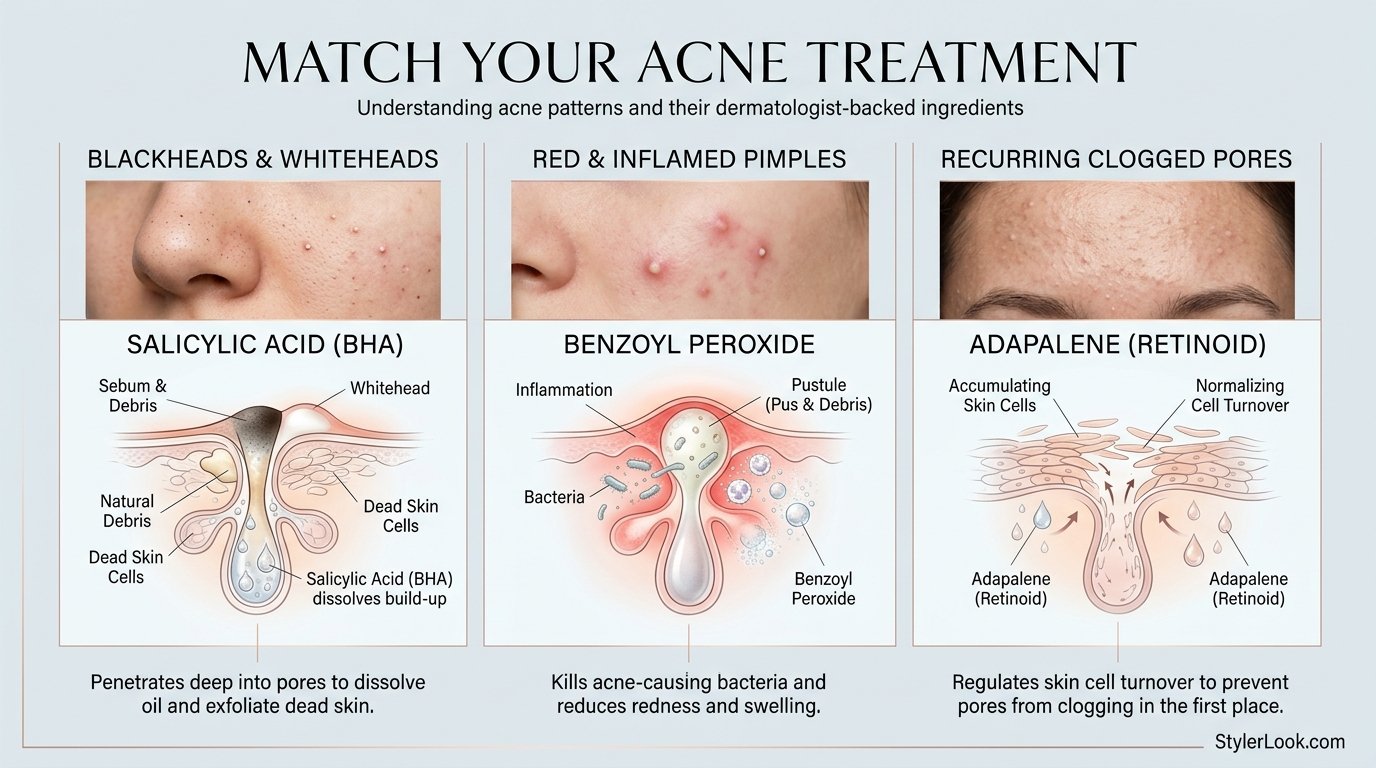
Frequently Asked Questions
1. What is the best skincare routine for acne?
Four steps, one active. Gentle cleanse, one treatment matched to your breakouts, a non comedogenic moisturizer, and broad spectrum SPF 30 every morning.
The active does the work; the other steps make it tolerable.
2. How many steps should an acne skincare routine have?
Four steps are enough. Cleanse, treat, moisturize, protect.
Toners, essences, and masks are optional extras added later for a named problem, and complicated routines are the ones readers abandon.
3. What order should I apply acne skincare products in?
Thinnest first, sunscreen last. Cleanse, then the treatment on clean dry skin, then moisturizer.
In the morning sunscreen goes on last; at night the active sits between cleansing and moisturizer.
4. Which is better for acne, benzoyl peroxide or salicylic acid?
It depends on the lesion. Salicylic acid wins for blackheads and whiteheads because it works inside the pore.
Benzoyl peroxide wins for red inflamed pimples because it kills bacteria and calms inflammation.
5. What is the best active for blackheads and whiteheads?
A pore unplugger. Salicylic acid, the oil soluble BHA, or a topical retinoid.
Both attack the plug behind comedonal acne; start one, ramp it slowly, and judge at twelve weeks.
6. What is the best active for red, inflamed pimples?
Benzoyl peroxide. It kills the acne bacterium and reduces inflammation, and bacteria cannot develop resistance to it.
Start at 2.5 percent, which the classic finding says performs like higher strengths with less irritation.
7. Should I use a retinoid for acne?
For recurring breakouts, yes. Retinoids prevent the plugs that become lesions, which makes them the prevention anchor.
Adapalene 0.1 percent is the over the counter reference; start two nights a week and ramp.
8. How often should I use adapalene when I start?
Start at two nights a week. Hold that for two weeks, then alternate nights, then nightly as tolerated.
Dryness and flaking early are the known adjustment; buffering with moisturizer manages them.
9. Can I use benzoyl peroxide and a retinoid on the same day?
Yes, split across the day. The usual pattern is benzoyl peroxide in the morning and the retinoid at night, or alternate nights.
Layering both in one session raises irritation for most skin.
10. Can I use salicylic acid and benzoyl peroxide together?
Yes, with spacing. A salicylic cleanser is the gentlest way to combine them.
Leave on acids and benzoyl peroxide in the same session can overload the barrier, so beginners separate them by session.
11. Why is my acne worse after starting a new routine?
Usually the mechanism, not a failure. Turnover actives surface plugs that were already forming, so weeks one to four often look worse.
Run the purging test: usual areas and faster healing mean hold course.
12. How do I know if my skin is purging or breaking out?
Location and feel decide. Purging stays in your usual breakout zones, cycles faster, and settles by about week six.
A reaction appears in new places with itching or burning and keeps worsening.
13. How long does purging last?
About four to six weeks. Purging begins in the first weeks as turnover accelerates and settles as the backlog of plugs clears.
Worsening that accelerates past week six is not a purge; reassess.
14. How long does an acne routine take to work?
Judge at twelve weeks. Improvement often starts around weeks four to eight, but prevention needs a full plug cycle.
The careful guides and the NICE course length both land on twelve weeks.
15. Why do dermatologists say to wait 12 weeks?
Because of the microcomedone clock. Every visible spot began as an invisible plug weeks earlier.
A prevention active empties the future queue, and one full formation cycle takes roughly twelve weeks to prove.
16. Do I need moisturizer if my skin is oily and acne prone?
Yes, even then. Moisturizer improves tolerance of drying acne treatments and protects the barrier.
Choose a lightweight, non comedogenic gel or lotion and oily skin usually finds it helps rather than harms.
17. Do I need sunscreen if I have acne?
Yes, every morning. Acne actives can raise sun sensitivity, and post acne dark marks darken with sun exposure.
Sunscreen is part of the treatment, not an optional beauty step beside it.
18. What SPF is best for acne prone skin?
Broad spectrum SPF 30 or higher. That is the floor the guidelines and routine guides share.
Texture decides compliance: a fluid or gel you will actually wear daily beats a richer cream you skip.
19. How many times a day should I wash acne prone skin?
Up to twice daily, gently. Wash with a gentle cleanser and fingertips, morning and night, and again after heavy sweating.
More washing, hot water, and scrubbing damage the barrier and can worsen breakouts.
20. Is a benzoyl peroxide cleanser as good as a leave on cream?
For many people, close. A wash gives short contact: less irritation, good for sensitive skin and large areas.
Leave ons are stronger commitments for stubborn patterns.
Both bleach fabric on contact.
21. Why does benzoyl peroxide bleach towels and pillowcases?
Because it is an oxidizer. Benzoyl peroxide bleaches dyes in towels, pillowcases, and collars on contact.
White linens during treatment are the standard practical advice, learned by many readers the hard way.
22. Is 2.5 percent benzoyl peroxide strong enough?
On the classic finding, yes. A clinic relayed study result says 2.5 percent performed like higher strengths against acne with significantly less irritation.
Tolerability, not the printed percentage, decides long term results.
23. Can teenagers use adapalene for acne?
Adapalene’s US label starts at 12. The guideline summaries note adapalene 0.1 percent is over the counter for adults and children 12 and older.
Severe or scarring teen acne should still see a dermatologist early.
24. What is the best skincare routine for hormonal acne?
The frame, plus honest routing. Jawline and cyclical breakouts use the same four steps and an active, but persistent hormonal acne often needs a clinician discussion about hormonal options no cream replaces.
25. What changes in an acne routine for sensitive skin?
Slow every dial. Longer ramps, wash off formats, fragrance free base products, and azelaic acid for its gentleness.
Sensitive skin that tolerates a routine for twelve weeks beats ambitious skin quitting at three.
26. What is the best budget skincare routine for acne?
Four drugstore products. A gentle cleanser, one matched active, a non comedogenic moisturizer, and SPF 30.
The frame is cheap by design; expensive versions buy texture and elegance, not extra clearing.
27. Are acne routine kits worth it?
Only if the kit matches you. Kits bundle a fixed active at a fixed strength.
If its active matches your pattern, the convenience helps; if not, you have bought three products to use one.
28. Can I wear makeup over an acne routine?
Yes, over the sunscreen. Let the SPF set for a few minutes, then apply makeup normally.
At night, remove it fully before the active, with micellar water first for heavy makeup.
29. Should I use a toner if I have acne?
Optional, not structural. A toner is not one of the four steps.
An alcohol free, gentle toner can stay if your skin likes it; astringent toners that sting belong on the retired shelf.
30. Is double cleansing good for acne prone skin?
Usually unnecessary. One gentle cleanse removes the day for most routines.
Double cleansing helps heavy makeup or water resistant sunscreen days; over cleansing acne prone skin costs barrier, not cleanliness.
31. What should I avoid in an acne skincare routine?
The barrier breakers. Physical scrubs on inflamed acne, harsh astringents, toothpaste and other folk spot treatments, fragranced heavy oils on congested zones, and any stack of three actives started in the same week.
32. Does toothpaste work on pimples?
No, and the AAD advises against it. The Skn Biome guide relays the academy’s position: use established acne ingredients such as adapalene, benzoyl peroxide, and salicylic acid instead of toothpaste.
33. Which acne ingredients are not safe during pregnancy?
Topical retinoids lead the list. The guideline summaries say retinoids are avoided during pregnancy.
Salicylic acid needs a label and clinician check, and any pregnancy routine should be built with the obstetric clinician.
34. What do I do if my acne routine is not working after 12 weeks?
Run the escalation test. Partly better means adjust one variable or add the second active by alternation.
Not better, or deep and scarring at any point, means a dermatologist, not a fifth product.
35. When should I see a dermatologist about acne?
At the scarring line, immediately. Deep painful nodules, lesions leaving pits or persistent marks, or no improvement after twelve consistent weeks.
Earlier is always acceptable; scarring is the deadline that matters.
36. Can an acne routine fade dark marks and acne scars?
Marks yes, scars no. Flat dark marks fade over months, faster with azelaic acid and strict sunscreen.
True scars are texture changes, pits and ridges, which no topical routine reverses; those route to a dermatologist.
37. Does diet matter alongside an acne routine?
As context, not as a lever. Diet claims in acne are contested strands, and no food rule replaces the matched active.
Keep notes if you suspect a personal pattern, and bring them to a clinician.
38. Can I use vitamin C with acne treatments?
Cautiously, as a morning guest. Some guides use vitamin C for marks.
It is optional, can irritate beside actives, and should be added alone, weeks after the main active is tolerated, never during the ramp.
39. Why did my acne come back when I stopped the routine?
Because acne is chronic and managed, not cured. Stopping the prevention active lets new plugs form on the usual clock.
Cleared skin moves to a maintenance version of the routine, not to no routine.
40. How do I restart an acne routine after irritation?
Reset the barrier first. Pause actives for about two weeks on cleanser, moisturizer, and sunscreen only.
Then restart the single main active at the bottom of the ramp and rebuild slowly.
41. Does salicylic acid or benzoyl peroxide work better for body acne?
Both work; format decides. Washes cover backs and chests practically, which is why benzoyl peroxide washes dominate body routines.
Salicylic sprays and washes handle congestion; leave ons are awkward over large areas.
42. What is the cheapest acne routine that still follows the evidence?
A cleanser, one active, a moisturizer, SPF. All four exist at drugstore prices in the guides’ own examples: a benzoyl peroxide or salicylic wash, adapalene gel, a ceramide moisturizer, and SPF 30.
Conclusion
The best skincare routine for acne is a frame and a decision, not a shelf. Cleanse, treat, moisturize, protect; then spend your judgment on the one decision the shelf cannot make for you, which active your pattern needs.
Match first, then wait properly. Benzoyl peroxide for the inflamed pattern, a pore worker for the clogged pattern, adapalene for the recurring one, and the purging test in hand for weeks one to six.
Twelve weeks is the contract. Give the matched active one full microcomedone cycle, photograph monthly, change one variable at a time, and let the week twelve verdict, better, adjust, or escalate, be a decision rather than a drift.
General information only, in closing. This page assembles published guidance into a routine; it does not diagnose your skin, and deep, painful, or scarring acne, or acne unchanged at twelve weeks, belongs to a dermatologist who can examine it.
