

Choppy pixie cut is a finish, not a technique: a pixie whose texture is carried in visibly separated, uneven ends while the body keeps its weight. You do not ask for it by naming a tool. You specify it by piece size.
The making of texture is a different subject. How point cutting, razors and shears create a surface, and where each tool is fenced off, is taught in full on the textured pixie technique guide. This page owns the finished surface: piece size, separation, and how the finish behaves once worn.
Read the scale first, then your hair type row. Versions, registers and the finish script follow from the size chosen.
What a Choppy Pixie Cut Is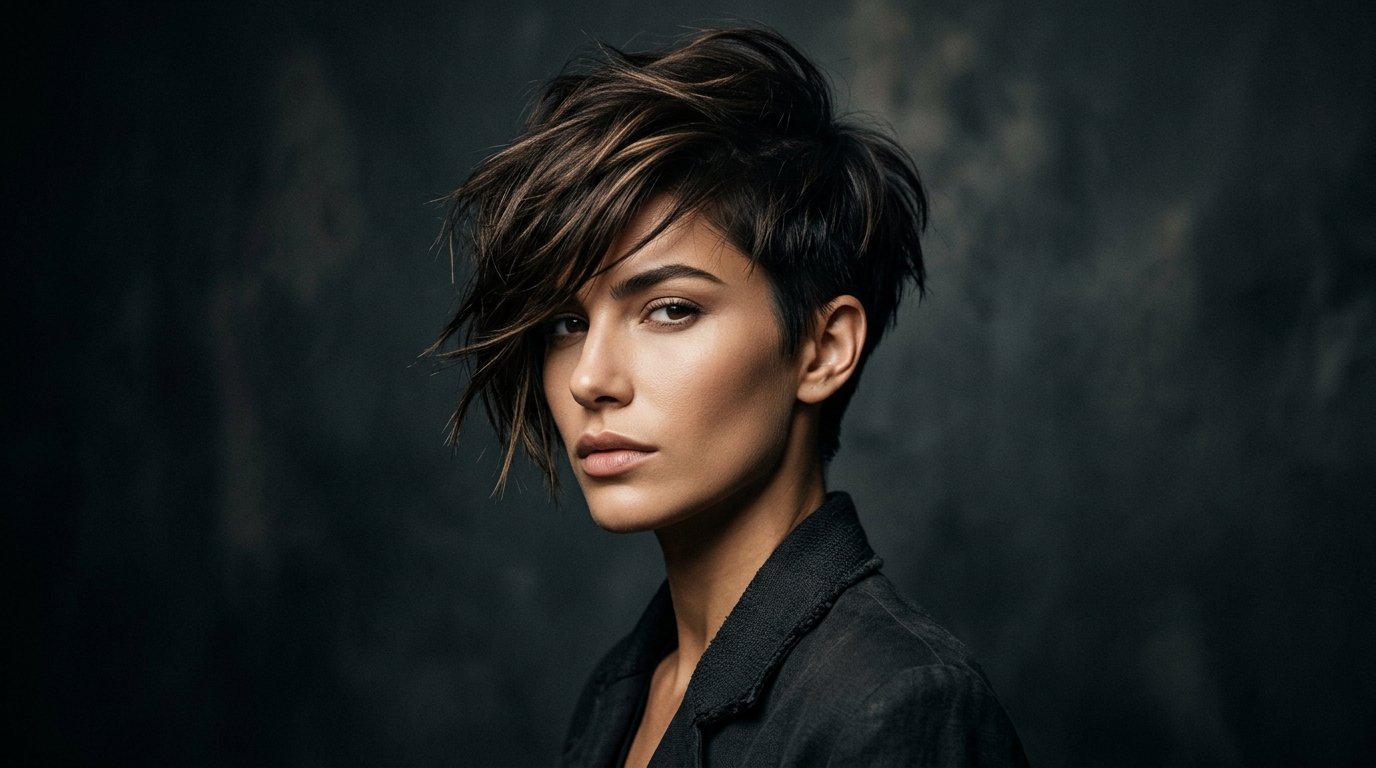
A choppy pixie keeps a normal pixie outline: cropped back and sides, length on top, a fringe. What makes it choppy is the ends: instead of one smooth perimeter, they are broken into separated pieces that read individually, like torn paper.
The clearest definition in the research comes from the DivaInspo gallery: choppy texture lives in the ends, while the body keeps its weight. That second clause is the protection. A pixie chopped through its whole body is not choppier; it is thinner, and it is the version that fails.
Ends only, or through the lengths: where the chop lives
The sources split here, and the strands stay separate. The ends-only strand (DivaInspo) keeps separation at the tips and fullness elsewhere. The layers-plus-ends strand (TheWoodMeter, HairDoLab) runs uneven layers through the cut too.
Choose by hair state. On fine or thinning hair, ends only is the safe specification; through-lengths chopping spends density you cannot spare. On thick hair, layers through the lengths are often what lets the pieces move.
The Piece Size Scale
A piece is one visible separated unit of the finish, and piece size is its width: the number no gallery gives you. The scale below is this page’s working specification, in fingertip widths you can check in the chair.
|
Piece size |
Width |
Separation |
Reads as |
Best on |
|---|---|---|---|---|
|
Fine pieces |
About half a fingertip |
Close, soft gaps |
Gentle piecey texture |
Fine hair, straight hair, first chop |
|
Medium pieces |
About one fingertip |
Clear visible gaps |
The classic choppy finish |
Most hair types, the default |
|
Chunky pieces |
About two fingertips |
Wide, bold gaps |
Jagged, edgy, high contrast |
Thick or coarse hair only |
One size up, one size down: how the wrong size fails
Go one size too big on fine hair and the gaps widen until they read as missing hair, with ends see-through at rest. Go one size too small on thick hair and the pieces cannot separate against that density; the cut reads as a smooth pixie with frayed ends.
Piece Size by Hair Type
|
Hair type |
Piece size |
Chop placement |
Why |
|---|---|---|---|
|
Fine |
Fine to medium |
Ends only, stacked support layers beneath |
Small pieces prop each other up |
|
Medium density |
Medium |
Ends only or through the lengths |
The forgiving middle: both strands work |
|
Thick or coarse |
Medium to chunky |
Through the lengths, weight out first |
Pieces need room and less bulk |
|
Curly |
Medium |
Ends only, cut dry |
Shrinkage narrows pieces as they dry |
|
Wavy |
Medium |
Either |
The wave break forms natural pieces |
|
Thinning crown |
Medium, directed forward |
Ends only |
Direction covers the part; chunky exposes it |
|
Silver or grey |
Medium |
Ends only |
Pieces break up grey blocks, catch light |
Fine hair: smaller pieces, fuller ends than the photos
The fine hair strand with a mechanism comes from DripDecoded: short, stacked, slightly jagged layers prop each other up, so the finish stands instead of lying flat. Keep ends fuller than gallery photos suggest; the see-through threshold arrives faster than the camera admits.
One fence travels with this row, taught in full on the textured page: thinning shears stay off fine and thin hair. The finish script below gives you the sentence that enforces it.
Silver and grey: the finish claim, with the dose rules elsewhere
On silver hair, medium pieces break up solid grey blocks and catch light at different angles, so the colour reads as dimension instead of one flat shade. That finish claim belongs here. The dose rules for changed hair live on the textured pixie for older women page; this page sizes the pieces once the dose is settled.
Choppy, Textured, Layered, Messy, Piecey: Five Words Separated
Salons and galleries use these five words as synonyms. They are not, and the strands below are printed as the sources give them, not merged.
|
Word |
What it actually names |
The one line test |
|---|---|---|
|
Choppy |
A finish: visible end break-up, body weight kept |
Can you count the pieces at the ends? |
|
Textured |
The process family: any texturising technique’s result |
It names how the surface was made, not one look |
|
Layered |
Length architecture: stacked or graduated lengths |
A pixie can be layered and completely smooth |
|
Messy |
A styling state: a precise cut worn undone |
The same cut can be worn polished tomorrow |
|
Piecey |
The unit: the visible separated pieces themselves |
Piecey names the pieces; choppy names their pattern |
The pair readers confuse most is choppy and textured. The textured page already answers that question in its own FAQ, and its answer stands: textured is the making, choppy is one look the making can produce. This page starts where that answer ends.
The Versions, Filed by Piece Size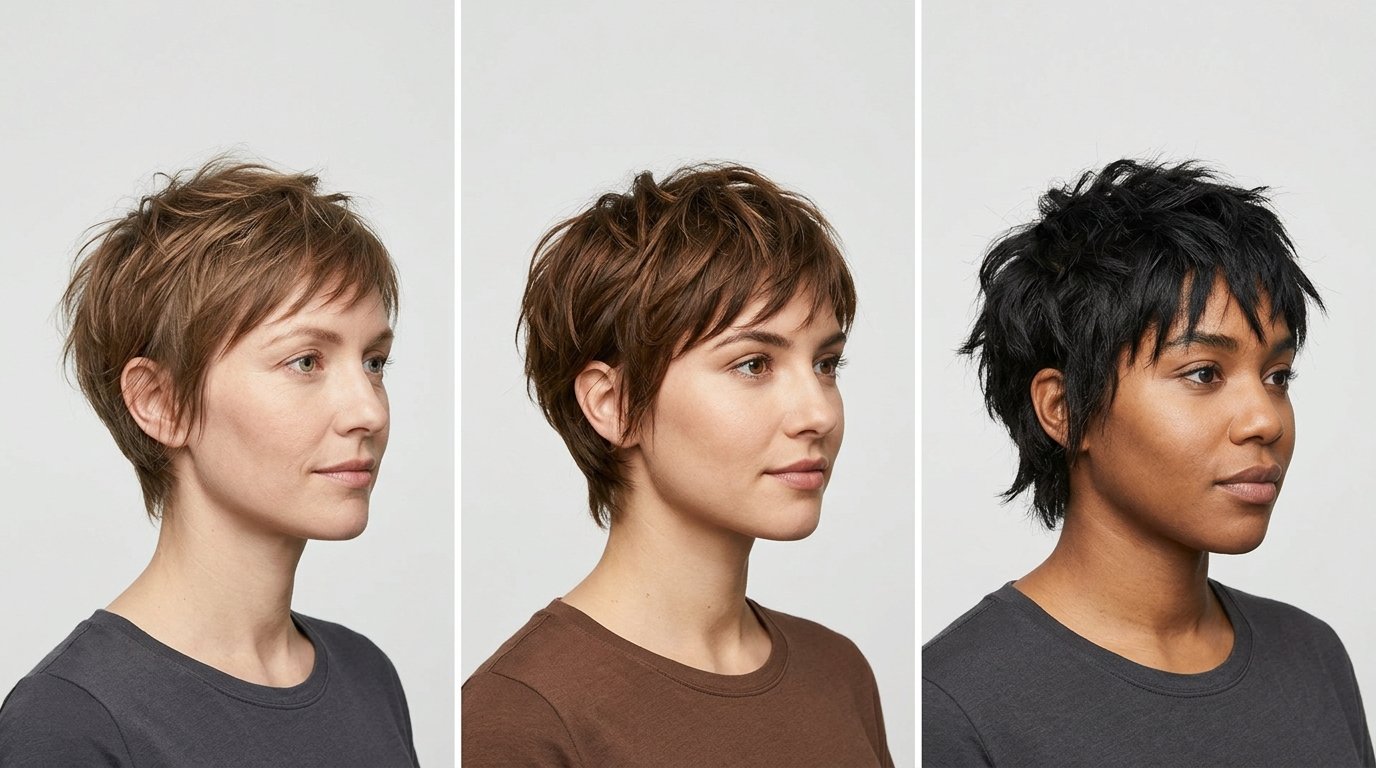
Each version states its piece size first, because that is the decision. More styles live in the hair styles collection.
1. Soft fine piece pixie
Fine pieces, ends only, perimeter softly broken. The entry version: choppy enough to read as texture, gentle enough to grow out invisibly.
2. Classic medium choppy pixie
Medium pieces through the crown and fringe, ends only at the sides. The default version, and the one the finish script describes.
3. Chunky edgy choppy pixie
Chunky pieces on thick hair, chop through the lengths. The boldest register; on finer hair it reads as gaps, not edge.
4. Disconnected choppy pixie
Medium pieces on a longer top, sides and back disconnected beneath it. The disconnection makes the top pieces read larger than their true size.
5. Feathered choppy pixie
Fine pieces with softened, feathered tips that taper instead of snapping. Suits softer faces and finer hair.
6. Spiky crown choppy pixie
Medium pieces at the crown, worn lifted. The sides stay smoother so the crown separation reads stronger.
7. Choppy pixie with a broken fringe
Medium pieces carried into the fringe, so the front edge is as broken as the crown. For a softer front instead, see the wispy curtain bangs and short curtain bangs guides.
8. Silver medium piece pixie
Medium pieces on grey or silver hair, ends only. The light catching version, sized by the silver row of the matrix above.
Two Registers, One Cut: Polished and Messy
A choppy finish has one advantage no smooth pixie offers: the same cut wears two registers. Hairstylematic’s galleries name the moods, sharp, soft, punky, polished, without teaching the switch. The switch runs on product direction, not more cutting.
The polished register, for work
- Start on dry hair; water resets fine pieces flatter than you want.
- Smooth a pea sized amount of light styling cream over the surface with flat palms, following the natural fall.
- Press the crown pieces down and together so separation reads as sheen lines, not gaps.
- Tuck the sides behind the ears; finish with the lightest hold spray you own.
The messy register, off duty
- Work a fingertip of matte paste through dry hair against its fall, then push it back.
- Pinch and twist the ends of the crown pieces so each piece points its own way.
- Leave the fringe broken. Symmetry is what makes choppy look styled; the messy register breaks it on purpose.
The cut never changes. What changes is whether the pieces are pressed together or pushed apart, under two minutes either way.
Colour Placement: The Separation Amplifier
Colour is a finish variable, and the galleries prove it without stating it. HairPrimo’s choppy entries return to one device across a whole list: dark roots and bright tips make the pieces stand out.
The principle is simple. Separation reads through contrast, which can be cut in or coloured in. Highlights or balayage on the piece ends make each piece catch light separately, so a medium finish reads a full size bolder.
The reverse holds too. One flat, all over colour flattens the read: the pieces are cut in but the eye cannot find them. If your finish looks weaker at home than in the chair, colour placement is a likelier cause than the cut.
Asking for It: The Finish Script
Galleries print stylist scripts for this cut, but they name tools: point cutting or razor, with no word about which hair gets which. Tool choice and its fences belong to the textured pixie technique guide. Your script should specify the finish and let the stylist choose tools inside their fences.
Medium pieces, about a fingertip wide, chop in the ends only, keep the body’s weight, and no thinning shears on my fine hair.
Adjust the first words to your matrix row: piece size, chop placement, protected area. Then ask the over-chop question out loud: how will we know if a piece has gone too thin?
Bring photos as a size reference, not a mood. Point at the pieces and state their width against your fingertip; that gesture prevents most of the gap between photo and result.
Grow-Out: The Mullet Stage and the Forgiving Weeks
A choppy pixie grows out unevenly on purpose, and mostly that is a gift. The broken perimeter has no single line to go blunt, so the shape softens gradually instead of expiring on one date.
One competitor claim belongs here, labelled as a claim: HairDoLab states that a choppy pixie hides growth about two weeks longer than a blunt pixie. No source is given. It matches the mechanism, but it is printed as their claim, not a measured fact.
The mullet stage: the one awkward phase
TheWoodMeter’s over 50 guide names the risk plainly: a choppy pixie left untrimmed grows out into a mullet shape. The mechanism is growth geometry. The nape grows down while the shorter crown pieces lose separation and lie flat. Length collects at the back, lift leaves the top, and the silhouette reads mullet.
Style through it rather than restarting: lift the crown with root product, pinch the pieces back into separation, keep the nape tucked or pinned flat, and book the reshape when the nape passes your collar line. This stage is a grow-out phase, not the pixie mullet style; that trend variant belongs to the trendy pixie haircuts page.
Trim strands, printed by source and never merged
|
Strand |
Source |
Applies to |
|---|---|---|
|
3 to 5 weeks |
TheWoodMeter choppy guides |
Keeping the intentional messiness and edge |
|
Neckline 3 to 4 weeks, reshape 5 to 6, restructure 8 to 10 |
HairDoLab schedule, a non-US source, labelled |
A split schedule: perimeter care more often than reshaping |
|
4 to 6 weeks |
TheWoodMeter tables and the cluster core pixie strand |
General shape upkeep |
What upkeep costs is frequency, not a figure: the strands above are the honest maintenance maths for this finish.
Frequently Asked Questions
1. What is a choppy pixie cut?
A pixie whose texture is carried in visibly separated, uneven ends while the body keeps its weight. A finish you specify by piece size, not a technique you name.
2. What is the difference between a choppy pixie and a messy pixie?
Choppy is cut in; messy is worn. A messy pixie is a precise cut styled undone, and the same choppy cut can be worn polished instead. Messy names the styling state; choppy names the finish underneath.
3. What is the difference between a choppy pixie and a layered pixie?
Layering is length architecture underneath any finish. A layered pixie can be completely smooth, and a choppy pixie can sit on few layers. Choppy pieces are a finish on top of whatever layering exists.
4. What is the difference between a choppy pixie and a piecey pixie?
Piecey names the unit: one visible separated piece. Choppy names the pattern the units make across the ends. Every choppy pixie is piecey; soft, even separation is gentler than choppy.
5. What is the difference between a choppy pixie and a shaggy pixie?
Length and layering. Shaggy pixies carry longer, heavier layers and a softer outline. Choppy stays at true pixie length with its break-up in the ends. The shag begins where the length stops reading as a crop.
6. How big should the pieces be in a choppy pixie?
Use the fingertip scale: fine pieces about half a fingertip wide, medium about one, chunky about two. Medium is the default. State the width in the chair; no gallery gives you this specification.
7. Which piece size suits fine, medium and thick hair?
Fine hair: fine to medium pieces, ends only, stacked support layers beneath. Medium density: medium pieces, either placement. Thick hair: medium to chunky, weight removed first so pieces can separate.
8. How do you tell if a choppy pixie has been over-chopped?
Three signs: pieces thinner than the hair can support, ends see-through at rest, and shape that collapses within days. One gallery warns over-thinned pixies lose shape within a week; treat that as the outer limit.
9. Does a choppy pixie work for fine hair?
Yes, at the fine hair specification: smaller pieces, ends only, stacked layers underneath propping each other up, and ends fuller than the photos suggest. Through-lengths chopping and thinning shears are both wrong for fine hair.
10. Is a choppy pixie good for thinning hair?
It cuts both ways. Medium pieces directed forward soften a widening part, because broken ends scatter the eye. Chunky pieces do the opposite, opening gaps that show the scalp. Sudden or patchy loss belongs with a clinician first.
11. What is a disconnected choppy pixie?
A choppy pixie whose longer top is not blended into the cropped sides and back. The disconnection makes top pieces read larger and more deliberate, and books its own tidy ups as the underlayer grows.
12. What is a feathered choppy pixie?
A choppy pixie whose piece ends are tapered soft instead of snapped blunt. The separation remains, but each piece dissolves at its tip. The gentlest choppy register, and the kindest for fine hair and softer faces.
13. Does a choppy pixie work on grey or silver hair?
Yes, and the finish helps the colour: medium pieces break up solid grey blocks and catch light at different angles, so silver reads as dimension. Dose rules for changed hair live on the older women textured page in this cluster.
14. Do highlights or balayage change how choppy a pixie looks?
Yes. Contrast on the piece ends makes each piece catch light separately, so the same cut reads a full size bolder. One flat all over colour reverses it: the pieces are cut in, but the eye cannot find them.
15. How do you style a choppy pixie for the bedhead look?
Work a fingertip of matte paste through dry hair against its fall, push it back, and pinch and twist the crown pieces so each points its own way. Bedhead is deliberate direction chaos, not unwashed hair.
16. How do you spike a choppy pixie?
Spike the crown only. Apply a fingertip of strong hold product to dry crown pieces, lift them between finger and thumb, and let the sides stay smoother. Spiking everywhere reads as a different cut.
17. Can the same choppy pixie be worn polished for work and messy off duty?
Yes; that is this finish’s main advantage. Polished means pieces pressed down and together with light cream, following the fall. Messy means pieces pushed apart with matte paste, against it. Same cut, two directions.
18. How do you refresh a choppy pixie in the morning without washing?
Keep it dry and short: no re-wetting for fine pieces. Pinch and twist the flattened crown pieces back into separation, smooth the sides with a flat palm, and stop. Sleep flattens pieces one way; your fingers return them several ways.
19. Does a choppy pixie grow out better than a blunt pixie?
Mostly yes, because there is no single line to go blunt; the broken perimeter softens gradually. One competitor claims roughly two extra forgiving weeks, printed here as a labelled claim, not a measured fact.
20. Why does a choppy pixie grow out into a mullet shape, and how do you style through it?
The nape grows down while shorter crown pieces lose separation and lie flat, so length collects at the back. Lift the crown, pinch the pieces back, keep the nape tucked flat, and book the reshape when it passes your collar line.
21. Does a choppy pixie need re-chopping at every trim?
No. Reshaping and re-chopping are different appointments: a reshape restores the outline; pieces are re-cut only once they outgrow their specified width. One non-US schedule splits the rhythm this way, neckline care more often than restructuring.
22. What should I ask my stylist for when I want a choppy pixie?
The finish script: piece size in fingertip widths, ends only or through the lengths, the body’s weight kept, and your protected area named, including no thinning shears if your hair is fine. Then ask how you will both recognise an over-chopped piece.
Conclusion
A choppy pixie cut rewards the reader who specifies the finish: choose your piece size, state where the chop lives, protect the body’s weight, and the same cut wears polished on Monday and messy on Saturday.
For the technique teaching behind every fence named here, read the textured pixie technique guide. For matching this finish against every other family, the pixie haircuts matching guide carries the full system, and the short hair family lives at StylerLook.
