

Angled pixie cut means a pixie whose perimeter slopes downward from a shorter back to a longer front. The cut is defined by three numbers: the drop in inches, the longest point landmark, and the back treatment.
Galleries name the angle constantly and measure it almost nowhere. This page measures it, so you can specify the cut in numbers instead of hoping a photo translates.
Every version below carries its three numbers. Read the specification first, then use the measurement script to ask for exactly that.
What an Angled Pixie Cut Is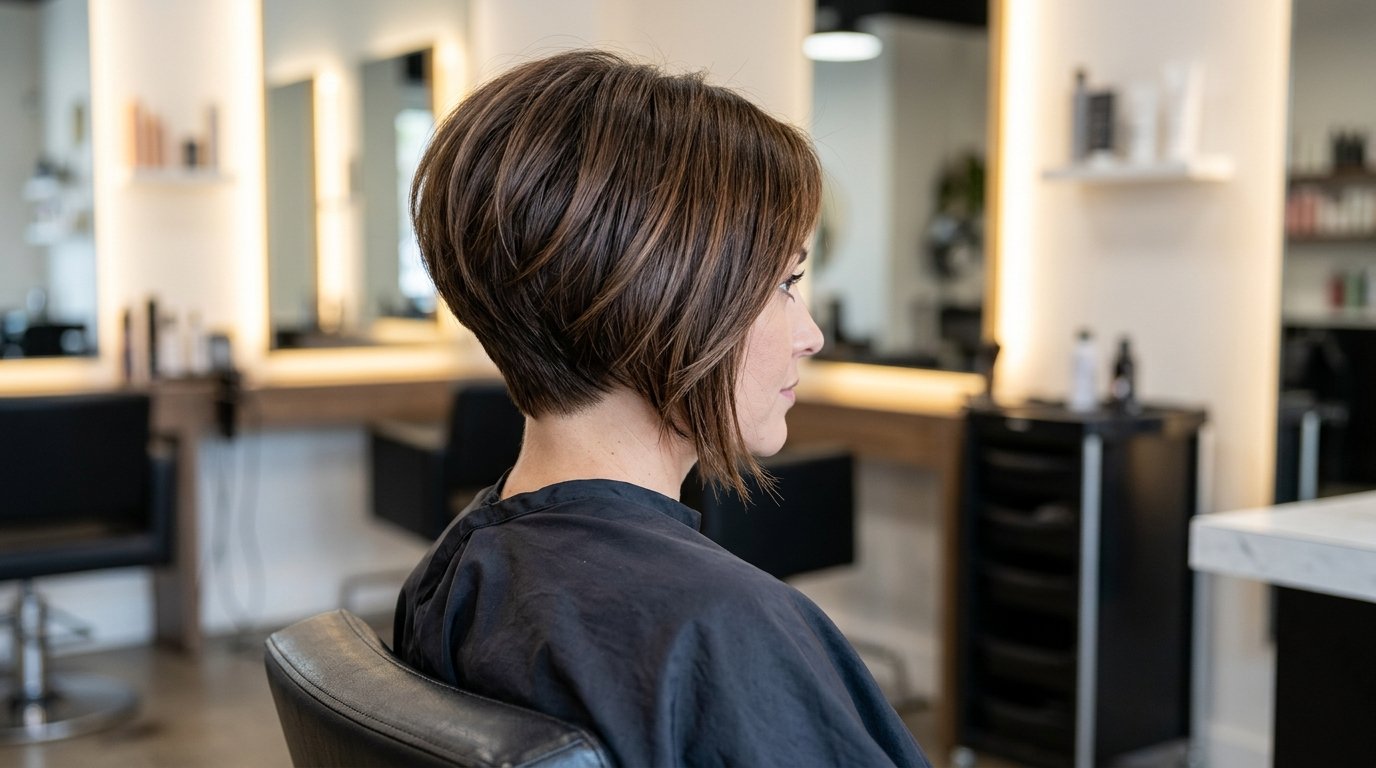
An angled pixie cut is a cropped back and sides with front panels left longer, joined by one continuous diagonal perimeter line. The back sits at pixie length; the front reaches the ear, cheekbone, jaw or, at most, the chin.
The three numbers that define the cut
The first number is the drop: how many inches longer the front is than the back. The second is the longest point: the facial landmark where the front panel ends. The third is the back treatment: a clean line, or layers stacked into it.
Change any one number and you change the cut. A one inch drop with a clean A-line back reads soft and classic; a three inch drop with a stacked back reads sharp and architectural.
Angled, asymmetrical, graduated, inverted, stacked: the words, separated
Salons use these words loosely, and the fetched sources do not all agree. The strands are printed as found, not merged, because the working rule matters more than any single word: specify measurements, not vocabulary.
|
Term |
What it names |
The strand to know |
|---|---|---|
|
Angled |
The front to back slope of the perimeter |
Some galleries use it for any diagonal detail, even a fringe |
|
Asymmetrical |
A side to side length difference |
The difference must remain when styling stops, per one fetched guide |
|
Graduated |
Stacked layers built into the back |
Some sources use it as a synonym for the whole family |
|
Inverted |
One strand: a synonym of graduated, often more dramatic |
Another strand: a distinct type with a curved, heavily stacked back |
|
Stacked |
The dramatic, closely layered end of graduation |
All stacked backs are graduated; not all graduated backs are stacked |
|
A-line |
The perimeter only: a clean diagonal, little or no stacking |
The cleanest synonym for angled at pixie length |
The distinction that protects you is the first two rows. Angled runs front to back; asymmetrical runs side to side. A cut can be either, both, or neither, and the two words are not interchangeable.
For general matching across every family, the pixie haircuts matching guide carries the full system. This page owns one thing: the angle, measured.
Steep, Soft or Subtle: Choosing Your Angle
Steepness is the first decision, before face shape, before texture. The ranges below are this page’s working specification for pixie length, stated as a salon guide, not a fetched rule.
|
Angle class |
Drop, front vs back |
Longest point |
Reads as |
|---|---|---|---|
|
Subtle |
About half an inch to 1 inch |
Ear to cheekbone |
A classic pixie with a lean |
|
Soft |
About 1 to 2 inches |
Cheekbone to jaw |
The most wearable, most requested setting |
|
Steep |
About 2 to 3 inches |
Jaw to chin |
Sharp, architectural, highest upkeep |
For scale, the fetched bob length strands run larger: one bob guide calls a 4 to 5 inch drop dramatic, and a degree framing of 15 to 45 degrees appears on the same bob pages. Those figures belong to bob length only and are never pixie measurements.
Where the longest point should land
The longest point is the landmark you say out loud. Cheekbone length sharpens the cheek and suits finer fronts; jaw length frames the jawline and carries more styling weight.
Chin length is the boundary: past the chin, the front belongs to bob territory, whatever the back is doing. If your front reaches the chin, read the angled bob comparison below before booking.
The back: clean A-line or graduated and stacked
A clean A-line back keeps the perimeter as one unbroken line, with the nape tapered close. It grows out evenly and asks the least discipline between cuts.
A graduated or stacked back builds short layers into the nape, lifting the silhouette and sharpening the slope. It looks stronger in week one and loses its shape fastest, because the stacked layers are the shortest hair on your head.
Choose the back by your trim discipline, not the photograph. If appointments drift, the clean line forgives you.
The Angle by Face Shape
|
Face shape |
Angle setting |
Longest point |
Why |
|---|---|---|---|
|
Round |
Soft to steep |
Jaw |
The diagonal lengthens the face outline |
|
Square |
Soft, with feathered ends |
Cheekbone to jaw |
A soft slope takes the edge off a strong jaw |
|
Oval |
Any class |
Any landmark |
The balanced shape carries every setting |
|
Heart |
Soft |
Jaw |
Front length adds width where the face narrows |
|
Long |
Subtle only, or skip |
Ear to cheekbone |
A steep front adds length the face does not need |
|
Diamond |
Soft |
Cheekbone |
Length at the cheek widens the narrowest zone |
Round faces: the angle earns its keep
A round face is where the angled pixie does its best work. The forward diagonal draws the eye down and forward, and the face reads longer without any height added at the crown.
Keep the sides close and tapered. Width at the ears cancels the lengthening the front just bought, which is the most common round face mistake in the galleries.
Square faces: soften the slope, feather the ends
A square jaw already supplies the geometry, so the cut should contrast, not echo. A soft angle with point cut, feathered ends breaks the straight lines a steep blunt slope would repeat.
Long faces: the honest warning
Most galleries push this cut at round faces and stay silent on long faces. A steep angle on a long face stretches the outline further, and no styling fully reverses it.
If your face is long, choose the subtle class, keep the longest point at the cheekbone, and add a fringe for width. Or choose a different family entirely.
Heart and diamond faces: length where the face narrows
Heart faces narrow at the jaw, so a jaw length front restores balance below the cheekbones. Diamond faces narrow at both ends, so the longest point sits at the cheekbone, widening the middle.
The Angle by Hair Texture and Density
Fine hair: the angle builds fullness, until it thins the ends
On fine hair, the longer front reads as fullness, because length concentrated at the face looks like density. The illusion holds while the front ends stay blunt and unthinned.
It reverses at the see-through point. If the front panel is texturised hard, the longest point goes stringy, and the angle reads as two thin strings instead of one clean line.
Ask for the slope cut with scissors and point cutting only at the front. The texture techniques behind that request are taught in full on the textured pixie technique guide.
Thick hair: debulk under the line, or wear a triangle
Thick hair on a steep slope flares outward as it lengthens toward the front, forming a triangle silhouette. The fix is internal: weight removed under the perimeter line, so the outline stays clean while the bulk goes.
The perimeter itself stays blunt. Thinning the visible line on thick hair frays the very edge the angle exists to show.
Curly and coily hair: cut it dry, because shrinkage moves the point
Curls shrink as they dry, and they shrink unevenly. A longest point measured on wet hair can land an inch higher by evening, and the two sides can land differently.
The rule from the fetched cutting guidance is simple: cut curly hair dry, in its natural fall, and set the longest point where it sits dry. The angle on curls reads softer, which suits a soft or subtle class best.
Wavy and straight hair: the easy carriers
Wavy hair holds the slope with natural movement, and the front panel swings instead of hanging. Straight hair shows the line most precisely, which means it also shows every uneven millimetre at a trim.
Straight hair on a steep angle is the highest precision version. Choose it only with a stylist whose short hair work you have seen.
The Versions, Filed by Angle
Each entry states its drop, longest point and back treatment, in that order. More short styles live in the hair styles collection once you know your numbers.
1. Subtle lean pixie
Drop about half an inch, longest point at the ear, back clean and tapered. The entry level angle: a classic pixie that leans forward instead of sitting level.
2. Soft classic angled pixie
Drop about 1 to 2 inches, longest point at the cheekbone, back clean A-line. The balanced version most first time wearers should start from.
3. Jaw drop angled pixie
Drop about 2 inches, longest point at the jaw, back lightly graduated. The front frames the jawline and tucks behind the ear on one side.
4. Steep architectural pixie
Drop about 2 to 3 inches, longest point approaching the chin, back stacked. The sharpest pixie length version, and the one that books its trims in advance.
5. Angled pixie with stacked back
Drop about 2 inches, longest point at the jaw, back stacked and lifted. Choose it for flat hair at the nape that needs built in volume.
6. Angled pixie with undercut
Drop about 2 inches, longest point at the cheekbone, back and sides undercut beneath the slope. The disconnection makes the diagonal read stronger than the drop alone would.
7. Angled pixie with side swept fringe
Drop about 1 to 2 inches, longest point at the cheekbone, fringe swept diagonally across the forehead. The fringe echoes the perimeter angle, doubling the diagonal effect.
8. Angled pixie with diagonal micro fringe
Drop about 1 inch, longest point at the ear, fringe cut on a short diagonal. An edgier register; the fringe needs its own trims between full cuts.
9. Textured angled pixie
Drop about 1 to 2 inches, longest point at the jaw, ends point cut throughout. Texture softens the geometry, the forgiving choice for wiry or coarse hair.
10. Sleek angled pixie
Drop about 2 inches, longest point at the jaw, back clean, front worn smooth and forward. The precision showcase version for straight hair.
11. Curly angled pixie, cut dry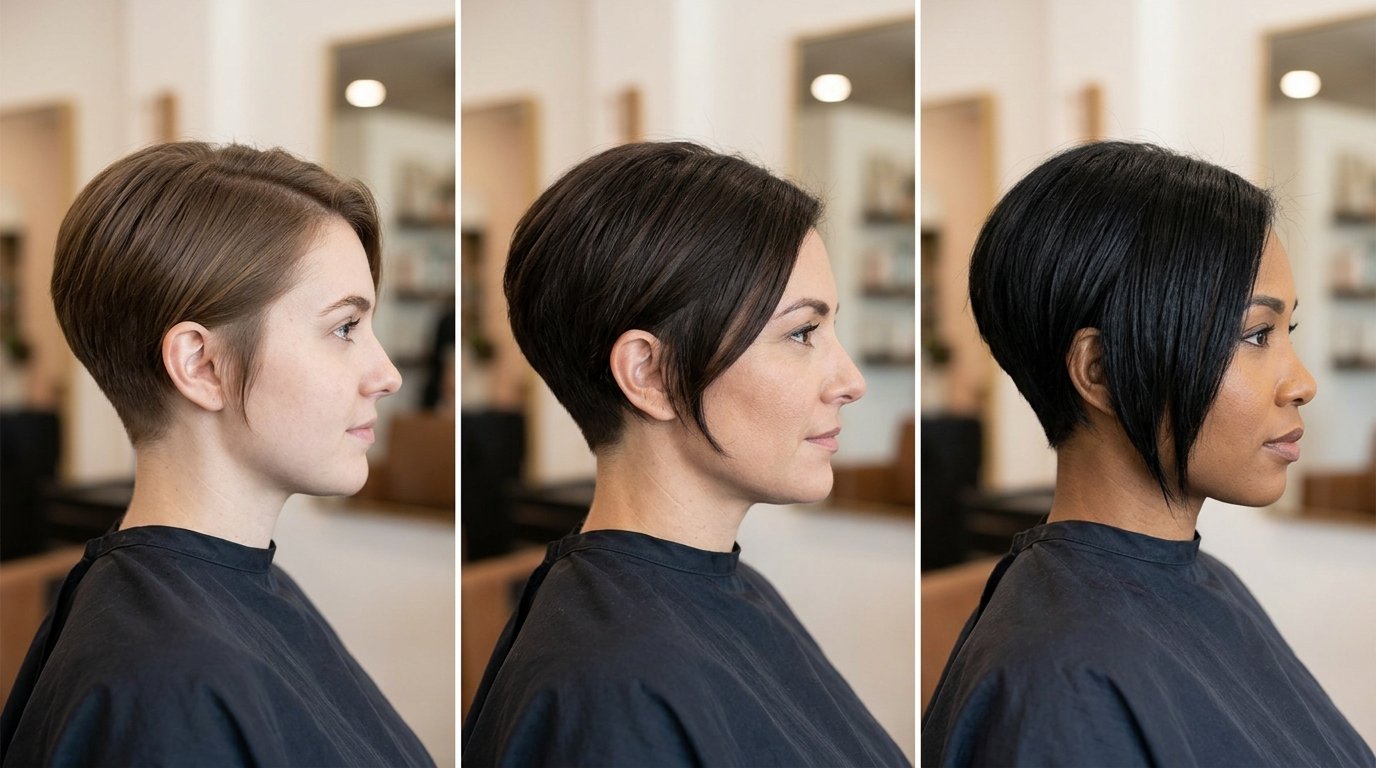
Drop about 1 to 2 inches dry, longest point at the cheekbone dry, back tapered. Measured in the dry state, because that is the state you wear.
12. Angled pixie for fine hair
Drop about 1 inch, longest point at the cheekbone, front panel kept blunt and full. The fullness illusion version, with texturising kept off the front ends.
13. Angled bixie boundary version
Drop about 2 to 3 inches, longest point at the chin, back cropped close. The longest pixie length version before the cut crosses into the angled pixie bob boundary below.
14. Silver angled pixie
Drop about 1 to 2 inches, longest point at the jaw, back clean. On silver hair the unbroken diagonal reads as deliberate and modern, and the clean line shows the colour at its brightest. Where current fashion takes these bones is tracked on the trendy pixie haircuts page.
Angled Pixie vs the Neighbours
Vs asymmetrical pixie: front to back against side to side
|
Angled pixie |
Asymmetrical pixie |
|
|---|---|---|
|
Direction of difference |
Front to back |
Side to side |
|
Test |
Measure back length against front length |
Style it flat; the imbalance must remain |
|
Sides |
Even, unless combined |
Deliberately uneven |
|
Trim driver |
The perimeter and the longest point |
The shorter side sets the timeline |
One cut can carry both: a front to back slope and one longer side. Name both in the salon, because each has its own trim discipline.
Vs angled bob: the boundary table
|
Landmark |
Angled pixie |
Angled bob |
|---|---|---|
|
Back |
Cropped, tapered or stacked at the nape |
Below the nape, covering the neck’s top |
|
Front longest point |
Ear to chin |
Chin to collarbone |
|
Drop strands |
About half an inch to 3 inches (this page’s pixie specification) |
4 to 5 inch dramatic drop (fetched bob strand) |
|
Reads as |
A pixie from every side |
A bob from the front, shorter from behind |
Vs classic pixie and the pixie bob
A classic pixie sits level: back and front within a whisper of each other. Add a measured slope and it becomes angled; grow the front to chin length all round and it becomes a pixie bob, with the angled pixie bob as the sloped member of that family.
The angled pixie bob is handled here as a boundary, never a second topic: if the whole outline reaches bob landmarks, the bob rules, bob drops and bob trims apply, not this page’s.
How to Ask for It: The Measurement Script
Photos alone fail because two salons read the same photo at different steepness. Numbers travel; impressions do not. Say this, before the cape goes on:
Back cropped to the nape, front dropping about [one / two] inches to land at my [cheekbone / jaw], back kept [clean / stacked].
Then ask for the mirror check: the stylist holds the mirror so you see the side profile before cutting starts. The side view is where the angle lives; the front mirror view hides it.
Bring photos of your angle class, not just your dream finish, and state which of the three numbers each photo represents for you. If a stylist cannot repeat your three numbers back, the consultation is not finished.
Styling the Angle So It Shows
The angle is a direction, and styling either underlines it or erases it. Dry the front forward and down, following the slope, never brushed back against it.
- Start on towel dried hair with a pea sized amount of smoothing product through the front panel only.
- Blow dry the back down and close, then direct the front forward along the diagonal with a paddle brush.
- Finish with a light texture spray or a fingertip of paste on the longest point, defining the end the eye should land on.
- Tuck one side behind the ear if you want the slope to read steeper without cutting anything.
Products stay by function: a smoothing serum for sleek versions, a texture spray for piecey ones, a root lift product at the crown for flat hair. Heavy product on the front panel weighs the longest point down and bends the line.
Fringe styling interacts with the angle, which is why the wispy curtain bangs and short curtain bangs guides are worth reading before choosing a longer diagonal fringe.
Trims: The Discipline That Keeps the Angle
An angled pixie does not grow out evenly in effect, even though hair grows evenly in fact. The difference between front and back is the cut, and even growth shrinks that difference in proportion every week.
Trim guidance arrives in strands, printed unmerged. The cluster core strand for pixies is 4 to 6 weeks for a full reshape. One fetched angled guide gives 6 to 8 weeks, with lived in versions stretched to 10 to 12 weeks; that strand describes softer angles, and it is printed here as its source gives it.
|
Trim type |
What it protects |
Working rhythm inside the core strand |
|---|---|---|
|
Full reshape |
The drop and the back treatment |
The 4 to 6 week core strand |
|
Perimeter check |
The longest point and the clean line |
Between reshapes, when the front starts to curl or split |
|
Nape dusting |
The cropped back and stacked layers |
The shortest hair grows out of shape first |
|
Fringe trim |
The diagonal fringe line |
More often than the rest of the cut |
The rule that saves the angle: protect the longest point. Trimming the front at the same rate as the back between reshapes is exactly how the drop quietly dies.
What upkeep really costs is frequency, not a figure: a steep angle on the core strand books more salon visits a year than a level classic pixie. That rhythm, not a price list, is the honest maintenance maths.
Growing Out an Angled Pixie: The Uneven Stage and the Bob Exit
The grow out has a built in awkward stage, and it helps to know its shape in advance. The back reaches toward the front’s length while the front keeps growing, so the slope flattens first, then the silhouette turns bottom heavy.
Secondary sources attribute to the American Academy of Dermatology a growth figure of about half an inch per month; in this cluster’s record that figure is an attributed strand, not primary verified, and it is used here only to explain the mechanics: even growth everywhere is what erases a length difference.
The exit routes are two. Convert to an angled bob: keep growing the front, let the back lengthen past the nape, and the cut crosses the boundary table above into bob territory, cleanly. Or level it off: one reshape cuts the front back to a classic pixie, ending the angle on purpose.
Surviving the middle weeks is mostly styling: tuck the longer side, pin the front panel, and let a perimeter check trim tidy the line without touching the growing lengths. The precision vocabulary behind all of this is ground cosmetology programmes such as Ogle School teach.
Mistakes That Kill the Angle, and Fixes
- Judging the angle from the front mirror. The slope is invisible head on. Fix: always check the side profile before and after cutting.
- Trimming the front with the back. Equal trimming erases the drop. Fix: longest point protected, perimeter checks only.
- Stacking a back you cannot maintain. The strongest week one shape fades fastest. Fix: choose the clean A-line back if appointments drift.
- Texturising the front ends on fine hair. The longest point goes stringy. Fix: blunt front panel, texture kept to the crown and interior.
- Cutting curls wet to a landmark. Shrinkage moves the point. Fix: dry cutting, landmark set in the worn state.
- Going steep on a long face. The diagonal adds length. Fix: subtle class, cheekbone point, fringe for width.
For the older reader weighing this shape against softer options, the short shaggy haircut for women over 70 page carries the over 70 comparison in full.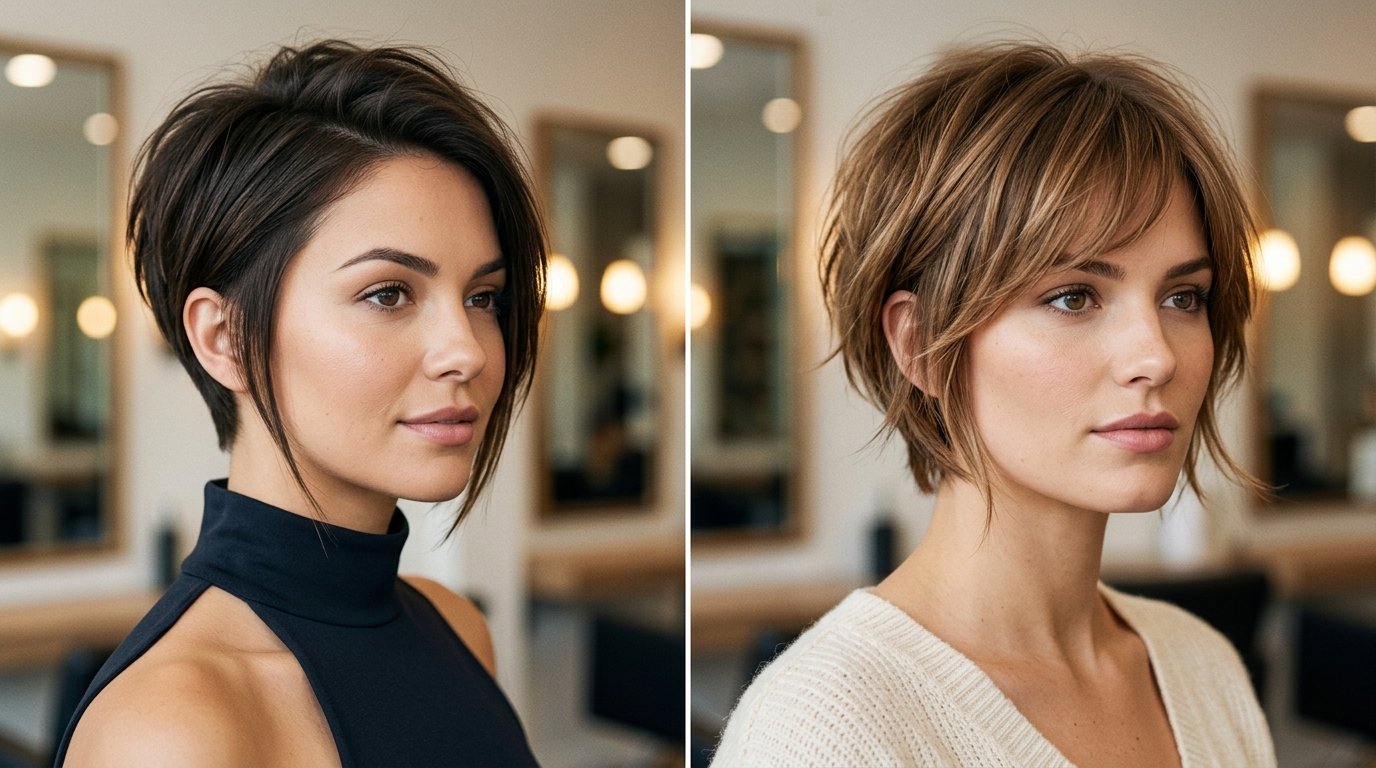
Frequently Asked Questions
1. What is an angled pixie cut?
A pixie whose perimeter slopes from a shorter back to a longer front. It is specified by three numbers: the drop in inches, the longest point landmark, and the back treatment, clean or stacked.
2. Is an A-line pixie the same as an angled pixie?
Essentially yes at pixie length. A-line names the perimeter: a clean diagonal line with little or no stacking in the back. An angled pixie with a stacked back is angled, but no longer a pure A-line.
3. What is the difference between an angled pixie and an asymmetrical pixie?
Direction. Angled runs front to back: the front is longer than the back, sides even. Asymmetrical runs side to side: one side is longer, and the difference must remain when styling stops. One cut can be both.
4. What is the difference between an angled pixie and a graduated or inverted pixie?
Graduation names the back’s layering, not the outline: stacked layers building volume at the nape. Inverted is a strand word, a graduated synonym in some salons, a distinct stacked type in others. The outline slope is the angle.
5. What is the difference between an angled pixie and an angled bob?
Length landmarks. The pixie’s back is cropped at the nape and its front ends between ear and chin. The bob’s back covers the neck’s top and its front reaches chin to collarbone, with larger fetched drop strands.
6. What is the difference between an angled pixie and a pixie bob or bixie?
A pixie bob keeps bob length all round, front and sides included; a bixie sits between pixie and bob. An angled pixie keeps a truly cropped back and carries its length only in the front panel.
7. How steep should the angle of an angled pixie be?
For most wearers, the soft class: a drop of about 1 to 2 inches. Go subtle for a first short cut or a long face, steep only if you will keep the shorter trim rhythm it demands.
8. How much longer should the front be than the back?
At pixie length, about half an inch to 3 inches, by class: subtle under an inch, soft 1 to 2, steep 2 to 3. The 4 to 5 inch dramatic drops in circulation are fetched bob length strands, not pixie figures.
9. Where should the longest front point land: cheekbone, jaw or chin?
Match it to your goal. Cheekbone sharpens and suits fine fronts; jaw frames the jawline and balances heart faces; chin is the boundary setting, one step from bob territory, best on round faces wanting maximum lengthening.
10. Does an angled pixie suit a round face?
Yes, it is the cut’s strongest case. The forward diagonal lengthens the outline and the jaw length front slims the read of the face. Keep the sides close, because width at the ears cancels the effect.
11. What angle softens a square face?
A soft angle with feathered, point cut ends. The gentle slope contrasts with a strong jaw instead of echoing it, and feathering breaks the straight lines a steep blunt slope would repeat.
12. Can an angled pixie make a long face look longer?
Yes, and galleries rarely warn about it. A steep front adds visual length. Choose the subtle class, land the longest point at the cheekbone, and add a fringe for width, or pick a width building cut instead.
13. What angle suits a heart shaped face?
A soft angle with the longest point at the jaw. Heart faces narrow toward the chin, and front length at jaw level restores width exactly where the face gives it up.
14. What angle suits a diamond face?
A soft angle with the longest point at the cheekbone. Diamond faces are widest at the cheekbones and narrow at forehead and jaw, so cheek length emphasises the strong zone without stretching the outline.
15. Does the angle make fine hair look fuller, and when does it thin the ends instead?
It reads fuller while the front panel stays blunt and full, because length at the face mimics density. It thins the read when the front ends are texturised past the see-through point and the longest point turns stringy.
16. How is an angled pixie cut for thick hair so it does not flare into a triangle?
By internal debulking: weight removed under the perimeter line while the visible outline stays blunt. Thinning the line itself frays the edge; removing interior bulk lets the slope lie flat instead of flaring.
17. Can you get an angled pixie with curly hair?
Yes, cut dry and in its natural fall. Shrinkage moves the longest point as curls dry, unevenly, so the landmark is set in the worn state. Curls soften the line, suiting subtle and soft classes best.
18. Does an angled pixie work on wavy hair?
Yes, waves are easy carriers. Natural movement lets the front panel swing along the slope instead of hanging straight, and the line stays readable with minimal heat or product.
19. Why does the angle disappear as an angled pixie grows out?
Because the cut is a difference, not a length. Hair grows evenly everywhere, so the back closes on the front proportionally each week, the slope flattens, and the silhouette turns bottom heavy before it turns long.
20. Can you grow an angled pixie into an angled bob or a bixie?
Yes, it is the cleanest grow out in the pixie family. Protect the front, let the back lengthen past the nape, and the cut crosses into bixie, then angled bob, territory without an awkward restart.
21. Can an angled pixie have an undercut?
Yes. An undercut beneath the slope disconnects the back and sides, making the diagonal read stronger than the drop alone. It also sharpens upkeep: the undercut grows out visibly and books its own tidy ups.
22. Does an angled pixie need a stacked or graduated back?
No. A clean A-line back is a complete version, and the lower maintenance one. Stacking adds lift and sharpness at the nape, paid for with faster shape loss and stricter trim discipline.
23. Does the part change how the angle reads?
Yes. A side part throws more length across the front panel and makes the slope read steeper; a centre part splits the panel evenly and softens it. State your usual part at the consultation.
24. Can a classic pixie be converted into an angled pixie at the next trim?
Usually yes, if the front has enough length to spare. The conversion cuts the back up to create the drop rather than waiting for the front to grow, so the first angled version is often a subtle one.
25. How often should you trim an angled pixie to keep the angle?
Strands, unmerged: the pixie cluster core is 4 to 6 weeks for a full reshape; one fetched angled guide gives 6 to 8, with lived in versions at 10 to 12. Perimeter checks and nape dustings sit between reshapes.
26. Is an angled pixie high maintenance compared with a classic pixie?
Slightly, and the difference is the longest point. A level pixie forgives a late trim; an angled one spends its drop. Steep angles and stacked backs sit at the demanding end, subtle clean versions at the easy end.
27. How do you style an angled pixie every day so the angle shows?
Dry the front forward and down along the slope, never brushed back. Smooth the back close, define the longest point with a fingertip of paste or texture spray, and tuck one side to steepen the read.
28. What products keep an angled pixie line clean without weighing the front down?
By function: a light smoothing serum for sleek versions, a texture spray for piecey ones, root lift at the crown for flat hair. Keep heavy product off the front panel; weight bends the line.
29. What are the stages of growing out an angled pixie?
First the slope flattens as the back closes on the front. Then the silhouette turns bottom heavy. Then it resolves: level it into a classic pixie, or keep growing through bixie into an angled bob.
30. How do you survive the uneven grow out stage of an angled pixie?
Style through it: tuck the longer side, pin the front panel, and book perimeter check trims that tidy the line without touching the growing lengths. Cutting the front back in frustration restarts the whole process.
31. What should I ask my stylist for when I want an angled pixie?
The three numbers: back cropped to the nape, front dropping about one to two inches to land at your cheekbone or jaw, back clean or stacked. Then ask for the side profile mirror check before cutting starts.
32. How do you fix an angled pixie cut at the wrong angle?
Too steep: soften by lifting the front at the next reshape and letting the back grow toward it. Uneven side to side: a perimeter correction re-levels the line. Most fixes take one reshape, not a restart.
33. What is the best angled pixie for women over 60?
A soft angle, jaw length front, clean back: modernising without the stacked upkeep, and kind to finer hair when the front stays blunt. The dose rules for changed hair sit on the older women sibling pages in this cluster.
34. Do angled pixies work with glasses?
Yes, with the front panel and sideburn point cut for ear clearance. State that you wear glasses and bring them: a jaw length front tucks behind the earpiece cleanly when the ear zone is cut around the frames.
35. Do angled pixies look good with bangs?
Yes, and the strongest pairing is a diagonal fringe, which echoes the perimeter slope. Side swept fringes soften steep angles; micro fringes sharpen subtle ones. The fringe books its own trims between full cuts.
36. Can an angled pixie hide thinning hair at the front?
Partly. A longer front panel directed forward can cover a softening hairline, and a side part borrows coverage from the heavier side. It redistributes the read; it cannot restore density, and severe thinning needs a clinician first.
37. Should I bring a photo to my angled pixie appointment?
Yes, but bring it as a measurement, not a mood. Choose photos of your angle class and state which drop, longest point and back treatment each photo represents for you. Numbers plus photo beats either alone.
38. Does an angled pixie work if I have a cowlick at the front hairline?
Usually, if the panel is cut with the cowlick’s direction, not against it. A side part placed on the cowlick’s natural side lets the front fall along the slope; forcing the opposite direction makes the panel split daily.
Conclusion
An angled pixie cut rewards the reader who specifies it: choose your class, state your drop in inches, name the landmark your front should reach, and pick a back you can actually maintain.
Start subtle if you are new to short hair, protect the longest point between reshapes, and let the angle soften on purpose, not by neglect. For matching across every family, read the pixie haircuts guide and browse StylerLook.
