

Textured pixie for older women is not a new cut. It is the same five texture techniques, re-judged for hair that has changed: strands gone wiry or fragile as colour faded, density dropped at the crown and the part, and mornings that allow two minutes, not twenty.
The techniques themselves are taught in full on the textured pixie technique guide. This page does a different job. It gives each tool a dose verdict for older hair: how much, in which zones, and where the tool is switched off entirely.
Read it by hair state, not by age alone. Find the state that matches your hair, take its verdicts into the salon, and use the one sentence script near the end to protect the result.
What Changes in Your Hair, and Why the Old Texture Rules Stop Working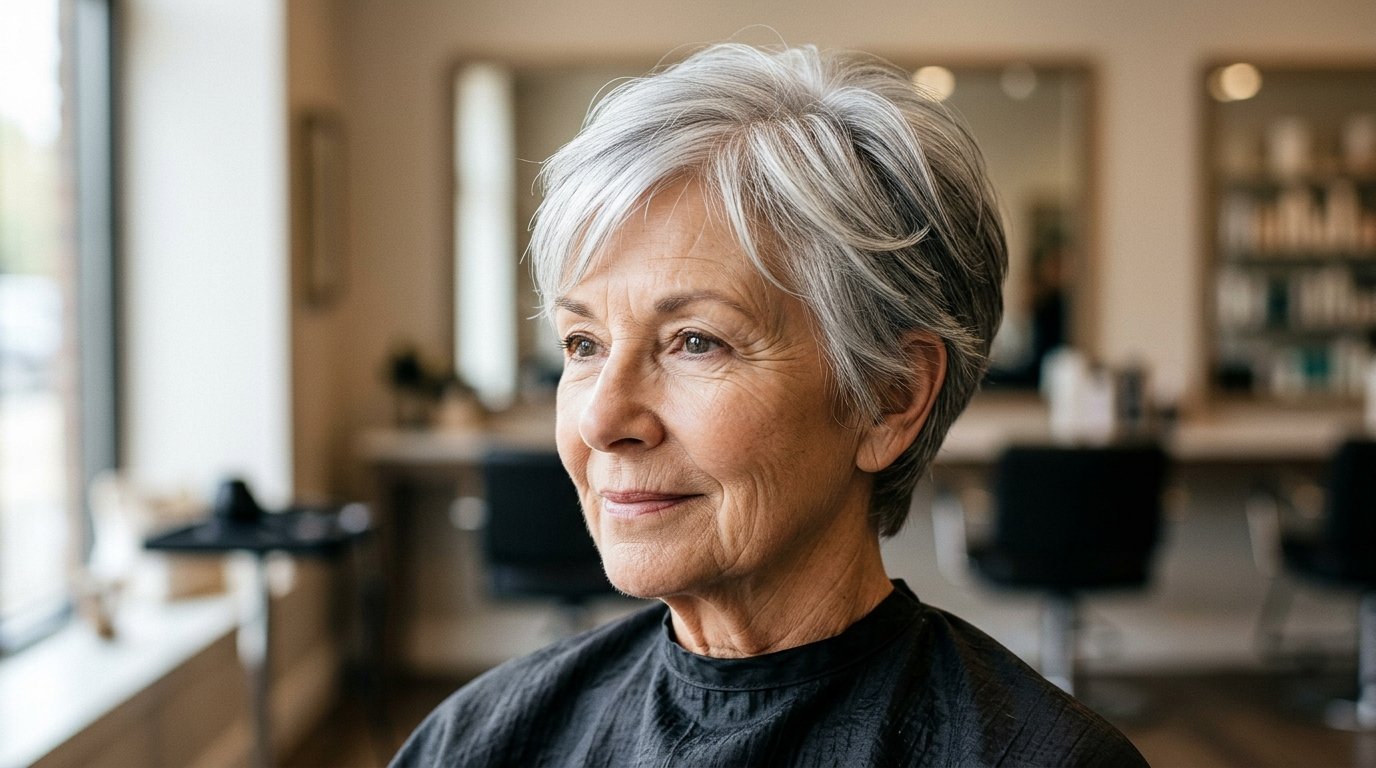
Texture rules written for younger hair assume strands that are thick, elastic and plentiful. Older hair breaks all three assumptions at once, which is why a cut that looked piecey at forty can look stringy or spiky at sixty five.
The change starts with melanin loss. As pigment falls, the strand itself changes character, and it can flip in either direction. Some hair turns wiry and coarse; other hair turns finer and more fragile. Both states wear the same cut name and need opposite tool verdicts.
Wiry and coarse: the grey that pokes out
Wiry grey strands are stiffer and less flexible than the hair they replaced. Cut them with the wrong tool and they refuse to lie down, standing away from the head in short, pokey spikes.
The answer is weight management, not more texture. Bulk is removed from inside the shape so the surface can settle, while the ends stay blunt enough to keep their line instead of fraying into points.
Fine and fragile: the grey that cannot spare a strand
Fine older hair has the opposite problem. Every strand is load bearing, and aggressive texturising removes exactly the hair that was creating the illusion of coverage.
The tell is the see-through threshold: the point where ends become so thinned that light passes through them and the scalp shows. Fine hair reaches it fast, so its texture dose is surface only, with the perimeter kept solid.
The crown and the part: where density goes first
Density rarely falls evenly. It drops at the crown and along the part first, which is why a style can look full from the front and thin from above.
The American Academy of Dermatology describes this pattern in its hair loss guidance: a widening part is a common early sign in women, and thinning often becomes more noticeable after menopause. A textured pixie is designed around that map, placing its lift where density fell.
The medical guardrail: when thinning is not a haircut question
A haircut manages gradual, even thinning. It does not manage sudden shedding, patchy loss, or a scalp that is sore, flaky or inflamed.
If loss is sudden or patchy, the next appointment is with a clinician, not a stylist. The AAD shedding guidance explains how doctors separate normal shedding from loss that needs treatment. Get the cause checked first; the cut can follow.
Who this cut is judged for
The core reader here is sixty plus, because that is where the re-judgement bites: grey is usually the majority colour, crown thinning is common enough to design around, and the effort budget is a real constraint.
In your late fifties with early grey and early thinning, every verdict below already applies; you are simply ahead of the schedule. Past seventy, the same table is read one row stricter, with the razor off and the heat ceiling lower.
For the younger version of this question, the pixie haircuts matching guide already carries the answer. This page starts where that one stops.
The Dose Table: Five Techniques Re-Judged for Older Hair
A texture dose is how much of a technique your hair state can absorb before the cut turns against you. The same point cutting that adds movement to coarse hair can hollow out fine hair at double the depth.
|
Technique |
Wiry, coarse grey |
Fine, fragile hair |
Thinning crown |
Mixed states |
|---|---|---|---|---|
|
Point cutting |
Full dose, standard depth |
Shallow dose only |
Crown dose, light |
Per zone verdicts |
|
Slide cutting |
Yes, for bulk removal |
No |
No |
Coarse zones only |
|
Notching |
Moderate, interior only |
No |
Crown accents only |
Coarse zones only |
|
Razor cutting |
Conditional, strong hair only |
Off |
Off |
Off on fragile zones |
|
Thinning shears |
Contested, see verdict below |
Off |
Off |
Off by default |
Point cutting: the default, at a shallower dose
Point cutting stays the default tool for older hair because it removes weight in small, controlled bites. The change is depth: on fine or fragile strands, the points are cut shallower, so ends soften without losing their density.
On coarse grey hair the standard dose still works. The cutting guidance for fine hair makes the same point from the stylist side: the shallower the point cut, the more of the perimeter weight survives.
Slide cutting: for coarse grey bulk only
Slide cutting, where the blade travels down the strand, is the bulk tool for wiry grey hair. It takes weight out of the interior so stiff strands can lie flatter and move as a group.
It stays off fine hair entirely. A sliding blade on a fragile strand shaves the surface it needs for strength, and the result reads as frizz within days, not texture.
Notching: crown accents, nowhere else
Notching cuts deeper, chunkier bites and creates the strongest separation of the scissor techniques. On older hair its licence is narrow: small accents at the crown, where a visible piecey break is the goal.
Everywhere else it spends density the cut cannot afford. On fine sides or a fragile fringe, notching reads as accidental gaps, not design.
The razor: a conditional tool, off on fragile ends
Here this page parts company with the big galleries. Some competitor pages offer razor cut pixies to older women with no condition attached. On strong, coarse hair a razor can work; on dry, brittle ends it frays the strand, and the fray shows as fuzz that no product fully calms.
The verdict is by hair condition, not style name. The shears versus razor comparison sets out the trade honestly: razors trade a softer edge for a weaker one. If your ends snap when you pinch them, the razor is off, whatever the photo shows.
Texturising and thinning shears: the grey conflict, resolved by hair state
This is the most contested question in the research, and the strands are printed, not merged. One fetched guide for grey hair over seventy recommends thinning shears to remove coarse grey bulk. Two other fetched sources argue against them on grey hair, warning that shears chew the ends and invite frizz.
The resolution is hair state. On fine or fragile grey hair, all strands agree in practice: shears stay off. On genuinely coarse, dense grey hair, a stylist may use them sparingly in the interior, never at the ends, and only after saying so out loud. When in doubt, the default is no shears, and the ask script below gives you the sentence that enforces it.
The Versions, Filed by Hair Change
Galleries usually file versions by look name. This one files them by the hair change they answer, because that is the choice you actually face. More short styles live in the hair styles collection once you know your state.
1. Crown dose pixie, for a thinning crown
Length stays longer on top, around two to three inches, with point cut layers placed only at the crown. The perimeter is left blunt and full, so the eye reads the lift, not the thinning beneath it.
2. Surface texture pixie, for fine fragile hair
Texture lives on the surface only: shallow point cutting through the top layer, nothing carved from the interior. The shape looks piecey from across the room and stays solid at the ends up close.
3. Slide cut tamer, for wiry grey that pokes out
Interior bulk is removed with slide cutting so stiff strands settle instead of springing. The top keeps enough length to weigh itself down, and the finish is fingertip smooth, never spiked.
4. Salt and pepper piecey pixie, for mixed colour
Where dark and silver strands mix, piecey separation turns the colour contrast into dimension. Short point cut pieces let the silver read as highlights the cut placed on purpose.
5. Forward fringe pixie, for a widening part
The top is directed forward into a textured fringe, covering the part instead of splitting along it. It is the strongest disguise in this gallery for early part widening, and it needs no part line at all.
6. Side part lift pixie, for a part that still holds
If your part is thinning but present, a deep side part with crown texture borrows fullness from the heavier side. The lift sits at the root, and the longer side sweeps across the thinner one.
7. Soft classic textured pixie, for a first short cut
The gentlest entry: light texture everywhere, no disconnection, no sharp contrast. It reads as a classic pixie with movement, and it is the easiest version to grow out if you change your mind.
8. Choppy crown pixie, for flat hair that needs movement
Short, choppy crown layers break up a flat top that lies against the head by midday. The chop is kept off the sides, where hair is usually thinner and needs its fullness.
9. Feathered fringe pixie, for forehead softening
A feathered, point cut fringe softens the forehead line and draws attention to the eyes. The feathering dose stays shallow, because fringe hair on older foreheads is often the finest on the head.
10. Tapered nape pixie, for a clean neckline
The back is tapered with scissors, following the neckline without a hard clipper line. It grows out softly, which matters when salon visits are spaced further apart.
11. Long top pixie, for styling choice
The top keeps four to five inches in the longest versions, long enough to sweep, tuck or lift. It asks a little more styling than the short versions and repays it with options.
12. Curly dry cut pixie, for mature curls
Mature curls are cut dry, curl by curl, so shrinkage is visible in the chair instead of surprising you at home. Razor and slide work stay off; the dose is point cutting at the ends only.
13. Glasses first pixie, for frame wearers
The fringe is cut above the frame line and the temples are textured to tuck behind the earpiece. Nothing grows down into the lenses between trims, which is the usual glasses complaint.
14. Silver crop with blunt perimeter, for maximum fullness illusion
The shortest version here keeps a blunt, unthinned perimeter all round. On silver hair the solid edge reads as density, and the texture is carried by styling, not by removing hair.
15. Grow out friendly pixie, for the dye transition
Cut during a colour grow out, this version keeps the two tone stage short: the shape is refreshed at each trim while the silver line moves down, and the crop can lengthen into a bob later.
16. Low effort wash and wear pixie, for the tightest effort budget
Every choice serves the two minute morning: air dry shape, fingertip styling, no heat, no brush work. It is the version the styling section below is built around. For a bolder register, the trendy pixie haircuts page shows where current fashion takes the same bones.
The Crown Protocol: Fewer Layers, Placed Once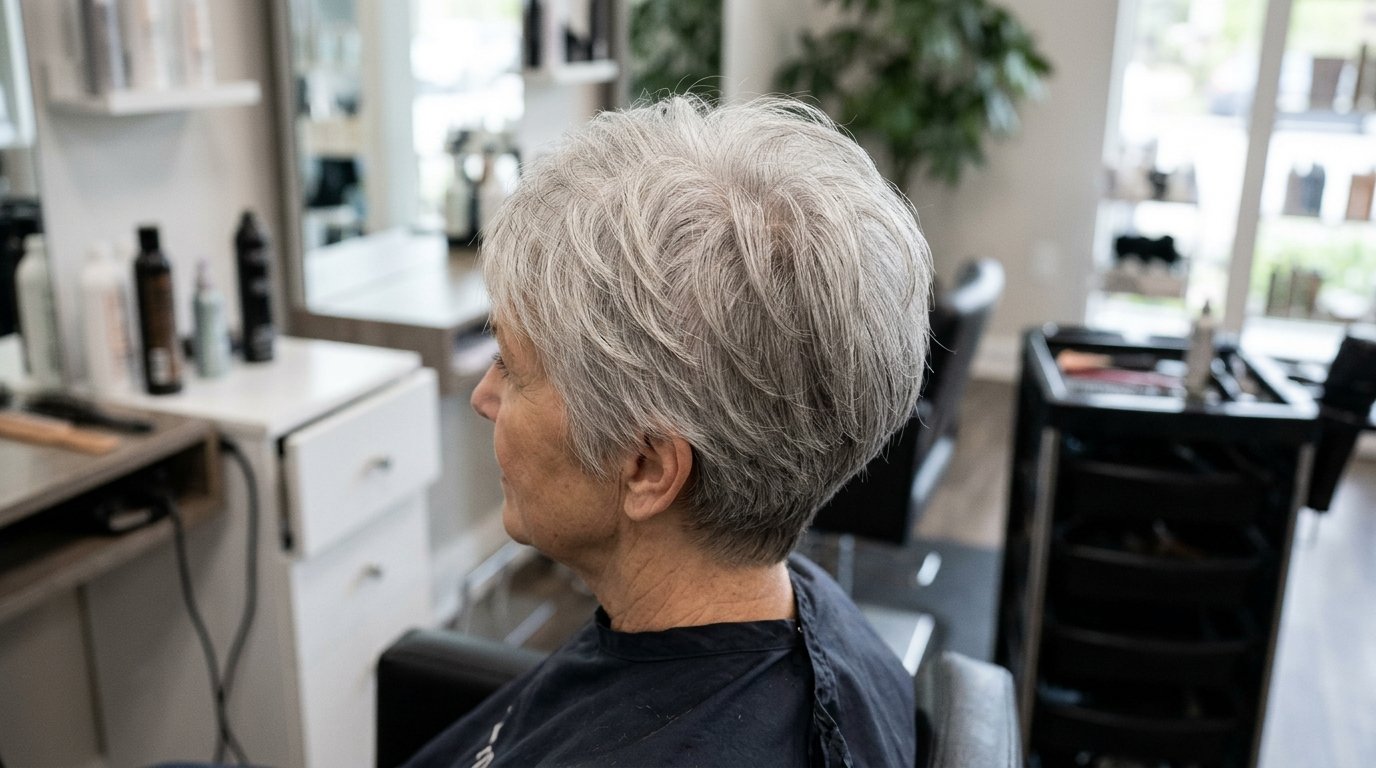
The most useful rule in the research runs against gallery instinct: on thinning hair, you want fewer layers, not more. Layers everywhere divide already scarce hair into thinner groups, and each group shows more scalp.
The protocol is simple. Layers are placed once, at the crown, where lift is needed. The sides and perimeter stay in longer, blunter sections that read as one solid mass of hair.
Ask for it in those words: crown layers only, blunt perimeter. A stylist who reaches for layers throughout the cut is working from the younger hair rulebook, and this is the moment the script in the ask section earns its place.
The limit is honest. Texture can redistribute the appearance of fullness; it cannot create hair. Once the crown is so thin that scalp shows through even a blunt perimeter at rest, the cut has reached its limit, and the guardrail conversation matters more than the gallery.
Styling Inside an Effort Budget
The two minute fingertip routine
- Start on damp or dry hair; this cut does not need a wash to restyle.
- Warm a pea sized amount of texturizing paste between your palms until it disappears.
- Push the top up and forward with flat fingers, then pinch the ends of the crown pieces to separate them.
- Smooth the sides down with the flat of your hand, tucking behind the ears.
- Leave it alone. Overworking fine hair with product is what flattens it by midday.
Pump and spray formats beat jars when hands are stiff, because they need no scooping and no grip strength. The whole routine is fingertip only by design, not by compromise.
Products by function and by hair state
|
Hair state |
Use by function |
Avoid |
|---|---|---|
|
Fine, fragile |
Lightweight mousse at the root, dry texture spray to finish |
Heavy gels, oils at the root |
|
Wiry, coarse grey |
Light texture cream, flexible hold spray |
Stiff gels that set strands into spikes |
|
Thinning crown |
Root lift powder or mousse, pea sized paste for pieces |
Gel, which clumps grey hair and shows scalp |
|
Silver, all states |
Purple toning shampoo once a week at most |
Daily toning, which dries piecey ends |
One warning deserves its own line: on grey hair, gel clumps strands together and the gaps between clumps show scalp that loose hair would cover. Paste separates; gel gathers. For this cut, paste wins.
Glasses, hearing aids and the frame line
Glasses need three things from this cut: a fringe that ends above the frame, sides that tuck behind the earpiece, and enough clearance that frames can be taken on and off without dragging the style flat.
Hearing aids need the same clearance, plus one more: hair at the ear kept short and smooth, so it does not rub the device or feed back against it. Mention both devices at the consultation; a good stylist adjusts the ear zone in seconds when told.
Fringe choice interacts with frames, which is why the wispy curtain bangs and short curtain bangs guides are worth a look before you commit to a longer fringe style.
Silver Care for Piecey Ends
Silver hair is drier by nature, and piecey ends dry fastest of all because each separated tip is exposed to air on every side. Care for this cut is mostly about not stripping what little moisture the ends hold.
Purple toning shampoo keeps silver bright by neutralising yellow tones, and the fetched guides converge on once a week as the working strand. More often than that, the same product that brightens the colour leaves the ends dry and wiry.
In winter, dry indoor air adds static, and short silver pieces lift and float. A tiny amount of lightweight cream pressed over the surface, or a natural bristle brush pass, settles it without product weight.
Chlorine is the summer risk: it can leave a greenish cast on silver ends and rough up already dry tips. Wet the hair with clean water before swimming, rinse straight after, and the cast rarely gets a chance to set.
How to Ask for It: The One Sentence Script and the Photo Rules
Most bad outcomes on older hair are communication failures, not skill failures. The stylist used a standard dose because nobody stated a different one. This sentence states it:
Point cut the crown only, keep my perimeter blunt, and no thinning shears anywhere.
It names the tool, the zone and the protected area in one breath. Say it before the cape goes on, and repeat the shears clause if a second stylist takes over mid appointment.
Photos help, with two rules. Bring photos of women with your hair state, not just your target look: grey, fine or wiry, at a similar density. And treat every photo as a dose question: ask which tools made that finish, and whether your hair state can take them.
One more chair skill: if you asked for no thinning shears, you can check the result. Shears leave ends that look chewed into fine points all at the same level; point cut ends vary softly. Look at the side hair in the mirror before you leave, while a fix is still free.
Trims, Grow Out and the Softer Second Month
Trim advice for this cut arrives in strands by version, and they are printed unmerged, exactly as the sources give them. Slower growth after sixty stretches every strand a little, which is why your neighbour’s interval may not match yours.
|
Strand |
Applies to |
|---|---|
|
About 4 to 5 weeks |
Asymmetric versions; general pixie upkeep strands |
|
About 4 to 6 weeks |
The general short cut range, including the textured pixie row in fetched comparison tables |
|
About 5 to 6 weeks |
A fetched over 60 textured gallery strand |
|
About 5 to 7 weeks |
Longer versions only, the bixie length row |
Grow out is this cut’s quiet strength. Because the texture is placed, not overall, the shape softens gradually instead of collapsing, and the second month usually looks like a softer version of the same cut, not a different haircut.
If you are heading somewhere longer, tell your stylist early. A pixie cut with its top length protected at each trim grows toward a bob; one trimmed evenly all over just becomes a longer crop.
One question is answered in full on a sibling page rather than repeated here: whether this cut needs heat styling to look right is covered by the heat guidance on the short shaggy haircut for women over 70 page, and its low heat ceiling applies here too.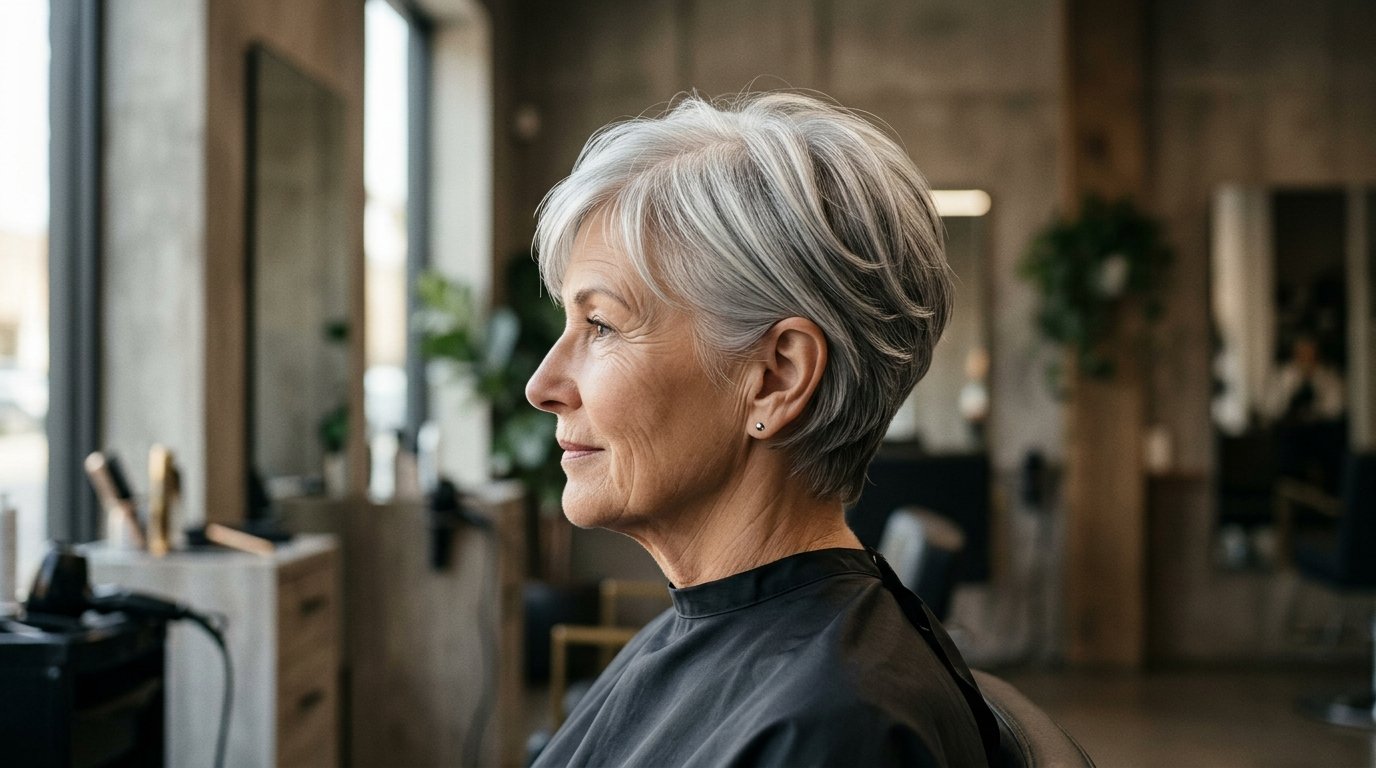
Frequently Asked Questions
1. What is a textured pixie for older women?
It is a short pixie whose texture is dosed for changed hair: point cut separation placed mainly at the crown, a protected blunt perimeter, and tool choices re-judged for grey, wiry or thinning strands instead of younger hair rules.
2. Is there an age limit for a textured pixie, or can it work in your 80s?
No age limit exists. The verdicts simply get stricter with hair state: razor off, heat lower, styling fingertip only. In your eighties the cut often suits the effort budget better than any longer style.
3. Is a razor cut safe on older, more fragile hair?
Only on strong, coarse hair in good condition. On dry or brittle ends a razor frays the strand and the fray reads as frizz. Galleries offering razor pixies with no condition attached are skipping this check.
4. Should thinning shears ever be used on grey hair?
On fine or fragile grey hair, no. On coarse, dense grey hair, sources conflict; the safe default is no shears, or sparing interior use only, agreed out loud before cutting starts.
5. Can wiry grey hair hold a textured pixie, or will it poke out?
It can, when bulk is removed from the interior with slide cutting and the top keeps weighing length. Wiry hair pokes out when it is cut too short on top or razored at the ends.
6. My hair is wiry on top but fine at the sides. Can one pixie use two techniques?
Yes, and it should. Mixed states are the norm, not the exception: slide cutting for the wiry top, shallow point cutting and a protected perimeter for the fine sides, judged zone by zone.
7. Does a textured pixie work for fine hair after 60?
Yes, at the fine hair dose: surface texture only, shallow point cutting, nothing carved from the interior, and a blunt perimeter. The shape reads piecey while the ends stay solid enough to cover.
8. Does texture really make fine older hair look thicker, and where is the limit?
Texture redistributes apparent fullness: crown lift and separation make existing hair cover more visual ground. The limit is the see-through threshold; once ends are thinned past it, texture makes hair look thinner, not thicker.
9. Is a textured pixie good for a thinning crown?
It is one of the better cuts for it, provided layers sit at the crown only and the perimeter stays blunt. Layers everywhere divide scarce crown hair into thinner groups and show more scalp.
10. Can a textured pixie hide a widening part?
Partly. Directing the top forward into a fringe removes the part from view entirely, and crown texture softens its edges. A deep, exposed centre part is the one arrangement that works against you.
11. On a widening part, does a side part or a forward textured fringe hide it better?
The forward fringe hides more, because it covers the part instead of restyling it. A side part is the gentler change and works while the part is only beginning to widen.
12. Does a textured pixie help or expose a thinning front hairline?
It helps when the fringe is soft, feathered and forward, breaking the hairline into pieces. It exposes the hairline when the top is swept straight back or the fringe is cut blunt and short.
13. How do I ask for a textured pixie without being over thinned?
Use one sentence: point cut the crown only, keep my perimeter blunt, and no thinning shears anywhere. It names the tool, the zone and the protected area before cutting starts.
14. How can I tell in the chair if thinning shears were used after I asked for none?
Look at the side ends in the mirror. Shear thinned ends look chewed into fine points at one level; point cut ends vary softly in length. Raise it before you leave the chair.
15. Can texture be added to my existing pixie without making it shorter?
Usually yes, because texturising removes weight, not length. On already thin older hair the dose must stay shallow, since there is no spare density to spend, but the outline length can stay.
16. Can I convert my classic pixie to a textured one at the next trim?
Yes, one trim is enough for the conversion itself. What it cannot do is restore density: on thinner hair the conversion uses surface texture only, so expect movement, not a fuller looking perimeter.
17. How often does a textured pixie need trimming after 60?
By version, printed as strands: about 4 to 5 weeks for asymmetric cuts, 4 to 6 as the general range, 5 to 6 in one over 60 gallery strand, and 5 to 7 for longer versions only.
18. Does a textured pixie grow out well at this age?
Yes. Placed texture softens gradually instead of collapsing, and slower growth after sixty stretches each stage. The second month usually reads as a softer version of the same cut.
19. Can a textured pixie be cut so it grows out into a bob instead of a crop?
Yes, if the stylist protects the top length at every trim and only cleans the nape and edges. Tell them the destination early; even all over trimming just produces a longer crop.
20. How do you style a textured pixie in two minutes if your hands are stiff?
Use pump or spray formats that need no grip, warm a pea sized amount of paste, push the top up with flat fingers, pinch the crown pieces, and smooth the sides with your palm.
21. Can you air dry a textured pixie and still get the texture?
On wavy, coarse and medium hair, yes: the cut shape does the work as it dries. On very fine or straight hair, two minutes of directed drying at the crown may be needed for lift.
22. How do you refresh a textured pixie on day two without washing?
Mist lightly with water, pinch the crown pieces back into separation, smooth the sides with a flat palm, and stop. No brush and no heat are needed, and both usually flatten fine hair.
23. What products suit a textured pixie on mature hair?
By function: a lightweight mousse for roots, a pea sized texturizing paste for pieces, a dry texture spray to finish. Avoid heavy gels, which clump grey strands together and show the scalp between clumps.
24. Does a textured pixie work with glasses?
Yes, when the fringe ends above the frame line and the temples tuck behind the earpieces. Tell the stylist you wear glasses and bring them to the appointment so the ear zone is cut around them.
25. Does a textured pixie sit well with hearing aids as well as glasses?
Yes, with the same clearance plus one detail: hair at the ear kept short and smooth, so it does not rub the device. Mention the aids at consultation; the adjustment takes seconds.
26. Should the nape be tapered with scissors rather than clippers on older skin?
For most, yes. A scissor taper follows the neckline softly, avoids a hard clipper line on skin that marks easily, and grows out gently when appointments are spaced further apart.
27. Which fringe suits a textured pixie on an older face?
A soft, feathered or side swept fringe suits most older faces: it softens the forehead, can cover a widening part, and stays clear of glasses when cut above the frame line.
28. Does a textured pixie work with an uneven hairline or a widow’s peak?
Yes. A forward, piecey fringe breaks the hairline into sections so a peak reads as part of the texture. Avoid blunt, short fringes, which frame the peak and draw the eye to it.
29. Can curly hair be texturised after 60 without frizz?
Yes, cut dry and curl by curl, with point cutting at the ends only. Razor and slide techniques stay off mature curls, and loosened curl patterns after menopause make the dry cut even more important.
30. Why does my textured pixie go flat by midday?
Usually product weight: too much paste, gel clumping, or crown density loss letting pieces collapse. Use less product, apply it to the crown only, and finish with dry texture spray instead of more paste.
31. Why does my textured pixie look stringy instead of piecey?
On older hair the first suspect is over thinning: ends cut past the see-through threshold separate into strings. Recovery means trims that protect the perimeter until the thinned ends have grown out.
32. Does humidity frizz a grey textured pixie more than it used to?
Often yes. Grey strands are drier and more porous, so they drink humidity unevenly and lift. Fighting it with heavy product backfires; a light cream pressed over the surface settles it better.
33. How do you revive a textured pixie after a hat, a cap or a cycle helmet?
Mist the crown, push the top up with flat fingers, pinch the pieces back into separation, and let it air set for a minute. Short hair recovers faster than any longer style after headwear.
34. Does purple shampoo help or dry out a silver textured pixie?
Both, depending on frequency. Used about once a week, it neutralises yellow tones and keeps silver bright. Used daily, it dries the piecey ends, which are the driest part of this cut.
35. Does a silver textured pixie need different care in winter dry air and static?
Yes. Dry heated air makes short silver pieces lift with static. A tiny amount of lightweight cream pressed over the surface, or a natural bristle brush, settles it without weighing fine hair down.
36. Can I swim with a grey textured pixie, and what does chlorine do to silver ends?
Yes. Chlorine can leave a greenish cast on silver ends and rough up dry tips. Wet hair with clean water before swimming and rinse straight after, and the cast rarely sets.
37. Can a textured pixie shorten the two tone stage of growing out dye?
Yes. Short hair sheds the dyed length fastest, and refreshing the shape at each trim moves the silver line down quickly. The two tone stage on a pixie is measured in weeks, not seasons.
38. I still colour my hair. Does the older women advice still apply if I am not going grey?
Yes. The verdicts follow hair state, not colour: fine, fragile or thinning coloured hair takes the same doses. Only the silver care section is colour specific; the tool fences apply in full.
39. My texture changed at menopause rather than at 70. Should the technique change already?
Yes. The rules follow the change, not the birthday. Once strands turn wiry or fragile and the part starts widening, the dose verdicts on this page apply, whatever your age when it happens.
40. Does a short textured pixie leave a thinning crown exposed to the sun?
It can, which is why scalp sun protection belongs in the routine: a hat outdoors, or sunscreen applied along the part and crown where hair is thinnest. Short, thin crowns burn faster than covered skin.
41. Can a textured pixie work on regrowth hair after illness or treatment?
Gently, yes: regrowth is often finer and curlier at first, so the dose stays at the fragile setting, surface texture only. Any ongoing or sudden loss still belongs with a clinician first, not the salon.
42. Is a textured pixie or a short shag better after 70?
The pixie wins on effort and crown control; the shag wins on softness around the face and a gentler grow out. If length is negotiable, compare both on the short shaggy haircut for women over 70 page before deciding.
Conclusion
A textured pixie for older women works when the dose matches the hair state: point cutting as the default at a shallower depth, slide cutting reserved for wiry bulk, the razor and the shears fenced by condition, and layers placed once, at the crown, over a blunt perimeter.
Start with your state, not a photo. Take the verdicts and the one sentence script to a stylist, protect the perimeter, and let the cut do in two minutes what younger hair rules made complicated. For the full technique teaching behind every verdict here, read the textured pixie technique guide, and browse the rest of the short hair family at StylerLook.
