
Skincare routine for combination skin stops being a contradiction the moment you stop treating your face as one skin type: it is two skins sharing one face, an oily center and a drier border, and the routine works when it is zoned only where the two actually differ.
Most combination routines fail in one of two directions. Built for the oily zone, they leave cheeks tight and flaky; built for the dry zone, they turn the forehead into a midday mirror. The fix is not a compromise product. It is a map.
Everything here is general information drawn from dermatology guidance and the routine guides in this research, not personal advice. Persistent rashes, acne, or irritation belong with a dermatologist, and this article will say so again where it matters.
What Combination Skin Actually Is
The definition is consistent across the credible sources. The British Skin Foundation describes skin where some areas, such as the forehead and nose, produce too much sebum while other areas are normal or dry.
A board certified dermatologist quoted on the medically reviewed page, Dr. Alpana Mohta, defines it the same way: both oily and dry areas, often at the same time. The zone guide in this research phrases it as two skins living side by side.
The oily territory is the T-zone: forehead, nose, and chin, where oil glands are densest, which is why shine, enlarged pores, and breakouts concentrate there. The dry or normal territory is the U-zone: cheeks, jawline, and the eye area, which can feel tight or rough after cleansing.
Neither zone is a defect. They are two different production levels on one face, and the routine below simply stops asking each zone to tolerate the other’s products.
The 30 Minute Test: Mapping Your Zones
Identification is a test, not a guess. The Cleveland Clinic method, carried by the routine blog in this research, takes half an hour and a mirror:
The wash and wait test, step by step:
- Wash your face with a gentle cleanser and pat dry. Apply nothing.
- Wait 30 minutes without touching your face or applying products.
- Observe where oil has appeared and where skin feels tight, matte, or comfortable.
Reading the result is pattern recognition:
|
What You See at 30 Minutes |
Likely Map |
First Move |
|---|---|---|
|
Shine on forehead, nose, chin; cheeks matte or tight |
Classic combination |
The zoned routine in this article |
|
Shine everywhere, including cheeks |
Oily leaning |
Oil control emphasis, still gentle |
|
No shine; tightness or flaking in patches |
Dry leaning |
The dry skin system as your base |
|
Comfortable everywhere, no strong signals |
Normal leaning |
The simple base, unchanged |
The restrained version of the routine, with the test at its center, is laid out in the YukaFace combination skin routine, whose minimalism this page adopts as its conscience.
Repeat the test seasonally, not once. The map it draws in July is not guaranteed to be the map in January, and the drift section below explains why the remap is part of the routine itself.
One Base for the Whole Face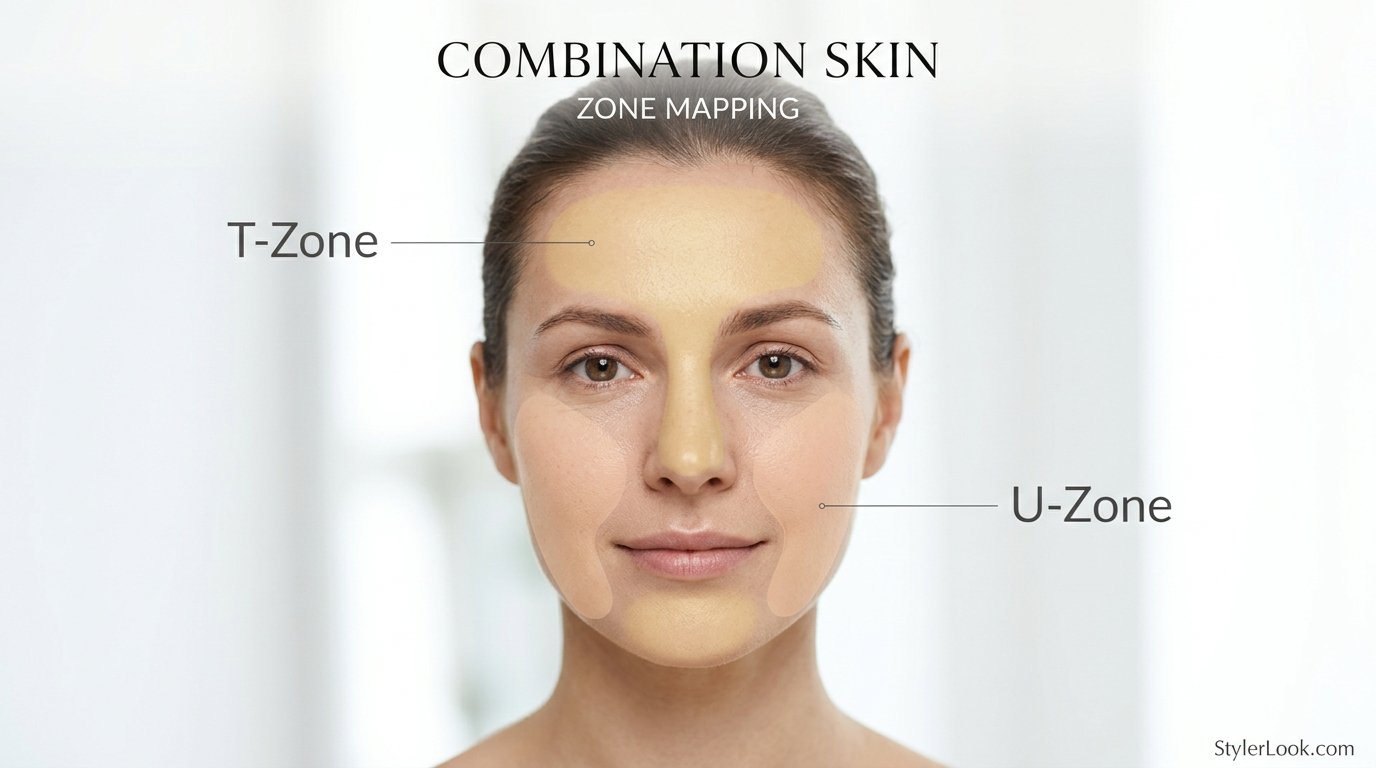
Zoning applies to textures and treatments, not to everything. The base steps stay single and shared, because two cleansers and two sunscreens is a routine nobody keeps.
The cleanser is the shared compromise: gentle and non stripping, a mild gel, low foam, or cream formula that removes the day from the T-zone without leaving the cheeks tight. The template guide’s combination block uses exactly this, a gentle low foam cleanser morning and night.
Tightness after cleansing is the diagnostic: if your cheeks feel stretched within minutes, the cleanser is doing oil control at the barrier’s expense, and it is the first product to change, before any serum is blamed.
The minimal version of this base, stripped to its essentials, is the subject of our simple skincare routine, and combination skin is where that minimalism earns its keep: the fewer shared steps, the more precisely the zoned steps can be tuned.
The Water Only Morning Rinse Question
One morning question divides the guides productively. If your skin is not visibly oily overnight, a plain water rinse can replace the morning cleanse, an option the zone guide attributes to AAD guidance.
The logic is zoned too: the dry areas gain a gentler start, while the T-zone, which produced little oil overnight, loses nothing it needed. On visibly oily mornings, or after heavy night products, the gentle cleanser returns.
Treat it as a two week experiment, not a doctrine: rinse only mornings for a fortnight, watch the T-zone’s midday behavior and the cheeks’ comfort, and let the diary decide. Skin type advice that cannot be tested cheaply is usually marketing.
Two Textures: Moisturizing by Zone
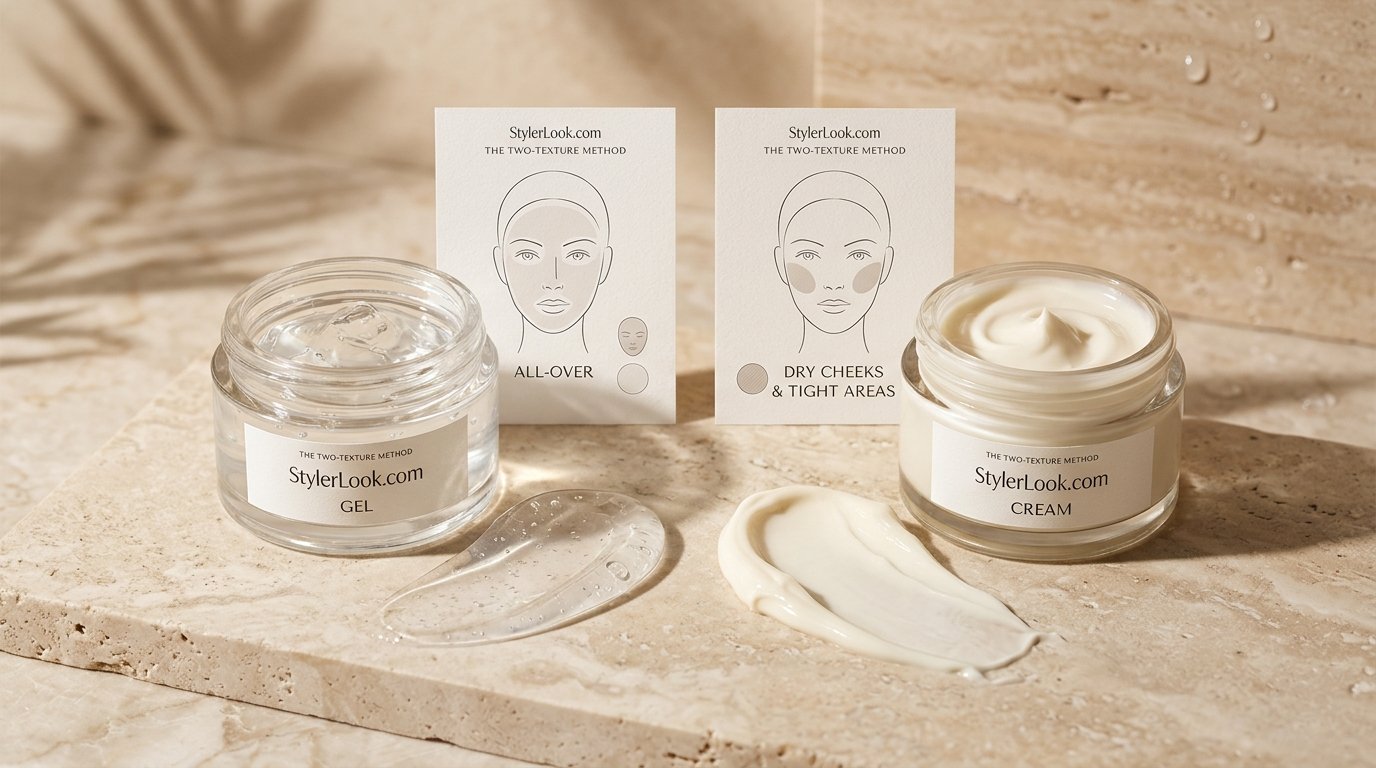
Moisturizer is where zoning becomes literal. The rule, stated identically by two independent guides in this research, is one lightweight moisturizer everywhere, plus a richer layer only where skin is dry.
In texture terms: a gel or light lotion across the whole face, then a richer cream pressed onto cheeks, jawline, and any tight patches. The zone guide phrases the same system as gel on the T-zone and cream on the dry areas.
Apply to slightly damp skin, which the guides note helps lock in hydration, and apply the light layer first so the rich layer lands only where it is invited. The visible border people fear rarely appears when the light layer is genuinely light.
Buying two full moisturizers is one way to run this; the cheaper way is one good light moisturizer plus a small rich cream used as a spot layer, a tube that lasts a year because only a third of your face ever meets it.
Sunscreen: The One Whole Face Non Negotiable
Sunscreen does not zone. Both territories get broad spectrum SPF 30 or higher, every morning, because UV does not respect the map and because several combination friendly actives raise sun sensitivity.
Order settles the layering question: products go thinnest to thickest, the AAD rule the zone guide cites, which is exactly why sunscreen goes last, over both moisturizer textures.
Reapplication follows the AAD pattern in the guidance: every two hours outdoors, with the practical note that a mattifying or gel texture over the T-zone makes the second application something you will actually do.
The full layering logic for mornings like this, thin to thick with protection last, is detailed in our skincare routine order guide for readers who want the general system behind the rule.
The Morning Routine, Zoned
Morning, step by step:
- Rinse or cleanse gently. Water only if the overnight test says so; otherwise the gentle low foam cleanser, lukewarm water.
- Treat lightly, by zone. A hydrating serum on the dry areas if used; oil control serum, where used, on the T-zone only.
- Moisturize in two textures. Light layer everywhere, richer cream on the cheeks and tight patches, on damp skin.
- Protect the whole face. Broad spectrum SPF 30+ as the final layer.
Mornings should be quick, as the zone guide insists: the discipline is in the placement, not in the product count. Four steps, two of them zoned, done.
The Evening Routine, Zoned
Evening, step by step:
- Cleanse once, thoroughly. Twice only in the sense of removing makeup or sunscreen first (a balm or oil step), then the gentle cleanser.
- Treat by zone. The evening active goes where its job is: oil control and pore care on the T-zone, gentler support on the cheeks.
- Moisturize in two textures. Same map as morning, with the rich layer allowed to be slightly more generous overnight.
Evening is also where exfoliation lives, on its scheduled nights rather than daily, aimed by the placement rules in the next sections.
Actives Go by Zone, Never Blanketed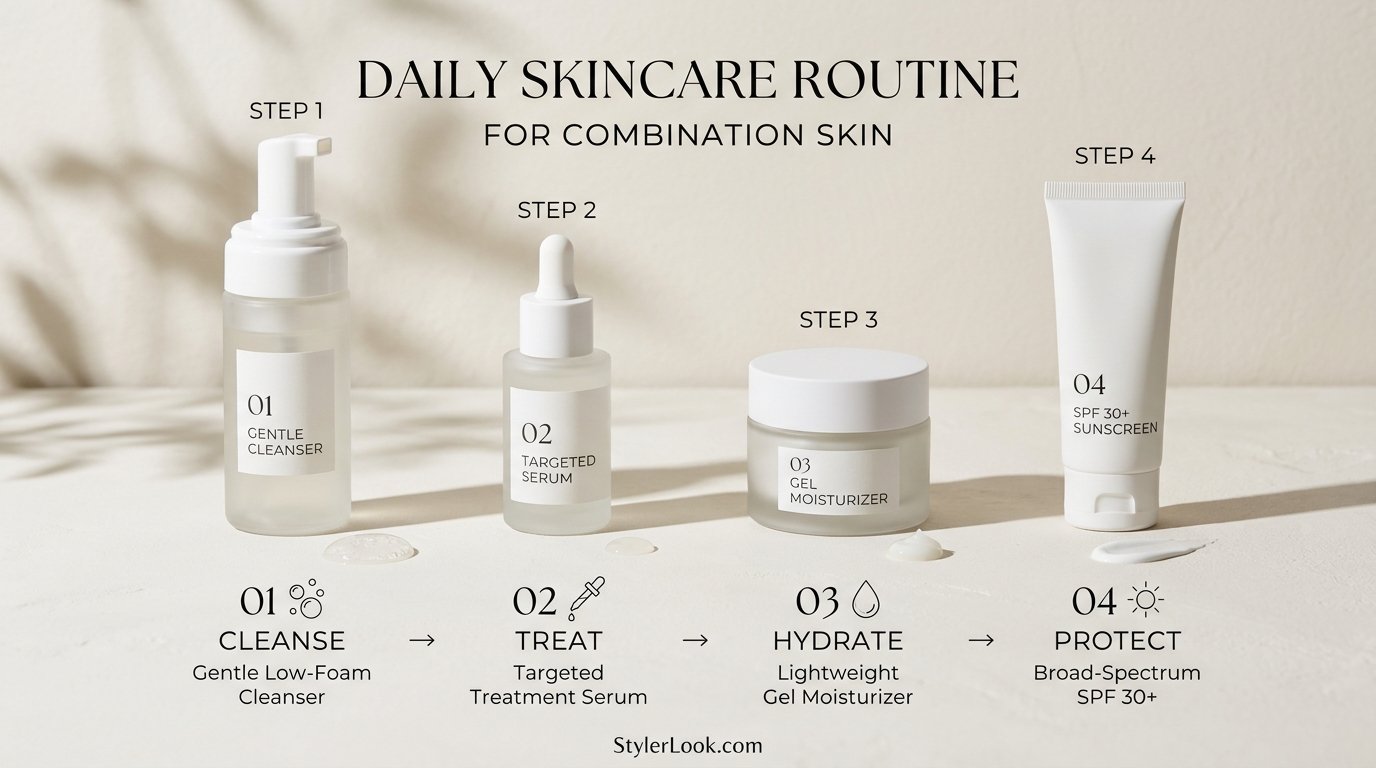
The single most transferable sentence in this research comes from the zone guide: applying targeted treatments like salicylic acid only to oily zones prevents unnecessary dryness and irritation on dry cheeks.
Generalize it and you have the whole doctrine. An active is a tool with an address. Pore and oil tools live in the T-zone; hydration and barrier tools live on the cheeks; whole face tools are the rare exception, not the default.
This is also why combination skin tolerates fewer, better placed actives than either pure type: each zone receives only what it asked for, so neither accumulates the irritation of the other’s prescription.
The full zoned system, written as a routine with a results window in its title, is the QueenCompares zone based combination skin routine, the research’s purest statement of the approach this page builds on.
Salicylic Acid and Niacinamide: The T-Zone Pair
Salicylic acid is the T-zone’s pore tool: oil soluble, at home in congested areas, and placed by the guides on the oily zones only. In cleanser or leave on form, its cheeks exemption is the point.
Niacinamide is the template guide’s T-zone serum, used there for oil balance support in the zone that produces the oil. It is the gentlest member of the oil control cast, which is why templates reach for it first.
Neither belongs on flaking cheeks by default. If a cheek problem genuinely needs an active, it gets a cheek appropriate one, chosen for dryness or sensitivity, not a borrowed T-zone tool applied out of symmetry.
Retinoids and Exfoliants: Placement and Nights
Chemical exfoliation follows the blog’s restraint: once or twice a week at first, aimed at the T-zone, skipped or reduced on dry cheeks, and stopped if skin stings or looks tight. Frequency is earned by tolerance, never assumed.
Retinoids, where used, are evening, whole face cautious, and tolerance led, with the reviewed guidance’s gradual pattern behind them. Combination skin adds one refinement: the cheeks set the pace, because they are the zone that complains first.
Keep exfoliant nights and retinoid nights separate at the start. The zone guide’s warning stands: weekly actives used carelessly, or stacked on the same night, overstrike skin that was only asking for balance.
The Never All at Once Rule
The medically reviewed page carries the warning every routine builder should print: you cannot use all the ingredients at the same time, or on the same day, without risking irritation, however good each one sounds alone.
Its companion advice is equally plain: consult a dermatologist before starting a regime of multiple ingredients at once, because personal circumstances change what is suitable. That is not boilerplate; on combination skin, with two territories reacting differently, it is the operating manual.
Introduction therefore runs on the cluster’s standing rule: one change at a time, judged over weeks, so that when a zone objects you know exactly which arrival it is objecting to.
The medically reviewed framing itself, definition first and routine second, is modeled in the Miiskin combination skin explainer, including its named dermatologist and its medical review statement.
Judging the Routine: The Four Week Window
The zone guide gives the pacing instruction plainly: keep the simple routine, one active at a time, and wait at least four weeks for visible results.
Its title offers a 4 to 8 week window; both figures are that guide’s, printed here as its strand rather than merged into a promise.
What should change inside the window is specific: midday shine arriving later, cheeks staying comfortable through the afternoon, fewer congested pores on the nose, makeup separating less. Judge those signals, zone by zone, not a global glow verdict.
Photograph the map monthly, same light, same hour. Combination skin improvement is partly a border moving, and borders are only visible in comparisons.
Zones Drift: Seasons, Hormones, and the Remap
The map expires. Summer humidity expands the oily territory; winter heating expands the dry one; hormones redraw borders month to month and decade to decade. A routine that was correct in one season becomes half wrong in another, zone by zone.
The maintenance ritual is therefore the remap: rerun the 30 minute test at each season change, adjust the rich layer’s territory first (it is the cheapest adjustment), and only then reconsider actives.
Most combination frustration is drift misread as product failure. The cleanser did not stop working in November; the cheeks’ needs grew, and the routine’s dry zone settings did not.
When the dry territory expands far enough that the two texture system feels like a dry routine with an oily footnote, the companion system to study is our skincare routine for dry skin, which owns the dryness brief in this cluster.
Sensitive, Teen, and Aging Combination Skin
Sensitive combination runs the same map with fragrance as the first suspect and every introduction patch tested, the AAD pattern for reactive skin that the routine blog carries: test new products on a small patch, consistently, before they earn a zone.
Teen combination is usually T-zone forward, with breakouts riding the oily territory. The zoned system suits it precisely because the cheeks are spared the acne tools, and persistent or scarring breakouts move the whole question to a dermatologist early.
Aging combination watches the dry zone expand year by year while the T-zone keeps its shine longer than expected. The two texture system adapts gracefully here: the rich layer’s territory simply grows, and the map, redrawn honestly, stays true.
Makeup Over Zones
Makeup fails by zone for the same reason skincare does: one product asked to do two opposite jobs. Prep mirrors the routine: hydration weighted to the cheeks, oil control weighted to the T-zone, and powder living where the shine lives rather than across the whole face.
Separation by midday is diagnostic information, not just annoyance. It usually reports that the T-zone’s morning layers were too rich or the cheeks’ too thin, and the fix is in the prep map, not in a new foundation.
Blotting deserves its honest place in the system: a sheet pressed on the T-zone at midday removes shine without disturbing the cheeks’ work or adding powder where skin is dry. It is a zone tool in paper form, and it costs almost nothing.
Setting spray, by contrast, is a whole face product, and combination skin is where its compromise shows: enough hold for the center can feel like a film on the edges. Use it if your map tolerates it, and let the test, not the trend, decide.
Photographs help here too. A monthly front camera shot at the same midday hour shows whether the shine border is retreating, which is the makeup outcome this routine actually promises.
When to Simplify, and When to See a Dermatologist
Simplify when the routine itself becomes the irritation: the routine blog’s own chapter makes simplification a feature, returning to cleanser, the two textures, and sunscreen while zones settle, then reintroducing one element at a time.
See a dermatologist for the escalation list the guides converge on: acne that is painful, deep, or leaves scars; persistent rashes or irritation that outlast simplification; and any multi ingredient regime you want reviewed against your own circumstances, as the medically reviewed page advises.
Start the whole cluster from the guides gathered on our StylerLook home page, where the skin type systems, including this zoned one, sit together.
A Week on the Zoned System
|
Day Part |
Whole Face (Shared) |
T-Zone Addition |
Cheek Addition |
|---|---|---|---|
|
Morning |
Rinse or gentle cleanse, SPF 30+ last |
Oil control serum where used |
Hydrating serum where used; rich layer in moisturizer step |
|
Evening |
Gentle cleanse |
Evening active on its nights |
Rich cream layer, slightly more generous |
|
1 to 2 nights weekly |
None |
Chemical exfoliation slot |
Exfoliation skipped or reduced |
|
Monthly |
Dated map photo |
Pore and shine check |
Comfort and flaking check |
The grid’s message is how little is doubled. One cleanser, one sunscreen, one light moisturizer; only the cream layer and the actives carry zone addresses.
Common Combination Skin Mistakes
Buying for one zone. A routine chosen for the forehead will betray the cheeks by week two. The map comes first; products audition against both territories.
Blanketing the actives. Salicylic acid across flaking cheeks because the bottle says face. Placement is the treatment; the ingredient is only half of it.
Stacking the ingredient list. Every promising active in the same week, against the reviewed page’s explicit warning. Irritation is the usual prize, and no one can tell which product caused it.
Judging in days. The window is weeks, plural, and zone signals are the scoreboard. A routine abandoned at day nine was reviewed, not tried.
Framing the first map forever. Last summer’s borders, defended in February. The remap is five minutes with a mirror and a timer, and it is the cheapest upgrade in this entire article.
Reading Labels for Combination Skin
Combination labels reward skepticism. Non comedogenic is a claim about pore clogging tendency, most relevant to your T-zone; it says nothing about whether a rich cream will leave your forehead shining by ten.
Oil free matters in the T-zone’s products and matters hardly at all on the cheeks, where a small amount of the right oil is often exactly what the texture needs. Read labels per zone, the way you will apply the product.
For combination skin on a bottle usually means a middle texture that fully satisfies neither territory. Middle products are not useless, they make fine light layers, but the system in this article outperforms the compromise bottle precisely because it refuses the middle where the zones disagree.
Fragrance free earns priority on the sensitive end of the spectrum, and the dry zone is where fragrance complaints surface first. When a product stings the cheeks but not the forehead, the label’s fragrance line is the first line to reread.
The Budget Shape of a Zoned Routine
Zoning sounds expensive and is mostly reallocation. The shared products, cleanser and sunscreen, are bought once and used everywhere, exactly as in any routine.
The two texture system splits one moisturizer budget into a full size light product and a small rich cream.
The small one lasts disproportionately long because a third of your face uses it. The net cost of the system is close to a single moisturizer routine plus patience.
Actives are where beginners overspend, buying one for every zone and every promise. The doctrine caps you at one active per zone problem, introduced in sequence, which means the shelf grows by one product per judging window at most.
Replacement timing is a real saving too: products stop being discarded for failing a zone they were never meant for. The rich cream that failed your forehead in a one product routine becomes, correctly placed, the product your cheeks finish to the last gram.
Troubleshooting by Zone
|
Signal |
Zone |
Likely Reading |
First Adjustment |
|---|---|---|---|
|
Tight, stretched feeling after cleansing |
Cheeks |
Cleanser too aggressive for the dry zone |
Gentler cleanser before anything else changes |
|
Shine returns within the hour |
T-zone |
Morning layers too rich for the oily zone |
Lighter texture in the center; powder lives there |
|
Flaking beside congested pores |
Both |
Zones drifting apart, often seasonal |
Remap; expand the rich layer’s territory |
|
Stinging on cheeks only |
Cheeks |
Fragrance or an active trespassing zones |
Audit placements; patch test replacements |
|
Breakouts clustering on the nose |
T-zone |
Congestion outpacing the current active |
Review the T-zone active’s frequency before adding products |
|
Everything suddenly worse |
Both |
Stacked introductions or over exfoliation |
Simplify to base for two weeks, reintroduce singly |
The table’s discipline is one adjustment per signal, matched to the zone that sent it. Combination troubleshooting fails when a cheek complaint triggers a whole face overhaul, resetting two territories to solve one.
Frequently Asked Questions
1. What is a good skincare routine for combination skin?
One base, two textures, actives by zone. A gentle non stripping cleanser and SPF 30+ for the whole face, a light moisturizer everywhere with a richer layer on dry areas, and treatments placed only where their job is.
2. How do I know if I have combination skin?
Run the 30 minute test. Wash gently, apply nothing, wait half an hour.
Shine on the forehead, nose, and chin with matte or tight cheeks is the classic combination pattern described by the Cleveland Clinic method.
3. What is the 30 minute skin type test?
It is the wash and wait identification method. Cleanse, wait 30 minutes untouched, then read the map: where oil appeared, where skin stayed matte or felt tight.
The routine blog in this research carries it from the Cleveland Clinic.
4. What is the T-zone?
Forehead, nose, and chin. The T-zone is where oil glands are densest, which is why shine, enlarged pores, and breakouts concentrate there while the cheeks, jawline, and eye area run normal to dry.
5. Why are my cheeks dry but my forehead oily?
Different oil gland density. The T-zone packs more oil glands per area than the cheeks, which run thinner and drier by comparison.
Two production levels on one face is the definition of combination skin, not a malfunction.
6. What cleanser is best for combination skin?
Gentle and non stripping. The template guide’s combination block uses a mild gel or low foam cleanser morning and night.
Tight, stretched cheeks minutes after cleansing mean the cleanser is too aggressive for the dry zone.
7. Can I rinse with water only in the morning?
Yes, on the guides’ conditions. If skin is not visibly oily overnight, a water rinse can replace the morning cleanse, an option the zone guide attributes to AAD guidance.
Test it for two weeks and watch both zones.
8. What moisturizer should combination skin use?
A lightweight one, plus richness by zone. One light gel or lotion moisturizer everywhere, with a richer cream layered only on cheeks and tight patches.
Texture follows territory; that two texture rule is the system’s core.
9. Do I need two different moisturizers?
Not necessarily two full products. One light moisturizer for the whole face plus a small rich cream used as a spot layer on dry areas runs the same system, and the rich tube lasts far longer.
10. How do I apply moisturizer by zone?
Light first, rich second, on damp skin. Apply the light layer across the whole face, then press the richer cream only onto cheeks, jawline, and tight patches.
The guides note damp skin application helps lock in hydration.
11. Does combination skin need sunscreen every day?
**Yes.
Sunscreen does not zone.** Both territories get broad spectrum SPF 30 or higher every morning, applied last because products go thinnest to thickest, and several combination friendly actives raise sun sensitivity.
12. What SPF is right for combination skin?
Broad spectrum SPF 30 or higher. That is the floor across the guidance in this research, reapplied every two hours outdoors on the AAD pattern.
A gel or mattifying texture over the T-zone makes reapplication realistic.
13. Should combination skin use a toner?
Optional, and only in its gentle form. No guide here makes toner a required step.
An alcohol free, balancing toner is a preference item; astringent, stripping toners work against the dry zone and the barrier alike.
14. Where does salicylic acid go on combination skin?
On the T-zone only. The zone guide’s transferable rule: targeted treatments like salicylic acid applied only to oily zones prevent unnecessary dryness and irritation on dry cheeks.
Placement is half the treatment.
15. Can combination skin use niacinamide?
Yes, as the T-zone’s gentle oil balance option. The template guide places niacinamide serum in the T-zone of its combination routine.
It is the mildest member of the oil control cast, which is why templates reach for it first.
16. Can combination skin use retinol?
Cautiously, in the evening, tolerance led. The reviewed guidance supports gradual retinoid introduction, and combination skin adds one refinement: the cheeks set the pace, because they are the zone that complains first.
Keep exfoliant nights separate at the start.
17. How often should combination skin exfoliate?
Once or twice a week at first. That is the routine blog’s starting frequency, aimed at the T-zone and skipped or reduced on dry cheeks.
Stop if skin stings or looks tight; frequency is earned by tolerance.
18. Can I use vitamin C with combination skin?
Yes, as a morning option. The reviewed page’s example routine includes a vitamin C serum, and the zone guide applies it lightly, focused on the cheeks and avoiding heavy layering on the T-zone.
19. What order do products go in for combination skin?
Thinnest to thickest, sunscreen last. That AAD order rule settles most layering questions: cleanser, zoned treatments and serums, moisturizer in its two textures, then SPF in the morning.
Evening drops the SPF and adds scheduled actives.
20. Should I double cleanse combination skin?
Only when the day needs removing. Makeup or sunscreen days can start with a balm or oil step, then the gentle cleanser.
On ordinary days a single gentle cleanse is enough; combination skin rarely needs more.
21. Why does my skin get shiny by noon?
Because the T-zone produces oil on its own schedule. Midday shine is the oily territory doing its normal work, often amplified by morning layers that were too rich for it.
Lighter T-zone textures and zoned powder address it better than harsher cleansing.
22. Why does makeup separate on my combination skin?
Separation is a zone report. It usually means the T-zone’s prep was too rich or the cheeks’ too thin.
Prep mirrors the routine: hydration weighted to the cheeks, oil control and powder weighted to the T-zone.
23. Does combination skin change with the seasons?
Yes, and the routine should change with them. Summer humidity expands the oily territory; winter expands the dry one.
The maintenance ritual is the seasonal remap: rerun the 30 minute test and adjust the rich layer’s territory first.
24. Can combination skin turn into dry or oily skin?
Skin type can drift over years. Zones shift with season, climate, age, and hormones, and a face that was combination can lean drier with age.
That is why this system treats the map as renewable rather than permanent.
25. Is combination skin common?
**Very.
It is one of the most common patterns in the guides.** The reviewed page calls combination skin one of the most common skin types, and also one of the more difficult to manage precisely because its zones disagree.
26. Can men have combination skin?
Yes, with the same map. Male skin follows the same zone logic, usually with a shorter product list.
The test, the two textures, and zoned actives transfer unchanged; only preferences and facial hair change the details.
27. What about combination skin in teenagers?
Usually T-zone forward. Teen combination skin typically runs oily in the center with breakouts riding that territory, which is why sparing the cheeks from acne tools matters.
Deep, painful, or scarring breakouts go to a dermatologist early.
28. Does aging change combination skin?
The dry territory expands. With age the U-zone commonly dries further while the T-zone keeps some shine, so the rich layer’s territory grows.
The two texture system adapts by redrawing the map rather than replacing the routine.
29. Can combination skin also be sensitive?
Yes, and it is a common pairing. Sensitive combination skin runs the same map with fragrance as the first suspect and every new product patch tested, following the AAD pattern for reactive skin carried in the routine guides.
30. Can combination skin be acne prone?
**Yes.
The oily zone hosts the breakouts.** Acne prone combination skin borrows the acne system’s discipline by zone: graded actives where congestion lives, cheeks spared, and deep or scarring acne escalated to a dermatologist rather than layered over.
31. What ingredients should combination skin avoid?
The cross zone offenders. Harsh stripping cleansers, astringent alcohol heavy toners, and strong actives blanketed over dry cheeks lead the list.
The reviewed page’s warning covers the rest: the full promising ingredient list was never meant to run at once.
32. Can I use facial oil on combination skin?
On the dry zone, sparingly. Facial oil belongs, if anywhere, on cheeks that ask for it, in drops rather than layers.
Across the T-zone it adds shine the routine is trying to schedule, not create.
33. Are clay masks good for combination skin?
On the T-zone, as a zoned extra. Clay masks are the classic multi masking move: oil absorbing texture where oil lives, none where skin is dry.
They are an optional extra in this system, not a step.
34. How long before a combination routine shows results?
Weeks, on the zone guide’s pacing. Keep the simple routine and wait at least four weeks for visible results; its title offers a 4 to 8 week window.
Judge zone signals: later shine, comfortable cheeks, calmer pores.
35. Should I patch test new products?
Yes, every new product, by the AAD pattern. The routine blog carries the method: test on a small patch, consistently, before a product earns a zone.
On combination skin, test in the zone where the product will actually live.
36. What if only my nose is oily?
Then your map is a small one, and that is fine. A nose only oily zone gets nose only oil control, with the rest of the face run as normal to dry.
The system scales down as gracefully as it scales up.
37. Can dehydration look like combination skin?
Yes, and it is the classic misread. Dehydrated skin can shine and flake simultaneously because it lacks water, not because its oil map is split.
If tightness follows every cleanse everywhere, suspect dehydration and barrier stress before combination.
38. How many products does a combination routine need?
About five. One gentle cleanser, one light moisturizer, one small rich cream, one sunscreen, and one zoned active cover the system.
Everything beyond that must solve a specific zone problem to earn its place.
39. Does diet affect combination skin?
This research does not settle diet claims, and says so. The routine guides here build on zones, textures, and guidance, not dietary rules.
Anyone suspecting a personal pattern should track it and discuss it with a clinician.
40. When should combination skin see a dermatologist?
For the convergent triggers. Painful, deep, or scarring acne; persistent rashes or irritation that outlast simplification; or before starting a multi ingredient regime you want reviewed against your own circumstances, per the medically reviewed page.
41. Can I use the same routine all year?
The base can; the settings cannot. Cleanser, textures, sunscreen, and order stay constant all year.
The rich layer’s territory, exfoliation frequency, and morning rinse decision are seasonal settings, adjusted at each remap.
42. What is multi moisturizing?
Using more than one moisturizer texture by zone. One light moisturizer across the face with a richer cream layered only on dry areas, the exact system the template guide blesses with its line that multi moisturizing is allowed.
Conclusion
Skincare routine for combination skin holds together as one map, one base, and two textures.
Sort before you shop. The 30 minute test draws the map: an oily T-zone, a drier U-zone, and a routine that finally stops asking each territory to tolerate the other’s products.
Share the base, zone the rest. One gentle cleanser and one sunscreen for the whole face; moisturizer in two textures and actives placed by address, salicylic acid where the oil is and richness where the dryness is.
Introduce slowly, judge in weeks. One change at a time inside a four week window, against the reviewed warning that the whole ingredient list was never meant to run at once.
Redraw the map. Seasons and hormones move the borders, so the test repeats and the rich layer’s territory adjusts first, long before products are blamed.
Keep the base forever. Long after the map feels familiar, the gentle foundations gathered on our StylerLook home page remain the system every zone adjustment is built on.

2 thoughts on “Skincare Routine for Combination Skin: Two Zones, One Gentle Base”