
Korean skincare routine 10 step guide pdf searches want one thing: the ten steps, in order, on a page that can be printed and kept.
This page is built as that page. It carries the canonical list, the frequency ledger, and the two grids, morning and night.
The wider shelf lives at the StylerLook home page, and our Korean skincare routine covers the philosophy in full.
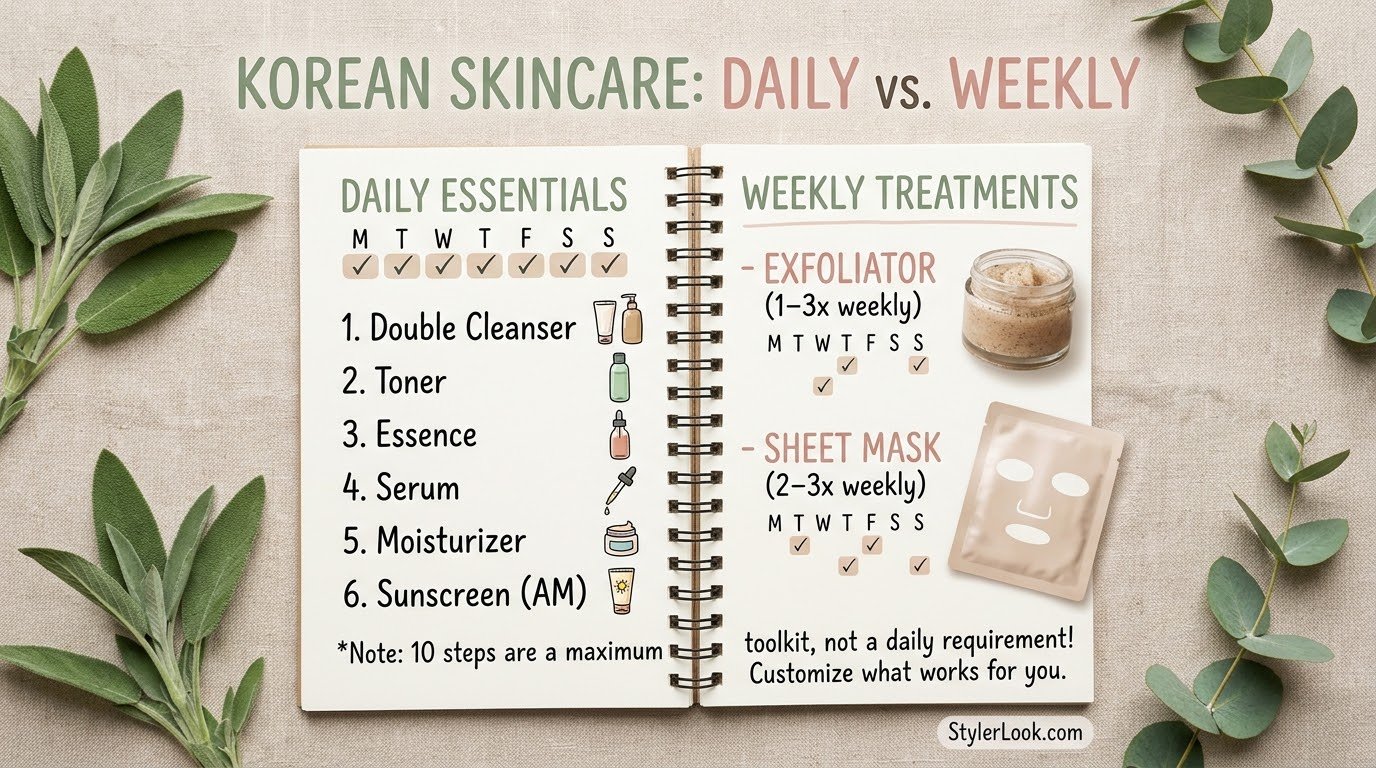
The list below is the maximum toolkit, not a daily assignment. Its own originator does five or six steps on a normal day.
Read the ledger column before the product column. When each step happens matters more than which brand fills it.
The Ten Steps in Order, With the Frequency Ledger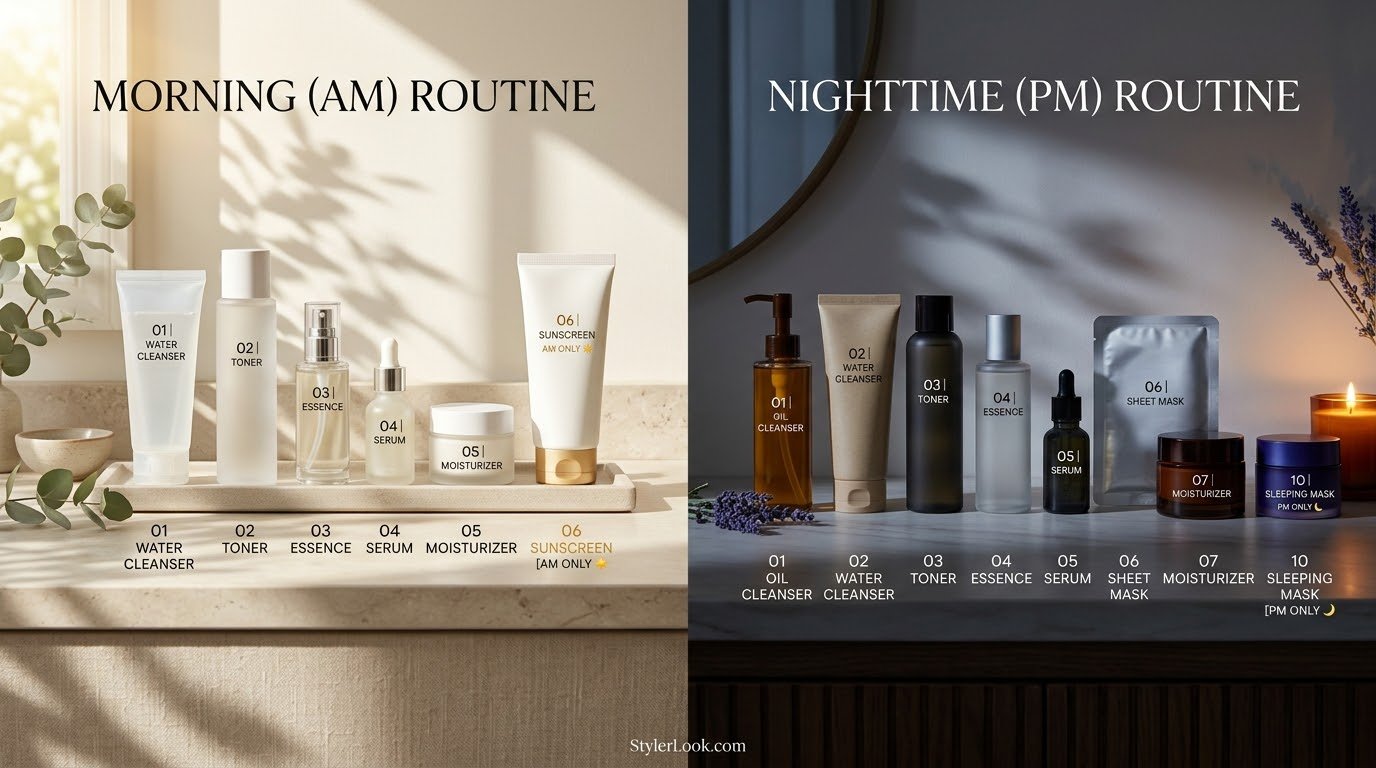
Ten steps are a menu with a maximum, not a mandate. That sentence comes from the routine’s own history, covered below.
The order never changes: products go on thinnest to thickest, water based before oil based, treatments close to clean skin.
What changes between people is frequency and texture. The ledger below prints both, because a list without frequencies is half a guide.
|
Step |
Product |
Job |
When |
Frequency |
|---|---|---|---|---|
|
1 |
Oil cleanser or balm |
Melts sunscreen, makeup, sebum |
Night |
Daily, if SPF or makeup worn |
|
2 |
Water based cleanser |
Washes sweat, dirt, residue |
Morning and night |
Daily |
|
3 |
Exfoliator |
Clears dead skin cells |
Night |
1 to 3 times weekly |
|
4 |
Hydrating toner |
First watery hydration layer |
Morning and night |
Daily |
|
5 |
Essence |
Light hydration, skin prep |
Morning and night |
Daily |
|
6 |
Serum or ampoule |
The targeted treatment step |
Morning and night |
Daily |
|
7 |
Sheet mask |
Occlusive hydration infusion |
Night |
2 to 3 times weekly |
|
8 |
Eye cream |
Moisture for the eye area |
Morning and night |
Daily, optional |
|
9 |
Moisturizer or emulsion |
Seals the layers under it |
Morning and night |
Daily |
|
10 |
Sunscreen, or sleeping mask |
Protection by day, seal by night |
Morning, or night |
Daily, swapped |
Step 1: Oil Cleanser, the First Cleanse
An oil cleanser dissolves what water cannot. Sunscreen, makeup, and sebum are oil based, so an oil based first step lifts them.
Apply it to a dry face with dry hands. Massage for about a minute, then add water until it turns milky and rinse.
That milky turn is emulsification, and skipping it leaves a film. The mechanics match the walkthrough in the Skinorea 10 steps guide.
Step 2: Water Based Cleanser, the Second Cleanse
The second cleanse washes what the first one loosened. Sweat, dust, and the oil cleanser’s residue leave with a gentle water based foam or gel.
Together, steps 1 and 2 are the double cleanse, the routine’s foundation. In the morning, this step stands alone.
Use lukewarm water and a light touch. Skin that squeaks afterward has been stripped, not cleaned.
Step 3: Exfoliator, the Weekly Step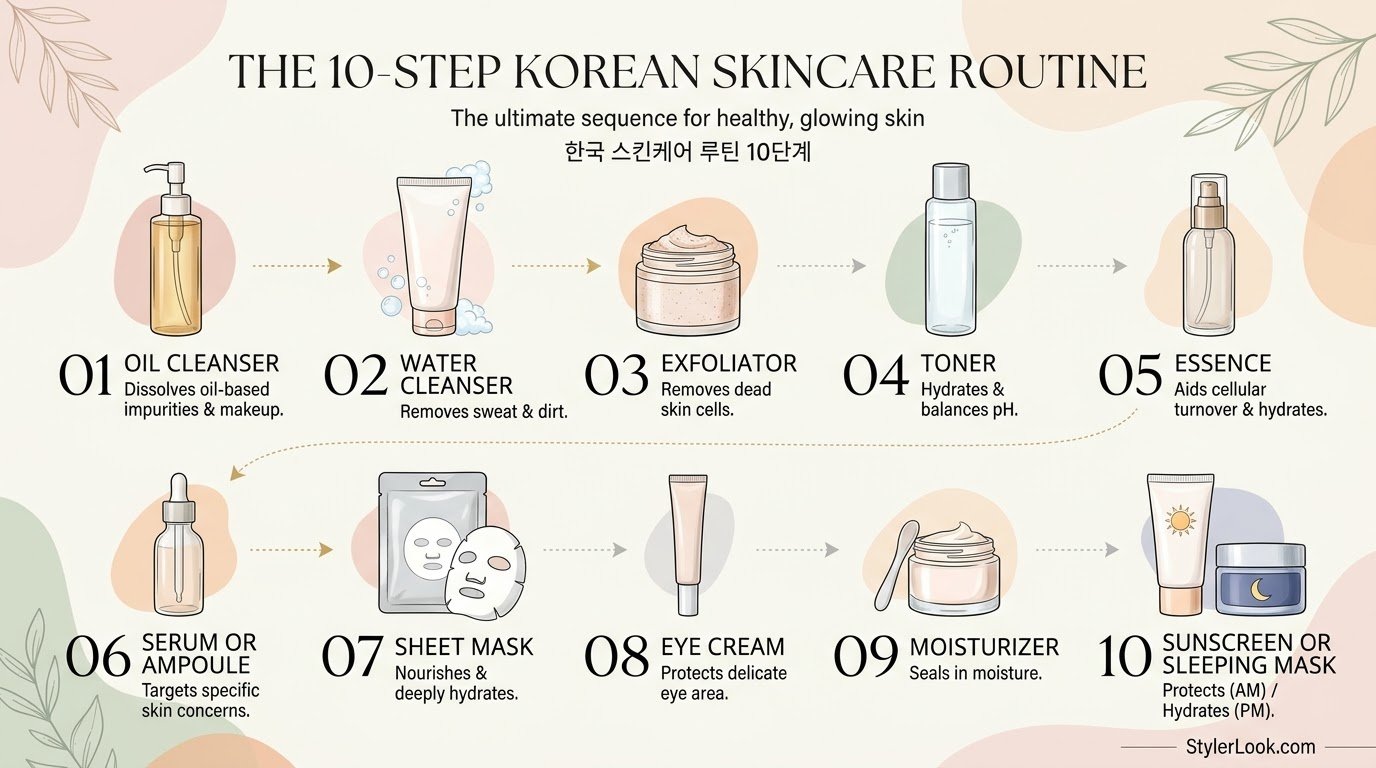
Exfoliation is a weekly event wearing a daily costume. The list position makes it look everyday, and the field disagrees on its frequency.
Two careful guides cap it at 1 to 2 times weekly. Three others print 2 to 3 times weekly, so the honest range is the printed one above.
Choose the family by goal: AHA for surface dullness, BHA for pores and congestion, gentler PHA for sensitive skin.
Step 4: Toner, the Korean Meaning
A Korean toner hydrates; a Western toner traditionally stripped. Same word, opposite products, and the confusion is decades old.
The Korean version is watery, alcohol free, and soothing. It lays down the first hydration and preps absorption for what follows.
Pat it in with palms, not cotton, to keep the product on skin. The hydrating role matches the one in the Ulta Beauty Korean routine explainer.
Step 5: Essence, the Signature Step
The essence is the step K beauty added to the world’s routines. It sits between toner and serum: lighter than a serum, richer than a toner.
Its job is hydration plus preparation, often built on fermented filtrates. The famous reference is a fermented yeast essence from Japan’s neighboring tradition.
An essence is recommended, not required. A strong serum can cover its ground, which the skip chapter weighs honestly.
Step 6: Serum or Ampoule, the Treatment Step
Step 6 is where a concern gets treated. Brightening, calming, firming, and pore care all live in this one slot.
A serum is the daily concentration. An ampoule is its stronger, short course cousin, used for a defined stretch.
Pick one treatment goal at a time. Stacking three actives here is the routine’s most common self inflicted wound.
Step 7: Sheet Mask, the Weekly Infusion
A sheet mask is an event, not a layer. The sheet holds essence against skin for 15 to 20 minutes, forcing hydration in.
Run it 2 to 3 times weekly, or before an occasion. It follows toner and essence in most charts, including TofuSecret day and night grid.
Never sleep in one. A drying sheet pulls moisture back out, reversing the step it was meant to boost.
Step 8: Eye Cream, the Optional Step
Eye cream is the most debated step on the list. The eye area is thin and dries early, which argues for it.
The counter case is simple: a gentle moisturizer often does the same job, the verdict printed plainly in the Comfort Mind Body skip verdict guide.
Keep it if your eye area runs dry or creases makeup. Drop it without guilt if your step 9 already serves the area.
Step 9: Moisturizer, the Seal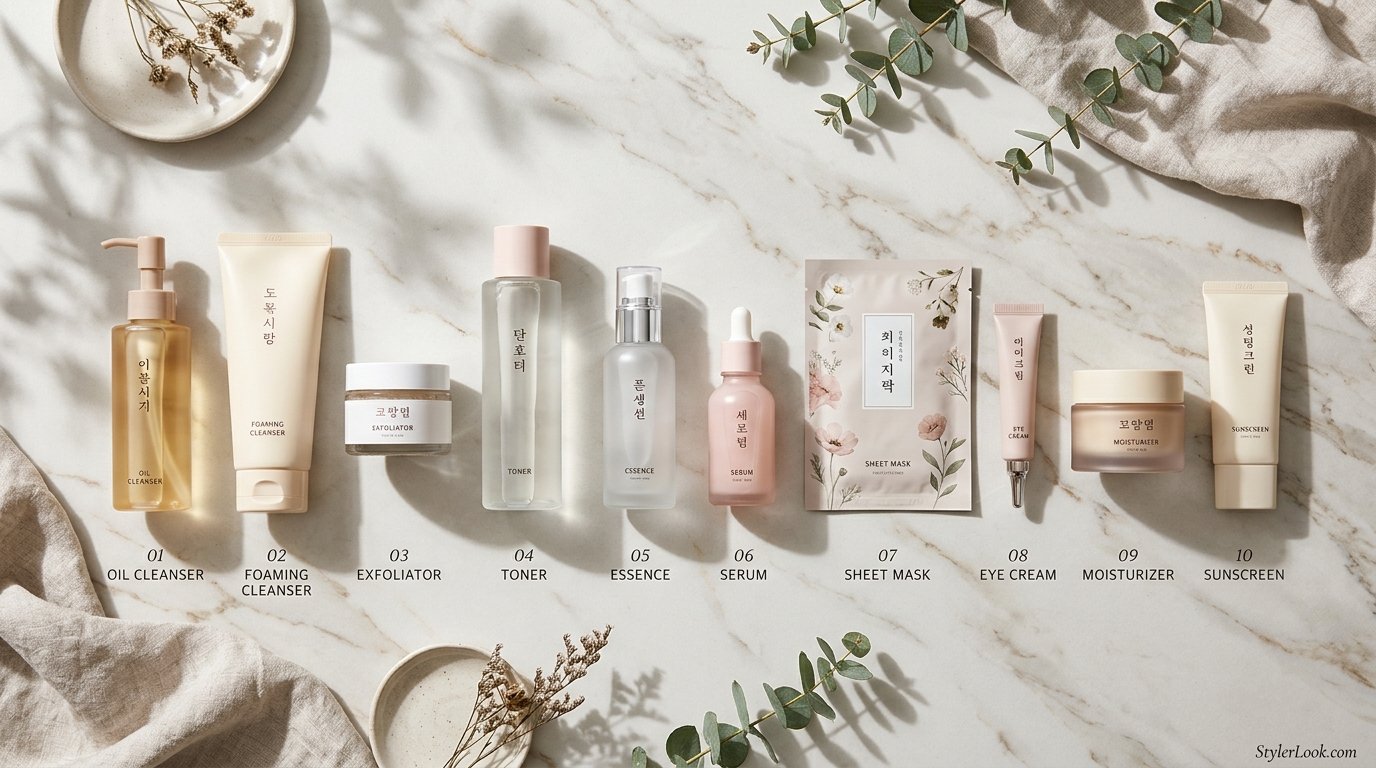
Moisturizer locks the water layers underneath. Without the seal, the hydration from steps 4 to 7 evaporates off the surface.
The category forks by texture. An emulsion is the light form, a cream the rich one, and oily skin usually takes the emulsion.
Dry skin often layers both in winter. The order between them stays light first, rich second.
Step 10: Sunscreen by Day, Sleeping Mask by Night
Step 10 is two products sharing one number. By day it is sunscreen, always last; by night the slot becomes a sleeping mask.
The same swap appears in the BeautyAppeals 10 step explainer. The swap is the chart detail most summaries lose.
A sleeping mask is a final occlusive layer over moisturizer, not a replacement for it. Sunscreen has no night substitute.
Morning Grid: The Seven Step Version
Morning is protection, not repair. One beginner guide counts the morning at seven steps, and that grid is the practical one.
Start with the water based cleanser, or plain water if your skin runs dry. There is no sunscreen or makeup to remove yet.
|
Morning step |
Product |
Note |
|---|---|---|
|
1 |
Water based cleanser |
Or a water rinse for dry skin |
|
2 |
Hydrating toner |
Pat in with palms |
|
3 |
Essence |
Optional on rushed days |
|
4 |
Serum |
One treatment goal |
|
5 |
Eye cream |
Optional |
|
6 |
Moisturizer |
Emulsion or cream by skin type |
|
7 |
Sunscreen |
Last, generous, SPF 30 or higher |
Sunscreen standards split by market, and the chart must say so. Korean charts print SPF 50 PA++++ as the local norm.
The American Academy of Dermatology floor, relayed in the Bustle explainer, is broad spectrum SPF 30 or higher. Either way, it goes on every morning, last.
Morning time is a guide strand, not a promise: one beginner guide budgets 5 to 10 minutes, and the four step starter runs faster.
Night Grid: The Full Version and the Step 10 Swap
Night is where the full list lives. The double cleanse opens it, the weekly steps slot in, and the seal closes it.
Exfoliation nights run after cleansing, 1 to 3 times weekly. Sheet mask nights run after essence, 2 to 3 times weekly.
On an ordinary night, both weekly steps are absent, and the routine is seven to eight steps. That is normal, not a shortcut.
Full evening time runs 15 to 20 minutes in one guide’s budget. Another prints 15 to 25, counting 30 to 60 second waits between layers.
The waits are one school, not a law. The pat and proceed school layers onto slightly damp skin instead, and both camps keep the same order.
The full philosophy lives in the house version, our Korean skincare routine. This page’s job is the grid, kept printable.
The Printable Chart: What the PDF Must Carry
A skincare PDF earns its place only if it carries the ledger. A pretty step list without frequencies recreates the confusion it was downloaded to end.
The chart on this page is built to print on one page: the ledger table, the two grids, and the step 10 swap rule.
Use your browser’s print command and save as PDF, or print it for the mirror. Either way, the numbers stay fixed while products change.
Keep three rules printed in the margin. Thinnest to thickest, weekly steps stay weekly, and sunscreen is morning only, always last.
Found PDFs Audited: The Book, the Influencer Files, the Brand Sheets
Found PDFs are real, and they vary in what they certify. One circulating file is a book summary edition of a published K beauty book.
Another is an influencer store file, nicely designed, carrying a morning grid of seven steps and a fuller night grid.
Both print no review date and no medical check. Treat any found file as a layout, not an authority, and cross check its frequencies here.
A maintained page can be corrected when guidance moves. A downloaded file cannot, which is why this chart lives on the page first.
Reading Any Step Chart: Numbers, Jobs, Frequencies
Read a step chart in three passes. First the numbers, because a chart that renumbers by day teaches nothing.
Second the jobs, one verb per step. A step whose job you cannot state in five words is a step you will skip under pressure.
Third the frequencies, where honesty lives. Any chart printing all ten steps as daily is selling a shelf, not a system.
Test the chart against your last week. Mark which steps you actually ran, and the chart becomes a diagnostic instead of a poster.
Worked Example One: A Normal Week on the Grid
Monday runs the ordinary seven at night. Cleanse twice, tone, essence, treat, seal, with no weekly steps scheduled.
Wednesday adds the exfoliation slot after cleansing. The treatment step rests that night, because stacking an acid on an active invites trouble.
Friday is mask night. Essence, then the sheet for 15 to 20 minutes, then the seal, the week’s most relaxing grid.
Sunday audits the week against the chart. Three calm runs out of four is a routine working, not a routine failing.
Worked Example Two: The Five Step Weekday
Workdays compress the grid to five steps. Morning: cleanser, toner, moisturizer, sunscreen, with the essence held for evenings.
Evenings run cleanser twice, toner, treatment, seal. Nothing weekly is owed on a weekday, and the chart says so in print.
The compression is honest because the numbers it drops are the weekly and optional ones. Dropping sunscreen instead would be a different, worse routine.
Weekends repay the difference with a mask night and a slower pace. The grid flexes by day, exactly as its designer described.
Where the 10 Steps Came From: The Origin, in Strands
The ten step name has a named author and a fuzzy date. Print the strands separately, because each source tells it slightly differently.
Charlotte Cho, Soko Glam’s co founder and a licensed esthetician, says she coined the term in 2012, in her own account relayed by Parade magazine.
A second source dates the concept’s popularization to about 2014. A Korean newspaper trace finds a ten step reference in a 2006 brand commercial.
The doctrine matters more than the date. Cho’s own correction, in interview, is that she runs five or six steps herself, double cleanse included.
The Philosophy Under the List: Prevention and Hydration
Korean skincare prevents; Western skincare traditionally corrects. That contrast is a strand from the guides, stated as a tendency, not a law.
The method follows from it. Hydration first, in thin layers, because hydrated skin tolerates actives and ages slower in appearance.
Gentleness is the second pillar: low irritation cleansers, no daily scrubbing, and sunscreen treated as the real anti aging step.
The third pillar is patience. Prevention compounds quietly, which is why the culture teaches skincare from adolescence, as one guide notes.
A 2022 survey strand, relayed by a Korean beauty publication, counts Korean users at just over five products per routine. The home country never ran ten a day.
Start at Four: The Beginner On Ramp
Every serious guide lands on the same starter. The start with four advice in the Ulta Beauty Korean routine explainer is not a retailer selling restraint cheaply.
The four are cleanser, hydrating toner, moisturizer, sunscreen, with the oil cleanser added at night when sunscreen or makeup was worn.
Run the four for two weeks before adding anything. Skin that stays calm has earned the fifth step, usually the essence.
Add one step at a time, with a week or two between additions. A reaction then has exactly one suspect.
The floor underneath the four is three: cleanse, moisturize, protect, and the house version, the basic skincare routine, builds from that same floor upward.
When the four feel automatic, the house tool, the skincare routine builder, helps assemble the longer version around your skin type.
Weeks One to Six: A Realistic Addition Schedule
Weeks one and two run the starter four alone. The only job is tolerance: no stinging, no new tightness, no mystery breakouts.
Week three adds the essence, the gentlest fifth step. Judge it by morning feel, not by the mirror on day one.
Week four or five adds the weekly steps, one at a time. Exfoliation enters before the sheet mask, because its frequency needs learning.
Week six reviews the whole grid. Steps that earned nothing leave, because a routine is edited like text, not collected like trophies.
What Each Added Step Must Prove
A new step earns its place with a job and a result. Hydration steps prove themselves in morning feel within two weeks.
Treatment steps get a longer trial, judged in weeks of consistency. A treatment dropped at day nine was never tested, only sampled.
Weekly steps prove themselves in texture. Skin that stays rough at two exfoliations weekly may need the family changed, not the frequency raised.
Keep a one line log per change. Date, step added, and the observation two weeks later turns guessing into editing.
Editing by Skin Type: Texture and Frequency, Never Order
The order is universal; the textures are personal. Changing the order breaks the logic, while changing textures keeps the system intact.
Oily skin takes gel and lotion textures and lighter layers. It still moisturizes, because stripped oily skin often produces more oil.
Dry skin layers hydration twice, toner and essence both, then seals richly. Combination skin runs two textures by zone, gel on the T zone, cream on cheeks.
Sensitive skin subtracts before it adds: the four step version, one new product at a time, fragrance avoided, stinging treated as a stop signal.
Acne prone skin keeps the same skeleton with fewer, matched products. The treatment slot discipline of the best skincare routine for acne applies directly here.
Where a treatment like a prescription retinoid belongs is step 6, at night, inside the slot logic of the skincare routine order guide.
The Texture Edit Table, by Skin Type
|
Skin type |
Cleanser edit |
Middle layers |
Seal edit |
|---|---|---|---|
|
Oily |
Gel, low foam |
Toner, one serum |
Gel moisturizer |
|
Dry |
Cream or milk cleanser |
Toner layered, essence kept |
Rich cream, sleeping mask nights |
|
Combination |
Gentle gel |
Light serum all over |
Gel on T zone, cream on cheeks |
|
Sensitive |
Fragrance free, minimal |
One hydrating layer |
Barrier cream, few ingredients |
|
Acne prone |
Gentle gel |
Treatment at step 6 only |
Non comedogenic gel |
Read the table as texture orders, not product orders. Every row keeps all ten numbers and changes only weight and frequency.
Two Households, One Chart
Partners with different skin can share one printed chart. The numbers and order match; the pencil notes in each margin carry the personal textures.
A teen in the house runs the shortest legal version. Cleanser, moisturizer, sunscreen, supervised, with actives added only on a clinician’s or parent’s call.
Guests and gifts follow the chart too. A kit given with the printed grid lands better than a kit given with a slogan.
One chart, many routines is the design’s strength. The document standardizes the logic while the margins hold the people.
The Seven Skin Method and Other Advanced Layers
The seven skin method layers one toner repeatedly. Three to seven thin applications build a water reservoir no single cream matches.
It suits dry or travel stressed skin on occasional nights. Beginners should master one layer first; seven layers of a wrong toner is seven mistakes.
Skin flooding and essence layering are cousins of the same idea: more water, held by one good seal at the end.
Advanced layers are options on top of the grid, never replacements for it. The sunscreen step has no advanced substitute.
Ingredient Glossary for the Chart Margin
Centella asiatica, called cica, is the calming signature. It anchors sensitive and acne prone edits across the Korean shelf.
Snail mucin is the hydration and repair strand, divisive and famous. Fermented filtrates power the classic essences, brightening by hydration first.
Niacinamide steadies tone and barrier at the treatment step. Ceramides and panthenol rebuild the seal in creams and sleeping masks.
Propolis and rice extracts carry the glow brief. Read labels for the ingredient’s seat in the list, not its place in the marketing.
Buying by Category: What Good Looks Like at Each Step
Cleansers should promise gentleness, not transformation. A cleanser touches skin for a minute; judge it on what it leaves behind, which is comfort.
The treatment step is where money concentrates. One well matched serum outearns three decorative bottles at any step.
Masks and eye creams are the flexible budget lines. They add pleasure and occasion value, and the grid survives their absence intact.
Sunscreen spending buys compliance. The best sunscreen is the one worn generously every morning, so texture preference is a real specification.
Mistakes the Chart Prevents
Over exfoliation is the signature error. A weekly step done daily thins the barrier until everything starts to sting.
Second is buying all ten products at once. Ten new variables mean a reaction with ten suspects and no answer.
Third is treating the sheet mask as daily. Fourth is skipping the seal, then blaming the essence for evaporating.
Fifth is order drift: cream before serum, sunscreen before moisturizer. The printed chart kills drift, which is its real function.
Last is expecting a timeline no guide can honestly give. Routines show themselves over weeks of consistency, and scarring or persistent pain belongs to a clinician.
Keeping the Routine Alive: Audits and Seasons
Audit the chart monthly with a pencil. Cross out steps skipped three weeks running, and ask whether the step failed or the schedule lied.
Edit seasonally without reordering. Winter adds a layer and a sleeping mask; summer lightens textures and guards the sunscreen step harder.
Travel cuts the grid, never the logic. Cleanser, one hydrating layer, moisturizer, and sunscreen travel; the weekly steps stay home without penalty.
A routine that survives audits and seasons is the actual product. The ten steps were only ever its first draft.
When to Stop Adding and Start Maintaining
Maintenance begins when two audits change nothing. The grid fits the week, the skin stays calm, and additions stop solving problems.
Calm skin is the deliverable. Glow language aside, a routine that no longer needs editing is the routine the chart was built to find.
Reopen the chart only on a trigger. A season change, a new prescription, a move to a drier climate, or a reaction with no named suspect.
Everything else is shopping, not skincare. The chart’s last gift is knowing the difference between the two.
A Note on Kits, Bundles, and the Shelf
Starter kits package the grid for convenience. They suit a reader who wants the categories decided and the sizes matched in one box.
Judge any kit against the chart, not the branding. If its steps skip the seal or daily sunscreen, the box is a shelf, not a system.
Buying by category costs less and fits better. It also lets each step arrive on the schedule this page recommends, one suspect at a time.
Either way, the chart stays the referee. Products join and leave; the numbers, the order, and the frequencies keep their seats.
Keep the paper copy current by hand. When a product changes, pencil the new name beside its step, and the chart stays truthful without a reprint.
Frequently Asked Questions
1. What are the 10 steps of the Korean skincare routine in order?
The order is oil cleanser, water cleanser, exfoliator, toner, essence. Then serum or ampoule, sheet mask, eye cream, moisturizer, and sunscreen by day.
The numbers never change, even when steps are skipped.
2. Can I get the Korean skincare routine 10 steps as a PDF?
Yes, by printing this page and saving it as a PDF. The chart here carries the ledger, both grids, and the swap rule, which most found PDFs leave out.
3. Do I need to do all 10 steps every day?
No, ten is the maximum, not the daily assignment. The routine’s originator runs five or six steps herself, and most people settle at five to seven on ordinary days.
4. Do I do the 10 step routine morning and night?
The full list belongs to the night. Mornings run a shorter grid of about seven steps ending in sunscreen, because there is no makeup or sunscreen to remove yet.
5. Which steps of the Korean routine are morning only?
Sunscreen is the only strictly morning step. It closes the morning grid, and nothing in the night routine replaces its protective job.
6. What replaces sunscreen at night in the 10 step routine?
A sleeping mask takes the step 10 slot at night. It seals the moisturizer under an occlusive layer while you sleep, which is a different job from sun protection.
7. How often do I exfoliate in the Korean routine?
One to three times a week, printed as a range on purpose. Careful guides split between one to two and two to three, and sensitive skin belongs at the low end.
8. How often should I use a sheet mask?
Two to three times a week covers most skin. Each session runs 15 to 20 minutes, and the mask comes off before it dries on the face.
9. How long does the full 10 step routine take?
About 15 to 25 minutes in the evening guides. Mornings run 5 to 10, and the four step starter is faster than both, which is the honest weekday answer.
10. What is the double cleanse and why is it two steps?
It is a two part wash for two kinds of dirt. Oil lifts sunscreen, makeup, and sebum first, then a water based cleanser washes away sweat and residue.
11. Do I need an oil cleanser in the morning?
No, the morning starts with the water based cleanser alone. The oil step exists to remove what the day put on your face, and a fresh morning face has none of it.
12. What is the difference between a Korean toner and a Western toner?
A Korean toner hydrates, while the classic Western toner stripped. The Korean version is watery and alcohol free, meant to add water, not remove oil.
13. What is an essence and how is it different from a serum?
An essence is a light hydrating prep layer with mild active support. A serum is the concentrated treatment, so the essence feeds and the serum targets.
14. Do I need both essence and serum?
No, one can cover the other’s ground. A hydrating serum can replace an essence, and many five step routines merge the two without losing the method.
15. What is an ampoule in the Korean routine?
An ampoule is a stronger, short course serum. It runs at step 6 for a defined stretch, when one concern needs more intensity than a daily serum gives.
16. What is the seven skin method?
It means layering one hydrating toner several times. Three to seven thin applications build deep water content, finished with a seal, a dry skin technique from K beauty.
17. Should beginners use the seven skin method?
Not until the basic routine is stable. Beginners master one toner layer first, because layering a product your skin dislikes multiplies the problem instead of the hydration.
18. What does glass skin mean?
Glass skin is a smooth, deeply hydrated finish that reflects light evenly. It describes a look of health and water content, not a skin type or a medical state.
19. Can the 10 step routine give me glass skin?
The routine builds the conditions, it cannot promise the finish. Hydration layering and daily sunscreen move skin toward it, and lighting, texture, and genetics still have their say.
20. Who invented the 10 step Korean skincare routine?
Charlotte Cho of Soko Glam says she coined the term in 2012. Her own account comes through interviews, while other strands date its spread to about 2014.
21. Do Korean women actually use 10 products every day?
No, survey evidence says otherwise. A 2022 survey relay puts Korean users at just over five products per routine, closer to a starter set than the full list.
22. How do I start the Korean routine as a beginner?
Start with cleanser, hydrating toner, moisturizer, and sunscreen. Add the night oil cleanser, run it two weeks, then add one step at a time as skin stays calm.
23. What is the minimum Korean routine that still works?
Three steps hold the method: cleanse, moisturize, protect. Add a hydrating layer and the night double cleanse, and the routine is recognizably Korean at four to five steps.
24. Which steps can I skip in the 10 step routine?
The weekly steps are the first candidates, then eye cream and essence. Sheet masks and exfoliation run weekly anyway, and essence can merge into a good serum.
25. Is eye cream a necessary step?
No, it is the most optional step on the list. A gentle moisturizer often serves the eye area, so keep eye cream only where that area runs dry.
26. What order do I apply the steps in if I forget the list?
Think thinnest to thickest and you hold the order. Cleanse, watery layers, treatment, seal, and sunscreen last by day, a rule that rebuilds the list from logic.
27. How long should I wait between layers?
One school waits 30 to 60 seconds between layers. Another layers onto slightly damp skin without waiting, and both keep the same order, so pick by feel.
28. Can I use the 10 step routine with sensitive skin?
Yes, in its shortest form. Four steps, fragrance free, one new product at a time, and stinging treated as a stop signal rather than a sign of working.
29. How do I adapt the 10 step routine for oily skin?
Keep the order and lighten every texture. Gel cleansers, watery toners, one treatment, and a gel moisturizer, because stripped oily skin often answers with more oil.
30. How do I adapt the 10 step routine for dry skin?
Layer the water twice and seal it richly. Toner plus essence before cream, a sleeping mask on dry nights, and a gentle hand with foaming cleansers.
31. Where does retinol or tretinoin fit in the 10 steps?
A retinoid sits at step 6, the treatment slot, at night. It replaces that night’s other actives rather than stacking with them, and sunscreen the next morning is non negotiable.
32. Can I do the Korean routine with acne prone skin?
Yes, with fewer products and matched actives. The treatment slot carries the acne active, the rest stays gentle, and persistent or scarring acne belongs with a dermatologist.
33. Why is my skin breaking out on the 10 step routine?
Usually a new product or too many at once. Ten new variables give a reaction ten suspects, so rebuild from the four step starter and add one product per fortnight.
34. How much does a 10 step routine cost to start?
A starter set from one retailer was listed at 199 dollars. Category by category buying costs less, and the four step start needs only four products, one already in most bathrooms.
35. Can men follow the 10 step Korean routine?
Yes, nothing in the method is gendered. Men usually start at the three step floor and add layers only where dryness or a specific concern asks for them.
36. Is a free Korean skincare PDF guide trustworthy?
Judge it by what it prints, not how it looks. A trustworthy file shows its source and date and prints frequencies honestly, and most circulating files show neither.
37. What should a good printable skincare chart include?
It must carry steps, jobs, timing, and frequencies together. Add the two grids, the step 10 swap, and the three margin rules, sized to print cleanly on one page.
38. Can I use sheet masks every day?
Most skin does better at two to three times weekly. Daily masking risks irritation and waste, and a mask should never be slept in or left to dry.
39. Is the sleeping mask the same as a moisturizer?
No, a sleeping mask is an extra seal over moisturizer. It replaces step 10’s sunscreen slot at night, not the moisturizer step that sits under it.
40. What is chok chok skin?
Chok chok is the dewy, bouncy finish term in K beauty. It names skin that looks freshly hydrated and elastic, the softer everyday cousin of the glass skin idea.
41. How long before the Korean routine shows results?
Judge it in weeks of consistency, not days. Hydration settles first, texture follows, and any guide printing an exact day count is selling, not informing.
42. What is the difference between an emulsion and a cream in the routine?
An emulsion is the light, milky form of moisturizer. A cream is the rich form, oily skin usually takes the emulsion, and dry skin may layer both.
Conclusion
A Korean skincare routine 10 step guide pdf is only useful if the document tells the truth, and the truth here is a ledger, not a list.
Ten steps are the maximum menu, most days run five to seven, exfoliation and masks are weekly, and step 10 swaps sunscreen for a sleeping mask when the day ends.
Keep the chart where the products live, start at four steps if you are new, and let texture, never order, carry your skin type. When the routine feels automatic, the skincare routine builder can shape its next version, and the StylerLook home page keeps the full shelf one click away.
