

The korean skincare routine order is a ladder, not a list: oil cleanser, water cleanser, exfoliator, toner, essence, serum, sheet mask, eye cream, moisturizer, and sunscreen, always thinnest to thickest.
That one rule explains the whole system. Thin layers sink in; thick layers seal. Run the ladder upward and every product reaches skin. Run it backward and the thick rungs lock the thin ones out.
Two corrections belong at the top. The ten steps never all happen in one session, because some are weekly and two are time bound. And morning and night climb different ladders that share most rungs.
Each rung below carries its cadence tag: daily, weekly, morning only, or evening only. Learn the tags and the famous ten steps collapse into a routine a real week can hold.
This page owns the sequence itself. The philosophy and product story live on the site’s Korean skincare routine guide; order for non Korean routines lives on its skincare routine order guide. Here, only the ladder.
The Ladder and Its One Rule
Thinnest to thickest is a traffic rule, not a recipe. It exists so products never block each other, which is why any brand can join the ladder at its rung.
Watery textures carry small, fast layers that need direct contact. Creams and oils form films. A film applied early turns every later watery layer into surface decoration.
The error therefore runs one way. Serum over cream wastes the serum, visibly and measurably. Cream over serum merely completes the design. Reversal is the only true order mistake.
Everything else the internet argues about is cadence or taste. Essence before serum is settled by texture. Eye cream before moisturizer is the field standard. The ladder tolerates debate everywhere except direction.
Keep the ladder product agnostic. When a product dies, its replacement takes the same rung. Routines built on rungs survive shopping; routines built on bottles collapse at the first empty.
The Ten Steps, Tagged by Cadence
|
Rung |
Step |
Cadence |
|---|---|---|
|
1 |
Oil cleanser |
Evening only |
|
2 |
Water cleanser |
Daily, twice |
|
3 |
Exfoliator |
Weekly nights |
|
4 |
Toner (hydrating) |
Daily, twice |
|
5 |
Essence |
Daily, twice |
|
6 |
Serum or ampoule |
Daily, targeted |
|
7 |
Sheet mask |
Weekly |
|
8 |
Eye cream |
Daily, twice |
|
9 |
Moisturizer |
Daily, twice |
|
10 |
Sunscreen AM, sleeping mask PM |
Morning only / optional |
1. Oil cleanser: evening only
Massage an oil cleanser or balm onto dry skin for about a minute, emulsify with water, and rinse. It dissolves the day’s sunscreen, makeup, and sebum, which water alone leaves behind.
This rung is the evening’s opener because its cargo is the day. Mornings have no sunscreen to remove yet, which is why the field keeps oil out of the AM ladder.
2. Water cleanser: daily, twice
The second half of the double cleanse follows at night, lifting what the oil loosened. Use a gentle gel or foam, and keep the water lukewarm rather than hot.
In the morning this is your only cleanse, and some skin simply rinses with water. Both are field normal; tightness after cleansing is the signal to soften the step.
3. Exfoliator: weekly nights
Chemical exfoliation sits after cleansing, on evenings only. Guide framing splits the family: AHA for surface and complexion, BHA for pores, each in gentle, printed strengths.
Frequency is the field’s honest disagreement. Strong guides print one to two times weekly; others print two to three. Beginners start at one, and skin response, not a chart, authorizes more.
4. Toner: daily, twice
The Korean toner is a hydrating water, not the astringent toner of Western memory. It replaces moisture cleansing removed and lays the first thin layer the ladder builds on.
Apply it to slightly damp skin with hands, patting rather than wiping. Cotton pads belong to a different toner era and mostly drink the product themselves.
5. Essence: daily, twice
The essence is the signature rung, thinner than a serum, built to hydrate and prep. Fermented versions carry the radiance reputation in the guides, printed here as reputation, not promise.
Essence goes before serum, always, and the reason is the ladder itself. The thinner texture needs the earlier slot or the serum’s body blocks it.
6. Serum or ampoule: daily, targeted
Serums carry the routine’s specific assignments: brightness, calm, texture, spots. One serum per session is the sane default, aimed at the concern that matters most this month.
Ampoules are the concentrated cousins, and guide notes treat them as courses, a few weeks of intensity, rather than permanent daily residents. Respect the course and the rung stays honest.
7. Sheet mask: weekly
The sheet mask sits after toner and essence, soaked fabric holding essence against skin for about 10 to 20 minutes. It is a delivery event, not a daily layer.
When the timer ends, pat the leftover essence in. Never rinse: rinsing throws away the step you just paid time for. Frequencies range from once to three times weekly across guides.
8. Eye cream: daily, gentle
Eye cream takes its rung before moisturizer, on the thinnest skin of the face. Use a rice grain amount, tapped along the bone with the ring finger’s lighter pressure.
Its placement confuses people because it feels like a cream. The ladder sorts by job and delicacy here: the eye area gets its layer before the face’s sealing layer covers everything.
9. Moisturizer: daily, twice
Moisturizer is the seal: the layer that keeps the watery rungs from evaporating off the surface. Texture shifts by ladder, lighter in the morning, richer at night in guide tables.
Skin type tunes this rung most. Oily skin takes gels; dry skin takes creams. The rung is mandatory; its weight is negotiable.
10. Sunscreen by day, sleeping mask by night
The morning ladder ends with sunscreen, the final film, SPF 50 with PA++++ grading in the Korean system. Nothing goes over it except makeup, and actives underneath make it non negotiable.
The night ladder may end with a sleeping mask, an optional occlusive over moisturizer for dry skin and dry weather. Optional is the operative word; humid nights and oily skin skip it freely.
Ulta Beauty’s Korean skin care routine guide runs this ladder with the field’s best cadence notes, including the exfoliator conflict tip below. Use it as the retail benchmark this page’s tables refine.
Morning and Night: Two Different Ladders
|
Step |
Morning ladder |
Night ladder |
|---|---|---|
|
Oil cleanser |
Skip |
Yes, first |
|
Water cleanser |
Yes, or water rinse |
Yes, second |
|
Exfoliator |
Skip |
Weekly nights |
|
Toner |
Yes |
Yes |
|
Essence |
Yes |
Yes |
|
Serum |
Yes, day safe picks |
Yes, actives hosted |
|
Sheet mask |
Rarely |
Weekly option |
|
Eye cream |
Yes |
Yes |
|
Moisturizer |
Light |
Richer |
|
Final film |
Sunscreen |
Sleeping mask, optional |
The morning ladder is a protection design: clean gently, hydrate in thin layers, treat lightly, seal, and finish with the sunscreen film. Five to six rungs on an ordinary day.
The night ladder is a repair design: the full double cleanse, the weekly exfoliator when scheduled, the stronger actives, richer sealing. Seven to nine rungs, and the full ten only on mask nights.
Notice what the table proves: ten is a weekly total, not a session count. The routine’s famous number describes the menu across a week, and every honest guide in the research concedes it.
The Dewy Edit’s explainer of the 10 step routine states the realistic load best: most followers run five to seven steps on a normal day, saving the full ladder for when skin asks. Completeness is a mood; consistency is the method.
The Conflict Log: Where Good Sources Disagree
Exfoliator frequency prints at one to two times weekly in several strong guides and at two to three in others, including the largest retailer guide. This page prints the range and starts beginners at one.
Sheet masks range from once or twice weekly to two or three times. The mask is forgiving, so the range matters less, but a beginner’s skin still earns frequency rather than assuming it.
Wait times between layers appear as a roughly 30 second tip in two guides. Treat it as practical patience for dense layers, not a measured law; visibly wet on visibly wet is the real error.
The molecular size story, printed by one order guide as the ladder’s mechanism, is a framing, not the reason. Texture and occlusion explain the ladder without inventing a sorting by molecule.
One page in the research opens the morning with an oil cleanser. That is an outlier against the field and against the step’s own logic, and it is corrected here rather than repeated.
Skinorea’s 10 steps guide with its frequency table prints the frequency table this log extends, rung by rung cadences in one view. Read together, the two pages give the sequence and its honest uncertainties.
Order Errors and Their Fixes
Thick before thin is the cardinal error, and its symptom is waste: essences and serums beading on a cream film, doing expensive nothing. Fix by re sorting the shelf in ladder order tonight.
Pilling is the visible cousin: products rolling into crumbs under fingers or makeup. Causes are reversed layers, rushed stacking, or incompatible films. Slow down, thin the stack, and let dense layers settle briefly.
Stacked actives injure quietly. The retailer guidance in the research is explicit: skip exfoliating on nights you use retinol or vitamin C. Conflict nights are scheduled, never improvised.
Daily exfoliation is the cadence error with barrier consequences: stinging, shine that is really damage, and products suddenly intolerable. The fix is demotion to weekly, with basics only until calm returns.
Rinsing the sheet mask throws away its payload. Rubbing instead of patting is the minor error beneath many disappointments; the guides’ patting instruction is technique, not ritual decoration.
KBeautyContent’s visual guide to the routine order prints the waits and patting details as part of its visual ladder. Its framing story is its own; its mechanics match the field.
The Beginner Ladder: Four Rungs First
Start with the retail consensus reduction: water cleanser, hydrating toner or essence, moisturizer, and morning sunscreen. Four rungs already honor the ladder’s logic and cover cleansing, hydration, sealing, and protection.
Run those for two to three weeks before additions, a pacing several guides print for exfoliators and masks especially. Skin that meets one variable at a time can actually report on it.
Add one rung at a time, about one to two weeks apart in the retailer guidance: the oil cleanser when evenings feel unclean, the serum when a target emerges, the weekly steps last.
The beginner ladder is not a lesser routine. It is the same ladder, honestly loaded, and most long term followers live nearer four to seven rungs than ten.
The site’s skincare routine builder helps you sequence additions into a week you design, and its basic skincare routine guide holds the foundation every ladder decorates. Order is a skill; the builder makes it a plan.
Tuning the Ladder to Your Skin
Oily skin lightens the seal: gel moisturizers, the sleeping mask skipped, exfoliation kept honest at the low end. It also double cleanses faithfully; oil dissolves oil is the guides’ recurring note.
Dry skin enriches the top rungs and may adopt the 7 skin method, repeated thin toner layers, for deep hydration in cold months. The method multiplies a rung rather than adding one, an elegant dry weather tool.
Sensitive skin slows everything: fewer actives, longer gaps between additions, exfoliation at the minimum cadence or paused. The ladder serves sensitive skin precisely because rungs can be dropped without breaking direction.
Combination skin zones the seal, gel on the T zone and cream on the cheeks, one rung applied at two weights. The sequence stays identical; only the rung’s texture splits.
The Ladder Under Makeup and Across Seasons
On makeup days the morning ladder ends the same way, with sunscreen as the last skincare film, then a brief settle before primer and base. The site’s makeup prep guidance covers the waits in detail.
Summer compresses the ladder for many skins: gel seals, skipped sleeping masks, masks straight from the fridge in one guide’s comfort tip. The order does not change; the weights do.
Winter extends it: richer seals, the 7 skin technique in play, the sleeping mask earning its option. Again the ladder’s direction is constant while cadence and texture carry the adaptation.
That constancy is the system’s real gift. Products, seasons, and skin all change; the traffic rule does not, and a rule you never relearn is a routine you actually keep.
Everything on this site’s StylerLook skincare cluster treats order this way. Learn the ladder once and every future product, Korean or not, arrives with its rung already assigned.
A Week on the Ladder: The Schedule in Practice
Monday runs the standard pair: the five to six rung morning ladder, and the evening ladder at seven rungs with no weekly steps scheduled. Ordinary days are the routine’s true shape.
Tuesday evening hosts the exfoliator: cleanse pair, exfoliator, toner, essence, serum chosen gentle, eye cream, moisturizer. Retinol and strong vitamin C sit this night out by the conflict rule.
Wednesday returns to standard. Thursday evening may host the sheet mask after essence, the week’s most ceremonial ladder, with the sleeping mask allowed on dry skin afterward.
Friday evening offers the second exfoliator slot only for skin that has earned it over weeks: tolerant, calm, and asking for more. Everyone else keeps Friday standard, which is most people.
The weekend flexes with life: a later morning ladder, a mask before an event, or a deliberately minimal night after a long day. The ladder bends by rung dropping, never by rung reversal.
Count the week and the design shows itself: the daily rungs ran fourteen times, the exfoliator once or twice, the mask once, sunscreen seven mornings, oil cleanser seven evenings. Ten steps, honestly distributed.
Two Serums, Oils, and Spot Treatments: The Edge Placements
Two serums order by the same rule that built the ladder: the thinner, more watery formula first, the richer second. When textures tie, the priority treatment goes first, closest to clean skin.
Facial oil is the debated rung. In the Korean frame it behaves like a seal, so it takes the moisturizer’s neighborhood: after watery layers, before sunscreen by day, or last at night.
Spot treatments sit after serum and before moisturizer in the practical consensus, targeted on the spot rather than the face. Strong drying formulas may go over moisturizer on sensitive skin, buffered deliberately.
Prescription topicals outrank the ladder entirely. A clinician’s placement instruction replaces any rung logic for that product, and the ladder politely rearranges itself around medicine.
The Mechanics on Skin: Patting, Dampness, Amounts
Apply the watery rungs to slightly damp skin where the guides converge: toner straight after cleansing, essence patted over toner. Damp layering is the Korean hydration thesis in one gesture.
Pat, do not rub, through the middle rungs. Patting presses product onto skin without dragging it sideways into hairlines and waste, and it keeps fragile eye territory calm.
Amounts stay modest: a coin of cleanser, a palm of toner, drops of essence and serum, a rice grain of eye cream, a finger length of sunscreen. The ladder multiplies thin layers, not thick ones.
Hands are the standard tools, warmed and clean. Devices, rollers, and stones are guests on finished ladders, after moisturizer, never rungs in themselves.
What the Ladder Costs: Time and Money
Honest timings from the guides’ realistic routines: about five minutes for the morning ladder and about seven for the evening, mask nights excepted. The ten step marathon of reputation is a scheduling myth.
Money follows cadence: the daily rungs consume product fourteen times a week, the weekly rungs once or twice. Budget belongs in the daily four, where the milliliters actually go.
The ladder also ends random buying. A product without a rung is a product without a job, and the shelf question, where does this sit, has saved more money than any discount.
Reading a New Product Into the Ladder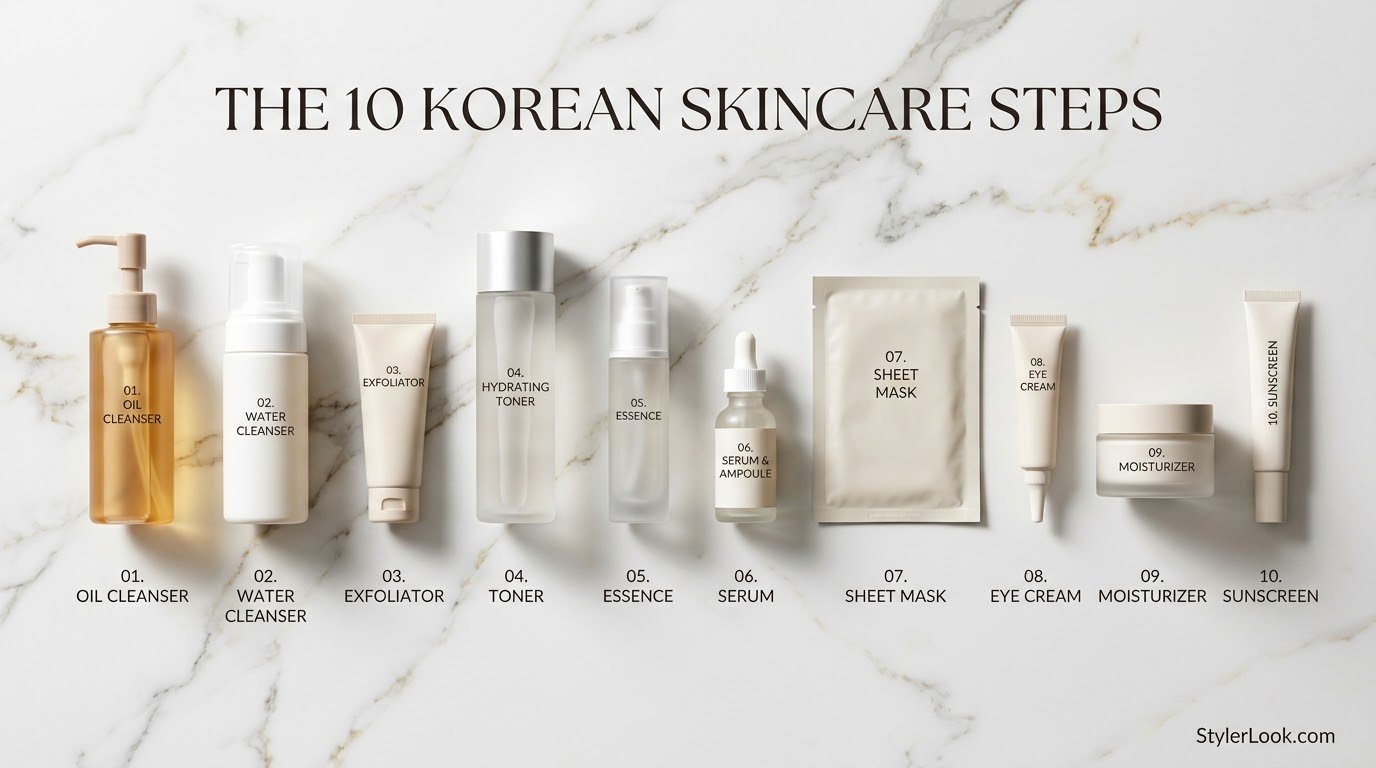
Ask three questions of any newcomer. What texture is it, which fixes its neighborhood? What job does it claim, which names its rung? What cadence does it deserve, daily or weekly?
A watery brightener is a serum rung. A rich balm is a seal. A rinse off acid is the exfoliator rung with its weekly tag. The answers arrive in seconds once the questions are habits.
When a product claims to be several rungs at once, treat it as the thickest rung it contains. Hybrids compress ladders for travel and light days; they do not repeal the direction rule.
New rungs still enter by the additions rule: one at a time, with a week or two of observation, and the log notes the date so reactions have a timeline to confess against.
Why This Ladder Exists: The Korean Difference
The Korean system grew around hydration layering rather than single hero products. Instead of one thick cream promising everything, several thin layers each contribute water, and the seal keeps the sum.
That philosophy explains the rungs Western routines lack. The essence exists because Korean formulation split toner’s prep job from serum’s treatment job and gave the watery middle its own product.
It also explains the toner divide. A Western astringent toner removes; a Korean hydrating toner adds. Same shelf word, opposite rungs in spirit, and the confusion dissolves once the ladder sorts by function.
Prevention over correction is the cultural through line in the guides: gentle daily layering and religious sunscreen, instead of aggressive rescue later. The ladder is that philosophy made into a daily sequence.
Understanding the why protects the how. A follower who knows each rung’s job can substitute, skip, and improvise for years. A follower memorizing bottles owns a routine that expires with the first discontinuation.
Actives on the Ladder: A Worked Rotation
Consider a common goal set: brightness and texture. Vitamin C takes the morning serum rung, protected by sunscreen above it, the classic daytime pairing in the guides’ examples.
Niacinamide is the flexible citizen, slotting into either ladder’s serum rung, mornings beside vitamin C in tolerant routines or evenings as the main treatment on non exfoliator nights.
The exfoliator owns its one or two evenings, and on those evenings the serum rung goes gentle or hydrating. The rotation is the conflict rule expressed as a calendar instead of a warning.
Retinol, when used, takes the evening serum rung on its own nights, buffered by moisturizer for sensitive skin in the sandwich pattern the wider field describes. It never shares a night with the exfoliator.
Notice what the ladder contributed: every active found a rung, a cadence, and a rest day structure without a single new rule. Rotation is just cadence applied to ingredients.
Troubleshooting by Rung
Morning skin feels coated. The seal was too rich or the watery rungs were doubled. Lighten rung nine first; the ladder rarely needs subtraction below the seal.
Evening skin still feels dirty. The double cleanse was rushed. Give the oil its full minute of massage and emulsify properly before the water cleanser, rather than adding a third cleanse.
Serums seem to do nothing. Check direction first: anything watery applied over the moisturizer this week was decoration. Re sort, wait two weeks, and only then judge the product.
Everything suddenly stings. That is cadence damage, usually exfoliator creep or an active added too fast. Demote to the four beginner rungs until calm, then rebuild one rung at a time.
Makeup slides by noon. The morning ladder was too glossy at the top. Let the sunscreen settle several minutes, lighten the moisturizer, and let the makeup prep guidance on this site handle the rest.
Ladder Myths, Corrected
Myth: ten steps, twice a day. Refuted by every cadence tag on this page. The full ladder exists across a week; sessions run four to nine rungs.
Myth: Korean routines are for Korean skin. The ladder is texture physics and hydration logic, which every skin obeys. Product choice personalizes; order universalizes.
Myth: more layers always beat fewer. Layers beat fewer layers only when each has a job. A rung repeated without purpose is dead weight the seal then traps against skin.
Myth: the order is marketing. Marketing invented the number ten, perhaps. It did not invent occlusion, and cream before essence fails in any country, in any decade, for physical reasons.
Myth: essence and toner are the same thing twice. They are two grades of watery layer, prep and enriched prep. Collapsing them is allowed by the ladder; pretending they are identical misunderstands both.
Myth: you must buy Korean brands for a Korean routine. The ladder assigns rungs, not passports. Any product that fits a rung’s texture and job may stand on it.
Worked Ladders by Goal
The hydration goal stacks the middle: toner, essence, a humectant serum, and a faithful seal, with the 7 skin technique on dry weeks. Its exfoliator cadence stays low, because flaky surface, not dullness, is the complaint.
The brightness goal runs vitamin C mornings, a gentle exfoliator evening or two, and sunscreen discipline as its real engine. Pigment goals live or die at rung ten, whatever the serum promises.
The texture goal gives the exfoliator its earned cadence and a treatment serum on the off nights, with moisturizer weights steady. Texture changes on skin cycle time, weeks not days, and the log proves it.
The calm goal strips the ladder to its kindest form: gentle cleanses, toner, a centella or panthenol style serum in guide examples, seal, sunscreen. Every optional rung waits until calm has lasted a month.
The oil control goal keeps the double cleanse sacred, chooses BHA in the exfoliator framing guides use for pores, and seals with gel. Its commonest failure is skipping moisturizer, which the ladder forbids.
Each goal changed contents and cadence only. The order never moved, which is the demonstration this whole page exists to make: one ladder, many routines.
When the Ladder Pauses: Illness, Procedures, Prescriptions
Illness weeks demote the ladder to basics without guilt: cleanse gently, moisturize, sunscreen if you go out. A routine that cannot pause gracefully was a burden wearing a ritual’s clothes.
After professional procedures, the provider’s instructions replace the ladder wholesale for the stated period. Exfoliators and actives retire until cleared, and the beginner four rungs are the usual re entry shape.
New prescriptions enter by the additions rule with the prescriber’s placement, one at a time, while the log watches. The ladder rearranges around medicine, always, and asks no permission from habit.
Sunburn, rashes, and sudden reactive phases also pause experimentation. The ladder’s weekly rungs are the first suspended, and time, not products, does the repair work while basics hold the line.
The Shelf in Ladder Order
Arrange the bottles physically in ladder order, cleansers at one end, sunscreen at the other. The shelf becomes the checklist, and a missing rung announces itself as a gap in the line.
Expiry discipline follows the same line: watery rungs turn over fastest by volume, weekly rungs slowest. Date opened products with a marker, because the weekly exfoliator is the bottle everyone overestimates.
Keep the sheet masks visible and counted. A mask habit dies in a drawer; a small stack beside the moisturizer keeps mask night in the week’s peripheral vision until it happens.
Duplicates belong behind their working bottle, same rung. The arrangement sounds trivial until the first groggy morning it saves, which is the entire case for designing the shelf.
The Ladder Meets Skin Cycling
Skin cycling organizes evenings into exfoliation, retinoid, and recovery nights. It overlays the Korean ladder cleanly, because cycling is a cadence system and the ladder welcomes cadence decisions at its active rungs.
On cycling’s exfoliation night, the Korean exfoliator takes rung three and the serum rung stays gentle. On retinoid night, rung three rests and the retinoid takes the serum rung. Recovery nights run hydration only, which the middle rungs were built for.
The merger exposes both systems’ shared skeleton: actives rotate, basics persist, and no night carries every weapon. Followers of either system will find the other strangely familiar, because both are scheduling wearing different clothes.
Choose one calendar language and keep it. Two systems issuing orders to the same evenings produce the stacked nights both exist to prevent.
Technique Notes the Guides Repeat
Water temperature is lukewarm at every rinse, in guide after guide. Hot water strips the lipids the sealing rungs then must replace, quietly taxing the whole ladder.
Cleansing duration gets the only stopwatch in the system: the oil’s minute of massage, and a gentle half minute or so for the water cleanser in practical guidance. Longer is scrubbing by another name.
Drying between rungs is partial by design. Skin should feel damp to dewy through the middle layers; bone dry between every step wastes the hydration transfer the ladder exists to create.
Neck and backs of hands inherit the ladder by extension, same order, leftover amounts. They age on the same sun and deserve the same final film in the morning.
Restocking rhythm follows cadence math: cleansers and sunscreen empty first, weekly rungs last. A household that buys by the ladder rarely faces the mid routine gap that breaks consistency.
Frequently Asked Questions
1. What is the correct Korean skincare routine order?
Oil cleanser at night, then water cleanser, exfoliator on weekly nights, toner, essence, serum, sheet mask weekly, eye cream, moisturizer, and sunscreen each morning. Always thinnest to thickest.
2. Why do Korean products go from thinnest to thickest?
Because thick layers form films that block thin ones. Watery products need direct contact with skin, and a cream applied first seals them out.
3. Do I need all 10 steps every day?
No, and you are not meant to. Cleansing, toner, essence or serum, and moisturizer are daily; the exfoliator and sheet mask are weekly steps.
4. Do all 10 steps happen in one routine?
No, never. Sunscreen is morning only, the oil cleanser is evening anchored, and two steps are weekly, so a full session runs nine rungs at most.
5. What are the daily steps in a Korean routine?
The cleanse, toner, essence or serum, and moisturizer. Eye cream is daily for most followers too, and sunscreen joins every morning as the final film.
6. How often should I use the exfoliator step?
Start at once a week. Strong guides range from one to two up to two or three times weekly; beginners earn the higher end slowly.
7. How often should I use a sheet mask?
Once a week is the sane start. Guides range from once or twice to two or three times weekly, and the mask forgives the range.
8. Is the oil cleanser for morning or night?
Night. The oil cleanser exists to dissolve the day’s sunscreen, makeup, and sebum, and mornings have none of that cargo yet.
9. What cleanser do I use in the morning?
A gentle water based cleanser, or just water. Many skins rinse only in the morning; tightness afterward is the signal to soften further.
10. Does essence go before or after serum?
Essence first, always. It is the thinner texture, and the ladder runs thin to thick, so the serum would block it in reverse.
11. What is the difference between an essence and a serum?
Texture and concentration. Essence is a watery hydrating prep; serum is the thicker, targeted treatment aimed at one concern.
12. What is an ampoule, and is it used daily?
An ampoule is a concentrated serum used as a course. Guide notes treat ampoules as a few weeks of intensity, not permanent daily residents.
13. When does the sheet mask go on in the order?
After toner and essence, before eye cream. The sheet holds essence against skin for about 10 to 20 minutes at that rung.
14. Should I rinse after a sheet mask?
No, never rinse. Pat the leftover essence into skin when the mask comes off; rinsing throws away the step’s payload.
15. Where does eye cream go in the order?
Before moisturizer, on the orbital bone. A rice grain amount, tapped gently, so the sealing layer goes over it rather than under.
16. What goes last in the morning?
Sunscreen, always. It is the morning’s final film, SPF 50 with PA grading in the Korean system, with nothing over it but makeup.
17. What goes last at night?
Moisturizer, or an optional sleeping mask. The sleeping mask is an extra occlusive for dry skin, skipped freely in humid weather.
18. Is a sleeping mask necessary?
No, it is the ladder’s most optional rung. Dry skin on dry nights benefits; everyone else can finish at moisturizer.
19. How long should I wait between layers?
Briefly, as a practical tip. About 30 seconds appears in guides for dense layers; visibly stacking wet on wet is the real error.
20. Should I pat or rub products in?
Pat the watery layers in. Patting presses product onto skin without dragging it away, and the guides repeat the instruction for a reason.
21. What happens if I apply products in the wrong order?
The thin layers get sealed out. A serum over cream mostly decorates the cream; the damage runs one way, which makes it easy to fix.
22. Why are my products pilling?
Usually reversed or rushed layering. Products roll into crumbs when films stack wrongly or too fast; thin the stack and slow down.
23. Can I skip steps in the Korean routine?
Yes, dropping rungs never breaks the ladder. Only reversing them does, so skip by cadence and skin need with a clear conscience.
24. What is the beginner version of the Korean routine?
Four steps: water cleanser, toner or essence, moisturizer, morning sunscreen. Run them two to three weeks, then add one rung at a time.
25. How quickly should I add new steps?
One at a time, about one to two weeks apart. Exfoliators and masks come last, after the basics have proven calm.
26. What is the 7 skin method?
It layers one hydrating toner up to seven times. A named technique for dry spells and cold months, multiplying a rung rather than adding products.
27. Is the Korean toner the same as a Western toner?
No, they are near opposites. Western toners classically astringe and remove; Korean toners hydrate and add the first water layer.
28. Can I use retinol in a Korean routine?
Yes, in the evening serum rung. It takes its own nights, buffered for sensitive skin, and never shares a night with the exfoliator.
29. Can I exfoliate and use retinol on the same night?
No, schedule them apart. Retailer guidance in the research is explicit: skip exfoliating on retinol nights, and the same care applies to strong vitamin C.
30. Where does vitamin C serum fit in the order?
In the morning serum rung. Vitamin C is the classic daytime treatment, sealed under moisturizer and protected by the sunscreen film.
31. What order do two serums go in?
Thinnest first. The more watery serum takes the earlier slot; when textures tie, the priority treatment goes first.
32. Where does facial oil fit in the Korean order?
Treat it as a seal. Facial oil sits in the moisturizer’s neighborhood, after the watery layers, last at night or before sunscreen by day.
33. Where do spot treatments go?
After serum, before moisturizer. Sensitive skin may buffer drying formulas over moisturizer instead; placement serves tolerance first.
34. How long does the full Korean routine take?
About five minutes in the morning, seven at night. Realistic guides time ordinary days there; mask nights are the exception.
35. How long does a realistic morning routine take?
Three to four steps and a few minutes. Water cleanser or rinse, toner, moisturizer or light serum, and sunscreen carry the morning.
36. Is the Korean routine good for oily skin?
Yes, with a lighter seal. Gel moisturizers, faithful double cleansing, and honest exfoliator cadence suit oily skin well.
37. Is the Korean routine good for dry skin?
Yes, it was built for hydration. Richer seals, the 7 skin technique in cold months, and the optional sleeping mask all serve dry skin.
38. Is the Korean routine good for sensitive skin?
Yes, slowly. Fewer actives, longer gaps between additions, and the exfoliator at minimum cadence or paused keep sensitive skin safe.
39. Does the order change in summer or winter?
The order never changes; the weights do. Summer lightens seals and skips sleeping masks; winter enriches seals and may add toner layers.
40. Can men follow the Korean routine order?
Yes, the ladder is universal. Texture physics does not check passports or gender; product choice personalizes what order standardizes.
41. What order do I apply Korean skincare under makeup?
Run the morning ladder, let sunscreen settle, then makeup. The sunscreen stays the last skincare film, and patience prevents the slide.
42. Where do I learn the Korean routine itself, beyond the order?
Read the site’s Korean skincare routine guide. It owns the philosophy and products; this page owns only the sequence and its cadence.
Conclusion
The korean skincare routine order asks for one habit and rewards it for years: climb the ladder thin to thick, and let the cadence tags do the scheduling.
Drop rungs when life or skin requires it. Reverse none of them. Start at four, add slowly, keep the exfoliator weekly and the sunscreen daily, and the famous ten steps become what they always were, a menu that fits a real week.
Print the ladder, tape it inside the cabinet door, and let the shelf stand in order. The routine will still be running, correctly, long after the bottles that taught it are empty.
