

Curtain bangs with long layers are not a fringe added to long hair. They are a staircase: four steps of length, each starting lower than the last, melting into each other from the center part to the very ends.
Get one step’s start point wrong and the whole cut shows it. Layers that start too high read choppy, and a fringe cut straight across is not a curtain at all.
Get the staircase right and you keep every inch of length while the hair gains what long hair usually lacks: movement that starts at the face.
The general curtain system lives in our full curtain bangs guide. This page owns the long pairing: the four steps, their start landmarks, and its two clocks.
The Staircase: Four Steps, Four Landmarks
Latest Hairstyles’ gallery of 15 elegant long hair looks with layers and curtain bangs makes the point in its introduction and then leaves it: done correctly, the bangs and layers create a fluid movement throughout the entire style.
Fluid movement is not a mood. It is a construction: each step hands the eye to the next with no visible line where one ends. Here is the staircase drawn, which the galleries praise and never specify.
|
Step |
What It Is |
Where It Starts |
Its Job |
|---|---|---|---|
|
The curtain itself, center parted |
Shortest point at or just under the cheekbone (strands tabled below) |
Opens the face and sets the cut’s identity |
|
The graduated pieces either side of the face |
Under the cheekbone toward the chin, by strand and by face |
Carries the fringe’s line down past the jaw |
|
Angled layers through the mid lengths and ends |
Low, through the lower third of the hair |
Movement and weight removal without losing length |
|
The bottom edge, the haircut’s hemline |
The full chosen length |
Holds the silhouette: soft V, soft U or blunt |
Read the table as a rule: each step starts where the previous step’s longest pieces end. A step that starts too late leaves a shelf between them.
The staircase also forgives: a mistake in one step can usually be repaired by adjusting the step below it.
Checking the Melt in the Mirror
Three checks before you leave the chair. First, the front view: the frame must be visible from the front, the rule the salon scripts give for choosing photographs, applied to your own head.
Second, the profile view: fringe, frame and layers should read as one descending line with no step or shelf in it. Third, the movement check: turn your head and watch the hair swing as one fabric, not as a fringe plus a separate body of hair.
Where Each Step Starts: The Landing Strands, Honestly Tabled
Ask the internet where the front of this haircut starts and you get six answers, sometimes two inside a single post. They print here as strands, because printing one as the rule would be inventing a consensus that does not exist.
|
Source |
The Strand |
What It Actually Describes |
|---|---|---|
|
The salon scripts shared on Lemon8 (two posts) |
The shortest piece starts under the cheekbone, one post calling it a non negotiable rule |
The fringe’s shortest point and the frame’s start, deliberately low |
|
The Lemon8 script family (two other posts) |
Chin length curtain bangs, longer pieces toward the jaw |
The fringe’s tail, not its center |
|
A third Lemon8 script |
Face framing layers starting at the chin |
Step 2, the face frame, not the fringe |
|
The Lemon8 blonde script |
Bangs starting around the nose, opening toward the cheekbones |
The fringe center on a high, dramatic frame |
|
Stylist Skye, via Latest Hairstyles’ gallery of 50 curtain bangs ideas on long hair |
The curtain fringe sits better at cheekbone length |
The fringe’s resting length on long hair |
|
Latest Hairstyles’ gallery of 50 curtain bangs ideas on long hair (its own rule) |
On waist length hair, the bangs are better chin length |
Scaling: fringe length follows hair length |
The resolution is the article in one line: these are three different landmarks, not one argument. Fringe center, fringe tail and face frame start are separate decisions, and the scripts conflate them because in the chair they are discussed in one breath.
Your specification names all three: center at the cheekbone zone, tail toward the jaw, frame starting under the cheekbone to the chin. A stylist given three landmarks cannot accidentally give you one.
Scaling the Fringe to Very Long Hair
The one scaling rule in the record comes from Latest Hairstyles’ gallery of 50 curtain bangs ideas on long hair: consider the length of your hair, because on waist length hair the bangs would better be chin length. Proportion, again: the longer the staircase, the longer each step can be.
|
Your Hair Length |
Fringe Center |
Fringe Tail and Frame Start |
Why |
|---|---|---|---|
|
Shoulder blade length |
Cheekbone |
Tail to the jaw, frame from under the cheekbone |
The staircase is compact; steps stay close |
|
Mid back length |
Cheekbone to just under |
Tail toward the chin, frame from the chin zone |
Room opens up; the frame can start lower |
|
Waist length |
Chin length bangs (the gallery’s rule) |
Frame flowing from the chin into long layers |
A cheekbone fringe on waist length hair reads as a separate, much shorter haircut pasted on top |
The failure the last row prevents is common: very long hair with a standard cheekbone fringe gives you two haircuts at two lengths on one head. Scaling makes it one.
The Perimeter Decision: Soft V, Soft U or Blunt
The bottom edge is the staircase’s last step, and for long hair it is a genuine decision with three live options in the record.
|
Perimeter |
Who It Suits |
The Strand Behind It |
|---|---|---|
|
Soft V |
Most long hair; readers who want the classic layered silhouette |
The Lemon8 scripts’ default: a V shape, not super sharp, just enough that the back is not blunt straight across |
|
Soft U |
Fine hair, and anyone protecting full looking ends |
The Lemon8 fine hair version: a soft U shape in the back with long layers that do not remove too much density |
|
Blunt |
Sleek, polished versions; thick hair that can carry a strong hemline |
A gallery version in Latest Hairstyles’ gallery of 51 layered haircuts with curtain bangs (layers with blunt ends) proves the pairing survives it when the fringe is kept neat |
Choose by density and ends, not by photograph. Fine hair in a deep V can look wispy at the point; thick hair in a blunt line can hang heavy and still.
The Specification: What to Ask Your Stylist (and the Do Not Line)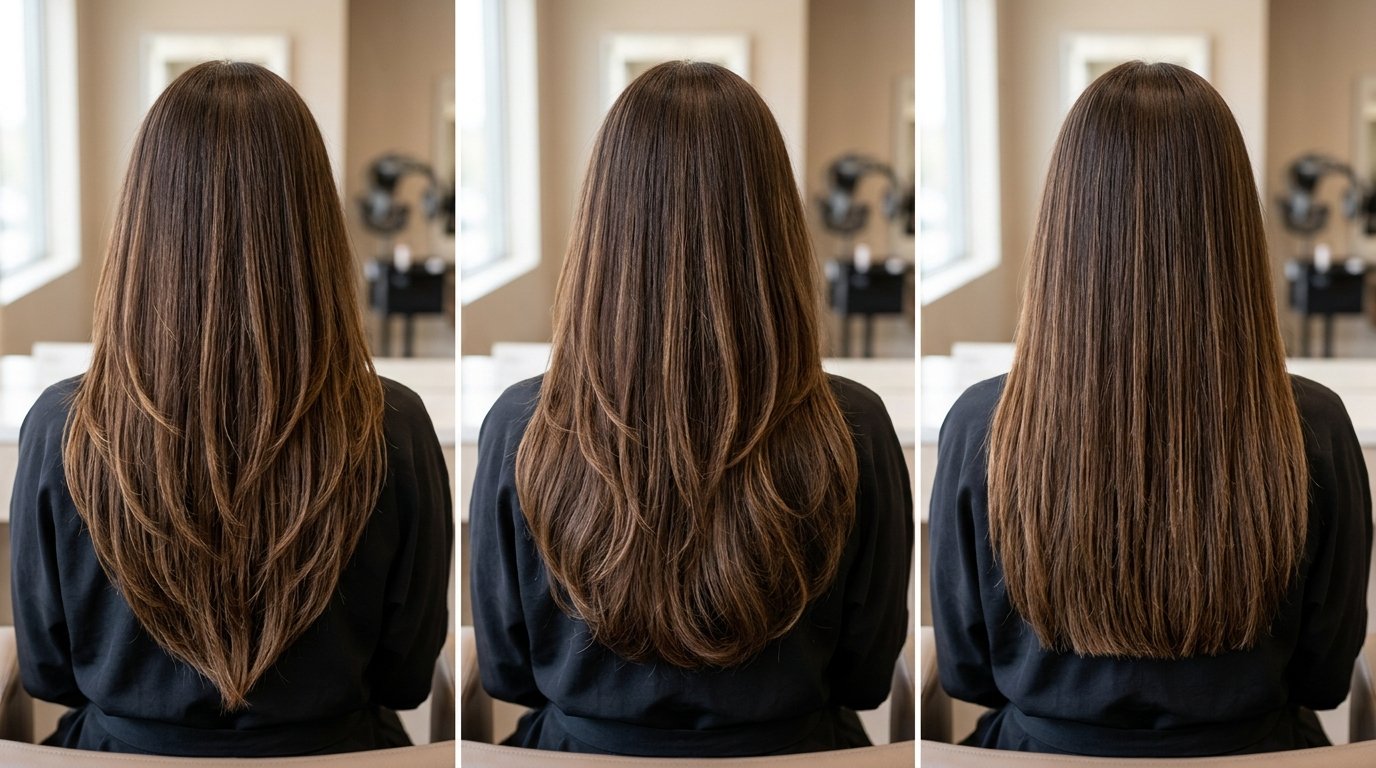
This topic’s SERP is famous for its salon scripts, exact wording shared by wearers on Lemon8, because wording is where this haircut is won or lost. Here is the complete specification in that tradition, finished and ordered the way one script wisely orders it: length first, fringe last.
- Length: keep it. State the trim you accept, around an inch to clean the ends is the scripts’ own example
- Layers: long layers, not short layers. Say it twice. Angled long layers, feathered out at the ends, nothing choppy, no short layers near the crown
- Face frame: soft face framing that starts at your chosen landmark, under the cheekbone to the chin, and blends into the layers
- Fringe: curtain bangs at your scaled length, split in the middle, blended, never a separate heavy section
- Perimeter: your chosen shape named out loud, soft V, soft U or blunt
- Movement and part: keep the volume, add the movement, and say whether you want the cut to switch parts
Then the line every script circles back to, the do not line, said plainly and without apology: please do not give me straight across bangs and push them to the side. That sentence, or one like it, is the difference between the haircut in the photograph and the haircut in the mirror.
Bring a front view photograph, per the scripts’ inspo rules: framing visible from the front, layers airy rather than stepped, ends still full. A back view cannot communicate a staircase whose point is at the front.
One method note from a named expert: cosmetologist Kristen Odonnell, quoted in Latest Hairstyles’ gallery of 51 layered haircuts with curtain bangs, advises cutting the hair wet, then blow drying it to visualize where you want the layers to hit. If your stylist works this way, the staircase gets checked dry before you leave, which is when it matters.
Fine Hair: Layers on a Density Budget
Fine hair is where this pairing is most often talked out of itself, wrongly. The scripts are blunt about the real risk: the wrong layering makes fine hair look stringy fast, and the fix is not no layers, it is the right kind of layers.
The fine specification, from the scripts’ fine hair versions: long layers only, starting low; a soft U perimeter; layers that do not remove too much density; and a fringe kept longer and lighter, light and airy, blended into the frame, no heavy triangle at the front.
Think of density as a budget. Long layers spend it slowly, at the ends, where movement is bought cheapest. Short layers spend it at the crown, where fine hair cannot afford the bill.
Genuinely thin hair, where density itself is the constraint, has its own full system in our curtain bangs for thin hair guide. This page’s rule is the pairing rule: on fine long hair, the staircase stays, the steps get gentler.
Thick Hair: Weight Out, Movement In
Thick hair wants the opposite budget decision: density is abundant, and the pairing’s job is spending it on purpose. Long layers are the spending mechanism, removing weight through the mid lengths so the hair moves instead of hanging.
The specification points: layers angled and thorough through the back, where thick hair stores its weight; internal layering to lift the interior; and a fringe section kept defined, because on thick hair an under defined fringe gets absorbed by the mass around it.
HairPrimo’s gallery of 19 curtain bangs hairstyles shows the result on thick espresso waves: long, voluminous layered waves with a soft fringe melting into them. Melt is the operative word at every density.
The thick hair failure mode is the timid layer: too little removed, and the staircase becomes a fringe on a wall of hair. If your hair is thick, say it aloud: you want movement, and you accept the layering it takes.
Wavy, Straight and the Blowout Question
This pairing is the blowout haircut of the current era, the soft, bouncy, 90s inspired movement the scripts name as the goal. Wavy hair is its home texture: the wave supplies the curve the staircase is shaped to show, and styling is mostly encouragement.
Straight hair wears it well with one honest condition: the swoop must be set, with a round brush or rollers, because straight hair will not invent the curve. Set it and the pairing reads expensive; skip it and the same cut reads plain.
Part of the specification, from cosmetologist Kristen Odonnell in Latest Hairstyles’ gallery of 51 layered haircuts with curtain bangs: you must have a middle part when opting for a curtain fringe, because a side partition gives a completely different look. If your part will not move, that is a consultation conversation, not a surprise for the chair.
The Blowout, Step by Step
The staircase is styled in its own order, front steps first, because they cool and set while you work behind them.
- One: dry the fringe first, away from the face, with a round brush, or set it in rollers while warm
- Two: dry the face frame in the same outward direction, so steps one and two dry as one surface
- Three: work the layers in sections with the brush, lifting at the root and rolling the ends under or out, your choice per version
- Four: let everything cool completely before shaking it out; the bounce is set in the cooling, not the heating
- Five: finish with the lightest touch of oil on the ends only, never at the frame, where it would collapse the steps you just built
Day two is kinder: the fringe and frame get a one minute re sweep, and the layers mostly need a brush out and dry shampoo at the root. The shape is cut in, not only styled in, so it holds between washes.
The Curly Version, Briefly
Curly long hair takes the staircase happily, with the cluster’s standing conditions: the fringe is cut dry, the steps are left longer than the straight eye expects, and shrinkage is priced in.
Layers are curly hair’s oldest friend and oldest risk: placed well, they build the shape; placed as on straight hair, they build the pyramid. The full texture system lives in our curtain bangs for curly hair guide; the pairing is not a straight hair club.
Eight Versions of the Pairing, Specified
SoloTravely’s guide to 17 long layered haircuts with curtain bangs organizes its looks by temperament, soft, rich and bold, each with a one line salon script. Here are the eight versions that matter most, each as a specification rather than a caption.
1. The Timeless Classic. Soft long layers, middle parted curtain bangs resting on the cheeks. SoloTravely’s own first cut, and the version against which the others are variations. Specify the staircase at standard landmarks.
2. The 70s Feather. Flicked, feathered layers full of air, bangs that blend back. Feathering is heaviest at steps two and three; the perimeter stays soft.
3. The Blowout Queen. Long layers made for a round brush blowout, bangs that curve into the layers. The 90s supermodel reading of the pairing, and the most styling dependent version here.
4. The Wispy and Light. Sheer bangs for fine hair, long layers kept light, with SoloTravely’s script warning carried verbatim in spirit: do not thin too much. The density budget version.
5. The Bottleneck Blend. Bottleneck bangs, narrow on top and wide at the cheeks, blended into long layers. The lowest drama fringe in the family, for readers easing into bangs.
6. The Glass Hair Sleek. Long clean layers, no texture, sleek curtain bangs in the middle. Every step must be exact, because nothing hides.
7. The Balayage Showcase. Color that travels with the layers, brighter pieces at the frame. The cut as a color delivery system, specified fully in the color section below.
8. The Thick Hair Tamer. Long layers with real weight removal and a defined fringe. SoloTravely captions its version with the honest joke that the forty minute blow dry is not included.
For the wider picture book across lengths and fringe types, our curtain bangs ideas gallery is the cluster’s gallery. The wispy mechanics in full belong to our wispy curtain bangs guide; here they appear as one version among eight.
Color Through the Layers: Balayage, the Money Piece and the Front
Long layers are a color architecture: each step catches light at a different point, which is why balayage and this cut are paired so often in the galleries. The brightest pieces belong at steps one and two, the frame the eye reads first.
The Lemon8 blonde script gives the color specification its clearest form: lift to a bright blonde level, ask for bright with no warmth, but not so ashy it looks grey, add a money piece at the front, and finish with a mini root smudge. Borrow the wording at any color: name the brightness, name the forbidden failure, name the front.
The front grows and fades fastest, so the frame’s color wants refreshing on the fringe’s clock, not the layers’. Two clocks again, this time in color.
Hair Up, Sports and the Honest Downside
Every other section of this page sells the pairing. This one prices it, using the record’s own expert. Cosmetologist Kristen Odonnell, in Latest Hairstyles’ gallery of 51 layered haircuts with curtain bangs, names the downside plainly: the cut is not ideal for women who wear their hair up or play sports a lot, and not ideal if you do not want strands hanging down your face.
She is right, and the reason is structural: a staircase’s top steps are too short to reach a ponytail, by design. The face strands are not a flaw in the cut; they are the cut.
The workarounds are honest but partial: low ponytails and clips that leave the frame out, headbands and pins for sport, and accepting that a sleek high bun will always have two soft escapees. If your life is high ponytails daily, choose with your eyes open.
Two Clocks: Maintaining the Pairing
The lob pairing runs on one clock, fringe and perimeter growing together. This pairing runs on two, and pretending otherwise is how the front quietly expires while the back still looks fine.
|
Element |
The Clock (strands) |
What Happens Between Appointments |
|---|---|---|
|
The fringe |
Every 3 to 4 weeks (Latest Hairstyles’ gallery of 15 elegant long hair looks with layers and curtain bangs, its first look) |
Grows past its landmark and starts reading as frame, which is graceful, not broken |
|
The fringe, relaxed reading |
Every 5 to 6 weeks (SoloTravely’s upkeep note for its classic version) |
The same growth, forgiven longer because the classic version’s fringe starts lower |
|
The classic curtain strands |
3 to 4 (Davines), 3 to 5 (Highland), 4 to 6 (Maki) weeks, the cluster’s salon strands |
The fringe tidy is a small, fast appointment on any of them |
|
The layers and perimeter |
A much slower clock: a few of the fringe appointments pass between layer refreshes |
Layers do not expire; they soften. The refresh is a choice about sharpness, not a rescue |
Book the fringe tidy as the standing appointment and add the layer refresh to one of them when the steps look soft in photographs. Two clocks, one diary.
Growing Out: The Fringe That Becomes the Layers
This pairing owns the kindest grow out in the fringe family, for a structural reason: the fringe’s exit is built into the cut. A curtain fringe growing out does not become a problem to solve; it becomes step two, the face frame, and then step three, the layers.
|
Stage |
What It Looks Like |
The Move |
|---|---|---|
|
Weeks 1 to 6 |
The cut as designed |
Photograph the staircase from the front for your records |
|
Months 2 to 3 |
The fringe reaches frame length |
Nothing; it is now a face frame, which people pay for separately |
|
Months 4 to 6 |
The frame reaches layer length |
Decide: re cut the fringe, or bless the layers and keep growing |
|
Month 6 plus |
Long layers, no fringe in evidence |
The exit is complete and invisible; the layers stand alone |
Growing the other direction, toward shorter lengths, the staircase compresses step by step instead of dissolving, and our short curtain bangs guide maps how the fringe behaves as the steps shorten.
Compare the exits honestly: a blunt fringe grows out as a visible band crossing the face for months. This pairing grows out as a gradient the whole way down. Readers who fear commitment are not being sold a line when stylists call this the low risk fringe; the staircase is the reason.
Mistakes: Short Layers, Stepped Lines and the Vanishing Fringe
Mistake one: saying layers and hearing short layers. The scripts’ central miscommunication. The word layers alone invites the stylist’s default, which may start far higher than you mean. Say long layers, not short layers, and name the start point.
Mistake two: the straight across fringe pushed to the side. A blunt fringe cut and then swept is not a curtain bang wearing a disguise; it is a different haircut with a daily styling tax. The do not line exists because this mistake is common enough to have a script against it.
Mistake three: stepped layers. Visible lines between layers mean the steps were cut as shelves, not gradients. The inspo rules warn against even choosing photographs with harsh lines showing, because a cut can copy its reference’s flaw. The melt check catches it in the chair.
Mistake four: the vanishing fringe. Over blending until the bangs exist only as a rumor at the front. The staircase needs its first step defined: a clear center section with a landmark, blended only at its tail.
Mistake five: thinning the ends to make layers move. This spends the density budget at the exact place fullness is judged. Movement comes from layer placement, not from removing the ends’ substance.
Frequently Asked Questions
Do curtain bangs work with long layers?
Yes; long layers are arguably their most natural partner, because the fringe is not an addition but the top step of the staircase the layers continue. The conditions are the start landmarks and the blend.
What is the staircase in a long layers haircut with curtain bangs?
The cut’s construction: four steps of length, fringe, face frame, long layers and perimeter, each starting where the previous step’s longest pieces end. No step shows a line; the eye travels from the center part to the ends without meeting a shelf.
Where should curtain bangs start with long layers?
The strands conflict and this article tables them rather than merging them: the scripts put the shortest piece under the cheekbone, stylist Skye puts the resting fringe at cheekbone length, and one script starts bangs around the nose. Name your landmark in the chair.
Where should face framing layers start, at the cheekbone or the chin?
They are different steps. The fringe lives at the cheekbone zone; the face frame starts lower, under the cheekbone toward the chin, per the Lemon8 scripts. Conflating the two is the most common specification error in this haircut.
How long should curtain bangs be on long hair?
Scaled to the hair. Cheekbone zone centers suit shoulder blade and mid back lengths; Latest Hairstyles’ gallery of 50 curtain bangs ideas on long hair rules that on waist length hair the bangs are better chin length. The scaling table in this article gives the full ladder.
How does bang length scale with hair length?
In proportion: as the staircase lengthens, each step lengthens. A standard cheekbone fringe on waist length hair reads as a second, shorter haircut pasted on top. Longer hair takes a longer fringe center and a lower frame start.
What is the difference between the fringe, the face frame and the layers?
The fringe is the center parted section at the front, the identity piece. The face frame is the graduated hair either side of the face that carries the fringe’s line downward. The layers are the angled cutting through the mid lengths and ends that creates movement and removes weight.
Long layers or short layers: what is the difference at the salon?
Start point and density. Long layers start low, through the lower third, keeping length and fullness. Short layers start high, spending density and reading choppier. Saying just layers invites the stylist’s default; say long layers, not short layers.
What do I ask my stylist for long layers with curtain bangs?
The ordered specification in this article: keep the length, long layers not short layers, a frame starting at your landmark, curtain bangs at your scaled length, your perimeter named, and the movement stated. Bring a front view photograph.
What is the do not line that prevents the wrong haircut?
The scripts’ shared sentence, said plainly: please do not give me straight across bangs and push them to the side. Add no short layers near the crown if that is your fear. One clear do not prevents the two most common wrong versions of this cut.
Why did my curtain bangs come out as straight across bangs pushed to the side?
Because the fringe was cut as a blunt section and then swept, a different haircut wearing a curtain’s name. A true curtain is cut parted, graduated and blended from the first snip. The fix is a re cut of the fringe as a staircase top step, not more styling effort.
V shape, U shape or blunt: which perimeter suits long layers?
By density and ends: soft V for most long hair (the scripts’ default), soft U for fine hair protecting full looking ends, blunt for sleek versions and thick hair that can carry a strong hemline. The decision table in this article matches them.
Can fine hair have long layers with curtain bangs?
Yes, and the scripts insist the fix for fine hair is the right kind of layers, not none: long layers starting low, a soft U perimeter, density protected ends and a light, longer fringe with no heavy triangle. Genuinely thin hair has its own system in our curtain bangs for thin hair guide.
Do long layers make fine hair look thinner?
Only the wrong ones do. Short, heavy layering spends fine hair’s density at the crown and mid lengths and leaves stringy ends. Long layers spend it slowly at the ends, where movement is cheapest, and the perimeter stays full. The variable is placement, not layering itself.
How do I keep my ends looking full with long layers?
Ask for the perimeter to be kept full as a stated requirement, choose the soft U over a deep V, keep the layers long and low, and refuse thinning at the ends. Fullness at the hemline is a specification, and stylists honor it when it is named.
Can thick hair have long layers with curtain bangs?
Very well; the pairing is a weight management system for thick hair. Angled layers through the back, internal layering, and a defined fringe section that the surrounding mass cannot absorb. HairPrimo’s gallery of 19 curtain bangs hairstyles shows the melted result on thick espresso waves.
Do long layers suit wavy hair with curtain bangs?
Wavy hair is the pairing’s home texture: the wave supplies the curve the staircase is shaped to display, and styling is mostly encouragement. A light hand with product and the blowout steps in this article are usually all it asks.
Can straight hair wear long layers with curtain bangs without daily heat?
Honestly, with a compromise: the cut still works, but the swoop must be set when you want it, with a brush or rollers, because straight hair will not invent the curve. Air dried, expect a softer, straighter reading of the same staircase, pretty but less blown out.
How do I style long layers with curtain bangs as a blowout?
In the staircase’s own order: fringe first away from the face, frame in the same direction, layers in sections with root lift, then let everything cool completely before shaking it out. The full five steps are in this article’s styling section.
How long does the blowout take on long hair?
There is no honest single figure in the record, and this article will not invent one: it scales with length and density. At every length the front steps take the smallest share and matter most, so a fringe and frame only reset is a legitimate shortcut.
Can a curly version of this pairing work?
Yes, with the cluster’s standing conditions: fringe cut dry, steps left longer for shrinkage, and layer placement that builds shape rather than a pyramid. The full texture system lives in our curtain bangs for curly hair guide.
Does this haircut need a middle part?
For the curtain read, yes. Cosmetologist Kristen Odonnell, quoted in Latest Hairstyles’ gallery of 51 layered haircuts with curtain bangs, states it directly: you must have a middle part with a curtain fringe, because a side partition gives a completely different look.
Can I switch my part with long layers and curtain bangs?
If you ask for it. One of the Lemon8 scripts adds exactly this line to the specification: cut it so I can switch my part. A part switchable version is cut with a less committed center, at the small cost of a less dramatic curtain on center part days.
Can I wear my hair in a ponytail with curtain bangs and long layers?
Yes, with the frame left out as the feature: a low or mid ponytail with the strands worn loose is one of this cut’s signature looks. What you cannot do is pull the top steps into the ponytail; they are too short by design.
Is this cut good for sports and gym hair?
It is the pairing’s honest weakness. Cosmetologist Kristen Odonnell names it in Latest Hairstyles’ gallery of 51 layered haircuts with curtain bangs: not ideal for sports or hair up lifestyles, because strands hang at the face. Headbands and pins manage it; they do not repeal it.
How often do the bangs need trimming with long layers?
By strand: every 3 to 4 weeks per Latest Hairstyles’ gallery of 15 elegant long hair looks with layers and curtain bangs, or every 5 to 6 weeks per SoloTravely’s classic version upkeep note, inside the cluster’s 3 to 5 and 4 to 6 week salon strands. Lower starting fringes forgive the longer rhythm.
How often do the layers themselves need refreshing?
On a much slower clock than the fringe: layers do not expire, they soften, and several fringe appointments pass between layer refreshes. No verified fixed interval exists in the record, so this article gives the pattern rather than a number: refresh when the steps look soft in photographs.
Can the fringe trim and the layer refresh be separate appointments?
Yes, and that is the system working as designed. The two clocks are independent: the fringe tidy is a small standing appointment, and the layer refresh joins one of them occasionally. Neither element has to wait for the other.
How does this pairing grow out?
The kindest exit in the fringe family: the fringe becomes the face frame, the frame becomes layers, and no stage has an awkward name. The exit is invisible because it was built into the staircase.
Curtain bangs with long layers or on a lob: which should I choose?
Choose by the length you want to live at. The lob pairing runs on one appointment clock and reads polished; this pairing keeps your length and runs on two clocks. The lob specification is in our curtain bangs on a lob guide once it publishes.
Curtain bangs with long layers or layers only, no bangs?
Layers only is the zero commitment version: movement and a soft frame with nothing to trim on a fringe clock. Curtain bangs add the center opening, the identity and the styling step. Many readers start with layers and add the fringe a visit later, which the staircase makes easy.
What is the difference between face framing layers and curtain bangs?
Face framing layers start lower and have no center section; they soften the face’s edges. Curtain bangs are a defined, center parted fringe that opens from the middle. On this haircut you usually have both, as steps one and two of the same staircase.
Bottleneck bangs or curtain bangs with long layers?
Bottleneck bangs are narrower on top and wider at the cheeks, the lowest drama entry in the fringe family, and SoloTravely’s guide to 17 long layered haircuts with curtain bangs scripts them as blending straight into long layers. Curtain bangs are the fuller, more defined opening. Both sit on the same staircase.
Does the pairing suit a round face?
Generally yes, with the frame kept longer: one of the Lemon8 scripts advises round faces to keep the curtain bangs longer, chin to jaw, and avoid anything ending right at the widest part of the cheeks. Length below the widest point is the lengthening mechanism. Face geometry in depth lives on the cluster’s face pages.
Does the pairing suit women over 40?
It is one of the most chosen long cuts at that age in the galleries, because it reads modern and deliberate without a length sacrifice. The age specific adjustments for the over 60 reader, length floors and glasses rules, are owned by our curtain bangs for women over 60 guide once it publishes.
What color works best with long layers and curtain bangs?
Color that travels with the steps: balayage through the layers, brighter pieces at the frame, a money piece for the front. The blonde script’s wording is worth borrowing at any color: name the brightness, name the failure you forbid, and finish with a root smudge for a soft grow out.
Do long layers with curtain bangs need special products?
Ordinary products in the right classes: heat protectant for blowout days, a light oil for the ends only, dry shampoo for second day roots. Heavy product at the frame is the common error; it collapses the top steps the whole cut is read by.
How do I refresh the cut on day two?
Front steps only: re sweep the fringe and frame with a brush and a minute of heat, or a quick roller set while you dress, and brush the layers out with dry shampoo at the root. The staircase’s shape is cut in, so day two is a reminder, not a rebuild.
Why do my layers look stepped instead of blended?
The steps were cut as shelves rather than gradients, or copied from a reference photograph where the lines already showed. A re blend appointment fixes the transitions; next time, run the melt check in the chair, profile view, before you leave.
Why do my curtain bangs disappear into my layers?
Over blending: the fringe was graduated until it became frame. The fix is a defined center section with a clear landmark, blended only at its tail. The seam between steps should hide the line, not the first step itself.
Can I go from one length long hair to this cut in one appointment?
Yes, it is the standard way in, and doing it at once is better for the staircase, because all four steps are designed together from the first cut. Bring the specification and a front view photograph.
When is this pairing the wrong choice?
When your life is high ponytails and sport daily and face strands would genuinely bother you, when you will not wear a middle part, or when density is so sparse that even gentle steps spend too much. The layers only version keeps most of the benefit in the first two cases.
Conclusion
Good curtain bangs with long layers are a staircase, not a fringe: four steps, each starting at its landmark, melting from the center part to the perimeter so the movement runs the full length of the hair.
Specify the steps, name the landmarks, say the do not line, and run the two clocks without apology. Save the staircase table and specification for the appointment, and browse StylerLook for the curtain family at every other length.
If you take one sentence to the salon, take the scripts’ own order: keep my length, long layers not short layers, a frame that starts under my cheekbone, and bangs that blend.
