

Curtain bangs on a lob are two haircuts that behave like one, and that is exactly where they go wrong.
Cut the fringe as its own decision and the lob as another, and the front of the head shows the join: a fringe that floats, front pieces that swallow it, or two finishes fighting.
Cut them as one gradient, fringe flowing into front length with no visible line, and the pairing becomes the most forgiving medium haircut in the salon.
The general curtain system lives in our full curtain bangs guide. This page owns the pairing: the seam, the length scale, and the single appointment that maintains both.
The Seam Is the Hairstyle
The seam is the stretch of hair where the fringe’s longest pieces meet the lob’s front corners. On a good pairing, you cannot find it.
Latest Hairstyles’ gallery of 51 long bob and curtain bang pairings says it in its lead caption without building on it: the bangs blended so thoroughly that there is no obvious line where the fringe ends and the hair begins.
That no line test is the quality check for the whole cut. Run a finger down the front: fringe, then longer fringe, then front length, each step a small increase, never a shelf.
The seam fails in two directions. Cut the fringe too separately and it floats, a neat little curtain pasted onto a blunt cut. Blend it too eagerly and it vanishes, and you have paid for bangs you cannot see.
Checking the Seam in the Mirror
Three checks, thirty seconds, before you leave the chair. First, the three quarter turn: the gradient should read as one slope from part to front corner, with no step in it.
Second, the tuck check: tuck one side behind your ear. A good seam survives tucking, because the lengths behind the fringe are a continuation, not a cliff.
Third, the movement check: shake your head gently. Fringe and front should swing together. If the fringe moves as one piece and the front as another, the seam is a border, not a blend, and it can still be fixed in the chair.
The Lob Zone: Chin to Collarbone, in Three Strands
Ask three sources where a lob lives and you get three edges of one zone. All three print, because the zone is a range, not a point.
|
Source |
The Lob Zone |
Note |
|---|---|---|
|
A widely shared essay on this pairing (DiffSense) |
Between the chin and the collarbone |
The classic definition |
|
Collarbone, or just below it |
Its ask blocks add: front pieces a touch longer than the back |
|
|
Latest Hairstyles’ gallery of 51 long bob and curtain bang pairings |
Neck or shoulder grazing |
The longest reading of the zone |
The practical reading: the pairing works across the whole zone, but the fringe must scale as the length moves. That scaling is the next section, and it is the table the galleries never print.
One length note with daily consequences: at collarbone, the cut can be tucked, waved or pinned back, the versatility point Haircelona’s introduction leads with. At chin length, none of that applies, and the fringe carries more of the style alone.
Scaling the Fringe to the Length
The rule is proportion: as the lob lengthens, the fringe’s landing point stays at the cheekbone but its longest pieces lengthen, so the gradient has room to breathe.
|
Lob Length |
Fringe Landing |
Longest Fringe Pieces Reach |
Front Differential |
|---|---|---|---|
|
Chin to jaw |
Cheekbone |
Just below the cheekbone |
Front level with the back or a touch longer |
|
Jaw to shoulder |
Cheekbone |
Toward the jaw corner |
Front a touch longer than the back (Haircelona’s specification) |
|
Collarbone and just below |
Cheekbone, sometimes a little lower |
Into the front length, fully blended |
The seam is longest here; blend matters most |
The cheekbone landing itself is agreed ground: Haircelona’s gallery of long bobs with curtain bangs specifies a fringe that starts near the temple and falls to cheekbone level, and Latest Hairstyles’ lead look splits around the nose and moves to the sides at cheekbone level.
What changes with length is not the landing but the tail. A chin lob with collarbone length fringe pieces is not a longer look; it is an unbalanced one, fringe and cut arguing about which haircut this is.
Blunt or Textured: The Perimeter Decision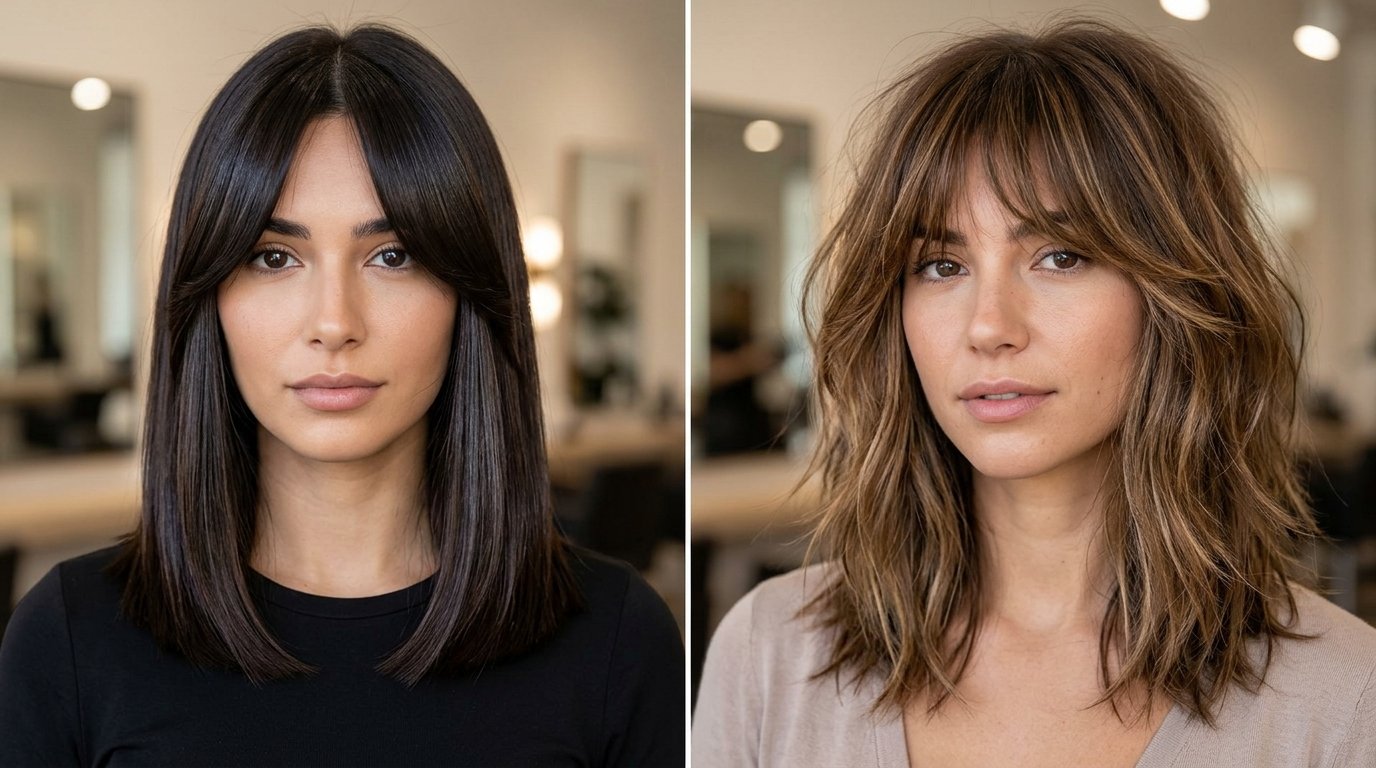
The bottom edge of the lob, its perimeter, is the pairing’s one real argument, and the sources take opposite sides. Both print here.
Haircelona’s gallery of long bobs with curtain bangs presents its blunt version as intentional contrast: a blunt lob with curtain bangs has a sharper edge, and that contrast is the whole point of the look.
The DiffSense essay on this pairing argues the other side: it recommends a textured, slightly shaggy lob, warning that if the bottom is too blunt and the bangs too soft, the hair can look like two different people are wearing it. (The essay’s site has moved since publication, so it is named here in text rather than linked.)
|
Your Fringe Finish |
Perimeter That Pairs |
Why |
|---|---|---|
|
Sleek and precise |
Blunt |
Two deliberate edges agree; the contrast reads designed |
|
Airy and wispy |
Textured |
Softness at both ends; a blunt bottom would strand the fringe |
|
Lived in and tousled |
Textured, razored ends welcome |
Movement throughout is the look |
|
Feathered and layered |
Lightly textured |
The gradient continues to the very ends |
The decision rule the table encodes: match the energy, not the edge. A precise fringe can carry a blunt perimeter because both are deliberate. A soft fringe needs softness below it.
The wispy end of the fringe spectrum pairs with the textured end of the perimeter spectrum, and the pairing has its own density logic. The wispy variant in full, its strand budget and its styling, is owned by our wispy curtain bangs guide; on a lob, keep its seam pieces longer than the wispy instinct suggests, because the gradient needs the length.
The Tuck Test: A Fitting Check You Can Do at Home
Before the appointment, run the tuck test on your current hair: gather the front sections and see where they land when tucked behind your ears.
If your target front length reaches the tuck comfortably, collarbone territory will behave the way the galleries promise. If tucking is the thing you do twenty times a day, choose the length that makes it effortless, not the length that photographs best.
The Specification: What to Ask Your Stylist
Haircelona’s per look ask blocks are the SERP’s best habit. Here is the pairing’s complete specification in that format, finished:
- Length: your chosen point in the zone, chin to just below collarbone, stated as a landmark, not inches
- Front: a touch longer than the back, unless you choose an even or angled line on purpose
- Fringe: center opening, starts near the temple, lands at the cheekbone, longest pieces scaled to the length
- The seam: blended until there is no line where the fringe ends
- Perimeter: blunt or textured, chosen to match the fringe finish, from the table above
- Finish: sleek, lived in or airy, named before the cut starts
Photograph the seam, not just the front. A straight on photo hides the gradient; a three quarter view shows your stylist exactly where the fringe hands over to the length.
Fine Hair: Keep the Front Light
Fine hair is where the seam earns its keep. Every strand at the front is doing visible work, so the fringe section stays shallow and the front layers stay light.
The pairing helps fine hair in one mechanical way, named by stylist Stacy Syroka in Latest Hairstyles’ gallery of 51 long bob and curtain bang pairings: short hair means less gravity to fight, so the cut offers natural volume whether you blow dry or air dry.
Less gravity is not a slogan; at lob length the front pieces are short enough to hold a curve that long hair would pull straight by noon.
The full density system for genuinely thin hair, section depth and camouflage limits, lives in our curtain bangs for thin hair guide. This page’s rule is narrower: on a fine lob, the fringe borrows little and the seam borrows nothing.
Thick Hair: Weight Where It Helps
Thick hair reverses the problem: there is plenty at the front, and the pairing’s job is weight placement, not volume.
Internal layering through the front lets the fringe open instead of shelfing, and a textured perimeter stops the bottom from reading as a solid block under a soft top.
Feathered versions built for thick hair appear across the galleries for this reason: the feathering is not decoration, it is the weight leaving in a controlled direction.
Ask for the fringe and the front layers to be cut as one weight decision. Thick hair cut in two passes, fringe then layers, almost always ends with too much removed from one of them.
Wavy and Pin Straight: The Effort Honesty Section
Latest Hairstyles’ introduction to its 51 pairings makes the effort split plainly: the lob with middle parted bangs benefits curly hair most, and women with pin straight hair need to put more effort into styling this cut.
Wavy hair sits in the easy middle. Haircelona’s gallery of long bobs with curtain bangs gives its wavy version one styling note: a light mousse at the roots before diffusing or blow drying, and the wave does the rest.
Pin straight hair needs grit: texture spray or a dry texture foam gives the front pieces something to hold onto, and the fringe needs its curve set with a brush or rollers rather than hoped for.
None of this is a verdict against straight hair. It is a time budget: two minutes for waves, five for straight, and the sleek version of the pairing is genuinely beautiful when those five are spent.
The Curly Lob: Cut Dry, Then Hands Off
Curly hair takes the pairing happily, with one non negotiable: the fringe is cut dry. The DiffSense essay’s warning is blunt: wet cut curly bangs bounce up far shorter than intended, and the result is micro bangs nobody ordered.
The lob’s weight is the curly version’s friend, pulling the curl down so the shape stays a lob instead of going triangular, the classic curly medium cut failure.
Keep the seam longer than feels right in the chair; shrinkage spends length the straight eye cannot see. The full texture system, curl pattern by curl pattern, lives in our curtain bangs for curly hair guide.
Eight Versions of the Pairing, Specified
The galleries show these versions on models. Here each carries its specification, so the look you choose arrives at the salon as instructions.
1. The sleek collarbone lob. Precise fringe, blunt or near blunt perimeter, front a touch longer. The polished office version, and the one that shows growth fastest.
2. The lived in lob. Textured perimeter, airy fringe, tousled finish. The lowest effort version and the most forgiving between appointments.
3. The blunt contrast lob. Blunt bottom, softer fringe, worn as a deliberate contrast per Haircelona’s position. Works when the fringe is kept neat, not wispy.
4. The angled lob. Back shorter, front longer, fringe scaled to the long front. The most dramatic seam, and the one to photograph from three quarters.
5. The choppy piecey lob. Razored texture throughout, fringe in separated pieces. For thick hair that needs the weight gone and readers who like an edge.
6. The feathered lob for thick hair. Feathered fringe and layers, weight removed in a gradient. The galleries’ answer to a heavy front.
7. The airy wavy lob. Mousse at the roots, diffused or air dried, fringe left soft. The wash and go specification.
8. The curly lob. Dry cut fringe, weight used against the triangle, seam left long. The version that proves the pairing is not a straight hair club.
For the wider picture book across every length and fringe type, our curtain bangs ideas gallery is the cluster’s gallery; this page is its specification sheet.
Styling the Pairing: The Front Does the Work
Style the front first and the back if time remains: the fringe and front pieces are what the world reads as the haircut.
The routine is short. Dry the fringe away from the face with a round brush, or set it in rollers while warm and let it cool. Blend the front pieces in the same direction, then leave the back to its natural finish.
Second day: steam or a light mist on the front only, re sweep, one minute of cooling. The back of a lob survives sleep far better than its front, which is another reason the front gets the minutes.
Tuckability is the length test in daily life: at collarbone the front pieces tuck behind the ears and pin back; at chin length they mostly do not, and the fringe is on duty all day.
Week one has one job: training the center part. Hair that has lived in a side part for years will argue for the first few days. Clip the sections into their split while they dry, and by the second week the part holds on its own and the two minute routine becomes the real routine.
The Sleek Finish, Step by Step
The precise version is a small ceremony. It takes five minutes and it is worth doing in order:
- One: dry the fringe first, away from the face, while the rest is still damp
- Two: dry the front pieces in the same direction, so the seam dries as one surface
- Three: let the front cool completely before touching it; the curve sets as it cools
- Four: one flat iron pass on the fringe only, if your texture needs it, never a second
- Five: finish the lengths however they fall; the sleek contract is with the front, not the back
Color at the Front: Highlights Through the Seam
Color placement follows the seam whether the colorist plans it or not: the fringe and front pieces are where light hits first and where regrowth shows first.
Fine highlights woven through the fringe and front corners make the gradient visible in a good way, emphasizing the blend the cut created. The galleries’ most photographed versions are rarely one flat color at the front.
The maintenance consequence is real: the front grows and fades fastest, so a front only color refresh between full appointments keeps the pairing looking intentional for less than a full service.
Readers growing out color get the pairing’s gift in reverse: the most trimmed zone is the front, so the fringe reaches natural color first, and the seam softens the boundary while the lengths catch up.
The Pairing by Face, Briefly
Face shape geometry belongs to the cluster’s face pages, and this page will not rebuild it. The pairing notes are short because the lob is a forgiving frame for most shapes.
Round faces take the longer end of the zone, where the vertical lines do their lengthening. Square jaws take the textured versions, where the sweep curves at the cheekbone.
Long faces take the shorter end, chin to jaw, where the fringe’s horizontal opening adds the width the shape wants. Heart shapes take the classic: cheekbone fringe, collarbone length, front pieces softening the jaw’s narrowness.
When a face note and a texture note conflict, texture wins: a pairing you can style beats a theoretically perfect shape you cannot.
One Appointment Maintains Both
The pairing’s quiet economic advantage: fringe and perimeter grow on compatible clocks, so one appointment rhythm maintains the whole cut.
|
Version |
Trim Rhythm (strands) |
What the Appointment Does |
|---|---|---|
|
Precise and sleek |
Every 3 to 4 weeks (Latest Hairstyles’ sleek look warning) |
Fringe reset before the intention flips, perimeter line cleaned |
|
Classic curtain versions |
3 to 4 weeks (Davines strand), 3 to 5 (Highland) |
Fringe tidy, seam re blended, ends dusted |
|
Lived in and textured |
4 to 6 weeks (Maki strand) |
Shape refresh; texture hides growth the longest |
Latest Hairstyles’ gallery of 50 modern lobs with curtain bangs carries the precise version’s warning in its sleek chestnut entry: precise bangs need a trim every 3 to 4 weeks, because once they grow slightly long, the entire intention of the cut flips.
That warning is version specific, not a sentence on the pairing. Choose the lived in version and the same head of hair forgives six weeks. The version chooses the cadence, not the other way round.
Growing Out Together, or Growing Out of It
Growing the pairing out is unusually civilized, because its elements exit into each other: the fringe becomes face framing layers, the layers become long hair, and no stage has a name like the awkward stage.
Growing out of it into a bob is the other direction: the fringe shortens its landing as the length rises, and our short curtain bangs guide maps the short zone the fringe passes through.
The one stage to plan is the middle: fringe at jaw length on a shoulder length lob can read as layers that forgot their purpose. A single seam re blend appointment fixes it.
|
Stage |
What It Looks Like |
The Move |
|---|---|---|
|
Weeks 1 to 4 |
The cut as designed |
Enjoy it; photograph the seam for reference |
|
Weeks 5 to 8 |
Fringe lengthens into the front |
Nothing; this is the design working |
|
Months 3 to 4 |
Fringe reads as face framing layers |
Decide: re cut the fringe, or bless the layers |
|
Month 6 plus |
A layered lob, no fringe in evidence |
The exit is complete; the lob stands alone |
Notice what the table never contains: a stage you would hide. That is the pairing’s grow out argument in full, and it is why stylists recommend this combination to readers who fear commitment.
Mistakes: Two Haircuts on One Head and the Vanishing Fringe
Mistake one: specifying the elements separately. A fringe chosen from one photograph and a lob from another arrive with two finishes, two lengths logics and no seam. Specify the pairing, as one gradient.
Mistake two: the vanishing fringe. Over blending, usually on fine hair, until the bangs exist only in the invoice. The seam should be invisible as a line and visible as a shape.
Mistake three: blunt by default. The perimeter chosen because it photographs cleanly, paired with a soft fringe chosen because it photographs softly. The table in the perimeter section exists to catch exactly this.
Mistake four: judging the curly version wet. Everything about the curly pairing, length, seam and triangle risk, must be assessed dry, in the chair and at home.
Mistake five: styling the back first. Ten minutes on the lengths and none on the front produces a beautiful back of head. The front is the haircut; spend the minutes there.
Frequently Asked Questions
Do curtain bangs work on a lob?
Yes; the lob is arguably their best length partner, long enough for the gradient and short enough for natural volume. The condition is the seam: fringe and front length cut as one blend, not two decisions.
What is the best lob length for curtain bangs?
Anywhere in the zone, chin to just below collarbone, with the fringe scaled to match. Collarbone is the most versatile point: tuckable, pinnable, and long enough for the fullest seam. The strands behind the zone are tabled in this article.
How long should curtain bangs be on a lob?
The landing stays at the cheekbone at every lob length, per Haircelona’s gallery of long bobs with curtain bangs and Latest Hairstyles’ lead look. What scales is the tail: the longest pieces lengthen as the lob lengthens.
What is the seam between curtain bangs and a lob?
The stretch where the fringe’s longest pieces meet the lob’s front corners. A good seam shows no line where the fringe ends and the hair begins, the observation Latest Hairstyles’ gallery of 51 long bob and curtain bang pairings makes in its lead caption.
Should the front of a lob be longer than the back with curtain bangs?
Usually, a touch. Haircelona’s gallery of long bobs with curtain bangs specifies front pieces a touch longer than the back in its ask blocks, which gives the seam its gradient. An even line is a deliberate choice, best with the sleek version.
Can a blunt lob have curtain bangs?
Yes, as a deliberate contrast: Haircelona presents the blunt version’s sharper edge as the whole point of that look. The pairing works best when the fringe is also kept neat and precise rather than wispy.
Blunt or textured lob: which pairs better with curtain bangs?
It depends on the fringe finish, and the sources argue both sides in this article. Match the energy: sleek precise fringe with blunt, airy or lived in fringe with textured. A soft fringe over a blunt bottom is the combination that risks looking like two haircuts.
How do curtain bangs blend into a lob with no visible line?
By graduated lengths: each step from fringe center to front corner is a small increase, cut in one pass logic, not two. Ask for the seam by name and check it in a three quarter mirror view before you leave.
Do curtain bangs on a lob need layers?
The front needs graduation, which is layering by another name at the seam. The back can stay one length, especially in the blunt version. A fully layered lob is one version, not a requirement.
How do you style a lob with curtain bangs?
Front first: dry the fringe away from the face with a round brush or set it in rollers to cool, blend the front pieces the same way, and let the back keep its natural finish. The full routine is in this article’s styling section.
How long does styling a lob with curtain bangs take?
About two minutes for wavy hair, five for pin straight, which needs grit and a set curve. The sleek version takes the longest because its precision shows.
Can a lob with curtain bangs air dry?
Wavy versions, yes, happily; stylist Stacy Syroka, quoted in Latest Hairstyles’ 51 pairings gallery, notes the cut offers natural volume whether you blow dry or air dry. Straight hair air dries flatter and usually wants the fringe set separately.
Does a lob with curtain bangs suit fine hair?
Yes, with the front kept light: a shallow fringe section and gentle front layers. The lob’s shorter length helps fine hair hold volume, the less gravity effect. Genuinely thin hair has its own system in our curtain bangs for thin hair guide.
Does a lob with curtain bangs suit thick hair?
Very well, with weight placed deliberately: internal layering at the front so the fringe opens, and texture at the perimeter so the bottom does not block. Feathered versions exist in the galleries precisely for thick hair.
Does a lob with curtain bangs suit pin straight hair?
Yes, with an honest time budget. Latest Hairstyles’ introduction to its 51 pairings says pin straight hair needs more styling effort on this cut: grit from a texture product and a curve set into the fringe, about five minutes.
Can a curly lob have curtain bangs?
Yes, and the same gallery introduction says a lob with middle parted bangs benefits curly hair the most. The conditions are a dry cut and a seam left long for shrinkage.
Should curly curtain bangs on a lob be cut dry?
Always. Wet curly hair hangs far longer than it lives; a wet cut fringe bounces up shorter than intended. Cut dry, judged dry, the rule this article’s curly section and the cluster’s curly guide both hold.
How do I stop a curly lob going triangular?
Use the lob’s weight and internal layering: weight at the lengths pulls the curl down, and removing bulk inside, not at the surface, keeps the silhouette a lob instead of a pyramid. A dry cut lets your stylist see the shape forming.
Does a lob with curtain bangs suit a round face?
Generally yes: the center part and cheekbone landing draw vertical lines that lengthen, and the lob’s length below the chin avoids adding width at the jaw. Face shape depth lives on the cluster’s face pages; this pairing is one of the kinder options for round faces in the galleries.
Does a lob with curtain bangs soften a square jaw?
Yes, in the textured versions: the feathered sweep curves at the cheekbone and the front gradient continues the softening past the jaw. A blunt angled version sharpens instead, which some square jawed readers prefer on purpose.
Can you tuck a lob with curtain bangs behind your ears?
At collarbone length, yes, the front pieces tuck and pin, the versatility Haircelona’s gallery of long bobs with curtain bangs leads with. At chin length, mostly no; the fringe is on duty all day.
What length lob can go into a ponytail with curtain bangs?
Collarbone and just below is where a low ponytail or clip becomes realistic, with the fringe left out as the frame, which is the look most wearers want anyway. Shorter lobs pin the back rather than tie it.
How often do you trim a lob with curtain bangs?
By version: 3 to 4 weeks for precise and sleek, 3 to 5 for classic versions, 4 to 6 for lived in and textured, strands tabled in this article. One appointment covers fringe and perimeter together.
Can one appointment maintain both the fringe and the lob?
Yes, and it is the pairing’s practical advantage: the two elements grow on compatible clocks, so the fringe tidy, seam re blend and perimeter clean up happen in the same visit on the same rhythm.
Why do precise curtain bangs on a lob need trimming sooner?
Latest Hairstyles’ gallery of 50 modern lobs with curtain bangs warns it in its sleek entry: precise bangs need a trim every 3 to 4 weeks because once they grow slightly long, the entire intention of the cut flips. Precision is a length, and length moves.
How does a lob with curtain bangs grow out?
Civilized: the fringe becomes face framing layers, the layers lengthen with the lob, and no stage is truly awkward. The middle stage, fringe at jaw length, may want one seam re blend appointment.
What happens if I grow out the bangs but keep the lob?
You land on face framing layers on a lob, a complete haircut in its own right, which is why this pairing is a low risk experiment: its exit is another good cut, not a punishment.
Curtain bangs on a lob or on long hair: which is easier?
The lob, for most readers: less gravity means the front holds its curve longer, drying is faster, and the seam is shorter to blend. Long hair wins only on tucking and tying options.
Lob or bob with curtain bangs: what changes?
Length changes the fringe’s job. On a bob, the fringe is a larger share of the style and lands closer to the cut’s own face frame; on a lob, the gradient is longer and more forgiving. Our short curtain bangs guide maps the fringe behavior as lengths shorten.
Curtain bangs or just face framing layers on a lob?
Layers alone are the zero commitment version: similar softening, no fringe to style or trim. Curtain bangs add the center opening, the eye framing and the style identity. Many readers start with layers and add the fringe a visit later.
Curtain bangs or side bangs on a lob?
Curtain for the modern, symmetrical, center parted look and the kindest grow out. Side bangs for diagonal softening and better coverage of a thinning hairline. Both pair with a lob cleanly; the part is the personality.
What do I ask my stylist for a lob with curtain bangs?
The six line specification in this article: length as a landmark, front a touch longer, fringe landing at the cheekbone, the seam blended to no line, perimeter matched to the fringe finish, and the finish named. Bring a three quarter view photograph.
Why do my curtain bangs disappear into my lob?
Over blending, usually on fine hair: the fringe was graduated until it became layers. The fix is a defined center section with a clearer landing at the cheekbone, blended only at its longest pieces. The seam should hide the line, not the bangs.
Why do my fringe and lob look like two different haircuts?
A finish mismatch, most often a soft wispy fringe over a blunt perimeter, the exact combination the DiffSense essay warns about, named in text in this article. Re texture one end or the other at the next appointment; the table in the perimeter section shows the pairings.
My lob ends flip out. Is the fringe the problem?
Almost never. Ends flip at shoulder contact length, a perimeter and length issue, usually fixed by moving the length a little above or below the shoulder or adding texture at the ends. Your fringe is innocent; do not let anyone shorten it to fix the back.
Are curtain bangs on a lob high maintenance?
In the lived in version, they are among the lowest maintenance medium cuts: a two minute front routine and a 4 to 6 week rhythm. The precise sleek version is genuinely higher maintenance, and this article prices that in honesty rather than hiding it.
Does a lob with curtain bangs work with glasses?
Yes. The fringe lands at the cheekbone, below most frame lines, and the longer front pieces sweep clear of the frames. The age focused glasses rules live in our curtain bangs for women over 60 guide once it publishes; the pairing itself is glasses friendly at any age.
Does a lob with curtain bangs suit women over 50?
It is one of the most chosen pairings at that age in the galleries, because it reads modern without effort theater. The age specific adjustments, length floor and cadence, are owned by the cluster’s over 60 page, which is in preparation; the pairing mechanics here apply as written.
What products suit a lob with curtain bangs?
By texture, in classes: light mousse at the roots for waves (Haircelona’s note), texture spray or dry foam for pin straight grit, dry shampoo for the fringe’s second day. Heavy products at the front are the common error across all textures.
Can I go from long hair to a lob with curtain bangs in one appointment?
Yes, it is a common single visit transformation, and doing both at once is actually better for the seam, since fringe and length are designed together from the first cut. Bring the specification and the three quarter photograph.
How do I refresh a lob with curtain bangs on day two?
Front only: steam or a light mist, re sweep the fringe, let it cool in shape for a minute. The back of a lob survives sleep well; spend the refresh where the haircut is read.
When is a lob the wrong length for curtain bangs?
At the extremes the pairing stops being itself: a very short bob leaves no room for the gradient, and hair well past the shoulders is a long hair pairing with different physics. Inside the chin to collarbone zone, the pairing is at home.
Conclusion
Good curtain bangs on a lob are one haircut, not two: a gradient that starts at the center part and does not stop until the front corners, scaled to the length and finished consistently at both ends.
Specify it that way, choose the version whose cadence fits your life, and the pairing maintains itself in a single rhythm. Save this page’s specification block and scaling table for the appointment, and browse StylerLook for the rest of the curtain family when you want the fringe’s other lengths and textures.
If you take one sentence to the salon, take this one: cut the front as one piece of design, from the center part to the front corners, and let everything behind it be the supporting act.
