

Curtain bangs for long face shapes are not the standard curtain fringe worn shorter. The long-face version is cut longer, worn wider, and styled outward, because its job is different.
A long face has length to spare and width to build. Every choice on this page is judged by one test: does it move the eye across the face instead of down it?
That test changes the landing point, the parting, and the fringe weight, and it reverses several rules that suit rounder faces, printed openly below.
The basics of the cut live on the curtain bangs parent page. This page owns one thing only: how the fringe is re-engineered when the face is long.
Quick Answer: The Long-Face Version Is a Different Cut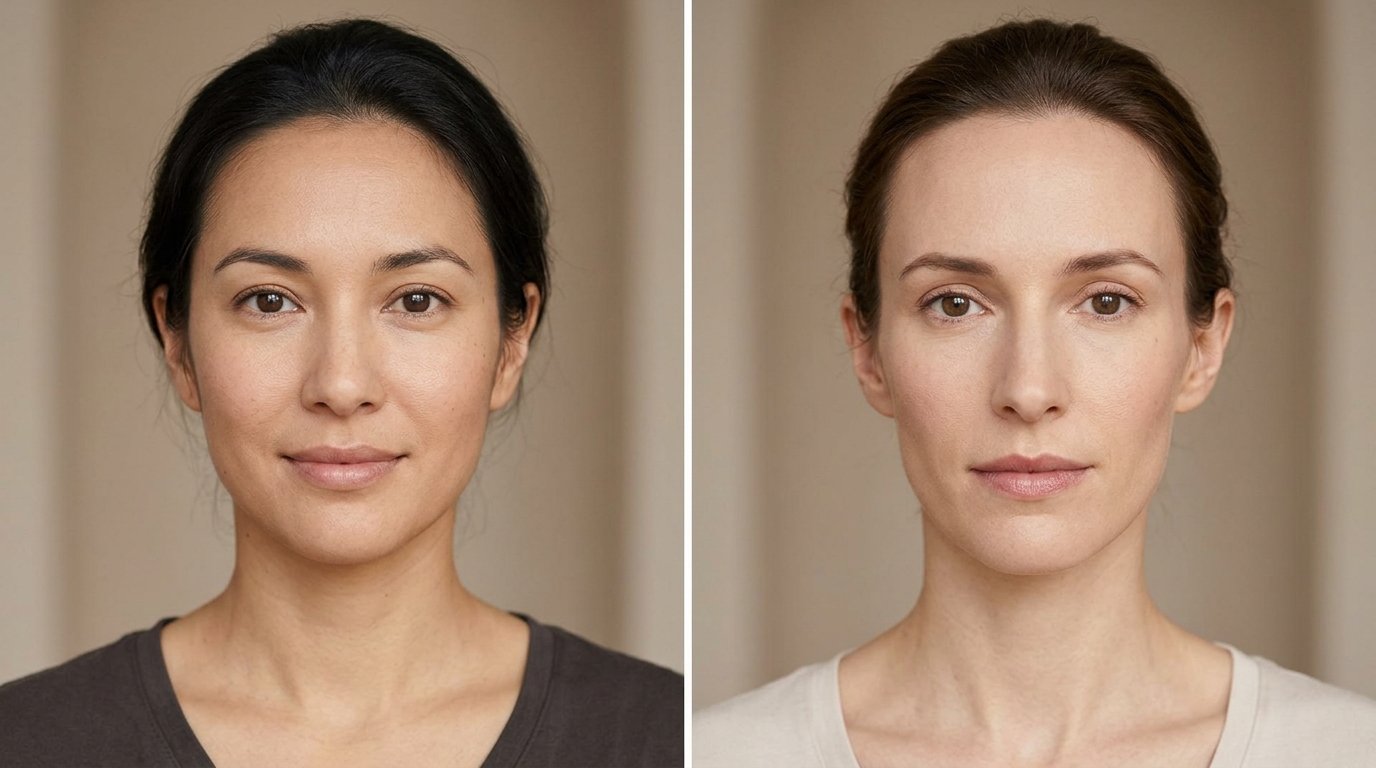
Curtain bangs suit a long face when they are cut longer than the standard version, landing between cheekbone and chin on the most-cited strand. They need width at the sides and a flat crown.
The parting is a decision, not a default, because the sources split on it. Fringe weight is also contested, and the honest answers sit in the strand sections below.
Long Face or Oblong Face: The Terminology Rule This Page Uses
This page uses long face as its primary term throughout: it matches the search term and how most readers describe their own face shape.
Oblong is defined once, here: an oblong face is the narrower, more parallel-sided end of the long-face family, with forehead, cheekbones and jaw at near-equal widths while length clearly exceeds width.
The sources split on whether the two words mean the same thing; that split is Strand T1:
|
Strand T1 position |
Sources |
What it means for you |
|---|---|---|
|
Long and oblong are interchangeable |
Herlify, HairAide body text, LooksMeter title |
One set of advice covers both labels |
|
Oblong is a distinct, measurable subset |
OblongFaceShape, FacialBrief, LooksMeter definition section |
The narrowest faces follow the strictest width rules |
So the working rule is simple. Every section below says long face; if your sides run close to parallel, treat yourself as the stricter oblong case in each table, otherwise you are the general long-face case.
How to Tell If Your Face Is Long: Ratios and the Thirds Check
Measure face length from hairline to chin, then width across the cheekbones. The length-to-width ratio is the number every diagnostic source in this research works from, and the sources disagree on the threshold, so all three ratio systems print as strands, none merged into a single rule.
|
Strand T2 system |
Threshold or range |
Source |
|---|---|---|
|
Single threshold |
Length-to-width at or above 1.50x counts as oblong |
LooksMeter, OblongFaceShape |
|
Landmark grid center |
Oblong centered near 1.44, inside a 1.34 to 1.56+ range |
FacialBrief |
|
Tiered severity |
1.65 to 1.75 is moderate, 1.75 and above is strong |
OblongFaceShape |
The facial thirds check needs no numbers. Compare forehead height, mid-face length and lower-face length; on a long face, one or more thirds runs visibly longer than the others.
FacialBrief also places oblong in the tall leptoprosopic range of classic anthropometry, citing the Farkas tradition. That framing is reported as cited by FacialBrief, not read first-hand.
Why Curtain Bangs Work on a Long Face: The Width Mechanism
The fringe works because it interrupts the longest uninterrupted line on the face. A bare forehead lets the eye travel from hairline to chin without stopping anywhere.
A parted fringe lays a horizontal break across that vertical path. The eye stops at the fringe, moves sideways along it, and reads width before it reads length again. The swept sides complete the job: hair moving outward toward the ears puts visible volume at cheek level, where a long face reads narrowest.
The crown is the failure point. Height on top adds vertical inches the face does not need, which is why every styling rule here keeps the crown flat.
No source supports a measured promise here. Guides claim the fringe visually shortens the face, printed as their claim, never as a guaranteed amount.
The Reversal Table: Round-Face Rules vs Long-Face Rules
StylerLook also publishes curtain bangs for round face guidance, in bold text only while that page is unpublished, and its core moves are the exact opposite of this page’s moves.
The round-face page adds length and crown height on purpose. This page removes both on purpose, and the table below exists so the two rule sets can never be swapped by accident. Read the columns as mirror images, not variations: a tip that flatters a round face can be the precise mistake on a long face.
|
Decision |
Round-face rule |
Long-face rule |
|---|---|---|
|
Fringe length |
Shorter center, opens the face upward |
Longer landing, cheekbone to chin on the lead strand |
|
Crown |
Volume on top adds balancing height |
Crown stays flat; height only adds length |
|
Eye direction |
Draw the eye up and down |
Draw the eye across, toward the ears |
|
Layers |
Start lower, keep the sides sleek |
Start at cheek level, build side width |
|
Parting |
Center part reinforces the length goal |
Parting decided by framework, never assumed |
The same caution applies to curtain bangs for oval face advice, named in bold only: oval guidance assumes freedom of choice, while a long face has a geometry job to do first.
Where the Fringe Should Land
Landing point is the most contested decision in the whole SERP, so its five positions print as Strand T3, then match to face sub-types below.
|
Strand T3 position |
Source |
|---|---|
|
Cheekbone to chin, longer than the round-face version |
HairAide |
|
Near eyebrow level, fuller across the forehead |
Herlify |
|
Shortest point at the brow |
HairstyleWave |
|
Fuller, slightly shorter center; shortest piece between brow and cheekbone |
BeautifyApp |
|
Cheekbone exactly |
FavoriteHairstyles |
The cheekbone appears in three of the five positions, making it the most-supported single landmark. The live cheekbone bangs page covers that landing target in depth.
|
Your case |
Landing guidance inside the strands |
|---|---|
|
General long face |
Cheekbone to chin (HairAide) or cheekbone exactly (FavoriteHairstyles) |
|
Long face, high forehead |
Brow level coverage matters most; see the forehead section below |
|
Long and narrow (oblong case) |
Longer landing plus maximum side sweep; width is the priority |
|
Long face, fine hair |
Cheekbone landing with a lighter section; see the fine hair section |
Long Face With a High Forehead
A high forehead is the most common pairing with a long face in this research, and it is where the extra length often lives, so covering part of it does real geometric work.
The weight advice conflicts, printed as Strand T6. HairAide’s look 10 uses heavy-edged curtain bangs from a deeper triangle section, specified for thick, straight hair.
HairAide’s look 11 takes the opposite route for fine hair: a wispy fringe from a narrow section. Same forehead problem, different hair, opposite weight answer, both printed rather than merged.
FacialBrief scores a full wispy or French fringe above curtain bangs when the high forehead drives the length, at 92 out of 100 in its own fit engine. LooksMeter credits brow coverage itself, via blunt or Birkin styles.
Long and Narrow: The True Oblong Case
The oblong case is where the sides run close to parallel and the width deficit is largest. Every general long-face rule applies here, with the width settings turned up: land the fringe at the longer end of the strand range, toward the chin, and sweep the sides as wide as your hair allows, because side volume is your scarcest resource.
Avoid anything that narrows the read further. Sleek, flat sides and a tall crown punish an oblong face hardest, and both are fully avoidable.
Long Face With Fine Hair
Fine hair changes the weight answer, not the geometry. A heavy fringe overwhelms fine hair and goes stringy by midday, a named problem across the fetched sources.
Take the wispy end of Strand T5 instead: a narrower triangle section, point-cut ends, and the cheekbone landing. The width illusion comes from sweep direction, not fringe density you do not have.
The wispy curtain bangs page covers wispy construction in full; here it is only the fine-hair weight strand.
Long Face With Thick Hair
Thick hair can carry the fuller end of every strand. Herlify’s fuller, thicker, wider-across-the-forehead rule was effectively written for your density.
Ask for weight removed from the ends, not the middle. Slide-cut or point-cut ends keep the sweep soft while the fringe body keeps its horizontal presence.
The Parting Decision: Side Part, Off-Center or Center
The parting sources disagree outright, so Strand T4 is printed in full. HairAide prefers a side part, arguing a center part emphasises length unless the bangs are long and the sides are full.
|
Strand T4 position |
Source |
|---|---|
|
Side part preferred; center part risks length unless fringe is long and sides full |
HairAide |
|
Classic middle part is the safest choice |
FavoriteHairstyles |
|
Flat centre-parted lengths lengthen; the fringe is not the problem |
OblongFaceShape |
The framework that respects all three strands runs on conditions. Choose a side or off-center part when your fringe is shorter, your sides are fine, or your crown tends to lift.
A center part stays available when the fringe lands long and the sides carry volume, HairAide’s own exception. Cut with the part in place either way, so the fringe is trained to its real position. A cowlick at the parting overrides the framework: cut following the cowlick’s direction, or the fringe separates in the middle within days.
Fringe Weight: Fuller, Medium or Wispy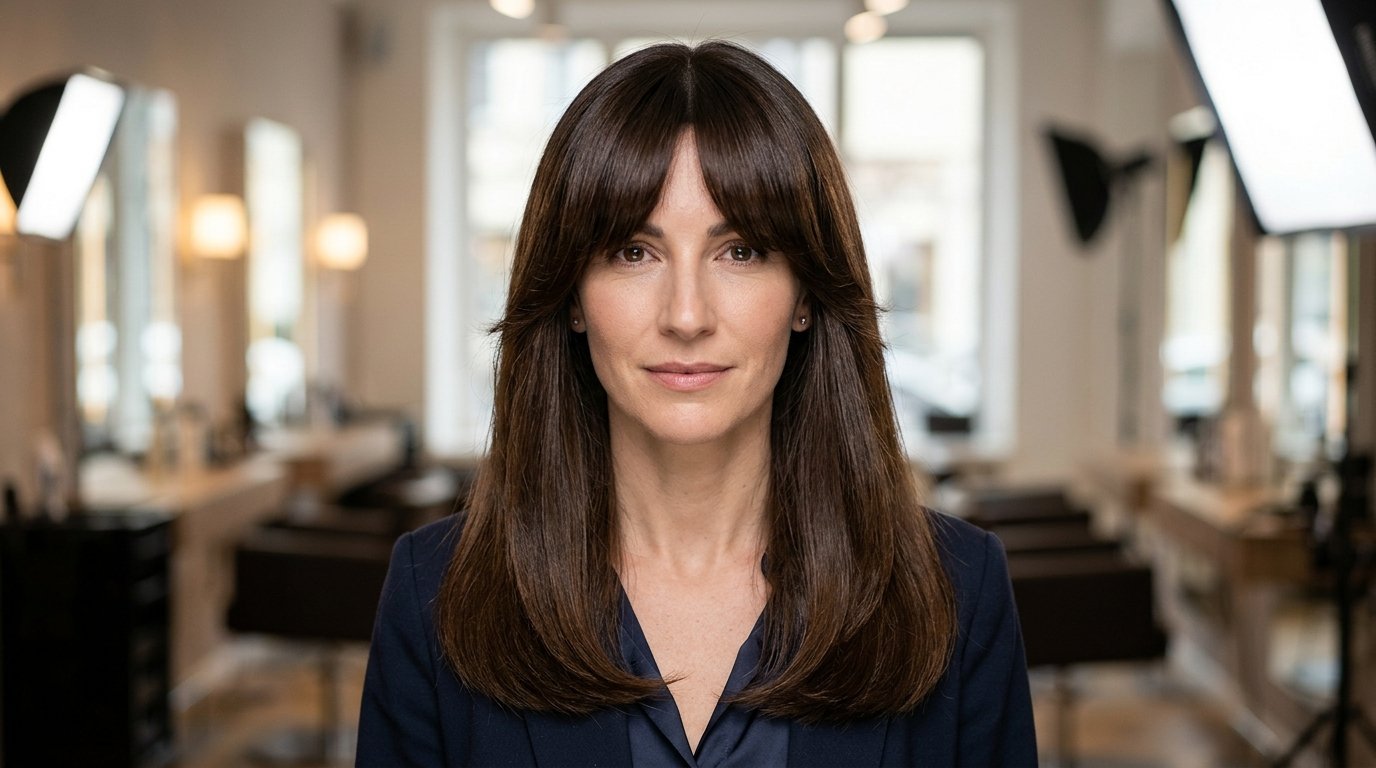
Weight is the third contested decision, held as Strand T5. Herlify advises fuller and thicker, cut wider across the forehead, as the default long-face specification. YourGirlStyle disagrees plainly: thick bangs are not necessary, and a medium fringe with sides is enough. Neither cites measurements, so neither is promoted here to a rule.
One guide goes further than both. The “What Curtain Bangs Should I Get” guide advises avoiding full curtain bangs on long faces entirely, allowing only partial or layered versions, judging the full version lengthening.
LooksMeter adds the comparison position: a blunt, brow-skimming fringe shortens more strongly than curtain bangs. That is one source’s appearance claim, printed as its position, not a measured fact. In practice, density decides: thick hair takes the fuller strand, fine hair the wispy strand, medium either.
The Looks: 16 Long-Face Curtain Bang Variations
Every look below is judged against the same test: what it subtracts from the vertical, what it adds to the horizontal. More variations sit in the curtain bangs ideas gallery; these sixteen are the long-face selection.
1. The Classic Cheekbone-to-Chin Curtain
Best for: the general long face, first fringe. This is HairAide’s lead specification: longer than the round-face version, opening at the cheekbone and sweeping to the chin.
Stylist script: ask for curtain bangs landing between cheekbone and chin, cut with your part in place. Trim interval: every 4 to 6 weeks on the standard strand.
2. Side-Parted Chin-Length Curtain Bangs
Best for: shorter fringes and fine sides. The diagonal part lays asymmetric weight across the forehead, which is the Strand T4 side-part position worn as a look.
Stylist script: ask for a side-parted curtain fringe with the long side sweeping to the chin. Trim interval: 4 to 6 weeks; side parts show growth sooner on the short side.
3. Full and Wide Across the Forehead
Best for: thick hair and high foreheads. This is Herlify’s specification: fuller, thicker, near eyebrow level, and cut wider across the forehead than the standard section.
Stylist script: ask for a wide triangle section with full weight, landing near the brow. Trim interval: 4 to 6 weeks; full fringes lose their brow line fastest.
4. Heavy-Edged Bangs for a High Forehead
Best for: thick, straight hair with a high forehead. HairAide’s look 10 takes a deeper triangle section and heavy edges, maximising brow coverage where the length concentrates.
Stylist script: ask for heavy-edged curtain bangs from a deeper section, kept off the crown. Trim interval: 4 to 6 weeks on the HairAide strand.
5. Wispy Narrow-Section Fringe
Best for: fine hair and narrower foreheads. HairAide’s look 11 answers the same forehead problem with a wispy fringe from a narrow section, the light end of Strand T6.
Stylist script: ask for a narrow section, point-cut ends, cheekbone landing. Trim interval: 4 to 6 weeks; wispy ends need dusting before they separate.
6. Curtain Bangs With a Chin-Length Bob
Best for: maximum width geometry. The bob’s hem sits at chin level, adding a second horizontal line below the fringe, and the whole silhouette reads wider.
Stylist script: ask for a chin-length bob with cheekbone curtain bangs and no crown layering. Trim interval: 4 to 6 weeks; bobs lose their hem line quickly.
7. Curtain Bangs With a Lob and Cheek-Level Layers
Best for: keeping length while adding width. The lob keeps the hair long, but layers starting at the cheekbone put the movement at width level instead of at the ends.
Stylist script: ask for a collarbone lob, first layer at the cheekbone, fringe to match. Trim interval: 6 to 8 weeks on the longer-fringe strand from Courtney’s World.
8. Curtain Bangs With Butterfly Layers
Best for: long hair that feels flat at the sides. Butterfly layers fan outward at cheek and jaw level, the widest-reading layer pattern available to long lengths.
Stylist script: ask for butterfly layers with the shortest layer at the cheekbone, fringe blended in. Trim interval: 6 to 8 weeks for the long version.
9. Curtain Bangs With a Shag
Best for: wavy hair and low-effort styling. The shag’s choppy, outward-flicking layers build texture width at every level, and the fringe sits naturally inside the shape.
Stylist script: ask for a shag with curtain bangs, crown kept flat, ends flicked outward. Trim interval: 6 to 8 weeks; shags forgive growth better than most cuts.
10. Curtain Bangs With a Wolf Cut
Best for: thick hair wanting edge. The wolf cut’s heavier top layers must be tamed for a long face: keep the volume at the sides, not the crown, or the cut lengthens you.
Stylist script: ask for a wolf cut with side-weighted layers and a flat crown. Trim interval: 6 to 8 weeks, with the fringe dusted between visits if needed.
11. Curtain Bangs With Collarbone Waves
Best for: an evidence-backed all-rounder. FacialBrief scores curtain bangs with collarbone waves at 96 out of 100 in its own fit engine, the highest score in its fetched comparison table.
Stylist script: ask for collarbone length, soft waves from cheek level down, cheekbone fringe. Trim interval: 6 to 8 weeks on the long curtain strand.
12. Curly Dry-Cut Curtain Bangs
Best for: type 3 curls. The fringe is cut dry, curl by curl, because wet cutting ignores shrinkage and lands the fringe far shorter than planned once it dries.
Stylist script: ask for a dry cut with the fringe shaped in its natural curl pattern. Trim interval: 6 to 10 weeks on the HairAide curly strand.
13. Coily Curtain Bangs, Rounded Silhouette
Best for: type 4 coils. The goal shifts from a flat sweep to a rounded silhouette that widens at the sides, with the fringe shaped as part of the overall halo.
Stylist script: ask for a dry-shaped fringe inside a rounded silhouette, width at the sides. Trim interval: 6 to 10 weeks, matching the coily reshape strand.
14. Curtain Bangs With Glasses
Best for: glasses wearers. HairAide’s look 18 sets the landing at the top of the frame, and its one firm instruction is to bring your glasses to the appointment.
Stylist script: ask for the fringe to land at frame-top level, checked with glasses on. Trim interval: 4 to 5 weeks on the HairAide glasses strand, the tightest in the set.
15. Seventies Flipped Curtain Bangs
Best for: straight and wavy hair, occasion styling. The ends are rolled outward toward the ears, the strongest sideways eye-direction in the gallery, borrowed from the seventies fringe revival.
Stylist script: ask for a cheekbone-to-chin fringe cut to flip, then style with a round brush outward. Trim interval: 4 to 6 weeks; the flip needs its length kept precise.
16. The Grow-Out Curtain
Best for: anyone leaving a full fringe behind. HairAide’s look 16 treats grow-out as a look in itself: the fringe is blended into face-framing layers while it lengthens past the awkward stage.
Stylist script: ask for the ends dusted and the sides blended into layers, nothing taken off the length. Trim interval: dusting every 8 to 12 weeks across the gallery’s grow-out looks.
Pairing the Fringe With the Rest of the Cut
The fringe does half the geometry; the lengths decide the other half. A perfect fringe above long, flat, centre-parted lengths still reads long, OblongFaceShape’s warning in Strand T4.
|
Pairing |
Width mechanism |
Watch out for |
|---|---|---|
|
Chin-length bob |
Hem adds a second horizontal line at chin level |
Crown layers that sneak height back in |
|
Lob |
Cheek-level layers widen the mid-face zone |
Layers starting too low, below the jaw |
|
Butterfly layers |
Layers fan outward at cheek and jaw |
Too much length below the chest dragging the eye down |
|
Shag |
Texture width at every level |
Choppy crown volume; keep the top flat |
|
Wolf cut |
Side-weighted layers, strong frame |
Standard wolf-cut crown height lengthens |
|
Long lengths |
Fringe plus cheek layers carry all the width |
Flat, centre-parted, one-length hair is the lengthening case |
Texture Sections: Straight, Wavy, Curly, Coily
Straight Hair
Straight hair shows the geometry most honestly. Every millimetre of landing point is visible, and the sweep must be styled in, because straight hair falls straight down by default. Dry the fringe outward with a round brush, never downward. HairAide’s heat strand puts fine or bleached hair near 150 C or 300 F, and coarse hair at 180 to 200 C, a single-source strand printed as such.
Wavy Hair
Wavy hair is the easiest texture for this fringe. The natural bend already moves outward, so the width mechanism works on low styling effort most days. Cut on the longer side of the landing strand: waves spring up as they dry, and a fringe cut wet at cheekbone length can wake up at brow length.
Curly Hair
Curly curtain bangs are cut dry, in the curl pattern, on every serious source in this research. Wet cutting ignores curl shrinkage, the single biggest cause of too-short curly fringes. Land the fringe longer than the straight-hair version: shrinkage shortens the worn length, so cut length and seen length are two different numbers your stylist should say out loud.
Coily Hair
Coily hair is shaped, not swept. The fringe joins a rounded silhouette with width at the sides, diffused or air-dried rather than brush-stretched, so the shape keeps its horizontal read. Reshape intervals run longest here: 6 to 10 weeks on the HairAide strand, and the silhouette holds better between visits than a straight fringe holds its sweep.
Curtain Bangs for Long Faces With Glasses
The full glasses protocol belongs to curtain bangs with glasses, in bold only while that page is unpublished; until it publishes, this compact protocol is the cluster’s glasses coverage.
Three rules carry it. Land the fringe at the top of your frames, bring the glasses to the appointment, and let the stylist check the landing with the frames on. A side-part sweep also clears the frame edge more cleanly than a center split.
Styling Routine: Dry Outward, Keep the Crown Flat
The daily routine follows the mechanism. Blow-dry the fringe forward first, then roll the round brush outward toward the ears on each side, so both halves dry into the sideways sweep. No backcombing or root lift on top: any height there spends the width the fringe just bought.
On second days, refresh the fringe alone with a light mist and re-dry outward, finishing with a flexible hold or dry texture spray, never a stiff finish that sets the fringe into one rigid bar.
Trims and Grow-Out
Trim timing is contested, so the intervals print as Strand T7, split by basis rather than merged:
|
Strand T7 basis |
Interval |
Source |
|---|---|---|
|
Standard fringe default |
Every 4 to 6 weeks |
HairAide |
|
Short curtain bangs |
Every 3 to 4 weeks |
Courtney’s World |
|
Long curtain bangs |
Every 6 to 8 weeks |
Courtney’s World |
|
Curly and coily reshape |
Every 6 to 10 weeks |
HairAide |
|
Glasses wearers |
Every 4 to 5 weeks |
HairAide look 18 |
Grow-out runs in stages: tuck and pin first, then blend the sides into face-framing layers, then let the layers become the style, dusting the ends as you go.
What to Avoid: The Lengthening Mistakes
Micro bangs top the avoid list on the diagnostic sources. A fringe ending high on the forehead exposes the full forehead height and makes the remaining length read longer.
Long, flat, centre-parted lengths are the second mistake. One-length hair with no cheek layers gives the eye an unbroken vertical track from crown to ends, the exact read this page exists to break. Crown height is the third: root lift, tall ponytails and top-heavy updos all spend vertical inches a long face has none of to spare.
The fourth is a fringe cut too short by accident. Wet-cut shrinkage on wavy and curly hair is the usual cause, which is why the texture sections insist on dry cutting.
What to Tell Your Stylist: The Full Script
Bring this list to the appointment. It compresses every strand decision on this page into lines a stylist can act on in one consultation.
- My face is long, so the goal is width, not length: please keep my crown flat.
- Cut my curtain bangs to land between my cheekbone and chin, or at the landing we agree from the strand range.3. Cut with my parting in place, and follow my cowlick if it fights the part.
- Take the section from the triangle width we chose for my density: wider if thick, narrower if fine.
- Point-cut or slide-cut the ends so the sweep stays soft, and start my layers at cheek level.
- If I wear glasses, check the landing with my frames on before you finish.
Cost Honesty: Why This Page Prints No Price
No salon price is printed on this page, deliberately. Fresh checks for this research found no top competitor publishing a curtain bang price, a fringe trim price, or a sourced price range for this topic.
That empty field is itself the honest finding. Fringe trims are priced from each salon’s own menu, and any range printed here would be invented, so the page prints the finding instead of a figure. Ask your salon for its fringe trim price and between-haircut policy when you book.
Frequently Asked Questions
Do curtain bangs suit a long face?
Yes, with conditions. Herlify calls them practically made for long faces; HairAide says yes with a longer cut and side volume. The conditions are the landing, the parting framework and the flat crown.
Will curtain bangs make my long face look shorter or longer?
Cut the long-face way, guides say they visually shorten the face by breaking the vertical line. Cut short and flat with sleek lengths, the same fringe can lengthen instead, the mistake the reversal table guards against.
What is the difference between a long face and an oblong face?
On this page’s terminology rule, oblong is the narrower, more parallel-sided end of the long-face family. Galleries treat the words as synonyms; diagnostic sources define oblong by ratio and near-equal widths. That split is Strand T1.
How do I know if my face is long or oblong?
Measure length from hairline to chin and width across the cheekbones, then compare. Also run the facial thirds check: on a long face at least one third runs visibly longer, and oblong adds near-parallel sides.
What length-to-width ratio counts as an oblong face?
Three systems print, never one rule. LooksMeter and OblongFaceShape use at or above 1.50x, FacialBrief centers oblong near 1.44, and OblongFaceShape tiers severity at 1.65 to 1.75 moderate and 1.75 plus strong.
Where should curtain bangs land on a long face?
The positions split, printed as Strand T3. HairAide says cheekbone to chin, Herlify says near eyebrow level and fuller, HairstyleWave puts the shortest point at the brow, and FavoriteHairstyles says cheekbone exactly.
Should curtain bangs for a long face be longer or shorter than usual?
The lead strand says longer: HairAide cuts the long-face version longer than the round-face version. BeautifyApp is the counter-strand, advising a fuller, slightly shorter center, so your forehead and density case decides.
Is a side part or a center part better for a long face with curtain bangs?
Both positions stand, printed as Strand T4. HairAide prefers a side part, warning a center part emphasises length unless the fringe is long and full at the sides. FavoriteHairstyles calls the middle part safest.
Can a center part ever work on a long face?
Yes, inside HairAide’s own exception. A center part works when the fringe lands long and the sides carry real volume. It fails with short fringes and fine, flat sides.
Should curtain bangs for a long face be thick or wispy?
It splits by density, Strand T5. Herlify advises fuller and thicker; YourGirlStyle says thick bangs are not necessary and medium is enough. Fine hair is honestly served by the wispy, narrow-section strand.
Are full curtain bangs a mistake on a long face?
One guide says yes: the “What Curtain Bangs Should I Get” guide allows only partial or layered versions, judging the full version lengthening. Other sources disagree, so the position is printed, not adopted as this page’s rule.
Are blunt bangs better than curtain bangs for a long face?
LooksMeter argues yes, claiming a blunt, brow-skimming fringe shortens more strongly than curtain bangs. That is one source’s appearance claim, printed as its position; curtain bangs remain the softer, easier grow-out.
What about Birkin bangs or bottleneck bangs for a long face?
Both are live alternatives. LooksMeter ranks Birkin bangs beside blunt for the brow-coverage mechanism, and HairstyleWave names bottleneck bangs as safer in passing.
Do curtain bangs help a long face with a high forehead?
Yes, because the fringe crosses and interrupts the forehead, where much of the extra length sits. HairAide gives the pairing two full looks, and FacialBrief treats the high forehead as its own fringe case.
How heavy should the fringe be if my forehead is high?
The weight advice splits, Strand T6. HairAide uses heavy edges from a deeper section for thick, straight hair, and a wispy, narrow section for fine hair. FacialBrief scores a full wispy or French fringe highest here.
Do curtain bangs work on a long, narrow face?
Yes, with the width settings turned up: the longer landing, the widest sweep your hair allows, and zero crown height. Narrow faces are where sleek, flat sides punish the read hardest.
Do curtain bangs work with fine hair on a long face?
Yes, at the light end of the strands. Take a narrower section and point-cut ends at the cheekbone landing, and let sweep direction create the width. A heavy fringe on fine hair goes stringy.
Do curtain bangs work with thick hair on a long face?
Yes, and thick hair can carry Herlify’s fuller, wider specification honestly. Ask for weight removed from the ends, not the middle, and keep the sweep’s widest point at cheek level, not jaw level.
Can I get curtain bangs with curly hair and a long face?
Yes, with one non-negotiable: the fringe is cut dry, curl by curl. Wet cutting ignores shrinkage and lands the fringe far shorter than planned. Land it longer than the straight-hair version for the same reason.
Can I get curtain bangs with coily hair and a long face?
Yes, shaped rather than swept. The fringe joins a rounded silhouette with width built at the sides, dried without brush-stretching. Reshapes run 6 to 10 weeks on the HairAide strand.
What haircut should I pair with curtain bangs on a long face?
Pairings that add width: a chin-length bob, a lob with cheek-level layers, butterfly layers, or a side-weighted shag or wolf cut. The pairing table gives each one’s mechanism and watch-out.
Do curtain bangs work with long hair, or do I need to cut my length?
You can keep your length, but the lengths must work. Cheek-level layers and side volume carry the width, because flat, centre-parted, one-length hair is the lengthening case OblongFaceShape warns about.
Do curtain bangs work with a bob or a lob on a long face?
Yes. The chin-length bob is the strongest geometry in the gallery: its hem adds a second horizontal line at chin level. A lob works when its first layer starts at the cheekbone, not below the jaw.
Should I add layers with curtain bangs on a long face?
Usually yes, starting at cheek level. Cheek-level layers put movement where the face needs width; layers starting at the jaw add swing at the bottom and leave the mid-face narrow and flat.
What styling makes a long face look wider with curtain bangs?
Dry the fringe outward toward the ears with a round brush, add wave or texture from cheek level down, and keep the crown flat. Sideways movement is the whole styling system; downward drying undoes it.
Why does crown volume make a long face look longer?
Because it adds vertical inches at the very top of an already long outline. The eye reads total height first, so crown lift spends length before the fringe’s width work is noticed.
Do curtain bangs work with glasses on a long face?
Yes, with this page’s compact protocol: land the fringe at the top of your frames, bring the glasses to the appointment, and trim every 4 to 5 weeks on the HairAide strand.
Do curtain bangs suit a long face over 50?
Yes. The geometry does not change with age, and the longer landing and easy grow-out suit lower-maintenance routines. Fine or thinning hair simply moves you to the wispy, narrow-section strand.
How do I style curtain bangs so they do not hang straight down?
Dry them forward first, then roll the brush outward toward each ear. Hanging straight down is a drying direction problem, not a cut problem, and a light texture spray holds the outward set.
What should I ask my stylist for if I have a long face?
Use the full script above. Short version: width is the goal, crown stays flat, landing between cheekbone and chin, cut with your part in place, layers from cheek level, ends point-cut.
What if I have a cowlick where the fringe parts?
Tell the stylist before the cut, because the cowlick wins every fight. The fringe is cut following the cowlick’s direction and the parting framework adjusts around it; forcing the opposite part separates within days.
Are curtain bangs high maintenance on a long face?
Moderate. The fringe needs a short daily dry-outward routine and regular trims, but the long-face version is the forgiving end of the fringe family: longer landings tolerate a missed appointment better than short fringes.
How often do curtain bangs on a long face need a trim?
The intervals split by basis, Strand T7. HairAide gives every 4 to 6 weeks as standard; Courtney’s World gives 3 to 4 weeks for short versions, 6 to 8 for long ones; curly reshapes run 6 to 10.
How long does styling curtain bangs take each morning?
About five minutes once the routine is set. Only the fringe is re-dried, forward then outward, and the lengths stay untouched most days.
Can curtain bangs cover a big forehead without a full fringe?
Partly. A longer, swept curtain fringe interrupts the forehead and covers its sides, but the center stays partly open by design. For full coverage, the blunt and Birkin strands in this research cover more.
What bang styles should a long face avoid?
The diagnostic sources agree on the core avoid list: micro bangs, and long flat center tendrils with no side volume. LooksMeter prints both; the mistakes section adds crown-height styles and one-length cuts.
Why do micro bangs make a long face look longer?
Because they end high on the forehead and expose its full height. The short fringe adds a small horizontal accent near the top, and the whole remaining face below it reads longer by contrast.
How do I grow out curtain bangs on a long face?
Run the stages in order: tuck and pin first, then blend the sides into face-framing layers, then let the layers become the style. Dust the ends every 8 to 12 weeks while the length arrives.
Can curtain bangs be pinned back or tucked on a long face?
Yes, and the long landing helps: cheekbone-to-chin lengths tuck behind the ears and pin back cleanly. Tucked days also bridge the awkward grow-out stage, before the layers take over.
Do curtain bangs work with an updo on a long face?
Yes, if the fringe stays out and the updo stays low. Leave the curtain fringe down to keep the horizontal break, and avoid tall, top-heavy updos, which spend the vertical inches the fringe saved.
Will curtain bangs still suit me if my face is long and my jaw is soft?
Yes. A soft jaw is the common long-face case in the galleries; FavoriteHairstyles describes its oblong readers exactly that way. Jaw-softening line work belongs to curtain bangs for square face guidance, in bold only here.
What if curtain bangs make my face look longer anyway – what should I change first?
Change the styling before the cut. Flatten the crown and dry the fringe outward, the two most common causes. If it still reads long, lengthen the landing and add cheek-level layers next.
Conclusion
Curtain bangs for long face shapes work when every decision passes one test: subtract vertical, add horizontal. Longer landings, a decided parting, honest fringe weight and a flat crown are that test applied four times.
The sources disagree on the details, and this page printed the disagreements rather than hiding them: your density, forehead and texture pick your strand, and the stylist script turns that pick into instructions.
The wider cluster sits around this page: the live Bardot bangs page owns the fullness comparison, curtain bangs for diamond face guidance, in bold only, owns middle-width building, and everything else returns to the StylerLook homepage.
